Table of Contents
- # Overview
- # Key Properties
- # Tree Array Representation
- # References
- # 0) Core Concepts
- # 0-1) Tree Types Classification
- # 0-2) Common Tree Patterns
- # 0-3) Traversal Order Selection Strategy
- # 1) Tree Templates & Algorithms
- # 1.1) Universal Tree Template
- # 1.2) Template Selection Guide
- # 1.3) Core Operations
- # 1.4) DFS Traversal Templates
- # 1.5) Tree Node Initialization
- # 2) Problems by Pattern Classification
- # 2.1) Problem Categories & Templates
- # 2.2) Pattern Selection Guide
- # 3) Classic Tree Algorithms
- # 3.1) Tree Right Side View (LC 199)
- # 3.2) Node Count Algorithms
- # 1-1-15) Invert Binary Tree
- # 1-1-16) Move Parent Pattern - Bidirectional Tree Traversal
- # 1-1-17) check Symmetric Tree
- # 1-1-18) Distance Between Nodes
- # 1-1-19) Find Paths with Specific Properties
- # 1-1-20) Tree Height and Depth Operations
- # 1-1-21) Node Path Pattern - Subtree Serialization
- # 2) LC Example
- # 2-1) Binary Tree Right Side View
- # 2-2) Construct String from Binary Tree
- # 2-3) Maximum Width of Binary Tree
- # 2-4) Construct String from Binary Tree
- # 2-5) Closest Leaf in a Binary Tree (Move Parent Pattern)
- # 2-7) Same Tree
- # 2-9) Validate Binary Search Tree
- # 2-10) Construct Binary Tree from Preorder and Inorder Traversal
- # 2-11) Construct Binary Tree from String
- # 2-12) Minimum Depth of Binary Tree
- # 2-13) Maximum Depth of Binary Tree
- # 2-14) All Nodes Distance K in Binary Tree
- # 2-15) Boundary of Binary Tree
- # 2-16) Binary Tree Maximum Path Sum
- # 2-17) Build Binary Expression Tree From Infix Expression
- # 2-18) Count Good Nodes in Binary Tree
- # 2-19) Balanced Binary Tree
- # 2-20) Reverse Odd Levels of Binary Tree
- # 4) Summary & Quick Reference
- # 4.1) Tree Algorithm Complexity Summary
- # 4.2) Traversal Quick Reference
- # 4.3) Problem-Solving Templates
- # 4.4) Common Patterns & Tricks
- # 4.5) Common Mistakes & Tips
- # 4.6) Interview Tips
- # 4.7) Related Topics
# Tree Data Structure
# Overview
Tree is a hierarchical data structure consisting of nodes connected by edges, with one root node and no cycles. Trees are fundamental in computer science for organizing data efficiently.
# Key Properties
- Nodes: Elements that store data and references to children
- Root: The topmost node with no parent
- Leaves: Nodes with no children
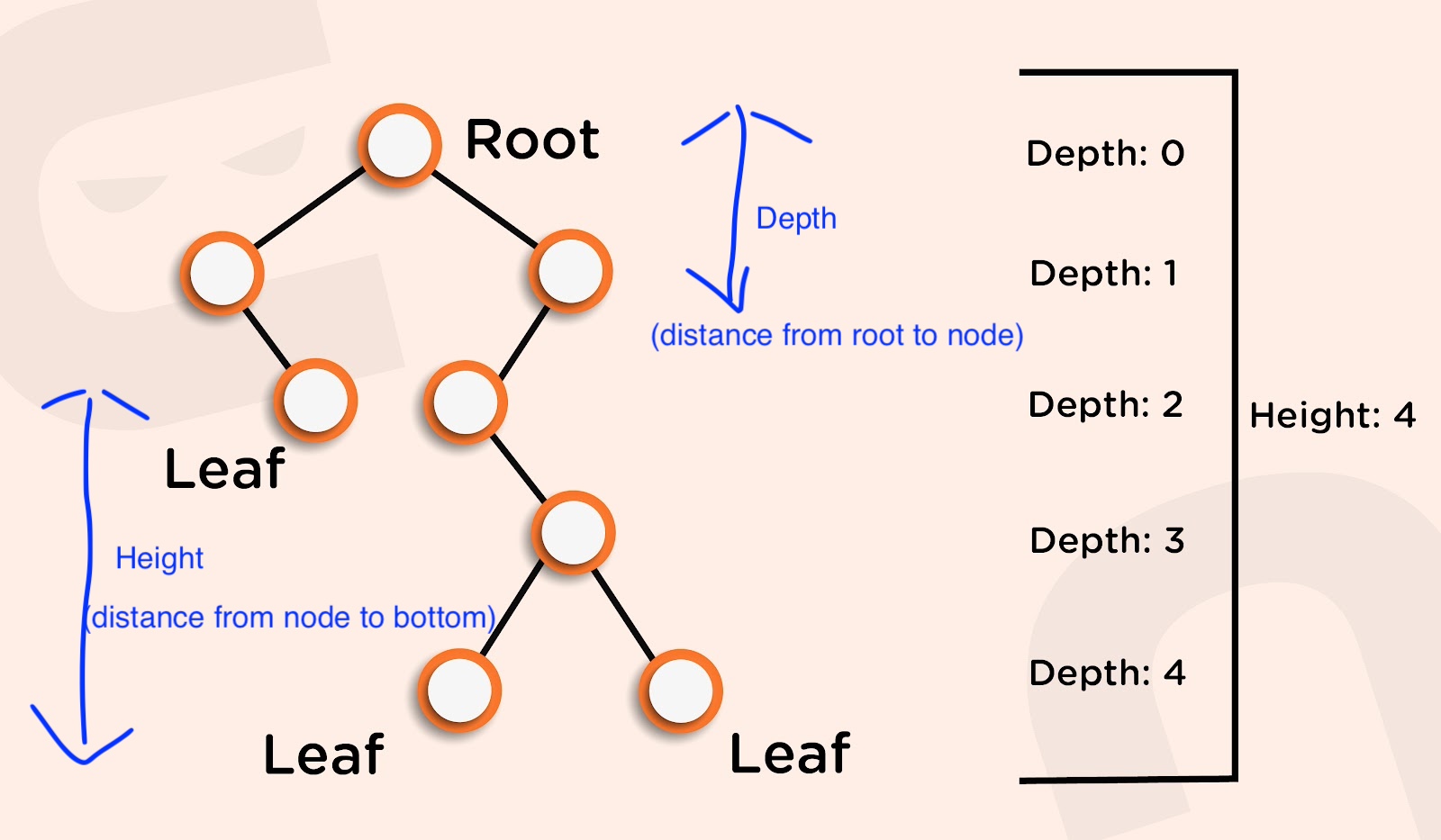
- Height: Distance from root to deepest leaf
- Depth: Distance from root to a specific node
- Time Complexity: O(log n) for balanced trees, O(n) for unbalanced
- Space Complexity: O(n) for storage, O(h) for recursion depth
# Tree Array Representation
Trees can be efficiently represented using arrays, especially for complete binary trees:
# Tree Structure
1
/ \
2 3
/ \
4 5
# Array Representation: [1, 2, 3, 4, 5]
# Index mapping:
# - Root at index 0
# - For node at index i:
# - Left child at index 2*i + 1
# - Right child at index 2*i + 2
# - Parent at index (i-1)/2
# References
# 0) Core Concepts
# 0-1) Tree Types Classification
# Basic Tree Types
| Type | Description | Key Properties | Use Cases |
|---|---|---|---|
| General Tree | Node with any number of children | Flexible structure | File systems, org charts |
| Binary Tree | Each node has β€ 2 children | Simple structure, recursive | Expression trees, decision trees |
| Complete Binary Tree | All levels filled except possibly last | Efficient array representation | Heaps, priority queues |
| Perfect Binary Tree | All levels completely filled | 2^h - 1 nodes | Theoretical analysis |
| BST | Left < Root < Right ordering | O(log n) search/insert/delete | Search operations, databases |
| Heap | Parent-child ordering property | Fast min/max extraction | Priority queues, sorting |
| Trie | Prefix tree for strings | Efficient string operations | Auto-complete, spell check |
# 0-2) Common Tree Patterns
# Pattern 1: Path-Based Problems
- Use Case: Find max/min values along paths
- Example: LC 1448 (Count Good Nodes) - maintain max value in path
- Technique: Pass accumulated values through DFS parameters
# Pattern 2: Subtree Validation
- Use Case: Check properties of subtrees
- Example: LC 101 (Symmetric Tree), LC 98 (Validate BST)
- Technique: Post-order traversal to validate children first
- Reference: Subtree Validation Video
# Pattern 3: Height vs Depth Calculations
- Height: Distance from node to deepest leaf (bottom-up)
- Use Post-order traversal (children β parent)
- Calculate after processing subtrees
- Depth: Distance from root to node (top-down)
- Use Pre-order traversal (parent β children)
- Pass down accumulated depth
- Example: LC 104 (Max Depth), LC 111 (Min Depth)
maxDepthcan safely use Math.max() with null children.minDepthneeds this guard, because null doesnβt count as a valid path
# Pattern 4: Tree Construction
- Use Case: Build trees from traversal arrays
- Examples: LC 105 (Preorder + Inorder), LC 106 (Inorder + Postorder)
- Key: Use one array for structure, another for positioning
# Pattern 5: Tree Serialization
- Use Case: Convert tree to/from string representation
- Examples: LC 297 (Serialize/Deserialize), LC 449 (BST Codec)
- Techniques: Preorder, postorder, or level-order encoding
# Pattern 6: Move Parent (Bidirectional Tree Traversal)
- Use Case: Problems requiring upward traversal or multi-directional exploration
- Core Concept: Convert tree to graph by adding parent pointers
- Key Technique: Build parent map + BFS for distance-based problems
- Example: LC 863 (All Nodes Distance K in Binary Tree)
- Why it works:
- Tree nodes only know children (left/right), not parents
- Build parent map via DFS preprocessing
- Then use BFS to explore all directions: left, right, and up (parent)
- Visited set prevents cycles when parent edges create bidirectional paths
Template Structure:
1. Build parent map (DFS preprocessing)
2. Convert tree to undirected graph (children + parent edges)
3. BFS from target node, exploring all neighbors (left, right, parent)
4. Track visited nodes to avoid cycles
5. Stop at desired distance/condition
Common Applications:
- Finding all nodes at distance K from target
- Closest node to target with specific property
- Path between any two nodes (not necessarily ancestor-descendant)
- Problems requiring βomnidirectionalβ tree exploration
# Pattern 7: Node Path (Subtree Serialization)
- Use Case: Problems requiring subtree comparison, duplicate detection, or structural matching
- Core Concept: Serialize each subtree into a unique string representation for comparison
- Key Technique: Post-order traversal to build serialization strings bottom-up
- Examples: LC 652 (Find Duplicate Subtrees), LC 572 (Subtree of Another Tree)
- Why it works:
- Each unique subtree structure maps to a unique serialization string
- Post-order ensures children are serialized before parent
- String comparison is O(1) with hashing, enabling efficient duplicate detection
- Can use HashMap to track seen subtree patterns
Template Structure:
// Serialize a subtree rooted at 'node' into a unique string
private String getNodePath(TreeNode node) {
if (node == null) {
return "#"; // marker for null children
}
// post-order: left β right β node
String left = getNodePath(node.left);
String right = getNodePath(node.right);
// build serialization string
return node.val + "," + left + "," + right;
}
# Python version
def get_node_path(node):
if not node:
return "#"
# post-order: left β right β node
left = get_node_path(node.left)
right = get_node_path(node.right)
# build serialization string
return f"{node.val},{left},{right}"
Common Applications:
- Finding duplicate subtrees in a binary tree
- Checking if one tree is a subtree of another
- Counting unique subtree structures
- Tree isomorphism problems
- Pattern matching in trees
Key Points:
- Use post-order traversal (children before parent)
- Include null markers (β#β) to distinguish structures
- Use HashMap<String, Integer> to track frequency
- Delimiter (e.g., β,β) prevents ambiguity (e.g., β12β vs β1,2β)
- Time complexity: O(NΒ²) worst case (string building), O(N) with optimization
- Space complexity: O(N) for HashMap and recursion stack
# 0-3) Traversal Order Selection Strategy
When to use which traversal:
1. No specific root processing needed?
β Any order works (preorder/inorder/postorder)
2. Need parent data for children?
β Use PREORDER (root β left β right)
3. Need children data for parent?
β Use POSTORDER (left β right β root)
4. Processing sorted data (BST)?
β Use INORDER (left β root β right)
5. Level-by-level processing?
β Use BFS/Level-order traversal
6. Need to move upward (to parent) or explore all directions?
β Use MOVE PARENT pattern (Build parent map + BFS)
7. Need to compare or identify subtrees?
β Use NODE PATH pattern (Subtree serialization with post-order)
# 1) Tree Templates & Algorithms
# 1.1) Universal Tree Template
Core Principle: Tree problems are naturally recursive - solve for current node using solutions from subtrees.
# Universal Tree Template
def solve_tree_problem(root, params):
# Base case
if not root:
return base_case_value
# Process current node (preorder position)
process_current_node(root, params)
# Recursively solve subtrees
left_result = solve_tree_problem(root.left, updated_params)
right_result = solve_tree_problem(root.right, updated_params)
# Combine results (postorder position)
result = combine_results(root, left_result, right_result)
return result
// Java Universal Tree Template
public ResultType solveTreeProblem(TreeNode root, ParamType params) {
// Base case
if (root == null) {
return defaultValue;
}
// Preorder: Process current node
processCurrentNode(root, params);
// Recursive calls
ResultType leftResult = solveTreeProblem(root.left, updatedParams);
ResultType rightResult = solveTreeProblem(root.right, updatedParams);
// Postorder: Combine results
ResultType result = combineResults(root.val, leftResult, rightResult);
return result;
}
# 1.2) Template Selection Guide
| Pattern | Template | When to Use | Example Problems |
|---|---|---|---|
| DFS Recursive | Standard recursion | Most tree problems | LC 104, 110, 226 |
| DFS Iterative | Stack-based | Avoid recursion depth limits | LC 94, 144, 145 |
| BFS Level-order | Queue-based | Level processing needed | LC 102, 199, 515 |
| Divide & Conquer | Bottom-up recursion | Need subtree results | LC 124, 543, 687 |
| Path Tracking | DFS with path state | Path-related problems | LC 112, 257, 437 |
| Move Parent | Parent map + BFS | Bidirectional exploration | LC 863, 742, 1740 |
| Node Path | Subtree serialization | Subtree comparison/detection | LC 652, 572 |
# 1.3) Core Operations
# 1.3.1) Tree Traversal Strategies
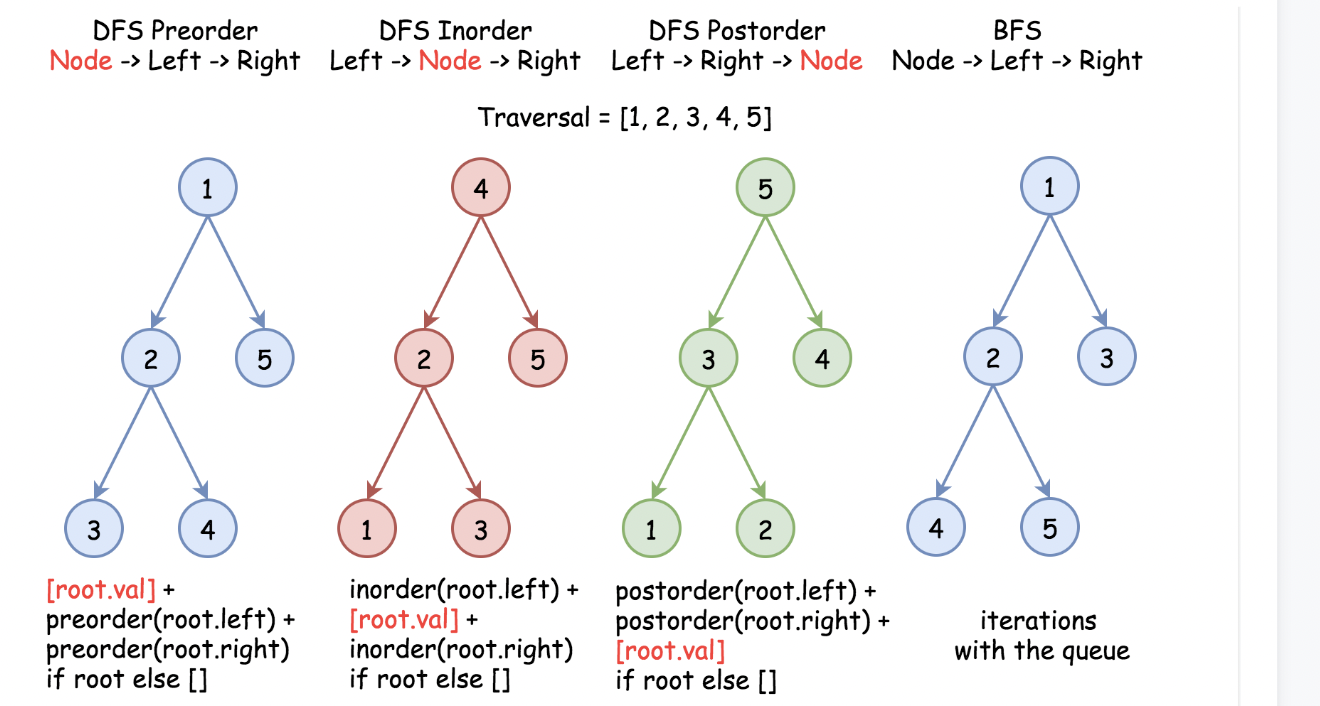
Two Main Approaches:
-
Depth-First Search (DFS) - Go deep before going wide
- Preorder: Root β Left β Right (top-down processing)
- Inorder: Left β Root β Right (sorted order for BST)
- Postorder: Left β Right β Root (bottom-up processing)
-
Breadth-First Search (BFS) - Process level by level
- Level-order: Process all nodes at depth d before depth d+1
# 1.4) DFS Traversal Templates
# Template 1: Preorder Traversal
Root β Left β Right | Use when you need parent data for processing children
# Recursive Preorder
def preorder_recursive(root, result):
if not root:
return
result.append(root.val) # Process root first
preorder_recursive(root.left, result) # Then left subtree
preorder_recursive(root.right, result) # Then right subtree
# Iterative Preorder
def preorder_iterative(root):
if not root:
return []
result = []
stack = [root]
while stack:
node = stack.pop()
result.append(node.val) # Process current node
# Add children to stack (right first, then left)
if node.right:
stack.append(node.right)
if node.left:
stack.append(node.left)
return result
// Java Preorder Implementation
public void preorderRecursive(TreeNode root, List<Integer> result) {
if (root == null) return;
result.add(root.val); // Process root
preorderRecursive(root.left, result); // Process left
preorderRecursive(root.right, result); // Process right
}
# Template 2: Inorder Traversal
Left β Root β Right | Use for BST to get sorted order
# Recursive Inorder
def inorder_recursive(root, result):
if not root:
return
inorder_recursive(root.left, result) # Process left subtree first
result.append(root.val) # Then process root
inorder_recursive(root.right, result) # Finally process right subtree
# Iterative Inorder
def inorder_iterative(root):
result = []
stack = []
current = root
while stack or current:
# Go to leftmost node
while current:
stack.append(current)
current = current.left
# Process current node
current = stack.pop()
result.append(current.val)
# Move to right subtree
current = current.right
return result
// Java Inorder Implementation
public void inorderRecursive(TreeNode root, List<Integer> result) {
if (root == null) return;
inorderRecursive(root.left, result); // Left subtree
result.add(root.val); // Current node
inorderRecursive(root.right, result); // Right subtree
}
# Template 3: Postorder Traversal
Left β Right β Root | Use when you need children data for parent processing
# Recursive Postorder
def postorder_recursive(root, result):
if not root:
return
postorder_recursive(root.left, result) # Process left subtree first
postorder_recursive(root.right, result) # Then right subtree
result.append(root.val) # Finally process root
# Iterative Postorder (using two stacks)
def postorder_iterative(root):
if not root:
return []
result = []
stack1 = [root]
stack2 = []
# First pass: collect nodes in reverse postorder
while stack1:
node = stack1.pop()
stack2.append(node)
if node.left:
stack1.append(node.left)
if node.right:
stack1.append(node.right)
# Second pass: pop from stack2 to get postorder
while stack2:
result.append(stack2.pop().val)
return result
# Template 4: Level-Order Traversal (BFS)
Process nodes level by level | Use for level-based problems
# Basic Level-Order Traversal
from collections import deque
def level_order_traversal(root):
if not root:
return []
result = []
queue = deque([root])
while queue:
level_size = len(queue)
current_level = []
# Process all nodes at current level
for _ in range(level_size):
node = queue.popleft()
current_level.append(node.val)
# Add children to queue for next level
if node.left:
queue.append(node.left)
if node.right:
queue.append(node.right)
result.append(current_level)
return result
# Simple level-order (flat list)
def level_order_simple(root):
if not root:
return []
result = []
queue = deque([root])
while queue:
node = queue.popleft()
result.append(node.val)
if node.left:
queue.append(node.left)
if node.right:
queue.append(node.right)
return result
// Java Level-Order Implementation
public List<List<Integer>> levelOrder(TreeNode root) {
List<List<Integer>> result = new ArrayList<>();
if (root == null) return result;
Queue<TreeNode> queue = new LinkedList<>();
queue.offer(root);
while (!queue.isEmpty()) {
int levelSize = queue.size();
List<Integer> currentLevel = new ArrayList<>();
for (int i = 0; i < levelSize; i++) {
TreeNode node = queue.poll();
currentLevel.add(node.val);
if (node.left != null) queue.offer(node.left);
if (node.right != null) queue.offer(node.right);
}
result.add(currentLevel);
}
return result;
}
# 1.5) Tree Node Initialization
# Python TreeNode Class
class TreeNode:
def __init__(self, val=0, left=None, right=None):
self.val = val
self.left = left
self.right = right
# Create a simple tree
root = TreeNode(1)
root.left = TreeNode(2)
root.right = TreeNode(3)
root.left.left = TreeNode(4)
root.left.right = TreeNode(5)
// Java TreeNode Class
public class TreeNode {
int val;
TreeNode left;
TreeNode right;
TreeNode() {}
TreeNode(int val) { this.val = val; }
TreeNode(int val, TreeNode left, TreeNode right) {
this.val = val;
this.left = left;
this.right = right;
}
}
# 2) Problems by Pattern Classification
# 2.1) Problem Categories & Templates
# Tree Traversal Problems
| Problem | LC # | Pattern | Template | Difficulty |
|---|---|---|---|---|
| Binary Tree Preorder Traversal | 144 | DFS Preorder | Preorder Template | Easy |
| Binary Tree Inorder Traversal | 94 | DFS Inorder | Inorder Template | Easy |
| Binary Tree Postorder Traversal | 145 | DFS Postorder | Postorder Template | Easy |
| Binary Tree Level Order Traversal | 102 | BFS Level-order | BFS Template | Medium |
| Binary Tree Zigzag Level Order | 103 | BFS with alternating | BFS + Direction | Medium |
# Tree Property Problems
| Problem | LC # | Pattern | Template | Difficulty |
|---|---|---|---|---|
| Maximum Depth of Binary Tree | 104 | DFS Bottom-up | Postorder Height | Easy |
| Minimum Depth of Binary Tree | 111 | BFS/DFS | BFS Early Stop | Easy |
| Balanced Binary Tree | 110 | DFS Height Check | Height Validation | Easy |
| Symmetric Tree | 101 | DFS Comparison | Mirror Validation | Easy |
| Same Tree | 100 | DFS Comparison | Tree Comparison | Easy |
# Path-Based Problems
| Problem | LC # | Pattern | Template | Difficulty |
|---|---|---|---|---|
| Binary Tree Maximum Path Sum | 124 | DFS Path Tracking | Global Max Update | Hard |
| Path Sum | 112 | DFS Path Validation | Path Accumulation | Easy |
| Path Sum II | 113 | DFS Path Collection | Path + Backtrack | Medium |
| Path Sum III | 437 | DFS Prefix Sum | Path Count Tracking | Medium |
| Sum Root to Leaf Numbers | 129 | DFS Path Calculation | Path Value Building | Medium |
| Count Good Nodes in Binary Tree | 1448 | DFS Path Max | Path State Tracking | Medium |
| Diameter of Binary Tree | 543 | DFS Path Length | Longest Path | Easy |
| Longest Univalue Path | 687 | DFS Path Pattern | Same Value Path | Medium |
# Distance and LCA Problems
| Problem | LC # | Pattern | Template | Difficulty |
|---|---|---|---|---|
| Lowest Common Ancestor | 236 | DFS Post-order | LCA Standard | Medium |
| LCA of BST | 235 | BST Property | Value Comparison | Easy |
| Distance in Binary Tree | 1740 | LCA + Distance | Path Distance | Medium |
| All Nodes Distance K | 863 | Graph + BFS | Tree to Graph | Medium |
# Height and Depth Problems
| Problem | LC # | Pattern | Template | Difficulty |
|---|---|---|---|---|
| Maximum Depth | 104 | DFS Bottom-up | Height Calculation | Easy |
| Minimum Depth | 111 | BFS/DFS | Depth to Leaf | Easy |
| Balanced Binary Tree | 110 | DFS Height Validation | Balance Check | Easy |
| Find Bottom Left Tree Value | 513 | BFS Level-order | Leftmost at Depth | Medium |
# Tree Construction Problems
| Problem | LC # | Pattern | Template | Difficulty |
|---|---|---|---|---|
| Construct Binary Tree from Preorder and Inorder | 105 | Divide & Conquer | Tree Building | Medium |
| Construct Binary Tree from Inorder and Postorder | 106 | Divide & Conquer | Tree Building | Medium |
| Serialize and Deserialize Binary Tree | 297 | Tree Encoding | String Conversion | Hard |
| Construct String from Binary Tree | 606 | DFS String Building | String Construction | Easy |
# Tree Modification Problems
| Problem | LC # | Pattern | Template | Difficulty |
|---|---|---|---|---|
| Invert Binary Tree | 226 | DFS Node Swapping | Tree Inversion | Easy |
| Flatten Binary Tree to Linked List | 114 | DFS Restructuring | Tree Flattening | Medium |
| Merge Two Binary Trees | 617 | DFS Combination | Tree Merging | Easy |
# Subtree Comparison Problems (Node Path Pattern)
| Problem | LC # | Pattern | Template | Difficulty |
|---|---|---|---|---|
| Find Duplicate Subtrees | 652 | Node Path Serialization | Subtree Hashing | Medium |
| Subtree of Another Tree | 572 | Node Path Comparison | Subtree Matching | Easy |
| Count Univalue Subtrees | 250 | Node Path Validation | Subtree Property Check | Medium |
# 2.2) Pattern Selection Guide
Problem Analysis Decision Tree:
1. Need to process all nodes?
βββ Yes: Choose appropriate traversal (preorder/inorder/postorder/level-order)
βββ No: Continue
2. Need information from children for parent?
βββ Yes: Use POSTORDER traversal
βββ No: Continue
3. Need information from parent for children?
βββ Yes: Use PREORDER traversal
βββ No: Continue
4. Processing level by level?
βββ Yes: Use BFS/Level-order traversal
βββ No: Continue
5. Need to move upward (to parent) or explore multi-directionally?
βββ Yes: Use MOVE PARENT pattern (Build parent map + BFS)
βββ No: Continue
6. Need to compare or find duplicate subtrees?
βββ Yes: Use NODE PATH pattern (Subtree serialization)
βββ No: Continue
7. Working with BST and need sorted order?
βββ Yes: Use INORDER traversal
βββ No: Use any suitable approach
# 3) Classic Tree Algorithms
# 3.1) Tree Right Side View (LC 199)
// java
// LC 199
List<Integer> res = new ArrayList<>();
Queue<TreeNode> q = new LinkedList<>();
while (!q.isEmpty()) {
TreeNode rightSide = null;
int qLen = q.size();
/**
* NOTE !!!
*
* 1) via for loop, we can get `most right node` (since the order is root -> left -> right)
* 2) via `TreeNode rightSide = null;`, we can get the `most right node` object
* - rightSide could be `right sub tree` or `left sub tree`
*
* e.g.
* 1
* 2 3
*
*
* 1
* 2 3
* 4
*
*/
for (int i = 0; i < qLen; i++) {
TreeNode node = q.poll();
if (node != null) {
rightSide = node;
q.offer(node.left);
q.offer(node.right);
}
}
if (rightSide != null) {
res.add(rightSide.val);
}
}
# 3.2) Node Count Algorithms
// get nodes count of binary tree
// get nodes count of perfect tree
// get nodes count of complete tree
// LC 222
// dfs
class Solution {
public int countNodes(TreeNode root) {
if (root == null) {
return 0;
}
// Recursively count the nodes in the left subtree
int leftCount = countNodes(root.left);
// Recursively count the nodes in the right subtree
int rightCount = countNodes(root.right);
// Return the total count (current node + left subtree + right subtree)
return 1 + leftCount + rightCount;
}
}
// bfs
public int countNodes_2(TreeNode root) {
if (root == null){
return 0;
}
List<TreeNode> collected = new ArrayList<>();
Queue<TreeNode> q = new LinkedList<>();
q.add(root);
while (!q.isEmpty()){
TreeNode cur = q.poll();
collected.add(cur);
if (cur.left != null) {
q.add(cur.left);
}
if (cur.right != null) {
q.add(cur.right);
}
}
//return this.count;
System.out.println("collected = " + collected.toString());
return collected.size();
}
# 1-1-3 -1) Get Maximum depth
- LC 104 : Maximum Depth of Binary Tree
- LC 110 : Balanced Binary Tree
// java
// V0
// IDEA : RECURSIVE (DFS)
public int maxDepth(TreeNode root) {
if (root == null){
return 0;
}
// NOTE : below conditon is optional (have or not use is OK)
// if (root.left == null && root.right == null){
// return 1;
// }
int leftD = maxDepth(root.left) + 1;
int rightD = maxDepth(root.right) + 1;
return Math.max(leftD, rightD);
}
// V1
public int getDepthDFS(TreeNode root) {
if (root == null) {
return 0;
}
return Math.max(getDepthDFS(root.left), getDepthDFS(root.right)) + 1;
}
#-----------------
# BFS
#-----------------
# ....
layer = 1
q = [[layer, root]]
res = []
while q:
# NOTE !!! FIFO, so we pop first added element (new element added at right hand side)
layer, tmp = root.pop(0)
"""
KEY here !!!!
"""
if tmp and not tmp.left and not tmp.right:
res.append(layer)
if tmp.left:
q.append([layer+1, tmp.left])
if tmp.right:
q.append([layer+1, tmp.right])
# ...
# 1-1-3 -2) Get Minimum depth
- LC 111 : Minimum Depth of Binary Tree
// java
// V0'
// IDEA : DFS
public int minDepth(TreeNode root) {
if (root == null){
return 0;
}
return getDepth(root);
}
private int getDepth(TreeNode root){
if (root == null){
return 0;
}
/**
* NOTE !!! below condition
* -> we need to go till meat a node, then calculate min depths (number of node)
* -> Note: A leaf is a node with no children.
* -> plz check below example for idea
* example : [2,null,3,null,4,null,5,null,6]
*
*
*/
if (root.left == null) {
return 1 + getDepth(root.right);
} else if (root.right == null) {
return 1 + getDepth(root.left);
}
return 1 + Math.min(getDepth(root.left), getDepth(root.right));
}
# 1-1-3 -2) Get Max path
- LC 124
int maxPathSum = 0;
// ...
public int getMaxPathHelper(TreeNode node){
if(node == null){
return 0;
}
int leftMaxDepth = Math.max(getMaxPathHelper(root.left), 0);
int rightMaxDepth = Math.max(getMaxPathHelper(root.right), 0);
maxPathSum = Math.max(maxPathSum, root.val + leftMaxDepth + rightMaxDepth);
return root.val + Math.max(leftMaxDepth, rightMaxDepth);
}
//...
# 1-1-4) Get LCA (Lowest Common Ancestor) of a tree
# LC 236 Lowest Common Ancestor of a Binary Tree
# LC 235 Lowest Common Ancestor of a Binary Search Tree
# LC 1650 Lowest Common Ancestor of a Binary Tree III
# V0
# IDEA : RECURSION + POST ORDER TRANSVERSAL
### NOTE : we need POST ORDER TRANSVERSAL for this problem
# -> left -> right -> root
# -> we can make sure that if p == q, then the root must be p and q's "common ancestor"
class Solution(object):
def lowestCommonAncestor(self, root, p, q):
### NOTE here
# if not root or find p in tree or find q in tree
# -> then we quit the recursion and return root
if not root or p == root or q == root:
return root
### NOTE here
# -> not root.left, root.right, BUT left, right
left = self.lowestCommonAncestor(root.left, p, q)
right = self.lowestCommonAncestor(root.right, p, q)
### NOTE here
# find q and p on the same time -> LCA is the current node (root)
# if left and right -> p, q MUST in left, right sub tree respectively
if left and right:
return root
### NOTE here
# if p, q both in left sub tree or both in right sub tree
return left if left else right
// java
// algorithm book p. 271
TreeNode lowestCommonAncestor(TreeNode root, TreeNode p, TreeNode q){
// base case
if (root == null) return null;
if (root == p || root == q) return root;
TreeNode left = lowestCommonAncestor(root.left, p, q);
TreeNode right = lowestCommonAncestor(root.right, p, q);
// case 1
if (left != null && right != null){
return root;
}
// case 2
if (left == null && right == null){
return null;
}
// case 3
return left == null ? right: left;
}
# 1-1-5) Merge Two Binary Trees
# LC 617 Merge Two Binary Trees
# NOTE !!! there is also BFS solution
# V0
# IDEA : DFS + BACKTRACK
class Solution:
def mergeTrees(self, t1, t2):
return self.dfs(t1,t2)
def dfs(self, t1, t2):
if not t1 and not t2:
return
if t1 and t2:
### NOTE here
newT = TreeNode(t1.val + t2.val)
newT.right = self.mergeTrees(t1.right, t2.right)
newT.left = self.mergeTrees(t1.left, t2.left)
return newT
### NOTE here
else:
return t1 or t2
// java
// V0
// IDEA : RECURSIVE
public TreeNode mergeTrees(TreeNode t1, TreeNode t2) {
if (t1 == null && t2 == null){
return null;
}
if (t1 != null && t2 != null){
t1.val += t2.val;
}
if (t1 == null && t2 != null){
// NOTE!!! return t2 directly here
return t2;
}
if (t1 != null && t2 == null){
// NOTE!!! return t1 directly here
return t1;
}
t1.left = mergeTrees(t1.left, t2.left);
t1.right = mergeTrees(t1.right, t2.right);
return t1;
}
# 1-1-6) Count nodes on a basic binary tree
// java
// algorithm book (labu) p. 250
public int countNodes (TreeNode root){
if (root == null) return 0;
return 1 + countNodes(root.left) + countNodes(root.right);
}
# 1-1-7) Count nodes on a perfect binary tree
// java
// algorithm book (labu) p. 250
public int countNodes(TreeNode root){
int h = 0;
// get tree depth
while (root != null){
root = root.left;
h += 1;
}
// total nodes = 2**n + 1
return (int)Math.pow(2, h) - 1;
}
# 1-1-8) Count nodes on a complete binary tree
// java
// algorithm book (labu) p. 251
public int countNodes(TreeNode root){
TreeNode l = root;
TreeNode r = root;
int hl = 0;
int hr = 0;
while (l != null){
l = l = left;
h1 += 1;
}
while (r != null){
r = r.right;
hr += 1;
}
// if left, right sub tree have SAME depth -> this is a perfect binary tree
if (hl == hr){
return (int)Math.pow(2, hl) - 1;
}
// if left, right sub tree have DIFFERENT depth, then we follow the simple bianry tree approach
return 1 + countNodes(root.left) + countNodes(root.right);
}
# 1-1-9) Serialize binary tree with pre-order traverse
// java
// algorithm book (labu) p.256
String SEP = ",";
String NULL = "#";
/* main func : serialize binary tree to string */
String serialize(TreeNode root){
StringBuilder sb = new StringBuilder();
serialize(root, sb);
return sb.toString();
/* help func : put binary tree to StringBuilder */
void serialize(TreeNode root, StringBuilder sb){
if (root == null){
sb.append(NULL).append(SEP);
return;
}
}
/********* pre-order traverse *********/
sb.append(root.val).append(SEP);
/**************************************/
serialize(root.left, sb);
serialize(root.right, sb);
}
# 1-1-10) Deserialize binary tree with pre-order traverse
// java
// algorithm book (labu) p.256
String SEP = ",";
String NULL = "#";
/* main func : dserialize string to binary tree */
TreeNode deserlialize(String data){
// transform string to linkedlist
LinkedList<String> nodes = new LinkedList<>();
for (String s: data.split(SEP)){
nodes.addLast(s);
}
return deserlialize(nodes);
}
/* **** help func : build binary tree via linkedlist (nodes) */
TreeNode deserlialize(LinkedList<String> nodes){
if (nodes.isEmpty()) return null;
/********* pre-order traverse *********/
// the 1st element on left is the root node of the binary tree
String first = nodes.removeFirst();
if (first.equals(NULL)) return null;
TreeNode root = new TreeNode(Integer.parseInt(first));
/**************************************/
root.left = deserlialize(nodes);
root.right = deserlialize(nodes);
return root;
}
# 1-1-11) Serialize binary tree with post-order traverse
// java
// algorithm book (labu) p.258
String SEP = ",";
String NULL = "#";
StringBuilder sb = new StringBuilder();
/* help func : pit binary tree to StringBuilder*/
void serialize(TreeNode root, StringBuilder sb){
if (root == null){
sb.append(NULL).append(SEP);
return;
}
serialize(root.left, sb);
serialize(root.right, sb);
/********* post-order traverse *********/
sb.append(root.val).append(SEP);
/**************************************/
}
# 1-1-12) Deserialize binary tree with post-order traverse
// java
// algorithm book (labu) p.260
/* main func : deserialize string to binary tree */
TreeNode deserlialize(String data){
LinkedList<String> nodes = new LinkedList<>();
for (String s : data.split(SEP)){
nodes.addLast(s);
}
return deserlialize(nodes);
}
/* help func : build binary tree via linkedlist */
TreeNode deserlialize(LinkedList<String> nodes){
if (nodes.isEmpty()) return null;
// get element from last to beginning
String last = nodes.removeLast();
if (last.equals(NULL)) return null;
TreeNode root = new TreeNode(Integer.parseInt(last));
// build right sub tree first, then left sub tree
root.right = deserlialize(nodes);
root.left = deserlialize(nodes);
return root;
}
# 1-1-13) Serialize binary tree with layer traverse
// java
// layer traverse : tree.html#1-1-basic-op
// algorithm book (labu) p.263
String SEP = ",";
String NULL = "#";
/* Serialize binary tree to string */
String serialize(TreeNode root){
if (root == null) return "";
StringBuilder sb = new StringBuilder();
// init queue, put root into it
Queue<TreeNode> q = new LinkedList<>();
q.offer(root);
while (!q.isEmpty()){
TreeNode cur = q.poll();
/***** layer traverse ******/
if (cur == null){
sb.append(NULL).append(SEP);
continue;
}
sb.append(cur.val).append(SEP);
/**************************/
q.offer(cur.left);
q.offer(cur.right);
}
return sb.toString();
}
# 1-1-14) Deserialize binary tree with layer traverse
// java
// algorithm book (labu) p.264
String SEP = ",";
String NULL = "#";
/* Deserialize binary tree to string */
TreeNode deserlialize(String data){
if (data.isEmpty()) return null;
String[] nodes = data.split(SEP);
// root's value = 1st element's value
TreeNode root = new TreeNode(Integer.parseInt(node[0]));
// queue records parent node, put root into queue
Queue<TreeNode> q = new LinkedList<>();
q.offer(root);
for (int i = 1; i < nodes.length){
// queue saves parent nodes
TreeNode parent = q.poll();
// parent node's left sub node
String left = nodes[i++];
if (!left.equals(NULL)){
parent.left = new TreeNode(Integer.parseInt(left));
q.offer(parent.left);
}else {
parent.left = null;
}
// parent node's right sub node
String right = nodes[i++];
if (!right.equals(NULL)){
parent.right = new TreeNode(Integer.parseInt(right));
q.offer(parent.right);
}else{
parent.right = null;
}
}
return root;
}
# 1-1-14-1) Serialize and Deserialize Binary Tree
// java
// LC 297
public class Codec{
public String serialize(TreeNode root) {
/** NOTE !!!
*
* if root == null, return "#"
*/
if (root == null){
return "#";
}
/** NOTE !!! return result via pre-order, split with "," */
return root.val + "," + serialize(root.left) + "," + serialize(root.right);
}
public TreeNode deserialize(String data) {
/** NOTE !!!
*
* 1) init queue and append serialize output
* 2) even use queue, but helper func still using DFS
*/
Queue<String> queue = new LinkedList<>(Arrays.asList(data.split(",")));
return helper(queue);
}
private TreeNode helper(Queue<String> queue) {
// get val from queue first
String s = queue.poll();
if (s.equals("#")){
return null;
}
/** NOTE !!! init current node */
TreeNode root = new TreeNode(Integer.valueOf(s));
/** NOTE !!!
*
* since serialize is "pre-order",
* deserialize we use "pre-order" as well
* e.g. root -> left sub tree -> right sub tree
* -> so we get sub tree via below :
*
* root.left = helper(queue);
* root.right = helper(queue);
*
*/
root.left = helper(queue);
root.right = helper(queue);
/** NOTE !!! don't forget to return final deserialize result */
return root;
}
}
# 1-1-15) Invert Binary Tree
# LC 226 Invert Binary Tree
# V0
# IDEA : DFS
# -> below code shows a good example that tree is a type of "linked list"
# -> we don't really modify tree's "value", but we modify the pointer
# -> e.g. make root.left point to root.right, make root.right point to root.left
class Solution(object):
def invertTree(self, root):
def dfs(root):
if not root:
return root
### NOTE THIS
if root:
# NOTE : have to do root.left, root.right ON THE SAME TIME
root.left, root.right = dfs(root.right), dfs(root.left)
dfs(root)
return root
# V0'
# IDEA BFS
class Solution(object):
def invertTree(self, root):
if root == None:
return root
queue = [root]
while queue:
# queue = queue[::-1] <-- this one is NOT working
for i in range(len(queue)):
tmp = queue.pop()
### NOTE here !!!!!!
# -> we do invert op via below
tmp.left, tmp.right = tmp.right, tmp.left
if tmp.left:
queue.append(tmp.left)
if tmp.right:
queue.append(tmp.right)
return root
// java
// DFS
// V0
// IDEA : DFS
public TreeNode invertTree(TreeNode root) {
if (root == null) {
return null;
}
/** NOTE !!!!
*
* instead of calling invertTree and assign value to sub tree directly,
* we need to CACHE invertTree result, and assign later
* -> since assign directly will cause tree changed, and affect the other invertTree call
*
* e.g. below is WRONG,
* root.left = invertTree(root.right);
* root.right = invertTree(root.left);
*
* need to cache result
*
* TreeNode left = invertTree(root.left);
* TreeNode right = invertTree(root.right);
*
* then assign to sub tree
*
* root.left = right;
* root.right = left;
*/
TreeNode left = invertTree(root.left);
TreeNode right = invertTree(root.right);
root.left = right;
root.right = left;
/** NOTE !!!! below is WRONG */
// root.left = invertTree(root.right);
// root.right = invertTree(root.left);
return root;
}
# 1-1-16) Move Parent Pattern - Bidirectional Tree Traversal
Core Concept: Convert tree to graph by building parent map, then use BFS for multi-directional exploration.
# Pattern Overview
Standard Tree (Unidirectional) β Tree with Parent Map (Bidirectional)
1 1
/ \ Build Parent Map / \
2 3 ===============> 2 β 3
/ \ / \
4 5 4 β 5
Can only go down (left/right) Can go down (left/right) AND up (parent)
# LC 863: All Nodes Distance K in Binary Tree
// java
// IDEA: DFS + Parent Map + BFS
/**
* Why this works?
*
* Tree β Graph β BFS (visiting)
*
* β’ From target you need to explore all directions reachable in k steps:
* left, right, and up (to parent).
* Converting the tree to an undirected graph (children + parent edges)
* and then running BFS from target to depth k returns the desired nodes.
*
* β’ visited ensures we don't revisit nodes (which would otherwise make the BFS
* incorrect/infinite once parent edges are present).
*/
public List<Integer> distanceK(TreeNode root, TreeNode target, int k) {
List<Integer> res = new ArrayList<>();
// parentMap stores parent pointers for every node (node -> parent)
Map<TreeNode, TreeNode> parentMap = new HashMap<>();
if (root == null) return res;
// Step 1: Build parent map for all nodes
buildParentMap(root, null, parentMap);
// Step 2: BFS starting from target, stop at distance k
Queue<TreeNode> queue = new LinkedList<>();
Set<TreeNode> visited = new HashSet<>();
queue.offer(target);
visited.add(target);
int dist = 0;
/**
* β’ Each loop iteration processes one BFS "level"
* (all nodes at the same distance from target).
*
* β’ If current distance dist equals k, the nodes currently
* in queue are exactly the nodes at distance k.
*/
while (!queue.isEmpty()) {
int size = queue.size();
if (dist == k) {
// Collect all nodes currently in the queue
for (TreeNode node : queue) {
res.add(node.val);
}
break;
}
/**
* NOTE!!!
* For each node, we visit cur.left, cur.right, and its parent via BFS
*
* β’ Process the size nodes of the current level:
* - For each cur, try to move to cur.left, cur.right, and its parent
* - visited.add(node) returns true only if node was not already present
* That both checks and marks in one call
*
* β’ After processing the whole level, increment dist and continue
*/
for (int i = 0; i < size; i++) {
TreeNode cur = queue.poll();
// Explore neighbors: left, right, parent
if (cur.left != null && visited.add(cur.left)) {
queue.offer(cur.left);
}
if (cur.right != null && visited.add(cur.right)) {
queue.offer(cur.right);
}
TreeNode parent = parentMap.get(cur);
if (parent != null && visited.add(parent)) {
queue.offer(parent);
}
}
dist++;
}
return res;
}
/**
* NOTE!!! Helper function to build parent map
*
* β’ We need to be able to move upwards from any node (to parent).
* A binary tree node only knows left/right children, so we precompute
* parents by a DFS.
*
* β’ Simple DFS that records parent of each node (parentMap.put(node, parent))
* β’ For root we pass parent = null
* β’ After this every node maps to its parent (or null for root)
*/
private void buildParentMap(TreeNode node, TreeNode parent,
Map<TreeNode, TreeNode> parentMap) {
if (node == null) return;
parentMap.put(node, parent);
buildParentMap(node.left, node, parentMap);
buildParentMap(node.right, node, parentMap);
}
# python
# LC 863. All Nodes Distance K in Binary Tree
from collections import defaultdict, deque
def distanceK(root, target, k):
"""
IDEA: Build bidirectional graph + BFS
Step 1: DFS to build parent-child bidirectional edges
Step 2: BFS from target to find all nodes at distance k
"""
# Build undirected graph
graph = defaultdict(list)
def build_graph(parent, child):
"""DFS to build bidirectional edges"""
if parent and child:
graph[parent.val].append(child.val)
graph[child.val].append(parent.val)
if child.left:
build_graph(child, child.left)
if child.right:
build_graph(child, child.right)
# Build graph from root
build_graph(None, root)
# BFS from target
queue = deque([(target.val, 0)])
visited = {target.val}
result = []
while queue:
node_val, dist = queue.popleft()
if dist == k:
result.append(node_val)
continue
# Explore all neighbors (left, right, parent)
for neighbor in graph[node_val]:
if neighbor not in visited:
visited.add(neighbor)
queue.append((neighbor, dist + 1))
return result
# Key Points
- Parent Map Construction: O(N) time, O(N) space
- BFS Exploration: O(N) time in worst case
- Visited Set: Critical to prevent infinite loops
- Applications:
- Distance-based problems
- Finding paths between arbitrary nodes
- Closest node with property
- Problems requiring upward traversal
# Pattern Comparison: Standard Tree vs Move Parent
| Aspect | Standard Tree Traversal | Move Parent Pattern |
|---|---|---|
| Direction | Unidirectional (down only) | Bidirectional (down + up) |
| Preprocessing | None required | Build parent map (O(N)) |
| Space Complexity | O(h) recursion stack | O(N) parent map + visited |
| Visited Tracking | Usually not needed | Critical to prevent cycles |
| Traversal Method | DFS recursive | DFS (build) + BFS (explore) |
| Use Cases | Standard tree problems | Distance, path, multi-directional |
| Graph Conversion | Tree remains tree | Tree β Undirected graph |
# Common Mistakes to Avoid
- β Forgetting visited set β infinite loops
- β Not handling null parent for root β NPE
- β Using DFS instead of BFS for distance β incorrect results
- β Building graph with values instead of node references β fails with duplicate values
# 1-1-17) check Symmetric Tree
# LC 101
class Solution(object):
def isSymmetric(self, root):
if not root:
return True
return self.mirror(root.left, root.right)
def mirror(self, left, right):
if not left or not right:
return left == right
if left.val != right.val:
return False
return self.mirror(left.left, right.right) and self.mirror(left.right, right.left)
# 1-1-18) Distance Between Nodes
// java
// LC 1740 Find Distance in a Binary Tree
// V1
/**
* IDEA of `getPathLen` help func:
*
* π§ Summary of Logic Flow
* 1. Stop when null (return -1) or when target is found (return distance).
* 2. Search left first. If found, return immediately.
* 3. Otherwise, search right.
* 4. If neither side contains the target, the function will bubble up -1.
*/
private int getPathLen(TreeNode root, int target, int dist) {
/** NOTE !!!
*
* base case:
*
* β’ Base case #1:
* if we hit a null node,
* -> the target DOES NOT exist in this branch.
*
* β’ Returning -1 is a sentinel value
* meaning βnot found in this subtreeβ
*/
if (root == null) {
return -1; // not found
}
/**
* NOTE !!!
*
* β’ Base case #2: if the current node matches the target, return dist, which is the current number of edges from the starting node (typically the LCA) to this node.
* β’ This is the successful termination of the recursion.
*/
if (root.val == target) {
return dist;
}
/**
* NOTE !!!
*
* β’ Recurse into the left subtree.
* β’ Increment dist by 1 because we moved down one level.
* β’ Store the result in left.
* - If target is in this subtree,
* left will contain the distance.
* - Otherwise, left will be -1.
*/
int left = getPathLen(root.left, target, dist + 1);
/**
* β’ If we found the target in the left subtree,
* return that distance immediately.
* β’ This avoids unnecessary searching in the right subtree.
*/
if (left != -1) {
return left;
}
/**
* NOTE !!!
*
* β’ If not found on the left, search the right subtree with dist + 1.
* β’ Return the result directly:
* - Either a valid distance if found,
* - Or -1 if not found in right subtree either.
*
*/
int right = getPathLen(root.right, target, dist + 1);
return right;
}
// V2
public int findDistance(TreeNode root, int p, int q) {
TreeNode lca = findLCA(root, p, q);
return getDistance(lca, p) + getDistance(lca, q);
}
private TreeNode findLCA(TreeNode node, int p, int q) {
if (node == null || node.val == p || node.val == q) {
return node;
}
TreeNode left = findLCA(node.left, p, q);
TreeNode right = findLCA(node.right, p, q);
if (left != null && right != null) return node;
return left != null ? left : right;
}
private int getDistance(TreeNode node, int target) {
if (node == null) return -1;
if (node.val == target) return 0;
int leftDist = getDistance(node.left, target);
int rightDist = getDistance(node.right, target);
if (leftDist != -1) return leftDist + 1;
if (rightDist != -1) return rightDist + 1;
return -1;
}
# 1-1-19) Find Paths with Specific Properties
# Path Sum Problems
# LC 112 Path Sum - Has Path with Target Sum
def hasPathSum(self, root, targetSum):
if not root:
return False
if not root.left and not root.right:
return root.val == targetSum
return (self.hasPathSum(root.left, targetSum - root.val) or
self.hasPathSum(root.right, targetSum - root.val))
# LC 113 Path Sum II - All Paths with Target Sum
def pathSum(self, root, targetSum):
result = []
def dfs(node, remaining, path):
if not node:
return
path.append(node.val)
if not node.left and not node.right and remaining == node.val:
result.append(path[:])
dfs(node.left, remaining - node.val, path)
dfs(node.right, remaining - node.val, path)
path.pop() # backtrack
dfs(root, targetSum, [])
return result
# LC 437 Path Sum III - Number of Paths with Target Sum (any start/end)
def pathSum(self, root, targetSum):
def dfs(node, current_sum):
if not node:
return 0
current_sum += node.val
result = prefix_sum.get(current_sum - targetSum, 0)
prefix_sum[current_sum] = prefix_sum.get(current_sum, 0) + 1
result += dfs(node.left, current_sum)
result += dfs(node.right, current_sum)
prefix_sum[current_sum] -= 1
return result
prefix_sum = {0: 1}
return dfs(root, 0)
# Path Length Problems
# LC 543 Diameter of Binary Tree - Longest Path Between Any Two Nodes
def diameterOfBinaryTree(self, root):
self.diameter = 0
def dfs(node):
if not node:
return 0
left_depth = dfs(node.left)
right_depth = dfs(node.right)
# Update diameter through current node
self.diameter = max(self.diameter, left_depth + right_depth)
return 1 + max(left_depth, right_depth)
dfs(root)
return self.diameter
# LC 687 Longest Univalue Path - Longest Path with Same Values
def longestUnivaluePath(self, root):
self.longest = 0
def dfs(node):
if not node:
return 0
left_length = dfs(node.left)
right_length = dfs(node.right)
left_path = left_length + 1 if node.left and node.left.val == node.val else 0
right_path = right_length + 1 if node.right and node.right.val == node.val else 0
self.longest = max(self.longest, left_path + right_path)
return max(left_path, right_path)
dfs(root)
return self.longest
// java
// LC 112 Path Sum
public boolean hasPathSum(TreeNode root, int targetSum) {
if (root == null) {
return false;
}
if (root.left == null && root.right == null) {
return root.val == targetSum;
}
return hasPathSum(root.left, targetSum - root.val) ||
hasPathSum(root.right, targetSum - root.val);
}
// LC 113 Path Sum II
public List<List<Integer>> pathSum(TreeNode root, int targetSum) {
List<List<Integer>> result = new ArrayList<>();
List<Integer> path = new ArrayList<>();
dfs(root, targetSum, path, result);
return result;
}
private void dfs(TreeNode node, int remaining, List<Integer> path,
List<List<Integer>> result) {
if (node == null) return;
path.add(node.val);
if (node.left == null && node.right == null && remaining == node.val) {
result.add(new ArrayList<>(path));
}
dfs(node.left, remaining - node.val, path, result);
dfs(node.right, remaining - node.val, path, result);
path.remove(path.size() - 1); // backtrack
}
# 1-1-20) Tree Height and Depth Operations
# Core Concepts: Height vs Depth
| Concept | Definition | Direction | Traversal | Use Case |
|---|---|---|---|---|
| Height | Distance from node to deepest leaf | Bottom-up | Post-order DFS | Tree properties, balance check |
| Depth | Distance from root to target node | Top-down | Pre-order DFS | Node distance, level finding |
Key Insight: getDepth() is the fundamental algorithm for calculating distance between nodes (from root to any target node).
# Visual Comparison
1 Height of 1: 2 (to deepest leaf)
/ \ Depth of 1: 0 (root)
2 3 Height of 2: 1, Depth of 2: 1
/ \ Height of 4: 0, Depth of 4: 2
4 5 Height of 5: 0, Depth of 5: 2
Height measures "how far down can I go?"
Depth measures "how far am I from the root?"
# 1. Get Height (Post-order DFS)
Purpose: Calculate distance from node to its deepest descendant leaf.
// java
/**
* π³ Get Height - Bottom-up approach
*
* Time: O(N) - visit each node once
* Space: O(h) - recursion stack depth
*
* Returns: Height of tree (number of edges from node to deepest leaf)
*/
public int getHeight(TreeNode root) {
if (root == null) {
return -1; // β
Return -1 for null (so leaf height = 0)
}
// Post-order: process children first, then current node
int leftHeight = getHeight(root.left);
int rightHeight = getHeight(root.right);
return Math.max(leftHeight, rightHeight) + 1;
}
/**
* Why return -1 for null?
*
* β’ By definition: leaf node has height 0
* β’ If root is a leaf:
* - leftHeight = -1 (null)
* - rightHeight = -1 (null)
* - max(-1, -1) + 1 = 0 β
(correct leaf height)
*
* Alternative: return 0 for null
* Then leaf height would be 1 (which is also valid but less standard)
*/
# python
def get_height(node):
"""
Height: Distance from node to deepest leaf (bottom-up)
Returns -1 for null so leaf height = 0
"""
if not node:
return -1
left_height = get_height(node.left)
right_height = get_height(node.right)
return max(left_height, right_height) + 1
# 2. Get Depth (Pre-order DFS)
Purpose: Calculate distance from root to target node. This is the core distance-finding algorithm.
// java
/**
* πΏ Get Depth - Top-down approach
*
* This is the fundamental algorithm for finding distance between nodes:
* - Distance from root to any target node
* - Can be used as building block for node-to-node distance (via LCA)
*
* Time: O(N) - worst case visit all nodes
* Space: O(h) - recursion stack depth
*
* Returns:
* - Depth (number of edges from root to target) if found
* - -1 if target not found
*/
public int getDepth(TreeNode root, TreeNode target) {
return getDepthHelper(root, target, 0);
}
private int getDepthHelper(TreeNode root, TreeNode target, int depth) {
if (root == null) {
return -1; // β Target not found in this branch
}
if (root == target) {
return depth; // β
Found! Return current distance from root
}
// Pre-order: try left subtree first
int leftDepth = getDepthHelper(root.left, target, depth + 1);
if (leftDepth != -1) {
return leftDepth; // Found in left subtree
}
// If not in left, try right subtree
return getDepthHelper(root.right, target, depth + 1);
}
/**
* Why return -1 for null?
*
* β’ -1 is a sentinel value meaning "not found"
* β’ Allows us to distinguish between:
* - "Found at root" (depth = 0)
* - "Not found" (depth = -1)
* β’ Enables early termination when target is found
*/
# python
def get_depth(root, target, depth=0):
"""
Depth: Distance from root to target node (top-down)
This is the core distance algorithm - finds distance from root to any node.
Returns:
- depth (number of edges) if target found
- -1 if target not found
"""
if not root:
return -1 # Not found
if root == target or root.val == target:
return depth # Found!
# Try left subtree
left_depth = get_depth(root.left, target, depth + 1)
if left_depth != -1:
return left_depth
# Try right subtree
return get_depth(root.right, target, depth + 1)
# 3. Comparison Table
| Aspect | Get Height | Get Depth |
|---|---|---|
| Traversal Order | Post-order (left β right β root) | Pre-order (root β left β right) |
| Direction | Bottom-up (leaf to node) | Top-down (root to node) |
| Null Return | -1 (so leaf height = 0) |
-1 (meaning βnot foundβ) |
| Parameter Passing | None (computed from children) | Pass depth down through recursion |
| Use Case | Tree balance, tree properties | Distance calculation, level finding |
| When to Use | Need children data first | Need parent data for children |
| Example Problems | LC 104 (Max Depth), LC 110 (Balanced Tree) | LC 1740 (Distance in Tree), LC 863 (Distance K) |
# 4. Relationship to Distance Between Nodes
/**
* Finding distance between ANY two nodes uses getDepth() as building block:
*
* 1. Find Lowest Common Ancestor (LCA) of node1 and node2
* 2. Distance = getDepth(LCA, node1) + getDepth(LCA, node2)
*
* See LC 1740 for full implementation.
*/
public int findDistance(TreeNode root, int p, int q) {
TreeNode lca = findLCA(root, p, q);
return getDepth(lca, p) + getDepth(lca, q);
}
# 5. Common Variations
// java
// Variation 1: Get depth by value instead of node reference
public int getDepth(TreeNode root, int targetVal) {
return getDepthHelper(root, targetVal, 0);
}
private int getDepthHelper(TreeNode node, int targetVal, int depth) {
if (node == null) {
return -1;
}
if (node.val == targetVal) {
return depth;
}
int left = getDepthHelper(node.left, targetVal, depth + 1);
if (left != -1) return left;
return getDepthHelper(node.right, targetVal, depth + 1);
}
// Variation 2: Get height returning 0 for null (leaf height = 1)
public int getHeightAlternative(TreeNode root) {
if (root == null) {
return 0; // Leaf node height = 1 with this approach
}
return 1 + Math.max(getHeightAlternative(root.left),
getHeightAlternative(root.right));
}
// Variation 3: Check if tree is balanced (height difference β€ 1)
public boolean isBalanced(TreeNode root) {
return checkBalance(root) != -1;
}
private int checkBalance(TreeNode node) {
if (node == null) {
return 0;
}
int leftHeight = checkBalance(node.left);
if (leftHeight == -1) return -1;
int rightHeight = checkBalance(node.right);
if (rightHeight == -1) return -1;
if (Math.abs(leftHeight - rightHeight) > 1) {
return -1; // Unbalanced
}
return 1 + Math.max(leftHeight, rightHeight);
}
# 6. Key Takeaways
- Height (Post-order): Used for tree properties, needs children info first
- Depth (Pre-order): Core distance algorithm, passes info down to children
- Return -1 for null:
- Height: Makes leaf height = 0 (standard definition)
- Depth: Signals βtarget not foundβ
- Distance between nodes = Use
getDepth()twice with LCA - Choose based on info flow:
- Need children data? β Use height (post-order)
- Need parent data? β Use depth (pre-order)
# 1-1-21) Node Path Pattern - Subtree Serialization
The Node Path pattern serializes each subtree into a unique string for efficient comparison and duplicate detection.
# LC 652: Find Duplicate Subtrees
// java
// LC 652 Find Duplicate Subtrees
/**
* IDEA: Node Path Pattern with Subtree Serialization
*
* Approach:
* 1. Serialize each subtree using post-order traversal
* 2. Use HashMap to track serialization frequency
* 3. Add to result when count reaches 2 (first duplicate)
*
* Key Points:
* - Post-order ensures children are processed before parent
* - Delimiter "," prevents ambiguity (e.g., "12" vs "1,2")
* - Null marker "#" distinguishes different structures
*/
public List<TreeNode> findDuplicateSubtrees(TreeNode root) {
List<TreeNode> result = new ArrayList<>();
Map<String, Integer> pathCount = new HashMap<>();
getNodePath(root, pathCount, result);
return result;
}
private String getNodePath(TreeNode node, Map<String, Integer> pathCount,
List<TreeNode> result) {
if (node == null) {
return "#"; // null marker
}
// Post-order: left β right β node
String left = getNodePath(node.left, pathCount, result);
String right = getNodePath(node.right, pathCount, result);
// Build serialization string with delimiter
String path = node.val + "," + left + "," + right;
// Track frequency and add to result on first duplicate
int count = pathCount.getOrDefault(path, 0);
if (count == 1) {
result.add(node); // First duplicate occurrence
}
pathCount.put(path, count + 1);
return path;
}
# python
# LC 652 Find Duplicate Subtrees
from collections import defaultdict
def findDuplicateSubtrees(root):
"""
IDEA: Node Path Pattern
Time: O(NΒ²) worst case (string operations), O(N) with optimization
Space: O(N) for HashMap and recursion
"""
result = []
path_count = defaultdict(int)
def get_node_path(node):
if not node:
return "#"
# Post-order: left β right β node
left = get_node_path(node.left)
right = get_node_path(node.right)
# Build serialization string
path = f"{node.val},{left},{right}"
# Track frequency
if path_count[path] == 1:
result.append(node)
path_count[path] += 1
return path
get_node_path(root)
return result
# LC 572: Subtree of Another Tree
// java
// LC 572 Subtree of Another Tree
/**
* IDEA: Node Path Pattern for Subtree Matching
*
* Approach 1: Serialize both trees and check if subRoot is substring of root
* Approach 2: Traditional recursive comparison (shown below)
*/
// Method 1: Using Node Path Serialization
public boolean isSubtree(TreeNode root, TreeNode subRoot) {
String rootPath = serialize(root);
String subPath = serialize(subRoot);
// Check if subPath is substring of rootPath
return rootPath.contains("," + subPath + ",");
}
private String serialize(TreeNode node) {
if (node == null) {
return "#";
}
// Post-order serialization with delimiters
String left = serialize(node.left);
String right = serialize(node.right);
// Add delimiters to prevent false matches (e.g., "12" in "123")
return "," + node.val + "," + left + "," + right + ",";
}
// Method 2: Traditional Recursive Comparison
public boolean isSubtree_v2(TreeNode root, TreeNode subRoot) {
if (root == null) {
return false;
}
// Check if current tree matches OR check subtrees
return isSameTree(root, subRoot) ||
isSubtree_v2(root.left, subRoot) ||
isSubtree_v2(root.right, subRoot);
}
private boolean isSameTree(TreeNode p, TreeNode q) {
if (p == null && q == null) return true;
if (p == null || q == null) return false;
if (p.val != q.val) return false;
return isSameTree(p.left, q.left) && isSameTree(p.right, q.right);
}
# python
# LC 572 Subtree of Another Tree
# Method 1: Node Path Serialization
def isSubtree(root, subRoot):
"""
Serialize both trees and check substring match
Time: O(M + N) where M, N are tree sizes
Space: O(M + N) for serialization strings
"""
def serialize(node):
if not node:
return "#"
# Post-order with delimiters
left = serialize(node.left)
right = serialize(node.right)
return f",{node.val},{left},{right},"
root_path = serialize(root)
sub_path = serialize(subRoot)
return sub_path in root_path
# Method 2: Traditional Recursive
def isSubtree_v2(root, subRoot):
if not root:
return False
def is_same(p, q):
if not p and not q:
return True
if not p or not q:
return False
return (p.val == q.val and
is_same(p.left, q.left) and
is_same(p.right, q.right))
return (is_same(root, subRoot) or
isSubtree_v2(root.left, subRoot) or
isSubtree_v2(root.right, subRoot))
# Pattern Insights
When to use Node Path Pattern:
- Finding duplicate or similar subtrees
- Checking if one tree is subtree of another
- Counting unique tree structures
- Tree pattern matching problems
Key Implementation Points:
- Post-order traversal: Process children before parent
- Null markers: Use β#β or βnullβ to represent null nodes
- Delimiters: Use β,β to separate values and prevent ambiguity
- HashMap tracking: Store serialization β frequency mapping
- Early termination: Add to result at count == 1 for duplicates
Common Pitfalls:
- β Forgetting delimiters β β12β matches β1,2β incorrectly
- β Not handling null nodes β different structures have same serialization
- β Using pre-order β harder to build complete subtree representation
- β Not caching serialization strings β O(NΒ²) time complexity
Complexity Analysis:
- Time: O(NΒ²) worst case (string concatenation), O(N) with StringBuilder
- Space: O(N) for HashMap and recursion stack, O(NΒ²) for all paths
# 2) LC Example
# 2-1) Binary Tree Right Side View
# LC 199 Binary Tree Right Side View
# V0
# IDEA : DFS
class Solution(object):
def rightSideView(self, root):
def dfs(root, layer):
if not root:
return
if len(res) <= layer+1:
#if len(res) == layer: # this works as well
res.append([])
res[layer].append(root.val)
if root.right:
dfs(root.right, layer+1)
if root.left:
dfs(root.left, layer+1)
if not root:
return []
res =[[]]
dfs(root, 0)
return [x[0] for x in res if len(x) > 0]
# 2-2) Construct String from Binary Tree
# LC 606. Construct String from Binary Tree
# V0
class Solution:
def tree2str(self, t):
if not t:
return ''
if not t.left and not t.right:
return str(t.val)
### NOTICE HERE
if not t.left:
return str(t.val) + '()' + '(' + self.tree2str(t.right) + ')'
### NOTICE HERE
if not t.right:
return str(t.val) + '(' + self.tree2str(t.left) + ')'
### NOTICE HERE
return str(t.val) + '(' + self.tree2str(t.left) + ')' + '(' + self.tree2str(t.right) + ')'
# V0'
class Solution:
def tree2str(self, root):
if not root:
return ""
### NOTE : this condition can make effect
# as ` return str(root.val) + "(" + self.tree2str(root.left) + ")" + "(" + self.tree2str(root.right) + ")" ` at the bottom
if not root.left and not root.right:
return str(root.val)
if root.left and root.right:
return str(root.val) + "(" + self.tree2str(root.left) + ")" + "(" + self.tree2str(root.right) + ")"
if not root.right:
return str(root.val) + "(" + self.tree2str(root.left) + ")"
if not root.left:
return str(root.val) + "()" + "(" + self.tree2str(root.right) + ")"
#return str(root.val) + "(" + self.tree2str(root.left) + ")" + "(" + self.tree2str(root.right) + ")"
# V0''
class Solution(object):
def tree2str(self, t):
if not t: return ""
s = str(t.val)
if t.left or t.right:
s += "(" + self.tree2str(t.left) + ")"
if t.right:
s += "(" + self.tree2str(t.right) + ")"
return s
# 2-3) Maximum Width of Binary Tree
# LC 662 Maximum Width of Binary Tree
# V0
# IDEA : defaultdict + DFS
from collections import defaultdict
class Solution:
def widthOfBinaryTree(self, root):
def dfs(node, level, idx):
if node:
d[level] += [idx]
dfs(node.left, level+1, 2*idx)
dfs(node.right, level+1, 2*idx+1)
d = defaultdict(list)
dfs(root, 0, 0)
return max(v[-1] - v[0] + 1 for _, v in d.items())
# V0'
# IDEA : BFS
# IDEA : GIVEN index = idx -> its left tree index = idx*2 ; its right tree index = idx*2 + 1
# -> SO GO THROUGH ALL LAYERS IN THE TREE, CALCULATE THEIR WIDTH, AND RETRUN THE MAX WIDTH WHICH IS THE NEEDED RESPONSE
from collections import defaultdict
class Solution(object):
def widthOfBinaryTree(self, root):
# edge case
if not root:
return 0
layer = 0
idx = 0
q = [[root, layer, idx]]
res = defaultdict(list)
while q:
for i in range(len(q)):
tmp, layer, idx = q.pop(0)
res[layer].append(idx)
if tmp.left:
q.append([tmp.left, layer+1, idx*2])
if tmp.right:
q.append([tmp.right, layer+1, idx*2+1])
#print ("res = " + str(res))
_res = [max(res[x]) - min(res[x]) + 1 for x in list(res.keys()) if res[x] > 1]
#print ("_res = " + str(_res))
return max(_res)
# 2-4) Construct String from Binary Tree
# LC 606 Construct String from Binary Tree
# V0
# IDEA : tree + check problem examples
# -> if root.right and not root.left
# -> if root.left and not root.right
class Solution(object):
def tree2str(self, root):
def dfs(root):
if not root:
### NOTICE HERE
return ""
### NOTICE HERE
if not root.left and not root.right:
return str(root.val)
### NOTICE HERE : "2()(4)" case
if root.right and not root.left:
return str(root.val) + '()' + '(' + dfs(root.right) + ')'
### NOTICE HERE
if root.left and not root.right:
return str(root.val) + '(' + dfs(root.left) + ')'
### NOTICE HERE
return str(root.val) + '(' + dfs(root.left) + ')' + '(' + dfs(root.right) + ')'
res = dfs(root)
return res
# 2-5) Closest Leaf in a Binary Tree (Move Parent Pattern)
# LeetCode 742. Closest Leaf in a Binary Tree
# V0
# IDEA : DFS build GRAPH + BFS find ans (MOVE PARENT PATTERN)
# See section 1-1-16 for detailed explanation of this pattern
### NOTE : closest to a leaf means the least number of edges travelled on the binary tree to reach any leaf of the tree. Also, a node is called a leaf if it has no children.
# -> We only consider the min distance between left (no sub tree) and k
### NOTE : we need DFS create the graph
# https://www.youtube.com/watch?v=x1wXkRrpavw
# https://blog.csdn.net/qq_17550379/article/details/87778889
import collections
class Solution:
# build graph via DFS
# node : current node
# parent : parent of current node
def buildGraph(self, node, parent, k):
if not node:
return
# if node.val == k, THEN GET THE start point FROM current "node",
# then build graph based on above
if node.val == k:
self.start = node
if parent:
self.graph[node].append(parent)
self.graph[parent].append(node)
self.buildGraph(node.left, node, k)
self.buildGraph(node.right, node, k)
# search via DFS
def findClosestLeaf(self, root, k):
self.start = None
### NOTE : we need DFS create the graph
self.buildGraph(root, None, k)
q, visited = [root], set()
#q, visited = [self.start], set() # need to validate this
self.graph = collections.defaultdict(list)
while q:
for i in range(len(q)):
cur = q.pop(0)
# add cur to visited, NOT to visit this node again
visited.add(cur)
### NOTICE HERE
# if not cur.left and not cur.right: means this is the leaf (HAS NO ANY left/right node) of the tree
# so the first value of this is what we want, just return cur.val as answer directly
if not cur.left and not cur.right:
# return the answer
return cur.val
# if not find the leaf, then go through all neighbors of current node, and search again
for node in self.graph:
if node not in visited: # need to check if "if node not in visited" or "if node in visited"
q.append(node)
# 2-7) Same Tree
# LC 100 Same tree
# V0
# IDEA : Recursion
class Solution(object):
def isSameTree(self, p, q):
def dfs(p, q):
### NOTE : we need to put this as 1st condition, or will cause "not sub tree" error
if not p and not q:
return True
### NOTE : elif (but not `if`)
elif (not p and q) or (p and not q):
return False
### NOTE : elif (but not `if`)
elif p.val != q.val:
return False
return dfs(p.left, q.left) and dfs(p.right, q.right)
res = dfs(p, q)
return res
# 2-9) Validate Binary Search Tree
# 98. Validate Binary Search Tree
# V0
# IDEA : BFS
# -> trick : we make sure current tree and all of sub tree are valid BST
# -> not only compare tmp.val with tmp.left.val, tmp.right.val,
# -> but we need compare if tmp.left.val is SMALLER then `previous node val`
# -> but we need compare if tmp.right.val is BIGGER then `previous node val`
class Solution(object):
def isValidBST(self, root):
if not root:
return True
_min = -float('inf')
_max = float('inf')
### NOTE : we set q like below
q = [[root, _min, _max]]
while q:
for i in range(len(q)):
tmp, _min, _max = q.pop(0)
if tmp.left:
### NOTE : below condition
if tmp.left.val >= tmp.val or tmp.left.val <= _min:
return False
### NOTE : we append tmp.val as _max
q.append([tmp.left, _min, tmp.val])
if tmp.right:
### NOTE : below condition
if tmp.right.val <= tmp.val or tmp.right.val >= _max:
return False
### NOTE : we append tmp.val as _min
q.append([tmp.right, tmp.val, _max])
return True
# V0'
# IDEA: RECURSION
class Solution(object):
def isValidBST(self, root):
"""
:type root: TreeNode
:rtype: bool
"""
return self.valid(root, float('-inf'), float('inf'))
def valid(self, root, min_, max_):
if not root: return True
if root.val >= max_ or root.val <= min_:
return False
return self.valid(root.left, min_, root.val) and self.valid(root.right, root.val, max_)
# 2-10) Construct Binary Tree from Preorder and Inorder Traversal
# Construct Binary Tree from Preorder and Inorder Traversal
# V0
# IDEA : BST property
class Solution(object):
def buildTree(self, preorder, inorder):
if len(preorder) == 0:
return None
if len(preorder) == 1:
return TreeNode(preorder[0])
### NOTE : init root like below (via TreeNode and root value (preorder[0]))
root = TreeNode(preorder[0])
# get the index of root.val in order to SPLIT TREE
index = inorder.index(root.val) # the index of root at inorder, and we can also get the length of left-sub-tree, right-sub-tree ( preorder[1:index+1]) for following using
# recursion for root.left
#### NOTE : preorder[1 : index + 1] (for left sub tree)
root.left = self.buildTree(preorder[1 : index + 1], inorder[ : index]) ### since the BST is symmery so the length of left-sub-tree is same in both Preorder and Inorder, so we can use the index to get the left-sub-tree of Preorder as well
# recursion for root.right
root.right = self.buildTree(preorder[index + 1 : ], inorder[index + 1 :]) ### since the BST is symmery so the length of left-sub-tree is same in both Preorder and Inorder, so we can use the index to get the right-sub-tree of Preorder as well
return root
# 2-11) Construct Binary Tree from String
# LC 536 Construct Binary Tree from String
# V0
# IDEA : tree property + recursive
class Solution(object):
def str2tree(self, s):
if not s:
return None
n = ''
while s and s[0] not in ('(', ')'):
n += s[0]
s = s[1:]
### NOTE this
node = TreeNode(int(n))
### NOTE this
left, right = self.divide(s)
node.left = self.str2tree(left[1:-1])
node.right = self.str2tree(right[1:-1])
return node
def divide(self, s):
part, deg = '', 0
while s:
"""
syntax exmaple :
In [9]: x = {'(' : 1, ')' : -1}
In [10]: x.get('(')
Out[10]: 1
In [11]: x.get('(', 0 )
Out[11]: 1
In [12]: x.get('&', 0 )
Out[12]: 0
"""
deg += {'(' : 1, ')' : -1}.get(s[0], 0)
part += s[0]
s = s[1:]
if deg == 0:
break
return part, s
# V0'
# IDEA : tree property + recursive
class TreeNode(object):
def __init__(self, x):
self.val = x
self.left = None
self.right = None
class Solution(object):
def str2tree(self, s):
"""
:type s: str
:rtype: TreeNode
"""
def str2treeHelper(s, i):
start = i
if s[i] == '-': i += 1
while i < len(s) and s[i].isdigit():
i += 1
node = TreeNode(int(s[start:i]))
if i < len(s) and s[i] == '(':
i += 1
node.left, i = str2treeHelper(s, i)
i += 1
if i < len(s) and s[i] == '(':
i += 1
node.right, i = str2treeHelper(s, i)
i += 1
return node, i
return str2treeHelper(s, 0)[0] if s else None
# 2-12) Minimum Depth of Binary Tree
# LC 111 Minimum Depth of Binary Tree
# V0
# IDEA : BFS
class Solution(object):
def minDepth(self, root):
# edge case
if not root:
return 0
if root and not root.left and not root.right:
return 1
layer = 1
q = [[layer, root]]
res = []
while q:
for i in range(len(q)):
layer, tmp = q.pop(0)
"""
NOTE !!! : via below condition, we get "layer" of " A leaf is a node with no children."
"""
if tmp and not tmp.left and not tmp.right:
res.append(layer)
if tmp.left:
q.append([layer+1, tmp.left])
if tmp.right:
q.append([layer+1, tmp.right])
# get min
#print ("res = " + str(res))
return min(res)
# V0'
# IDEA : DFS
# compare with LC 104 : Maximum Depth of Binary Tree
class Solution(object):
def minDepth(self, root):
if not root:
return 0
### NOTE here : we need min depth, so if not root.left, then we need to return directly
if not root.left:
return 1 + self.minDepth(root.right)
### NOTE here : we need min depth, so if not root.right, then we need to return directly
elif not root.right:
return 1 + self.minDepth(root.left)
else:
return 1 + min(self.minDepth(root.left), self.minDepth(root.right))
# 2-13) Maximum Depth of Binary Tree
# LC 104 Maximum Depth of Binary Tree
# V0
# IDEA : DFS
class Solution(object):
def maxDepth(self, root):
if root == None:
return 0
return 1 + max(self.maxDepth(root.left), self.maxDepth(root.right))
# V0'
# bfs
class Solution(object):
def maxDepth(self, root):
# edge case
if not root:
return 0
res = 0
layer = 0
q = [[root, layer]]
while q:
for i in range(len(q)):
tmp, layer = q.pop(0)
res = max(res, layer)
if tmp.left:
q.append([tmp.left, layer+1])
if tmp.right:
q.append([tmp.right, layer+1])
return res + 1
# 2-14) All Nodes Distance K in Binary Tree
// java
// LC 863
// V0-1
// IDEA: DFS + `Parent Map` + BFS (fixed by gpt)
/** IDEA:
*
* Why this works ?
*
* Tree -> Graph -> BFS (visiting)
*
* β’ From target you need to explore `all directions` reachable in k steps:
* ` left, right, and up (to parent). `
* Converting the tree to an `undirected graph` (children + parent edges)
* and then running BFS from target to depth k returns the desired nodes.
*
* β’ visited ensures we donβt revisit nodes (which would otherwise make the BFS
* incorrect / infinite once parent edges are present).
*
*/
List<Integer> res = new ArrayList<>();
/**
* parentMap stores `parent` pointers for every node (node -> parent).
*/
Map<TreeNode, TreeNode> parentMap = new HashMap<>();
public List<Integer> distanceK_0_1(TreeNode root, TreeNode target, int k) {
if (root == null)
return res;
// 1οΈβ£ Build parent map for all nodes
buildParentMap(root, null);
/**
* β’ We do a breadth-first search (BFS) starting at the target node.
* β’ queue holds the frontier for BFS.
* β’ visited prevents revisiting nodes
* (prevents cycles when we traverse parent links too).
* β’ Enqueue target and mark visited immediately so we donβt re-add it.
* β’ dist tracks current BFS depth (distance from target).
*/
// 2οΈβ£ BFS starting from target, stop at distance k
Queue<TreeNode> queue = new LinkedList<>();
Set<TreeNode> visited = new HashSet<>();
queue.offer(target);
visited.add(target);
int dist = 0;
/**
* - Each loop iteration processes one BFS βlevelβ
* (all nodes at the same distance from target).
*
* - If current distance dist equals k, the nodes currently
* in queue are exactly the nodes at distance k.
*
* - We collect their values and break out β no need to explore further.
*/
while (!queue.isEmpty()) {
int size = queue.size();
if (dist == k) {
// collect all nodes currently in the queue
for (TreeNode node : queue) {
res.add(node.val);
}
break;
}
/**
* NOTE !!!
*
* for each node, we visit `cur.left, cur.right, and its parent` via BFS
*
*
* - Process the size nodes of the current level:
* - For each cur, try to move to `cur.left, cur.right, and its parent.`
* - visited.add(node) returns true only if node was not already present in visited.
* That both checks and marks in one call, so if (node != null && visited.add(node))
* queue.offer(node); is a compact idiom to avoid duplicates.
*
* - After processing the whole level, increment dist and continue to next level.
* - If BFS finishes without dist == k (e.g. k larger than tree diameter), res remains empty.
* - Finally return res.
*/
for (int i = 0; i < size; i++) {
TreeNode cur = queue.poll();
// explore neighbors: left, right, parent
if (cur.left != null && visited.add(cur.left)) {
queue.offer(cur.left);
}
if (cur.right != null && visited.add(cur.right)) {
queue.offer(cur.right);
}
TreeNode parent = parentMap.get(cur);
if (parent != null && visited.add(parent)) {
queue.offer(parent);
}
}
dist++;
}
return res;
}
/** NOTE !!! help func
*
* β’ We need to be able to move `upwards` from any node (to parent).
* A binary tree node only knows left/right children, so we precompute parents by a DFS.
*
*
* β’ Simple DFS that records parent of each node (parentMap.put(node, parent)).
* β’ For root we pass parent = null.
* β’ After this every node maps to its parent (or null for root).
*/
private void buildParentMap(TreeNode node, TreeNode parent) {
if (node == null)
return;
parentMap.put(node, parent);
buildParentMap(node.left, node);
buildParentMap(node.right, node);
}
# 2-15) Boundary of Binary Tree
# LC 545. Boundary of Binary Tree
# V0
# IDEA : DFS
# https://xiaoguan.gitbooks.io/leetcode/content/LeetCode/545-boundary-of-binary-tree-medium.html
# https://www.cnblogs.com/lightwindy/p/9583723.html
class Solution(object):
def boundaryOfBinaryTree(self, root):
def leftBoundary(root, nodes):
if not root or (not root.left and not root.right):
return
nodes.append(root.val)
"""
NOTE this !!!
"""
if not root.left:
leftBoundary(root.right, nodes)
else:
leftBoundary(root.left, nodes)
def rightBoundary(root, nodes):
if not root or (not root.left and not root.right):
return
"""
NOTE this !!!
"""
if not root.right:
rightBoundary(root.left, nodes)
else:
rightBoundary(root.right, nodes)
nodes.append(root.val)
def leaves(root, nodes):
if not root:
return
if not root.left and not root.right:
nodes.append(root.val)
return
leaves(root.left, nodes)
leaves(root.right, nodes)
if not root:
return []
nodes = [root.val]
leftBoundary(root.left, nodes)
"""
NOTE this !!!
"""
leaves(root.left, nodes)
leaves(root.right, nodes)
rightBoundary(root.right, nodes)
return nodes
# V0'
class Solution(object):
def boundaryOfBinaryTree(self, root):
if not root: return []
left_bd_nodes = [root]
cur = root.left
while cur:
left_bd_nodes.append(cur)
cur = cur.left or cur.right
right_bd_nodes = [root]
cur = root.right
while cur:
right_bd_nodes.append(cur)
cur = cur.right or cur.left
leaf_nodes = []
stack = [root]
while stack:
node = stack.pop()
if node.right:
stack.append(node.right)
if node.left:
stack.append(node.left)
if not node.left and not node.right:
leaf_nodes.append(node)
ans = []
seen = set()
def visit(node):
if node not in seen:
seen.add(node)
ans.append(node.val)
for node in left_bd_nodes: visit(node)
for node in leaf_nodes: visit(node)
for node in reversed(right_bd_nodes): visit(node)
return ans
# 2-16) Binary Tree Maximum Path Sum
// java
// LC 124
// V0-1
// IDEA: DFS (GPT)
private int maxSum = Integer.MIN_VALUE;
public int maxPathSum_0_1(TreeNode root) {
if (root == null) {
return Integer.MIN_VALUE; // Handle null case
}
dfs(root);
return maxSum;
}
/** NOTE !!!
*
* the response type of dfs is `integer`
* e.g. the `max path sum` per input node
*/
private int dfs(TreeNode node) {
if (node == null) {
return 0;
}
// Compute max path sum of left and right children, discard negative values
/**
* NOTE !!!
*
* we cache `leftMax` on current node
* we cache `rightMax` on current node
*
* so we can update global `max path sum` below
*/
int leftMax = Math.max(dfs(node.left), 0);
int rightMax = Math.max(dfs(node.right), 0);
// Update global max sum with current node as the highest ancestor
/**
* NOTE !!!
*
* we update global `max path sum`,
* but the `maxSum` is NOT return as method reponse,
* we simply update the global variable `maxSum`
*
* -> the method return val is local max path (node.val + Math.max(leftMax, rightMax))
*/
maxSum = Math.max(maxSum, node.val + leftMax + rightMax);
// Return max sum path including this node (but only one subtree path)
/**
* NOTE !!!
*
*
* -> the method return val is local max path (node.val + Math.max(leftMax, rightMax)),
* instead of `maxSum`
*
*/
return node.val + Math.max(leftMax, rightMax);
}
# 124. Binary Tree Maximum Path Sum
# V0
# IDEA : DFS
# https://leetcode.com/problems/binary-tree-maximum-path-sum/discuss/209995/Python-solution
class Solution(object):
def maxPathSum(self, root):
def dfs(root):
if not root:
return 0
l_max = dfs(root.left)
r_max = dfs(root.right)
"""
handle if l_max < 0:
-> start again from root.val
else:
-> l_max += root.val
"""
if l_max < 0:
l_max = root.val
else:
l_max += root.val
"""
handle if r_max < 0:
-> start again from root.val
else:
-> r_max += root.val
"""
if r_max < 0:
r_max = root.val
else:
r_max += root.val
self.maximum = max(self.maximum, l_max + r_max - root.val)
return max(l_max, r_max)
self.maximum = -float('inf')
dfs(root)
return self.maximum
# 2-17) Build Binary Expression Tree From Infix Expression
# LC 1597 Build Binary Expression Tree From Infix Expression
# V0
# IDEA : LC 224 Basic Calculator
class Solution(object):
def help(self, numSt, opSt):
right = numSt.pop()
left = numSt.pop()
# Node(val=op, left=lhs, right=rhs)
return Node(opSt.pop(), left, right)
def expTree(self, s):
# hashmap for operator ordering
pr = {'*': 1, '/': 1, '+': 2, '-': 2, ')': 3, '(': 4}
numSt = []
opSt = []
i = 0
while i < len(s):
c = s[i]
i += 1
# check if int(c) if string
if c.isnumeric():
numSt.append(Node(c))
else:
if c == '(':
opSt.append('(')
else:
while(len(opSt) > 0 and pr[c] >= pr[opSt[-1]]):
numSt.append(self.help(numSt, opSt))
if c == ')':
opSt.pop() # Now what remains is the closing bracket ')'
else:
opSt.append(c)
while len(opSt) > 0:
numSt.append(self.help(numSt, opSt))
print (">>> numSt = {}, opSt = {}".format(str(numSt), opSt))
return numSt.pop()
# V0'
# IDEA : RECURSIVE
class Solution:
def expTree(self, s):
n = len(s)
if n == 1:
return Node(s)
fstOpIdx = None
kets = 0
for i in range(n-1, 0, -1):
if s[i] == ")":
kets += 1
elif s[i] == "(":
kets -= 1
elif kets == 0:
if s[i] in "+-":
fstOpIdx = i
break
elif s[i] in "*/" and fstOpIdx is None:
fstOpIdx = i
if fstOpIdx is None:
return self.expTree(s[1:-1])
rtNd = Node(s[fstOpIdx])
rtNd.left = self.expTree(s[:fstOpIdx])
rtNd.right = self.expTree(s[fstOpIdx+1:])
return rtNd
# 2-18) Count Good Nodes in Binary Tree
// java
// LC 1448
// V1
// IDEA : DFS
// https://leetcode.com/problems/count-good-nodes-in-binary-tree/editorial/
private int numGoodNodes = 0;
public int goodNodes_2(TreeNode root) {
dfs(root, Integer.MIN_VALUE);
return numGoodNodes;
}
private void dfs(TreeNode node, int maxSoFar) {
if (maxSoFar <= node.val) {
numGoodNodes++;
}
if (node.right != null) {
dfs(node.right, Math.max(node.val, maxSoFar));
}
if (node.left != null) {
dfs(node.left, Math.max(node.val, maxSoFar));
}
}
// V2
// IDEA : DFS + Iterative
// https://leetcode.com/problems/count-good-nodes-in-binary-tree/editorial/
class Pair {
public TreeNode node;
public int maxSoFar;
public Pair(TreeNode node, int maxSoFar) {
this.node = node;
this.maxSoFar = maxSoFar;
}
}
public int goodNodes_3(TreeNode root) {
int numGoodNodes = 0;
Stack<Pair> stack = new Stack<>();
stack.push(new Pair(root, Integer.MIN_VALUE));
while (stack.size() > 0) {
Pair curr = stack.pop();
if (curr.maxSoFar <= curr.node.val) {
numGoodNodes++;
}
if (curr.node.left != null) {
stack.push(new Pair(curr.node.left, Math.max(curr.node.val, curr.maxSoFar)));
}
if (curr.node.right != null) {
stack.push(new Pair(curr.node.right, Math.max(curr.node.val, curr.maxSoFar)));
}
}
return numGoodNodes;
}
# 2-19) Balanced Binary Tree
// java
// LC 110
// V0
// IDEA : DFS
// https://www.bilibili.com/video/BV1Ug411S7my/?share_source=copy_web
public boolean isBalanced(TreeNode root) {
// edge
if (root == null) {
return true;
}
if (root.left == null && root.right == null) {
return true;
}
int leftDepth = getDepthDFS(root.left);
int rightDepth = getDepthDFS(root.right);
// check if `current` node is `balanced`
if (Math.abs(leftDepth - rightDepth) > 1) {
return false;
}
// dfs call
// recursively check if `sub left node` and `sub right node` are `balanced`
return isBalanced(root.left) && isBalanced(root.right);
}
// LC 104
public int getDepthDFS(TreeNode root) {
if (root == null) {
return 0;
}
return Math.max(getDepthDFS(root.left), getDepthDFS(root.right)) + 1;
}
// V1
// IDEA : TOP DOWN RECURSION
// https://leetcode.com/problems/balanced-binary-tree/editorial/
// Recursively obtain the height of a tree. An empty tree has -1 height
private int height(TreeNode root) {
// An empty tree has height -1
if (root == null) {
return -1;
}
return 1 + Math.max(height(root.left), height(root.right));
}
public boolean isBalanced(TreeNode root) {
// An empty tree satisfies the definition of a balanced tree
if (root == null) {
return true;
}
// Check if subtrees have height within 1. If they do, check if the
// subtrees are balanced
return Math.abs(height(root.left) - height(root.right)) < 2
&& isBalanced(root.left)
&& isBalanced(root.right);
}
# 2-20) Reverse Odd Levels of Binary Tree
// java
// LC 2415
// V0-1
// IDEA: DFS + `left, right, layer as helper func parameter` (fixed by gpt)
public TreeNode reverseOddLevels_0_1(TreeNode root) {
if (root == null)
return null;
reverseHelper(root.left, root.right, 1);
return root;
}
/**
* NOTE !!!
*
* we NEED to setup 3 parameter in the helper func
*
* 1. left node
* 2. right node
* 3. layer
*
*
* NOTE !!!
*
* the helper func return NOTHING !!! (e.g. void)
*/
private void reverseHelper(TreeNode left, TreeNode right, int level) {
if (left == null || right == null)
return;
// Swap values if we're at an odd level
if (level % 2 == 1) {
int temp = left.val;
left.val = right.val;
right.val = temp;
}
/** NOTE !!! below
*
*
*/
// Recurse into symmetric children
reverseHelper(left.left, right.right, level + 1);
reverseHelper(left.right, right.left, level + 1);
}
# 4) Summary & Quick Reference
# 4.1) Tree Algorithm Complexity Summary
| Operation | Balanced Tree | Unbalanced Tree | Space Complexity |
|---|---|---|---|
| Search | O(log n) | O(n) | O(h) recursion |
| Insert | O(log n) | O(n) | O(h) recursion |
| Delete | O(log n) | O(n) | O(h) recursion |
| Traversal | O(n) | O(n) | O(h) recursion |
| Height Calculation | O(n) | O(n) | O(h) recursion |
# 4.2) Traversal Quick Reference
| Traversal | Order | Use Case | Key Characteristics |
|---|---|---|---|
| Preorder | Root β Left β Right | Tree copying, serialization | Process parent before children |
| Inorder | Left β Root β Right | BST sorted output | Process left, then root, then right |
| Postorder | Left β Right β Root | Tree deletion, calculations | Process children before parent |
| Level-order | Level by level | Tree printing, shortest path | Use queue, process by levels |
# 4.3) Problem-Solving Templates
# DFS Template (Most Common)
def solve_tree(root):
if not root:
return base_case
# Preorder: process current node
process_current(root)
# Recurse
left_result = solve_tree(root.left)
right_result = solve_tree(root.right)
# Postorder: combine results
return combine_results(root, left_result, right_result)
# BFS Template
def solve_tree_bfs(root):
if not root:
return []
result = []
queue = deque([root])
while queue:
level_size = len(queue)
current_level = []
for _ in range(level_size):
node = queue.popleft()
current_level.append(node.val)
if node.left: queue.append(node.left)
if node.right: queue.append(node.right)
result.append(current_level)
return result
# Path Tracking Template
def solve_path_problem(root, target):
def dfs(node, current_path, current_sum):
if not node:
return
# Add current node to path
current_path.append(node.val)
current_sum += node.val
# Check if we found target
if not node.left and not node.right: # Leaf node
if current_sum == target:
result.append(current_path[:]) # Add copy of path
# Recurse to children
dfs(node.left, current_path, current_sum)
dfs(node.right, current_path, current_sum)
# Backtrack
current_path.pop()
result = []
dfs(root, [], 0)
return result
# 4.4) Common Patterns & Tricks
# Height vs Depth Pattern
# Height (bottom-up, postorder)
def height(node):
if not node:
return 0
return 1 + max(height(node.left), height(node.right))
# Depth (top-down, preorder)
def calculate_depth(node, depth=0):
if not node:
return
node.depth = depth # Assign depth to node
calculate_depth(node.left, depth + 1)
calculate_depth(node.right, depth + 1)
# Global Variable Pattern
class Solution:
def __init__(self):
self.max_sum = float('-inf') # Global result
def max_path_sum(self, root):
def dfs(node):
if not node:
return 0
left_max = max(0, dfs(node.left)) # Ignore negative paths
right_max = max(0, dfs(node.right))
# Update global maximum
self.max_sum = max(self.max_sum, node.val + left_max + right_max)
# Return maximum path through this node
return node.val + max(left_max, right_max)
dfs(root)
return self.max_sum
# 4.5) Common Mistakes & Tips
π« Common Mistakes:
- Forgetting base cases in recursion
- Modifying tree structure incorrectly during traversal
- Not handling null nodes properly
- Using wrong traversal order for the problem
- Stack overflow due to deep recursion (use iterative approach)
β Best Practices:
- Always check for null nodes first
- Use helper functions to pass additional parameters
- Consider iterative solutions for very deep trees
- Validate input and handle edge cases
- Use meaningful variable names (left_result, right_result)
- Test with balanced and unbalanced trees
# 4.6) Interview Tips
- Clarify the Problem: Ask about null inputs, tree structure, expected output format
- Start with Recursive Solution: Most tree problems have elegant recursive solutions
- Consider Iterative Alternative: If recursion depth might be an issue
- Trace Through Examples: Walk through small examples to verify logic
- Analyze Complexity: Always discuss time and space complexity
- Handle Edge Cases: Empty tree, single node, very deep trees
# 4.7) Related Topics
- Binary Search Trees: Ordering property enables efficient operations
- Heaps: Complete binary trees with heap property
- Tries: Prefix trees for string operations
- Segment Trees: For range query problems
- Graph Algorithms: Trees are special cases of graphs