Heap & Priority Queue
Scope — Both the heap (the structure) and the priority queue (the ADT it implements), in Python and Java. Formerly split across
heap.md+priority_queue.md, which solved the same problems twice. See also — deep dives split out of this file: heap_advanced.md — lazy deletion, sweep-line “alive” heaps, regret greedy, resource-pool allocators, grid best-first search; heap_examples.md — the worked LC solution archive, one canonical solution per problem per language; heap_language_apis.md — the fullheapq/PriorityQueueAPI reference and the peek-without-popping rules. Neighbouring sheets: priority_queue.md — redirect stub; monotonic_queue.md — when a deque beats a heap for sliding-window extrema; Dijkstra.md — the canonical PQ algorithm; streaming_algorithms.md — top-k over a stream; sort.md — heap sort in context.
LeetCode Problem Lists
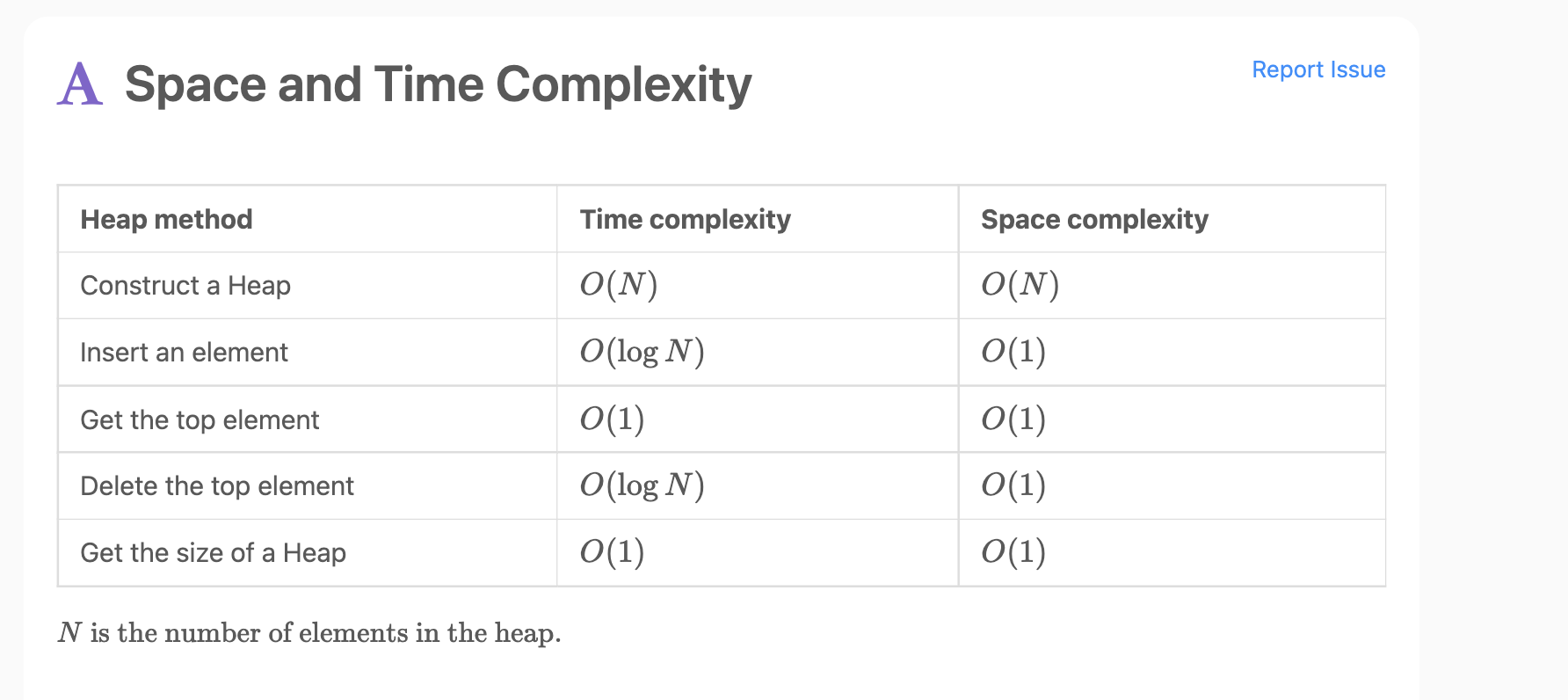
Time Complexity
| Data structure | Search | Insert | Delete | Min/Max |
|---|---|---|---|---|
| Heap | O(n) | O(log n) | O(log n) | O(1) |
Peek of the top element (min for a min-heap / max for a max-heap) is O(1); finding the opposite extreme is O(n). Building a heap from
nexisting items is O(N) via heapify — notO(N log N). Space is O(N).
Overview
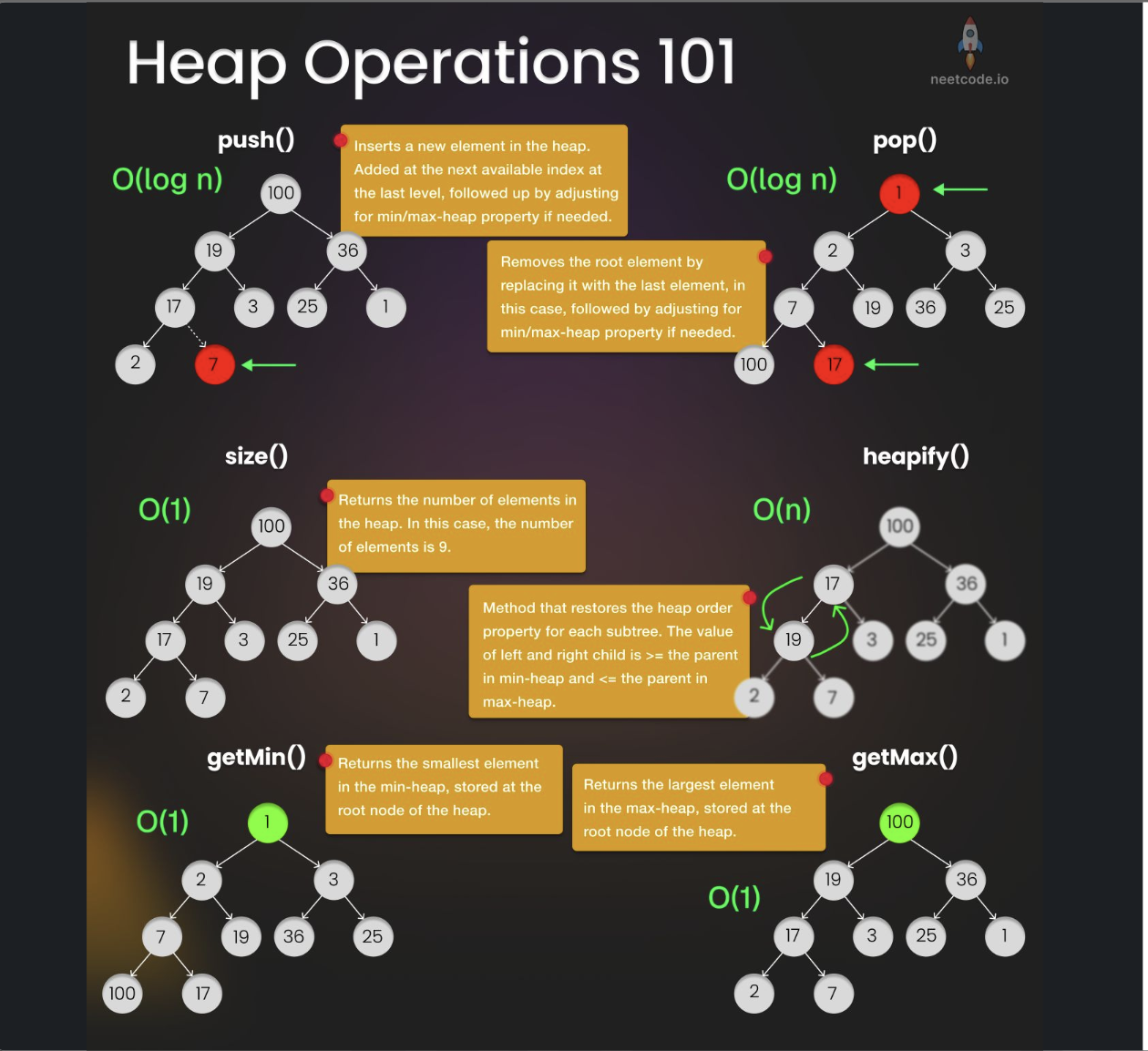
Heap is a complete binary tree that satisfies the heap property, making it ideal for efficient access to the largest or smallest element in a dataset. It’s the foundation for priority queues and heap sort algorithms.
Key Properties
- Complexity: see the Time Complexity table above
- Core Idea: Complete binary tree where parent-child relationship follows heap property
- When to Use: Need frequent access to min/max element, priority scheduling, sorting
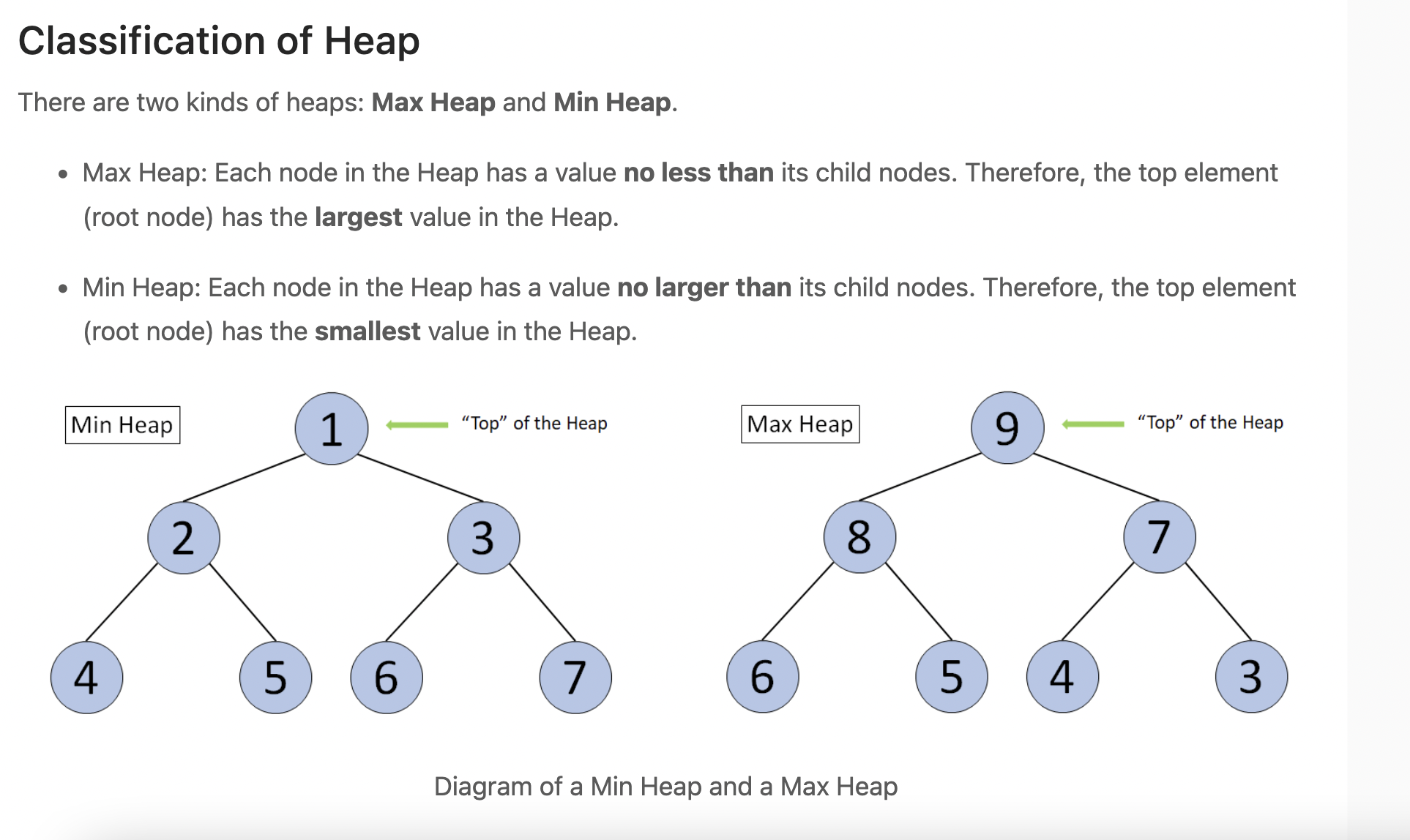
Heap Types
- Min Heap: Parent ≤ Children (root contains minimum)
- Max Heap: Parent ≥ Children (root contains maximum)
Priority Queue Relationship
- Priority Queue: Abstract data type with priority-based access
- Heap: Common implementation of priority queue
- Key Difference: Priority Queue is concept, Heap is implementation
Implementation
- Usually implemented using Binary Heap (min-heap or max-heap)
- Can also use balanced BST or Fibonacci heap for advanced operations
- Python:
heapqmodule (min-heap by default) - Java:
PriorityQueueclass (min-heap by default)
Problem Categories
Pattern 1: Kth Element Problems
- Description: Find the kth largest/smallest element in a dataset
- Examples: LC 215, 703, 1492 - Kth Largest Element, Kth Largest in Stream, Kth Factor
- Pattern: Use min/max heap of size k, maintain heap property
Pattern 2: Top K Problems
- Description: Find top k elements with highest/lowest frequency or value, or make frequencies unique
- Examples:
- Top K: LC 347, 692, 973 - Top K Frequent Elements, Top K Words, K Closest Points
- Frequency Uniqueness: LC 1647, 1481 - Make Frequencies Unique, Least Unique After K Removals
- Pattern: Count frequency, use heap to maintain top k results or ensure unique frequencies
Pattern 3: Merge Problems
- Description: Merge multiple sorted arrays/lists efficiently
- Examples: LC 23, 373, 378 - Merge k Lists, K Smallest Pairs, Kth Smallest in Matrix
- Pattern: Use min heap to track current minimum from each source
Pattern 4: Sliding Window Extrema
- Description: Find min/max in sliding windows efficiently
- Examples: LC 239, 480, 1438 - Sliding Window Maximum, Sliding Median, Longest Subarray
- Pattern: Use heap with lazy deletion or deque for extrema tracking
Pattern 5: Scheduling Problems
- Description: Schedule tasks or events based on priority/timing
- Examples: LC 1353, 502, 630, 621, 1834 - Max Events, IPO, Course Schedule III, Task Scheduler, Single-Threaded CPU
- Pattern: Use heap to maintain events by start/end time or priority
- Key Insight (time sweep + deadline heap): sort by window start so items enter the heap in time order; heap by window end so each time slot serves the most urgent (earliest deadline) item; lazy-delete expired tops
- Signature: “one item per unit of time” + “each item has a validity window / deadline” → see heap_examples.md § LC 1353
- Trap: do not reuse the LC 253 counting sweep. There
[1,3]occupies days 1–3; here it costs one day chosen from{1,2,3}, capped at one event per day — so max-overlap over-counts ([[1,1],[1,1],[1,1]]→ sweep 3, answer 1). See heap_examples.md § LC 1353
Pattern 6: Data Stream Problems
- Description: Handle continuous data stream with min/max queries
- Examples: LC 295, 480, 1825 - Find Median, Sliding Median, Finding MK Average
- Pattern: Use two heaps (min + max) to maintain balanced structure
Pattern 7: Grid Shortest Path with Range Jumps
- Description: Find shortest path in grid where each cell can jump to a range of cells
- Examples: LC 2617 - Minimum Number of Visited Cells in a Grid
- Pattern: DP + Per-row/column PQs with lazy deletion
- Key Insight: Standard BFS is O(N²) per cell; PQ reduces to O(log N) per cell
- Similar: LC 778 (Swim in Rising Water), LC 1631 (Path With Minimum Effort)
Pattern 8: Lazy Deletion (Stale Heap Entries) Priority 5 of 5 — Must know — expect it in almost every loop
- Description: Values in the heap get updated/invalidated, but a binary heap has no “decrease-key” / “remove arbitrary element” op — so we push the new value and leave the old one behind
- Examples: LC 3092, 2349, 1834, 480, 1825, 2336, 621, 1353, 2406
- Pattern: Heap = candidates (may be stale) + HashMap = source of truth → clean the top only at read time, only until the top is valid
- Key Insight: You never search the heap for the stale entry. You only ever check
heap[0], and a stale entry costs at most one pop over the whole run → amortized O(log n) - See: heap_advanced.md § Lazy Deletion · heap_examples.md § LC 3092
- Two extremes at once (LC 2034): mirror the heap — one truth map, a max-heap and a min-heap of
the same
(price, ts)pairs, cleaned with the same test → heap_advanced.md § the LC 2034 variant - Same idea elsewhere: hash-table tombstones, LSM-tree deletes, MVCC dead tuples, Dijkstra’s
d > dist[u]skip → heap_advanced.md § outside the heap
Pattern 9: Sweep Line + Heap of “Alive” Intervals Priority 5 of 5 — Must know — expect it in almost every loop
- Description: Sweep a coordinate; the heap holds every interval currently covering it
- Examples: LC 218 The Skyline Problem, LC 1851 Minimum Interval to Include Each Query
- Pattern: heap of
(value, endCoordinate)→ insert on start, lazy-evict at the top whenend <= pos, readheap[0] - Signature: “at every x, what is the max/min over all intervals covering x?”
- See: heap_advanced.md § Sweep Line
Pattern 10: Bounded “Regret” Heap (k free passes) Priority 4 of 5 — High value — a gap here costs you rounds
- Description: k free resources + a budget for everything else, decided online
- Examples: LC 1642 Furthest Building You Can Reach, LC 1792 Maximum Average Pass Ratio
- Pattern: optimistically give every item a free pass; min-heap capped at k; the evicted (smallest) item is paid from the budget
- Contrast: LC 630 evicts the largest (max-heap replace) — same “commit then regret” idea, opposite comparator
- See: heap_advanced.md § Bounded Regret Heap
Pattern 11: Two Heaps as Resource Pools Priority 4 of 5 — High value — a gap here costs you rounds
- Description: Allocator simulation — not every “two heaps” problem is a median problem
- Examples: LC 1942 Smallest Unoccupied Chair, LC 1606 Find Servers, LC 1801 Orders in Backlog, LC 2073 Process Tasks Using Servers
- Pattern:
free= min-heap by resource id,busy= min-heap by release time → RELEASE → ASSIGN → OCCUPY - See: heap_advanced.md § Resource Pools
Pattern 12: Greedy String/Sequence Building with Constraint Priority 4 of 5 — High value — a gap here costs you rounds
- Description: Build a string/sequence greedily using the most frequent element, but skip it when adding it would violate a constraint (e.g., 3 consecutive same chars). Use a max-heap to always have the current most frequent element ready.
- Examples: LC 1405 (Longest Happy String), LC 767 (Reorganize String), LC 621 (Task Scheduler), LC 358 (Rearrange String k Distance Apart)
- Pattern: Max-heap ordered by count; on each step try the top element — if it violates the constraint, temporarily use the 2nd element, then put the 1st back
- Key Trick: Two-case loop
- Case 1 — constraint violated: poll
second, append it, decrement, re-add if > 0; then re-addfirst(it was NOT consumed) - Case 2 — safe: append
first, decrement, re-add if > 0
- Case 1 — constraint violated: poll
- See: Java Template 7 — the run-length cap (1 vs 2) is what makes LC 767 and LC 1405 differ
Pattern 13: PQ + Cooldown Queue (k-Distance Scheduling) Priority 4 of 5 — High value — a gap here costs you rounds
- Description: Greedily pick the most frequent element from a max-heap, then lock it in a cooldown queue for k steps before it can be reused. This is the canonical pattern for “same element must be at least k distance apart” problems.
- Examples: LC 358 (Rearrange String k Distance Apart), LC 621 (Task Scheduler), LC 767 (Reorganize String — k=2 special case)
- Pattern: Max-heap picks next element; after use, element enters a cooldown queue with
releaseTime = time + k; whentime == releaseTime, element is moved back to the heap - Key Insight: PQ alone cannot track “last used position” — the cooldown queue acts as a k-slot delay line that automatically re-enables elements after k steps
- When to Use:
- Problem says “same element at least k apart” or “cooldown of k”
- Need to greedily pick most frequent available element
- Elements cycle through available → used → cooling → available
- Difference from Pattern 7: Pattern 7 checks a look-back window and swaps elements; Pattern 8 uses an explicit cooldown queue to enforce the distance, which is cleaner for variable k
References
Templates & Algorithms
Template Comparison Table
The canonical templates live here in both languages. The tier-4 specialisations were split out into heap_advanced.md — the right-hand column says where each one went.
| Template | Use case | Complexity | Where |
|---|---|---|---|
| Universal Heap | general min/max access | O(log N) push/pop | below |
| Kth Element | kth largest / smallest | O(N log k) | below |
| Top K Frequency | most / least frequent | O(N log k) | below |
| Merge K Sources | merge sorted arrays / lists | O(N log k) | below |
| Two Heap System | median of a stream | O(log N) per op | below |
| Window Extrema (2 heaps) | variable window needing max and min | O(N log N) | below |
| Interval Scheduling | meeting rooms, one event per day | O(N log N) | below |
| Greedy + Constraint | build a string with no k-in-a-row | O(N log Σ) | below |
| PQ + Cooldown Queue | k-distance / task scheduling | O(N log Σ) | below |
| Graph Shortest Path | Dijkstra with a PQ | O(E log V) | Dijkstra.md |
| Lazy Deletion | pushed values change or expire | O(log N) amortised | heap_advanced.md |
| Sweep + Alive Heap | max/min over intervals covering x | O(N log N) | heap_advanced.md |
| Bounded Regret Heap | k free passes + a budget | O(N log k) | heap_advanced.md |
| Greedy with Regret | undo the worst past decision | O(N log N) | heap_advanced.md |
| Resource Pools (2 heaps) | free-by-id + busy-by-release-time | O(N log N) | heap_advanced.md |
| Sort + Fixed-Size Heap | objective = sum(A) × max/min(B) |
O(N log N) | heap_advanced.md |
| Grid Best-First | expand the cheapest cell | O(MN log MN) | heap_advanced.md |
| Grid Range Jumps | each cell jumps to a range | O(MN log(M+N)) | heap_advanced.md |
| Frequency Uniqueness | make all frequencies distinct | O(N + K log K) | heap_advanced.md |
| Heap + Dedup Set | uniqueness constraint | O(log N) | heap_advanced.md |
Universal Heap Template
def solve_with_heap(nums, k=None):
    import heapq

    # Create heap (min heap by default in Python)
    heap = []

    # Build heap approach 1: Insert elements one by one
    for num in nums:
        heapq.heappush(heap, num)

    # Build heap approach 2: Heapify existing array
    # heapq.heapify(nums)  # O(N) time

    # Access min element (don't remove): heap[0]
    # Remove min element: heapq.heappop(heap)
    # Insert element: heapq.heappush(heap, value)

    # For max heap, use negative values
    # max_heap = [-x for x in nums]
    # heapq.heapify(max_heap)
    # max_val = -max_heap[0]  # Get max without removing
    # max_val = -heapq.heappop(max_heap)  # Remove and get max

    return heap
// Java Universal Template
public class HeapSolution {
    public void solveWithHeap(int[] nums, int k) {
        // Min Heap
        PriorityQueue<Integer> minHeap = new PriorityQueue<>();

        // Max Heap
        PriorityQueue<Integer> maxHeap = new PriorityQueue<>((a, b) -> Integer.compare(b, a));

        // Add elements
        for (int num : nums) {
            minHeap.offer(num);
        }

        // Access min: minHeap.peek()
        // Remove min: minHeap.poll()
        // Add element: minHeap.offer(value)
    }
}
Specific Pattern Templates
1. Kth Element Template
💡 Key Insight:
-
kth smallest element= biggest element from a Max PQ of size k- Use max heap of size k to find kth smallest
- The root (peek) of the max heap is the kth smallest element
- Why? Keep only the k smallest elements; the largest among them is the kth smallest overall
-
kth largest element= smallest element from a Min PQ of size k- Use min heap of size k to find kth largest
- The root (peek) of the min heap is the kth largest element
- Why? Keep only the k largest elements; the smallest among them is the kth largest overall
def find_kth_largest(nums, k):
    import heapq

    # Method 1: Min heap of size k
    heap = []
    for num in nums:
        if len(heap) < k:
            heapq.heappush(heap, num)
        elif num > heap[0]:
            heapq.heapreplace(heap, num)

    return heap[0]  # kth largest

def find_kth_smallest(nums, k):
    import heapq

    # Method 1: Max heap of size k (use negative values)
    heap = []
    for num in nums:
        if len(heap) < k:
            heapq.heappush(heap, -num)
        elif num < -heap[0]:
            heapq.heapreplace(heap, -num)

    return -heap[0]  # kth smallest
Variations of this template (same size-k invariant, only the comparator changes):
| LC | Problem | The twist |
|---|---|---|
| 1985 | Find the Kth Largest Integer in the Array | Elements are numeric strings → default lexicographic order is wrong. Compare by (len, string): longer string = bigger number, equal length falls back to lexicographic. Min-heap of size k, answer = heap[0]. |
| 1337 | The K Weakest Rows in a Matrix | Push the tuple (soldierCount, rowIndex) so ties break by row index; keep a max-heap of size k, then read out. |
# python
# LC 1985 - Find the Kth Largest Integer in the Array
# time = O(N log k), space = O(k)
# IDEA: kth largest -> min-heap of size k; key = (len, s) makes string order == numeric order
import heapq

def kthLargestNumber(nums, k):
    heap = []
    for s in nums:
        heapq.heappush(heap, (len(s), s))
        if len(heap) > k:
            heapq.heappop(heap)
    return heap[0][1]
// java
// LC 1985 - Find the Kth Largest Integer in the Array
// time = O(N log k), space = O(k)
// IDEA: min-heap of size k; comparator = length first, then lexicographic
public String kthLargestNumber(String[] nums, int k) {
    PriorityQueue<String> minHeap = new PriorityQueue<>(
        (a, b) -> a.length() != b.length() ? Integer.compare(a.length(), b.length()) : a.compareTo(b));

    for (String s : nums) {
        minHeap.offer(s);
        if (minHeap.size() > k) minHeap.poll();
    }
    return minHeap.peek();
}
2. Top K Frequency Template
def top_k_frequent(nums, k):
    from collections import Counter
    import heapq

    # Count frequencies
    count = Counter(nums)

    # Method 1: Min heap approach
    heap = []
    for num, freq in count.items():
        heapq.heappush(heap, (freq, num))
        if len(heap) > k:
            heapq.heappop(heap)

    return [item[1] for item in heap]

    # Method 2: Max heap approach
    # heap = [(-freq, num) for num, freq in count.items()]
    # heapq.heapify(heap)
    # return [heapq.heappop(heap)[1] for _ in range(k)]
Variations of this template (count first, then let a heap order the counts):
| LC | Problem | The twist |
|---|---|---|
| 451 | Sort Characters By Frequency | Same Counter + max heap, but you emit char * freq instead of just the key. Bucket sort is the O(N) alternative. |
| 1338 | Reduce Array Size to The Half | Max heap of counts; keep popping and accumulating until removed >= n/2; answer = number of pops. Greedy = always delete the most frequent value. |
| 1405 | Longest Happy String | Max heap on remaining count + a “last used letter” guard — same shape as LC 767 Reorganize String, but the guard allows the same letter twice in a row (aab is legal, aaa is not). |
| 1054 | Distant Barcodes | LC 767 with distance 2: max heap on remaining count, fill even indices first then odd indices. |
3. Merge K Sources Template
def merge_k_sorted_arrays(arrays):
    import heapq

    heap = []
    result = []

    # Initialize heap with first element from each array
    for i, arr in enumerate(arrays):
        if arr:  # Check if array is not empty
            heapq.heappush(heap, (arr[0], i, 0))

    while heap:
        val, array_idx, element_idx = heapq.heappop(heap)
        result.append(val)

        # Add next element from same array
        if element_idx + 1 < len(arrays[array_idx]):
            next_val = arrays[array_idx][element_idx + 1]
            heapq.heappush(heap, (next_val, array_idx, element_idx + 1))

    return result
Variants — merging nested sources (LC 1439) or a virtual grid (LC 373 / 378), plus the LC 632 “smallest covering range” twist: heap_advanced.md § K-Way Merge Variants.
4. Two Heap System Template (Median)
class MedianFinder:
    def __init__(self):
        import heapq
        self.small = []  # max heap (use negative values)
        self.large = []  # min heap

    def addNum(self, num):
        import heapq

        # Add to appropriate heap
        if len(self.small) == len(self.large):
            heapq.heappush(self.large, -heapq.heappushpop(self.small, -num))
        else:
            heapq.heappush(self.small, -heapq.heappushpop(self.large, num))

    def findMedian(self):
        if len(self.small) == len(self.large):
            return (self.large[0] - self.small[0]) / 2.0
        else:
            return float(self.large[0])
5. Sliding Window Extrema — Two Heaps + Index Expiry Priority 4 of 5 — High value — a gap here costs you rounds
Core Idea
A deque gives O(1) sliding-window max, but it only tracks one extreme and only for a fixed-size window. When the window is variable-size or you need max and min at the same time, use two heaps and expire entries by index:
maxHeap = (-value, index)     minHeap = (value, index)
stale  <=>  index < left      (the element has fallen out of the window)
Nothing is ever removed when left advances — entries are dropped only when they reach the top.
Worked example — LC 1438 Longest Continuous Subarray With Absolute Diff ≤ Limit
The window is valid iff max(window) - min(window) <= limit. Keep both heaps; when the window is
invalid, jump left past the older of the two offending extremes (that is the only way to
destroy the violating pair), then lazy-purge both heaps.
# python
# LC 1438 - Longest Continuous Subarray With Absolute Diff Less Than or Equal to Limit
# time = O(N log N), space = O(N)
# IDEA: two heaps hold window max/min; shrink past the older extreme; purge stale indices lazily
import heapq

class Solution(object):
    def longestSubarray(self, nums, limit):
        max_h = []   # max-heap: (-val, idx)
        min_h = []   # min-heap: ( val, idx)
        left = 0
        res = 0

        for i, v in enumerate(nums):
            heapq.heappush(max_h, (-v, i))
            heapq.heappush(min_h, (v, i))

            # window invalid -> must drop at least one of the two extremes
            while -max_h[0][0] - min_h[0][0] > limit:
                # NOTE !!! move left PAST the earlier of the two extreme indices
                left = min(max_h[0][1], min_h[0][1]) + 1
                # lazy delete: anything left of the window is stale
                while max_h[0][1] < left:
                    heapq.heappop(max_h)
                while min_h[0][1] < left:
                    heapq.heappop(min_h)

            res = max(res, i - left + 1)

        return res
// java
// LC 1438 - Longest Continuous Subarray With Absolute Diff Less Than or Equal to Limit
// time = O(N log N), space = O(N)
// IDEA: max-heap + min-heap of {val, idx}; shrink past older extreme; lazy-purge stale indices
public int longestSubarray(int[] nums, int limit) {
    PriorityQueue<int[]> maxH = new PriorityQueue<>((a, b) -> Integer.compare(b[0], a[0]));  // {val, idx}
    PriorityQueue<int[]> minH = new PriorityQueue<>((a, b) -> Integer.compare(a[0], b[0]));

    int left = 0, res = 0;

    for (int i = 0; i < nums.length; i++) {
        maxH.offer(new int[]{nums[i], i});
        minH.offer(new int[]{nums[i], i});

        while (maxH.peek()[0] - minH.peek()[0] > limit) {
            left = Math.min(maxH.peek()[1], minH.peek()[1]) + 1;
            while (maxH.peek()[1] < left) maxH.poll();
            while (minH.peek()[1] < left) minH.poll();
        }

        res = Math.max(res, i - left + 1);
    }
    return res;
}
Shrinking one step at a time — the form most people write first, and also correct: advance
left by 1 and purge after each step, instead of jumping. Same O(N log N) bound — left moves at
most N times in total — it just loops more.
# python
# LC 1438 - shrink form: left += 1 per step, purge stale tops after each step
# time = O(N log N), space = O(N)
            while -max_h[0][0] - min_h[0][0] > limit:
                left += 1
                while max_h[0][1] < left:
                    heapq.heappop(max_h)
                while min_h[0][1] < left:
                    heapq.heappop(min_h)
Pitfalls
- The tops are always fresh when you compare. Every exit from the shrink loop has purged
both tops, and a newly pushed entry is never stale, so a second purge before the
while(right after the two pushes) does nothing. It is harmless, not needed. - The purge loops need no
heap andguard. The entry just pushed has indexright >= left, so neither heap can empty while purging. - Purge both heaps, not only the one whose top moved. After the jump, the other heap’s
top can also sit left of the new
left.
Heap vs monotonic deque: LC 1438 also has an O(N) two-deque solution — monotonic_queue.md → Template 7. Use the heap version when the eviction rule is not “oldest first” (e.g. you evict by value or by an arbitrary predicate) — a monotonic deque cannot express that.
Variations of this template (same “max-heap + expire by index/coordinate” shape):
| LC | Problem | The twist |
|---|---|---|
| 1696 | Jump Game VI | dp[i] = nums[i] + max(dp[j]) for i-k <= j < i. Max-heap of (dp[j], j); before reading, pop while j < i-k. The heap holds DP values, not raw input. |
| 1499 | Max Value of Equation | Rewrite `y_i + y_j + |
Java Template Library (PriorityQueue)
The 5 templates above are Python-first. The 8 below are the same problem space written against Java’s
PriorityQueue. They were previously a separatepriority_queue.md; the table pairs each Java template with its Python counterpart so you can read either side.
| Java template (below) | Python counterpart (above) | Anchor problem |
|---|---|---|
| Template 1: Top K Elements | 1. Kth Element Template | LC 215 |
| Template 2: K-Way Merge | 3. Merge K Sources Template | LC 23 |
| Template 3: Two Heaps (Median) | 4. Two Heap System Template | LC 295 |
| Template 4: Interval Scheduling | (no Python counterpart here — see the LC 1353 pointer below) | LC 253 |
| Template 5: Graph Shortest Path | — see Dijkstra.md | LC 743 |
| Template 6: Custom Priority | 2. Top K Frequency Template | LC 347 |
| Template 7: Greedy String Building | (no Python counterpart) | LC 1405 |
| Template 8: PQ + Cooldown Queue | (no Python counterpart) | LC 358 |
Java Template Comparison Table
| Template Type | Use Case | Heap Type | Complexity | When to Use |
|---|---|---|---|---|
| Top K Elements | Find K largest/smallest | Min/Max heap | O(n log k) | Fixed K selection |
| K-Way Merge | Merge sorted lists | Min heap | O(n log k) | Multiple sorted sources |
| Two Heaps | Find median | Min + Max heap | O(log n) | Stream median/percentile |
| Interval Scheduling | Process intervals | Min heap | O(n log n) | Meeting rooms, events |
| Graph Shortest Path | Dijkstra’s | Min heap | O(E log V) | Weighted graphs |
| Custom Priority | Complex ordering | Custom comparator | O(log n) | Multi-criteria sorting |
| Greedy + Constraint | Build string avoiding consecutive repeats | Max heap | O(n log k) | Reorganize/happy string |
| PQ + Cooldown Queue | k-distance apart scheduling | Max heap + Queue | O(n log k) | Rearrange k-dist, task scheduler |
Template 1: Top K Elements Pattern — LC 215
# Python - Find K largest elements
def topKElements(nums, k):
    import heapq

    # Min heap of size k for k largest
    min_heap = []

    for num in nums:
        heapq.heappush(min_heap, num)
        if len(min_heap) > k:
            heapq.heappop(min_heap)

    return min_heap  # Contains k largest elements

# With custom key for frequency
def topKFrequent(nums, k):
    from collections import Counter
    import heapq

    count = Counter(nums)
    # Use negative count for max heap effect
    return heapq.nlargest(k, count.keys(), key=count.get)
// Java - Top K elements with frequency
public int[] topKFrequent(int[] nums, int k) {
    Map<Integer, Integer> map = new HashMap<>();
    for (int n : nums) {
        map.put(n, map.getOrDefault(n, 0) + 1);
    }

    // Min heap based on frequency
    PriorityQueue<Integer> pq = new PriorityQueue<>(
        (a, b) -> Integer.compare(map.get(a), map.get(b))
    );

    for (int key : map.keySet()) {
        pq.add(key);
        if (pq.size() > k) {
            pq.poll();
        }
    }

    int[] result = new int[k];
    for (int i = k - 1; i >= 0; i--) {
        result[i] = pq.poll();
    }
    return result;
}
Template 2: K-Way Merge Pattern — LC 23
# Python - Merge K sorted lists
def mergeKSortedLists(lists):
    import heapq

    min_heap = []

    # Initialize with first element from each list
    for i, lst in enumerate(lists):
        if lst:
            heapq.heappush(min_heap, (lst[0], i, 0))

    result = []
    while min_heap:
        val, list_idx, elem_idx = heapq.heappop(min_heap)
        result.append(val)

        # Add next element from same list
        if elem_idx + 1 < len(lists[list_idx]):
            next_val = lists[list_idx][elem_idx + 1]
            heapq.heappush(min_heap, (next_val, list_idx, elem_idx + 1))

    return result
// Java - Merge K sorted arrays
public int[] mergeKSortedArrays(int[][] arrays) {
    PriorityQueue<int[]> pq = new PriorityQueue<>(
        (a, b) -> Integer.compare(a[0], b[0])  // Compare values
    );

    int totalSize = 0;
    // Initialize PQ with first element from each array
    for (int i = 0; i < arrays.length; i++) {
        if (arrays[i].length > 0) {
            pq.offer(new int[]{arrays[i][0], i, 0});
            totalSize += arrays[i].length;
        }
    }

    int[] result = new int[totalSize];
    int idx = 0;

    while (!pq.isEmpty()) {
        int[] curr = pq.poll();
        result[idx++] = curr[0];

        int arrIdx = curr[1];
        int elemIdx = curr[2];

        if (elemIdx + 1 < arrays[arrIdx].length) {
            pq.offer(new int[]{
                arrays[arrIdx][elemIdx + 1],
                arrIdx,
                elemIdx + 1
            });
        }
    }

    return result;
}
Variants of this skeleton (LC 632, 355, 373, 378, 1439): heap_advanced.md § K-Way Merge Variants.
Template 3: Two Heaps Pattern (Median Finding) — LC 295
Python side: 4. Two Heap System Template above — the same two-heap invariant, written with
heappushpopinstead of an explicit rebalance.
// Java - Two heaps for median
class MedianFinder {
    private PriorityQueue<Integer> small;  // Max heap
    private PriorityQueue<Integer> large;  // Min heap

    public MedianFinder() {
        small = new PriorityQueue<>(Collections.reverseOrder());
        large = new PriorityQueue<>();
    }

    public void addNum(int num) {
        small.offer(num);

        // Balance property
        if (!small.isEmpty() && !large.isEmpty() &&
            small.peek() > large.peek()) {
            large.offer(small.poll());
        }

        // Size property
        if (small.size() > large.size() + 1) {
            large.offer(small.poll());
        }
        if (large.size() > small.size() + 1) {
            small.offer(large.poll());
        }
    }

    public double findMedian() {
        if (small.size() > large.size()) {
            return small.peek();
        }
        if (large.size() > small.size()) {
            return large.peek();
        }
        return (small.peek() + large.peek()) / 2.0;
    }
}
Template 4: Interval Scheduling Pattern — LC 253
# Python - Meeting rooms (minimum rooms needed)
def minMeetingRooms(intervals):
    import heapq

    if not intervals:
        return 0

    # Sort by start time
    intervals.sort(key=lambda x: x[0])

    # Min heap to track end times
    heap = []
    heapq.heappush(heap, intervals[0][1])

    for i in range(1, len(intervals)):
        # If current meeting starts after earliest end
        if intervals[i][0] >= heap[0]:
            heapq.heappop(heap)

        # Add current meeting end time
        heapq.heappush(heap, intervals[i][1])

    return len(heap)
// Java - Interval scheduling
public int minMeetingRooms(int[][] intervals) {
    if (intervals.length == 0) return 0;

    // Sort by start time
    Arrays.sort(intervals, (a, b) -> Integer.compare(a[0], b[0]));

    // Min heap for end times
    PriorityQueue<Integer> pq = new PriorityQueue<>();
    pq.offer(intervals[0][1]);

    for (int i = 1; i < intervals.length; i++) {
        // Room becomes free
        if (intervals[i][0] >= pq.peek()) {
            pq.poll();
        }
        pq.offer(intervals[i][1]);
    }

    return pq.size();
}
Variation: Maximum Number of Events That Can Be Attended (LC 1353) — twist: the heap holds end days of currently-open events and you sweep day by day (not interval by interval), attending the event that ends soonest each day. LC 253 counts concurrent intervals; LC 1353 picks one per day greedily. The two are not variants of one sweep: LC 253’s interval occupies its whole span, LC 1353’s costs a single day anywhere inside it, so counting overlaps here over-counts.
// java
// LC 1353 - Maximum Number of Events That Can Be Attended
// IDEA: sort by start day; each day push all events that opened, drop expired ones,
//       then attend the one with the earliest end day (min-heap)
// time = O(n log n), space = O(n)
public int maxEvents(int[][] events) {
    Arrays.sort(events, (a, b) -> Integer.compare(a[0], b[0]));
    PriorityQueue<Integer> pq = new PriorityQueue<>();   // end days of open events
    int i = 0, n = events.length, res = 0, day = 0;

    while (i < n || !pq.isEmpty()) {
        // idle -> jump to the next start day, otherwise advance one day
        day = pq.isEmpty() ? events[i][0] : day + 1;

        while (i < n && events[i][0] <= day) pq.offer(events[i++][1]);   // now open
        while (!pq.isEmpty() && pq.peek() < day) pq.poll();              // expired

        if (!pq.isEmpty()) { pq.poll(); res++; }   // attend earliest-ending event
    }
    return res;
}
Python side of LC 1353, with the day-jumping vs scan-every-day trade-off written out: heap_examples.md § LC 1353.
Template 5: Graph Shortest Path (Dijkstra) — LC 743
Owned by Dijkstra.md. The PQ is just (distance, node) guarded by a
lazy-deletion if d > dist[u]: continue; nothing heap-specific is added by repeating it here.
Template 6: Custom Priority Pattern
# Python - Custom priority with multiple criteria
class Task:
    def __init__(self, name, priority, deadline):
        self.name = name
        self.priority = priority
        self.deadline = deadline

    def __lt__(self, other):
        # Higher priority first, then earlier deadline
        if self.priority != other.priority:
            return self.priority > other.priority
        return self.deadline < other.deadline

def processTasks(tasks):
    import heapq

    heap = []
    for task in tasks:
        heapq.heappush(heap, task)

    result = []
    while heap:
        task = heapq.heappop(heap)
        result.append(task.name)

    return result
// Java - Custom comparator for complex ordering
class Task {
    String name;
    int priority;
    int deadline;

    Task(String name, int priority, int deadline) {
        this.name = name;
        this.priority = priority;
        this.deadline = deadline;
    }
}

public List<String> processTasks(List<Task> tasks) {
    PriorityQueue<Task> pq = new PriorityQueue<>((a, b) -> {
        // Higher priority first
        if (a.priority != b.priority) {
            return Integer.compare(b.priority, a.priority);
        }
        // Earlier deadline first
        return Integer.compare(a.deadline, b.deadline);
    });

    for (Task task : tasks) {
        pq.offer(task);
    }

    List<String> result = new ArrayList<>();
    while (!pq.isEmpty()) {
        result.add(pq.poll().name);
    }

    return result;
}
Template 7: Greedy String Building with Consecutive Constraint — LC 1405
// Java - Longest Happy String (LC 1405) / Reorganize String (LC 767)
// IDEA: Max-heap by count; two-case loop:
//   Case 1: top char would create 3 consecutive → use 2nd, put 1st back
//   Case 2: safe → use top char directly
// time = O((a+b+c) * log(3)) = O(n), space = O(1) heap size bounded by alphabet

class ValCnt {
    char val;
    int cnt;
    ValCnt(char val, int cnt) { this.val = val; this.cnt = cnt; }
}

public String longestDiverseString(int a, int b, int c) {
    PriorityQueue<ValCnt> pq = new PriorityQueue<>((x, y) -> Integer.compare(y.cnt, x.cnt));
    if (a > 0) pq.add(new ValCnt('a', a));
    if (b > 0) pq.add(new ValCnt('b', b));
    if (c > 0) pq.add(new ValCnt('c', c));

    StringBuilder sb = new StringBuilder();

    while (!pq.isEmpty()) {
        ValCnt first = pq.poll();
        int len = sb.length();

        // Case 1: adding `first` would create 3 consecutive → use second instead
        if (len >= 2
                && sb.charAt(len - 1) == first.val
                && sb.charAt(len - 2) == first.val) {

            if (pq.isEmpty()) break;          // no alternative → stop

            ValCnt second = pq.poll();        // use 2nd most frequent
            sb.append(second.val);
            second.cnt--;

            if (second.cnt > 0) pq.add(second);
            pq.add(first);                    // first was NOT used, put it back

        // Case 2: safe to use the most frequent character
        } else {
            sb.append(first.val);
            first.cnt--;
            if (first.cnt > 0) pq.add(first);
        }
    }

    return sb.toString();
}
Key Observations:
- Always greedily pick the most frequent (max-heap ensures this).
- When the constraint is about to be violated, temporarily skip the top element and use the next — then put the top back unchanged.
firstis only consumed in Case 2; in Case 1 it is re-inserted untouched.- Works for any “at most K consecutive” constraint by changing the look-back window check.
Variant: Reorganize String (LC 767) — at most 1 consecutive
// Only Case 1 check changes: len >= 1 && sb.charAt(len-1) == first.val
// Everything else is identical to the template above.
Template 8: PQ + Cooldown Queue (k-Distance Scheduling) — LC 358
// Java - Rearrange String k Distance Apart (LC 358)
// IDEA: Max-heap picks most frequent available char;
//       cooldown queue locks used chars for k steps.
//
// Flow: PQ → poll → append → cooldown.offer([char, releaseTime])
//       when time == releaseTime → move back to PQ
//
// time = O(n log 26) = O(n), space = O(26) = O(1)

public String rearrangeString(String s, int k) {
    if (k <= 1) return s;

    int[] freq = new int[26];
    for (char c : s.toCharArray()) {
        freq[c - 'a']++;
    }

    // Max-heap ordered by remaining frequency
    PriorityQueue<Integer> pq = new PriorityQueue<>((a, b) -> Integer.compare(freq[b], freq[a]));
    for (int i = 0; i < 26; i++) {
        if (freq[i] > 0) pq.offer(i);
    }

    // Cooldown queue: [charIndex, remainingCount]
    // Size reaches k → front element has cooled for k steps → re-enable
    Queue<int[]> cooldown = new LinkedList<>();
    StringBuilder res = new StringBuilder();

    while (!pq.isEmpty()) {
        int idx = pq.poll();
        res.append((char) ('a' + idx));
        freq[idx]--;

        // Enter cooldown with current remaining count
        cooldown.offer(new int[]{idx, freq[idx]});

        // Release from cooldown after k steps
        if (cooldown.size() == k) {
            int[] ready = cooldown.poll();
            if (ready[1] > 0) {
                pq.offer(ready[0]);  // re-add to heap
            }
        }
    }

    return res.length() == s.length() ? res.toString() : "";
}
Key Observations:
- The cooldown queue acts as a fixed-size delay line of length k. When its size reaches k, the oldest entry has waited exactly k steps and is ready.
- If
pqis empty butcooldownstill has entries → impossible to place anything → return"". - Alternative cooldown approach: store
[char, releaseTime]and checkcooldown.peek()[1] == timeinstead of checking queue size. Both are equivalent. - This pattern generalizes: LC 621 (Task Scheduler) uses the same idea but counts idle slots; LC 767 is k=2 special case.
Comparison: Cooldown Queue vs Skip-and-Swap (Template 7)
| Aspect | Cooldown Queue (Template 8) | Skip-and-Swap (Template 7) |
|---|---|---|
| Best for | Variable k, large k | Small k (k=2 or k=3) |
| Mechanism | Explicit queue delays re-entry | Look-back window + swap |
| Impossible detection | pq.isEmpty() while cooldown non-empty |
N/A (stops when no option) |
| Cleaner for | LC 358, LC 621 | LC 1405, LC 767 |
Language APIs
Full reference — every heapq call with its output, the peek rules, the partial-order traps:
heap_language_apis.md.
| What you need | Python heapq |
Java PriorityQueue |
|---|---|---|
| Min-heap | h = [] |
new PriorityQueue<>() |
| Max-heap | push negated keys: heappush(h, -v) |
new PriorityQueue<>(Collections.reverseOrder()) |
| Build from a list — O(N), not O(N log N) | heapq.heapify(lst) |
new PriorityQueue<>(collection) |
| Push | heapq.heappush(h, v) |
pq.offer(v) |
| Pop top | heapq.heappop(h) |
pq.poll() |
| Peek top — O(1) | h[0] — there is no peek() |
pq.peek() |
| Pop then push (one sift) | heapq.heapreplace(h, v) |
pq.poll(); pq.offer(v); |
| Push then pop (one sift) | heapq.heappushpop(h, v) |
pq.offer(v); pq.poll(); |
| Top k largest / smallest | heapq.nlargest(k, it) / nsmallest |
size-k min-/max-heap, then drain |
| Empty check | if h: |
pq.isEmpty() |
| Custom order | tuple keys, or __lt__ on the class |
comparator lambda |
Three rules that prevent most heap bugs
- Only index
0is meaningful.h[1],h[-1], and iterating a JavaPriorityQueueall give partial order, not sorted order. - Comparators use
Integer.compare(a, b)/Long.compare(a, b), nevera - b— subtraction overflows on large or negative values. - Guard the empty case.
h[0]raisesIndexError; Java’speek()returnsnullwhileelement()throws. In awhilecondition put the emptiness test first so it short-circuits.
# python
# the size-k idiom, written once
import heapq

def k_largest(nums, k):                 # time = O(N log k), space = O(k)
    h = []
    for v in nums:
        if len(h) < k:
            heapq.heappush(h, v)
        elif v > h[0]:                  # peek, then replace in one sift
            heapq.heapreplace(h, v)
    return h                            # h[0] == the kth largest

def k_smallest(nums, k):                # max-heap = negate on the way in and out
    h = []
    for v in nums:
        heapq.heappush(h, -v)
        if len(h) > k:
            heapq.heappop(h)
    return [-x for x in h]              # -h[0] == the kth smallest
Summary & Quick Reference
Decision Table — Which Heap Pattern?
Read top to bottom; the first row that matches is the pattern.
| If the problem says… | Reach for | Heap shape | Classic LC |
|---|---|---|---|
| “kth largest” / “kth smallest” | Kth Element | size-k min-heap for kth largest; size-k max-heap for kth smallest | 215, 703, 378, 1492, 1985, 1337 |
| “top k frequent” / “k closest” | Top K Frequency | Counter → size-k heap on the count / distance |
347, 692, 973, 658, 451, 1338, 1054 |
| “merge k sorted …” / a sorted grid | Merge K Sources | min-heap of (value, sourceIdx, elemIdx) |
23, 373, 378, 632, 786, 1439 |
| “median” / “balanced halves” of a stream | Two Heap System | max-heap of the small half + min-heap of the large half, sizes within 1 | 295, 480, 1825 |
| variable-size window needing max and min | Window Extrema (2 heaps) | two heaps of (value, index), stale iff index < left |
1438, 1696, 1499 |
| “minimum rooms / groups” — count overlaps | Interval Scheduling | sort by start, min-heap of end times, heap size = answer | 253, 2406, 1094 |
| “one item per unit of time” + a deadline | Interval Scheduling (day sweep) | sort by start, min-heap of end days, attend the earliest deadline | 1353, 1834, 1705 |
| “no k identical in a row” / “k apart” | Greedy + Constraint, or PQ + Cooldown Queue | max-heap on remaining count (+ a k-slot delay line) | 1405, 767, 621, 358, 1054 |
| weighted shortest path on a graph | Dijkstra — Dijkstra.md | min-heap of (distance, node) |
743, 787, 1514, 1631 |
| a pushed value later changes or expires | Lazy Deletion — heap_advanced.md | heap of candidates + hashmap of truth; clean the top at read time | 3092, 2349, 2034, 480, 1825, 239 |
| “at every x, the max over all intervals covering x” | Sweep + Alive Heap — heap_advanced.md | max-heap of (value, end), evict when end <= x |
218, 1851 |
| “k ladders / k free upgrades” + a budget | Bounded Regret Heap — heap_advanced.md | min-heap capped at k; the evicted smallest is paid for | 1642, 1792 |
| you only discover you overcommitted later | Greedy with Regret — heap_advanced.md | take everything, then poll() the worst decision |
871, 630, 502 |
| “smallest free chair / server / seat” | Resource Pools — heap_advanced.md | free-by-id heap + busy-by-release-time heap | 1942, 1606, 1801, 2073, 2102 |
objective is sum(A) × max/min(B) |
Sort + Fixed-Size Heap — heap_advanced.md | sort by B, size-k heap over A | 857, 1383 |
| a grid where cost is minimax or accumulated | Grid Best-First — heap_advanced.md | min-heap seeded from a boundary, expand the cheapest | 407, 778, 1631, 1368, 675 |
| each grid cell jumps to a range of cells | Grid Range Jumps — heap_advanced.md | one PQ per row + one per column, lazy pop | 2617 |
| “make all frequencies unique” | Frequency Uniqueness — heap_advanced.md | max-heap decrement, or a used-frequency set | 1647, 1481 |
| fixed-size window, only the max needed | not a heap — monotonic_queue.md | monotonic deque, O(1) amortised | 239, 1425 |
| a one-off kth element, no updates | not a heap — quickselect, O(N) average | — | 215 |
Complexity Quick Reference
| Operation | Binary heap | Sorted array | Balanced BST |
|---|---|---|---|
| Build from n items | O(n) (heapify) | O(n log n) | O(n log n) |
| Insert | O(log n) | O(n) | O(log n) |
| Delete min/max | O(log n) | O(1) | O(log n) |
| Peek min/max | O(1) | O(1) | O(log n) |
| Search / delete arbitrary | O(n) | O(log n) / O(n) | O(log n) |
| Merge two structures | O(n + m) | O(n + m) | O(n + m) |
| Space | O(n) | O(n) | O(n) |
Consequences worth stating out loud in an interview:
- No decrease-key, no remove-arbitrary. Everything in heap_advanced.md exists to work around that.
- A size-k heap turns
O(N log N)intoO(N log k)andO(N)space intoO(k). - The opposite extreme is O(n): a min-heap tells you nothing cheap about its maximum.
Common Patterns & Tricks
Max Heap in Python (Using Negation)
import heapq

# Create max heap by negating values
max_heap = [-x for x in nums]
heapq.heapify(max_heap)

# Insert into max heap
heapq.heappush(max_heap, -val)

# Get max value (remember to negate back)
max_val = -max_heap[0]  # peek
max_val = -heapq.heappop(max_heap)  # pop
Heap with Custom Objects
# Method 1: Using tuples (automatic comparison)
heap = []
heapq.heappush(heap, (priority, data))

# Method 2: Using custom class with __lt__
class Task:
    def __init__(self, priority, data):
        self.priority = priority
        self.data = data

    def __lt__(self, other):
        return self.priority < other.priority

heap = []
heapq.heappush(heap, Task(1, "high priority"))
Tie-Breaking
# python
# a heap of (key, payload) compares the payload when keys tie -> unorderable types crash.
# push a monotone counter as the second element so the comparison never reaches the payload.
import heapq, itertools

counter = itertools.count()
heapq.heappush(pq, (priority, next(counter), payload))   # FIFO among equal priorities
Common Mistakes & Tips
🚫 Common Mistakes
- Wrong heap direction. Min-heap of size k for “kth largest”; max-heap of size k for “kth smallest”. Say the invariant out loud before coding: “the heap holds the k largest seen so far, so its top is the answer.”
- Forgetting to negate back when faking a max-heap in Python — negate on push and on read.
- Letting the heap grow unbounded in a kth-element problem: pop as soon as
len(h) > k, or you have paidO(N log N)for nothing. - Unbalanced two-heap system. Re-establish
|len(small) - len(large)| <= 1after every insertion, not just when the median is read. a - bcomparators in Java — overflows. UseInteger.compare/Long.compare.- Cleaning stale entries at write time. Lazy deletion cleans the top, at read time,
with a
while(several stale entries can stack up) and an emptiness guard. - Reading
h[1]/h[-1]expecting the 2nd smallest or the largest. A heap is only partially ordered.
✅ Best Practices
heapifyan existing list — O(N) beats N × O(log N).- Use
heapreplace/heappushpopwhen you were going to replace the top anyway (one sift). - Push a tuple whose first element is the ordering key; add a counter to break ties.
- Consider the alternative first: sorting for static data, quickselect for a one-off kth,
a monotonic deque for a fixed-size window, a
TreeMap/SortedListwhen you truly need arbitrary deletion. - Test
k == 1,k == n, an empty input, and all-equal elements.
Interview Tips
- Ask first: duplicates allowed? can
k > n? stream or static? do values get updated? - Name the pattern from the decision table above, then state the heap’s invariant — that one sentence is what the interviewer is listening for.
- State complexity in terms of k, not just n:
O(N log k)time,O(k)space is the whole reason a heap beats sorting. - Expect the follow-ups: “what if the values change?” (lazy deletion), “what if the window is fixed?” (monotonic deque), “what if you need the kth element repeatedly?” (keep the heap).
Related Topics
- Dijkstra.md — the canonical PQ algorithm; its
if d > dist[u]: continueis a lazy delete - monotonic_queue.md — the O(1) alternative for fixed-size window extrema
- sort.md — heap sort, and when sorting beats a heap
- streaming_algorithms.md — top-k over an unbounded stream
- greedy.md — the exchange arguments that make the regret patterns correct
- intervals.md / scanning_line.md — the non-heap half of the interval-scheduling family
Language-Specific Notes
- Python
heapq— min-heap only; negate for a max-heap;heappush,heappop,heapify,heapreplace,heappushpop,nlargest,nsmallest,merge. - Java
PriorityQueue— min-heap by default;new PriorityQueue<>(Collections.reverseOrder())or a comparator built fromInteger.comparefor a max-heap;offer,poll,peek,size. - C++
priority_queue— max-heap by default; usepriority_queue<int, vector<int>, greater<int>>for a min-heap.