滑動視窗
範圍 — 依條件伸縮的視窗 — 固定大小、可變大小、至多 k 個,以及用相減湊出的恰好 k 個;擴張/收縮迴圈與七個標準視窗模板都歸這裡管。 另見 — 從本檔拆出:sliding_window_examples.md — LC 實作解法庫,每題每種語言一份標準解;sliding_window_advanced.md — 雙端佇列求極值、至多 K 的通用化、超出單一題目的恰好 K、補集/單字層級/分桶視窗。 相鄰文件:2_pointers.md — 相向逼近而非一前一後的指標;hash_map.md — 多數視窗都會帶著的計數表;monotonic_queue.md — 用 O(n) 求視窗極值;prefix_sum.md — 視窗內可能有負值時該去的地方。
LeetCode 題目清單
總覽
滑動視窗用兩個指標在陣列或字串上維護一個「視窗」,靠擴張與收縮有效率地找出最佳解。
關鍵性質
- 時間複雜度:O(n) — 每個元素最多被走訪兩次
- 空間複雜度:指標本身 O(1),視窗狀態 O(k)
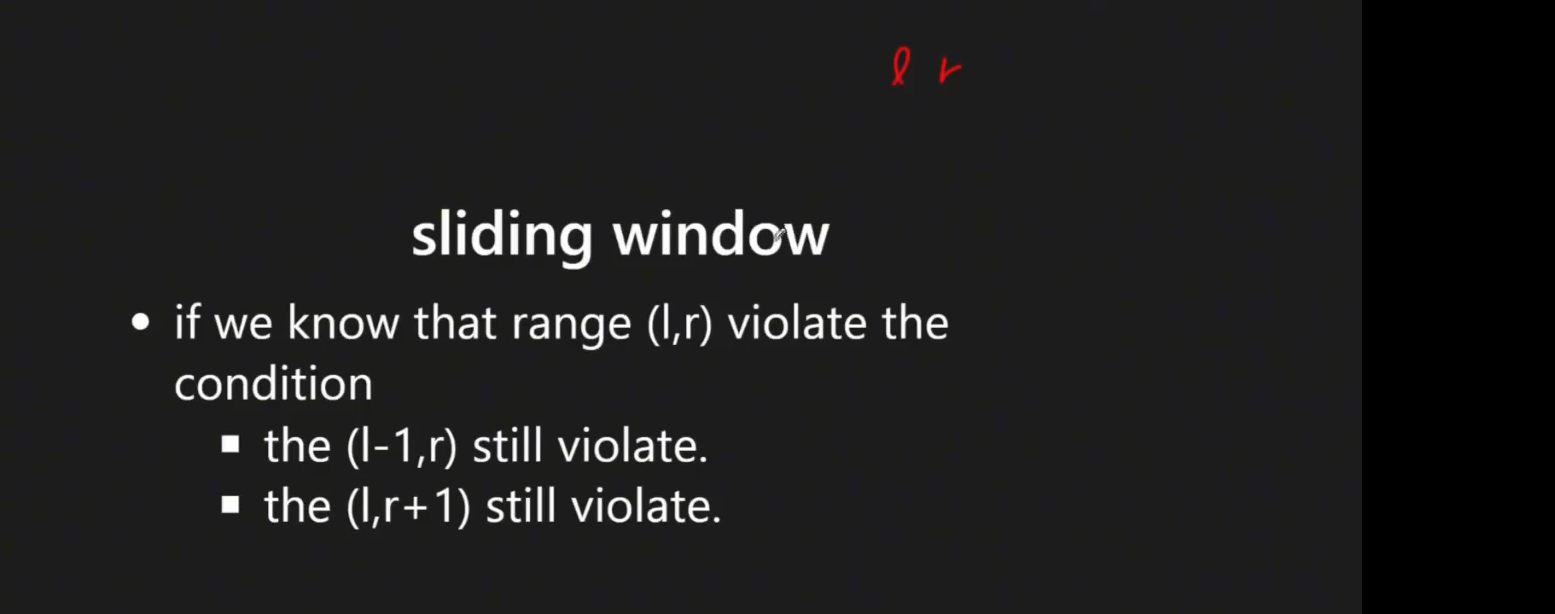
- 核心想法:維護一個在資料結構上滑動的視窗 [left, right]
- 兩個階段:
- 擴張:右指標往前,把視窗撐大
- 收縮:視窗不合法時,左指標往前縮小視窗
什麼時候用滑動視窗
- 子陣列/子字串題:找出具有特定性質的最佳子陣列
- 視窗型限制:牽涉到固定或可變視窗大小的題目
- 最佳化:在限制條件下求最小/最大長度、數量或總和
- 字元/元素追蹤:需要統計出現次數的題目
參考資料
題型分類
核心組成
- 雙指標:用
left和right界定視窗邊界 - 迴圈結構:
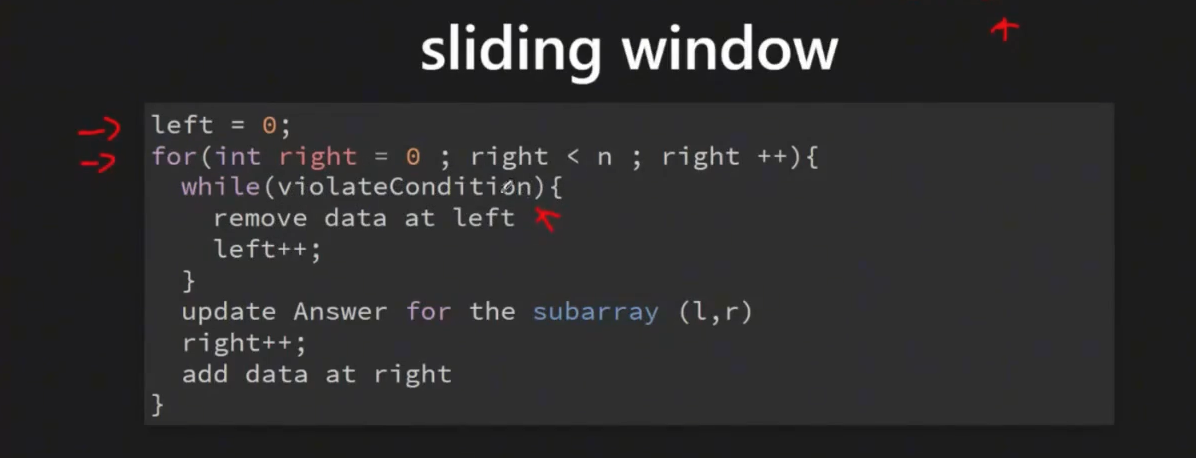
while-while:外層擴張,內層收縮for-while:for 負責擴張,while 負責收縮- 關鍵洞見:第一層迴圈找出可行解,第二層迴圈把它優化成最佳解
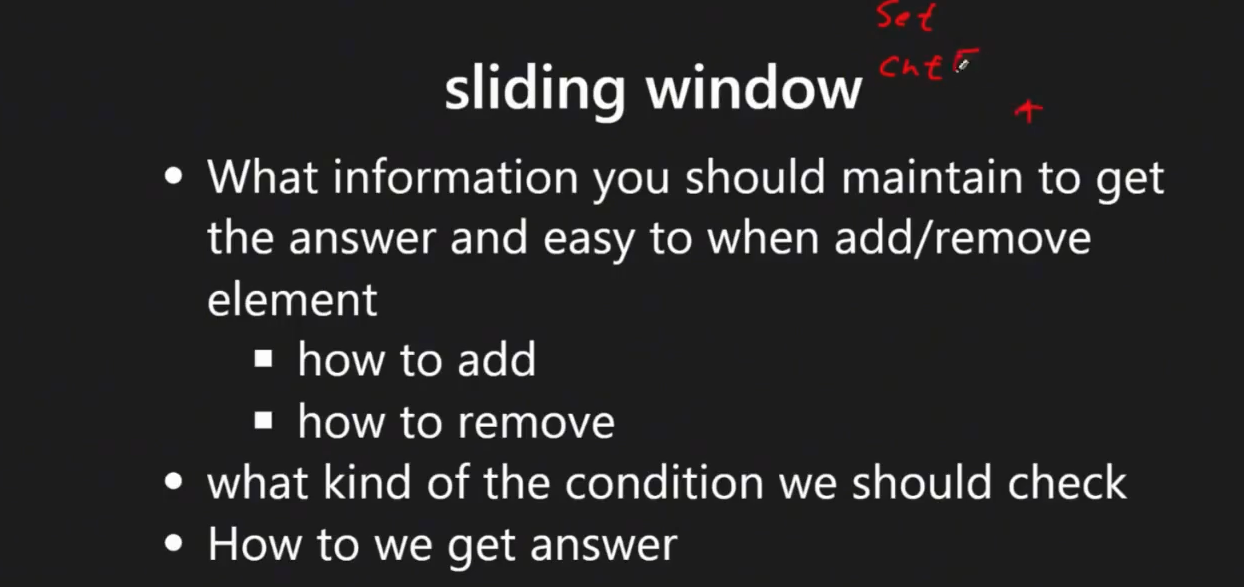
- 視窗狀態:追蹤當前視窗內的元素、次數或總和
- 合法性條件:定義視窗什麼時候合法/不合法
五種視窗型態
固定大小視窗
- 說明:視窗大小事先給定且固定不變
- 範例:LC 438(Find All Anagrams)、LC 567(Permutation in String)
- 模式:維持固定的視窗大小,一次滑動一格
可變大小視窗 — 求最大
- 說明:找出滿足限制的最大視窗
- 範例:LC 3(Longest Substring)、LC 424(Character Replacement)
- 模式:擴張到不合法為止,記錄最大值,然後收縮
可變大小視窗 — 求最小
- 說明:找出滿足限制的最小視窗
- 範例:LC 209(Minimum Subarray Sum)、LC 76(Minimum Window Substring)
- 模式:收縮到不合法為止,記錄最小值,然後擴張
子陣列計數
- 說明:計算符合條件的子陣列/子字串個數
- 範例:LC 713(Subarray Product)、LC 992(Subarrays with K Different)
- 模式:對每個右端點,數出合法的左端點有幾個
字串比對(雜湊式)
- 說明:追蹤視窗內的字元出現次數
- 範例:LC 567(Permutation)、LC 438(Anagrams)、LC 76(Window Substring)
- 模式:用 HashMap/Counter 追蹤字元次數
視窗狀態與輔助工具
- 技巧:雙指標、滑動視窗、次數統計
- 資料結構:HashMap、Counter、Set、陣列
- 輔助工具:Collections.Counter(Python)、HashMap.getOrDefault(Java)
固定大小視窗 vs 可變大小視窗
| 類型 | 什麼時候用 | 收縮條件 | 範例 |
|---|---|---|---|
| 固定大小 k | 題目直接給定視窗大小 | right - left + 1 > k |
LC 567 (Permutation in String) |
| 可變(求最小) | 找最小的合法視窗 | 視窗合法時就收縮 | LC 76 (Min Window Substring) |
| 可變(求最大) | 找最大的合法視窗 | 視窗不合法時才收縮 | LC 3 (Longest No-Repeat) |
| 恰好 K → 至多 K | 統計符合精確限制的視窗數 | 不適用 — 用相減技巧 | LC 992, LC 1248 |
| 可變(求最大),規則定義在每一對/每三個元素上 | 「視窗內沒有 i, j, k 使得 …」 |
新進元素會破壞規則時才收縮 | LC 4067 (Restricted Pair Sums) |
模板與演算法
六個模板涵蓋所有必會的滑動視窗型態,第七個則處理「難的不是迴圈,而是合法性判斷本身」的情況。 模板 2 是第一個要背到能默寫的 — 這個家族裡所有可變大小視窗,都只是換掉它的合法性判斷和結果更新而已。
模板比較表
| # | 模板 | 型態 | 結果更新 | 時間/空間 | 代表題 |
|---|---|---|---|---|---|
| 1 | 固定大小視窗 | for i + 逐出 i - k |
i >= k - 1 時判斷 |
O(n) / O(k) | LC 643, 438, 567 |
| 2 | 先擴後縮(while 不變量) |
for right + while invalid: shrink |
任何合法視窗 | O(n) / O(k) | 3–7 的基底 |
| 3 | 滿足 P 的最長視窗 | 不合法時收縮 | max(res, r - l + 1) |
O(n) / O(k) | LC 3, 424, 1004 |
| 4 | 滿足 P 的最短視窗 | 合法時收縮 | min(res, r - l + 1) |
O(n) / O(k) | LC 209, 76 |
| 5 | 字元計數視窗(have/need) |
次數表 + 匹配計數器 | 在 have == need 時更新 |
O(n) / O(charset) | LC 76, 438, 567 |
| 6 | 用「至多」相減湊出「恰好 K」 | 跑兩次至多 | count += r - l + 1 |
O(n) / O(k) | LC 992, 1248, 930 |
| 7 | 遺傳性限制 — 只檢查新進元素 | while joins(a[r]): shrink,再加入 |
max(res, r - l + 1) |
O(n · V) / O(V) | LC 4067 |
第 3 列和第 4 列只差一個字:最長是在視窗不合法時收縮,最短是在合法時收縮。 這個字寫錯,答案就會默默地錯掉。
模板 1:固定大小視窗 優先度 5/5 — 必備 — 幾乎每一輪面試都會出現
實作範例:LC 643、LC 438、LC 567、LC 1456、LC 219 — 見 sliding_window_examples.md。
這是大綱,不能直接跑 —
meets_condition/meetsCondition是你要自己填的題目專屬判斷。
適用情境:字母重排、排列、長度為 k 的子字串 模式:維持固定的視窗大小,一次滑動一格
# Fixed Size Window Template
def fixed_window(s, k):
    window = {}
    result = []

    for i in range(len(s)):
        # Add current element to window
        window[s[i]] = window.get(s[i], 0) + 1

        # Remove element that's outside window
        if i >= k:
            left_char = s[i - k]
            window[left_char] -= 1
            if window[left_char] == 0:
                del window[left_char]

        # Process window when it reaches target size
        if i >= k - 1:
            # Check condition and update result
            if meets_condition(window):
                result.append(i - k + 1)

    return result
// Fixed Size Window Template - Java
public List<Integer> fixedWindow(String s, int k) {
    Map<Character, Integer> window = new HashMap<>();
    List<Integer> result = new ArrayList<>();

    for (int i = 0; i < s.length(); i++) {
        // Add current element
        char cur = s.charAt(i);
        window.put(cur, window.getOrDefault(cur, 0) + 1);

        // Remove element outside window
        if (i >= k) {
            char leftChar = s.charAt(i - k);
            window.put(leftChar, window.get(leftChar) - 1);
            if (window.get(leftChar) == 0) {
                window.remove(leftChar);
            }
        }

        // Process when window is full
        if (i >= k - 1 && meetsCondition(window)) {
            result.add(i - k + 1);
        }
    }
    return result;
}
模板 2:先擴後縮 — while 不變量 優先度 5/5 — 必備 — 幾乎每一輪面試都會出現
整份文件最重要的一個慣用寫法。 一個 for 推進 right 並加入元素;一個 while
推進 left 直到視窗重新合法。因為 left 永遠不會往回走,每個元素最多被加入一次、
移除一次 → O(n),不管合法性判斷怎麼寫都一樣。
for right in range(n):         # 1. expand: the window may now be invalid
    add(a[right])
    while not valid(window):   # 2. restore the invariant (may run 0 times)
        remove(a[left]); left += 1
    update_result(left, right)  # 3. the window is valid HERE, and only here
那三個空位就是整個設計空間:add/remove 維護什麼、valid 判斷什麼、
update_result 記錄什麼。模板 3–6 就是把這個迴圈的空位填滿而已。
這是大綱,不能直接跑 —
is_valid、update_window_state和update_result是題目專屬的空位。
# Python Universal Template
def sliding_window(s, condition):
    # Initialize window state
    left = 0
    window_state = {}  # or Counter, set, etc.
    result = initialize_result()

    # Expand window with right pointer
    for right in range(len(s)):
        # Add current element to window
        update_window_state(s[right])

        # Contract window while invalid
        while not is_valid(window_state):
            # Remove leftmost element
            remove_from_window(s[left])
            left += 1

        # Update result with current valid window
        result = update_result(result, left, right)

    return result
// Java Universal Template
public ResultType slidingWindow(String s) {
    // Initialize window state
    int left = 0;
    Map<Character, Integer> window = new HashMap<>();
    ResultType result = initializeResult();

    // Expand window with right pointer
    for (int right = 0; right < s.length(); right++) {
        char rightChar = s.charAt(right);
        window.put(rightChar, window.getOrDefault(rightChar, 0) + 1);

        // Contract window while invalid
        while (!isValid(window)) {
            char leftChar = s.charAt(left);
            window.put(leftChar, window.get(leftChar) - 1);
            if (window.get(leftChar) == 0) {
                window.remove(leftChar);
            }
            left++;
        }

        // Update result with current valid window
        result = updateResult(result, left, right);
    }

    return result;
}
模板 3:滿足 P 的最長視窗 — LC 3 優先度 5/5 — 必備 — 幾乎每一輪面試都會出現
適用情境:最長子字串類題目、最大合法視窗 模式:擴張到不合法為止,記錄最大值,然後收縮
不變量:視窗不合法時才收縮,所以每輪迴圈結束時,視窗就是以 right 結尾的最長合法視窗。
在 while 之後記錄 r - l + 1,絕對不要寫在裡面。
// LC 3 - Longest Substring Without Repeating Characters
// IDEA: Sliding window with HashSet to track characters in window
// time = O(N), space = O(min(N, charset))
public int lengthOfLongestSubstring(String s) {
    Set<Character> set = new HashSet<>();
    int l = 0, ans = 0;
    for (int r = 0; r < s.length(); r++) {
        while (set.contains(s.charAt(r))) {
            set.remove(s.charAt(l++));
        }
        set.add(s.charAt(r));
        ans = Math.max(ans, r - l + 1);
    }
    return ans;
}
# LC 003 Longest Substring Without Repeating Characters
# IDEA : SLIDING WINDOW + DICT
#       -> use a hash table (d) record visited "element" (e.g. : a,b,c,...)
#          (but NOT sub-string)
class Solution(object):
    def lengthOfLongestSubstring(self, s):
        d = {}
        # left pointer
        l = 0
        res = 0
        # right pointer
        for r in range(len(s)):
            """
            ### NOTE : we deal with "s[r] in d" case first
            ### NOTE : if already visited, means "repeating"
            #      -> then we need to update left pointer (l)
            """
            if s[r] in d:
                """
                NOTE !!! this
                -> via max(l, d[s[r]] + 1) trick,
                   we can get the "latest" idx of duplicated s[r], and start from that one
                """
                l = max(l, d[s[r]] + 1)
            # if not visited yet, record the alphabet
            # and re-calculate the max length
            d[s[r]] = r
            res = max(res, r -l + 1)
        return res
Java 版一次縮一個字元;Python 版用「上次出現的索引」把
left直接跳到d[c] + 1。 同一個不變量,兩種寫法 — 正是因為會跳,所以需要max(l, ...),才不會讓過期的索引把left拉回去。
模板 4:滿足 P 的最短視窗 — LC 209 優先度 5/5 — 必備 — 幾乎每一輪面試都會出現
適用情境:最小覆蓋子字串、最小合法視窗 模式:擴張到合法為止,記錄最小值,然後試著收縮
不變量:視窗合法時就收縮,每次收縮之前先記錄長度。
這就是模板 3 把 while 條件反過來 — 其他一個字都沒變。
// LC 209 - Minimum Size Subarray Sum
// IDEA: Sliding window — shrink left when sum >= target, record min length
// time = O(N), space = O(1)
public int minSubArrayLen(int target, int[] nums) {
    int l = 0, sum = 0, minLen = Integer.MAX_VALUE;
    for (int r = 0; r < nums.length; r++) {
        sum += nums[r];
        while (sum >= target) {
            minLen = Math.min(minLen, r - l + 1);
            sum -= nums[l++];
        }
    }
    return minLen == Integer.MAX_VALUE ? 0 : minLen;
}
# LC 209 Minimum Size Subarray Sum
# IDEA : SLIDING WINDOW : start, end
class Solution:
    def minSubArrayLen(self, s, nums):
        if nums is None or len(nums) == 0:
            return 0

        n = len(nums)
        minLength = n + 1
        sum = 0
        j = 0
        for i in range(n):
            ### NOTE the while loop condition (j < n and sum < s)
            while j < n and sum < s:
                sum += nums[j]
                j += 1
            # NOTE : we need to check if sum >= s here
            if sum >= s:
                minLength = min(minLength, j - i)

            ### NOTE : we need to get min length of sub array
            #          so once it meats the condition (sum >= s)
            #          we should update the minLength (minLength = min(minLength, j - i))
            #          and move to next i and roll back _sum (_sum -= nums[i])
            sum -= nums[i]

        ### NOTE : if minLength == n + 1, means there is no such subarray, so return 0 instead
        if minLength == n + 1:
            return 0
        return minLength
模板 5:帶 have/need 計數器的字元計數視窗 — LC 76 優先度 5/5 — 必備 — 幾乎每一輪面試都會出現
模式:一張記錄視窗還需要什麼的次數表,加上一個整數,記錄視窗已經湊到多少。 有了這個計數器,合法性判斷才會是 O(1),而不是每一步都做 O(charset) 的次數表比對 — 這正是面試官會追問的細節。
經典的「合法就收縮」可變大小視窗:
from collections import Counter

def minWindow(s, t):
    need = Counter(t)
    missing = len(t)
    best = ""
    left = 0

    for right, c in enumerate(s):
        if need[c] > 0:
            missing -= 1
        need[c] -= 1

        if missing == 0:              # valid window found
            # Shrink from left
            while need[s[left]] < 0:
                need[s[left]] += 1
                left += 1
            if not best or right - left + 1 < len(best):
                best = s[left:right+1]
            # Break window to search for next
            need[s[left]] += 1
            missing += 1
            left += 1

    return best
// LC 76 - Minimum Window Substring
// IDEA: Sliding window with frequency maps; shrink when window is valid
// time = O(N + M), space = O(N + M)
public String minWindow(String s, String t) {
    Map<Character, Integer> need = new HashMap<>(), window = new HashMap<>();
    for (char c : t.toCharArray()) need.merge(c, 1, Integer::sum);
    int l = 0, valid = 0, start = 0, minLen = Integer.MAX_VALUE;
    for (int r = 0; r < s.length(); r++) {
        char c = s.charAt(r);
        window.merge(c, 1, Integer::sum);
        if (need.containsKey(c) && window.get(c).equals(need.get(c))) valid++;
        while (valid == need.size()) {
            if (r - l + 1 < minLen) { minLen = r - l + 1; start = l; }
            char d = s.charAt(l++);
            if (need.containsKey(d)) {
                if (window.get(d).equals(need.get(d))) valid--;
                window.merge(d, -1, Integer::sum);
            }
        }
    }
    return minLen == Integer.MAX_VALUE ? "" : s.substring(start, start + minLen);
}
同一個計數器的兩種寫法:Python 追蹤
missing(還欠幾個字元,往 0 遞減), Java 追蹤valid(已經湊滿的字元種類數,往need.size()遞增)。 直接比較兩張次數表的偷懶做法,只有固定大小視窗才划算; 見 sliding_window_examples.md 的 LC 438 / LC 567。
模板 6:用「至多」相減湊出「恰好 K」 — LC 992 優先度 5/5 — 必備 — 幾乎每一輪面試都會出現
核心洞見: 「恰好 K」的題目通常很難直接做,但可以用這個威力強大的公式轉換:
Exactly K = At Most K - At Most (K-1)
為什麼成立:
At Most K: All subarrays with ≤ K distinct/count
At Most (K-1): All subarrays with ≤ K-1 distinct/count

Difference: Only subarrays with EXACTLY K distinct/count
用例子證明:
Array: [1, 2, 1, 2, 3]
K = 2 (exactly 2 distinct integers)

At Most 2 distinct:
[1], [1,2], [1,2,1], [1,2,1,2], [2], [2,1], [2,1,2], [1], [1,2], [2], [2,3], [3]
Count = 12

At Most 1 distinct:
[1], [2], [1], [2], [3]
Count = 5

Exactly 2 distinct = 12 - 5 = 7 ✓
[1,2], [1,2,1], [1,2,1,2], [2,1], [2,1,2], [1,2], [2,3]
計數的那一行:count += right - left + 1
一旦 [left, right] 是以 right 結尾的最長合法視窗,它的每個後綴也都合法 —
所以以 right 結尾的子陣列恰好有 right - left + 1 個。就是這一行,把模板 3 變成了計數器。
適用情境:統計符合條件的子陣列個數 模式:對每個右端點,數出合法的左端點有幾個
這是大綱,不能直接跑 —
initialize_state、update_window_state、is_valid和remove_from_window是題目專屬的空位;下面的實作範例會把它們填起來。
# Subarray Counting Template
def count_subarrays(nums, condition):
    left = 0
    count = 0
    window_state = initialize_state()

    for right in range(len(nums)):
        # Add current element
        update_window_state(nums[right])

        # Shrink window while invalid
        while not is_valid(window_state):
            remove_from_window(nums[left])
            left += 1

        # Count valid subarrays ending at 'right'
        count += right - left + 1

    return count
實作範例 — Subarrays with K Different Integers
題目: 統計恰好含 K 個相異整數的子陣列個數。
# Python - LC 992 Subarrays with K Different Integers
def subarraysWithKDistinct(nums, k):
    """
    Count subarrays with exactly K distinct integers.

    Time: O(n)
    Space: O(k)

    Key: Use Exactly K = At Most K - At Most (K-1) transformation
    """
    def at_most_k_distinct(k):
        """Count subarrays with at most K distinct integers."""
        left = 0
        count = 0
        freq = {}

        for right in range(len(nums)):
            # Add right element
            freq[nums[right]] = freq.get(nums[right], 0) + 1

            # Shrink while > k distinct
            while len(freq) > k:
                freq[nums[left]] -= 1
                if freq[nums[left]] == 0:
                    del freq[nums[left]]
                left += 1

            # Count subarrays ending at right
            count += right - left + 1

        return count

    # Edge case
    if k == 0:
        return 0

    # Exactly K = At Most K - At Most (K-1)
    return at_most_k_distinct(k) - at_most_k_distinct(k - 1)

# Example:
# nums = [1,2,1,2,3], k = 2
# at_most_k(2) = 12
# at_most_k(1) = 5
# exactly_k(2) = 12 - 5 = 7 ✓
// Java - LC 992 Subarrays with K Different Integers
/**
 * time = O(N)
 * space = O(K)
 */
public int subarraysWithKDistinct(int[] nums, int k) {
    // Exactly K = At Most K - At Most (K-1)
    return atMostK(nums, k) - atMostK(nums, k - 1);
}

private int atMostK(int[] nums, int k) {
    if (k == 0) return 0;

    int left = 0;
    int count = 0;
    Map<Integer, Integer> freq = new HashMap<>();

    for (int right = 0; right < nums.length; right++) {
        // Add right element
        freq.put(nums[right], freq.getOrDefault(nums[right], 0) + 1);

        // Shrink while > k distinct
        while (freq.size() > k) {
            freq.put(nums[left], freq.get(nums[left]) - 1);
            if (freq.get(nums[left]) == 0) {
                freq.remove(nums[left]);
            }
            left++;
        }

        // Count subarrays ending at right
        count += right - left + 1;
    }

    return count;
}
用到這個轉換的題目
| 題目 | LC# | 難度 | 轉換方式 | 關鍵洞見 |
|---|---|---|---|---|
| Subarrays with K Different Integers | 992 | Hard | 恰好 K 個相異 = atMost(K) - atMost(K-1) | 核心範例 |
| Count Vowel Substrings of a String | 2062 | Medium | 恰好 5 個母音 = atMost(5) - atMost(4) | 遇到子音就重置視窗(只能全母音) |
| Count Nice Subarrays | 1248 | Medium | 恰好 K 個奇數 = atMost(K) - atMost(K-1) | 把奇數轉成 1、偶數轉成 0 |
| Binary Subarrays With Sum | 930 | Medium | 總和恰好 K = atMost(K) - atMost(K-1) | 子陣列和 |
| Longest Substring with At Most K Distinct | 340 | Medium | 直接用 atMost(K) 求最大長度 | 不用相減 |
| Fruits Into Baskets | 904 | Medium | atMost(2) 個相異,求最大長度 | K=2 的簡化版 |
| Max Consecutive Ones III | 1004 | Medium | atMost(K) 個 0,求最大長度 | 統計 0 的個數 ≤ K |
受限字母集的重置變化(LC 2062)、單趟前綴和的替代解(LC 1248)、 圖解證明,以及「為什麼直接做恰好 K 很難」的論證,全都在 sliding_window_advanced.md。
模板 7:遺傳性限制 — 只檢查新進元素 — LC 4067 優先度 3/5 — 值得會 — 多半是必備模式的變形
適用情境:「最長的子陣列,使得其中沒有任兩個/任三個元素滿足 …」— 合法性規則定義在視窗內的
每一對或每三個元素上,而不是某個次數或總和
模式:模板 3 的迴圈,但 valid() 只問「即將加入的那個元素」一個問題,
從不去問整個視窗
模板 3–6 倚賴兩件它們從來不必明說的事。這兩件事都要先確認,這個迴圈才站得住; 而第二件事就是讓它變快的關鍵:
- 合法性是遺傳的 — 合法視窗的每個子視窗都合法。這正是
left只會往右走的理由: 一旦[left, right]不合法,所有包含它的視窗也都不合法。 丟掉元素永遠不可能製造出被禁止的配對或三元組,所以「沒有i, j, k使得nums[i] + nums[j] == nums[k]」是遺傳的。「總和等於 k」在有負數時不是, 這就是為什麼 LC 560 是前綴和題而不是視窗題。 - 新進元素加入前的視窗是合法的 — 這是每一輪迴圈開頭的不變量。因此唯一可能新出現的違規,
只會是用到
nums[right]的那些;valid()也就從「視窗裡有沒有任何三元組」(每步 O(w²),總共 O(n³)) 縮成「nums[right]會不會和已經在裡面的元素湊成三元組」。
在 LC 4067 裡,新進元素 v 可以扮演兩種角色,每個問題都只需掃一次值域 1..V,
而不是掃視窗:
v is the sum    :  a + b == v   with a and b both in the window   (a == b needs two copies)
v is an addend  :  a and a + v  both in the window
值都 ≥ 1,所以一對數的和一定嚴格大於兩個加數:和某一對配上的 k 永遠不會是那一對自己的索引,
「三個相異索引」的條件自然成立
(兩個不同的 3 湊出 3 + 3 = 6 仍然算數,而「要有兩份」的檢查看得到它)。
# LC 4067 Longest Subarray With Restricted Pair Sums
# IDEA : SLIDING WINDOW OVER VALUE COUNTS — test only the newcomer
# time = O(n * V), space = O(V)   (V = max(nums) <= 500)
class Solution(object):
    def maxSubarray(self, nums):
        n = len(nums)
        if n <= 2:                       # fewer than 3 elements can not form a triple
            return n
        max_val = max(nums)
        cnt = [0] * (max_val + 1)        # value -> copies inside the window
        left = 0
        best = 0
        for right in range(n):
            v = nums[right]
            # the window WITHOUT v is valid (loop invariant), so the only
            # triples that can appear are the ones that use v
            while self.joins_triple(cnt, v, max_val):
                cnt[nums[left]] -= 1     # removing can never create a triple
                left += 1
            cnt[v] += 1
            best = max(best, right - left + 1)
        return best

    def joins_triple(self, cnt, v, max_val):
        # 1) v is the sum : a + b == v, a <= b, both present (a == b needs two copies)
        for a in range(1, v // 2 + 1):
            b = v - a
            if a == b:
                if cnt[a] >= 2:
                    return True
            elif cnt[a] >= 1 and cnt[b] >= 1:
                return True
        # 2) v is an addend : a and a + v both present (a + v > a, so distinct indices)
        for a in range(1, max_val - v + 1):
            if cnt[a] >= 1 and cnt[a + v] >= 1:
                return True
        return False
// LC 4067 - Longest Subarray With Restricted Pair Sums
// IDEA: Sliding window over value counts; the window before nums[r] joins is valid,
//       so only a triple that uses nums[r] can appear — test the newcomer, not the window
// time = O(n * V), space = O(V)   (V = max(nums) <= 500)
public int maxSubarray(int[] nums) {
    int n = nums.length;
    if (n <= 2) return n;                 // fewer than 3 elements can not form a triple
    int maxVal = 0;
    for (int x : nums) maxVal = Math.max(maxVal, x);
    int[] cnt = new int[maxVal + 1];      // value -> copies inside the window
    int l = 0, best = 0;
    for (int r = 0; r < n; r++) {
        int v = nums[r];
        // the window WITHOUT v is valid, so shrink until v completes no triple
        while (joinsTriple(cnt, v, maxVal)) {
            cnt[nums[l++]]--;             // removing can never create a triple
        }
        cnt[v]++;
        best = Math.max(best, r - l + 1);
    }
    return best;
}

private boolean joinsTriple(int[] cnt, int v, int maxVal) {
    // 1) v is the sum: a + b == v, a <= b, both present (a == b needs two copies)
    for (int a = 1; a <= v / 2; a++) {
        int b = v - a;
        if (a == b) {
            if (cnt[a] >= 2) return true;
        } else if (cnt[a] >= 1 && cnt[b] >= 1) {
            return true;
        }
    }
    // 2) v is an addend: a and a + v both present (a + v > a, so distinct indices)
    for (int a = 1; a + v <= maxVal; a++) {
        if (cnt[a] >= 1 && cnt[a + v] >= 1) return true;
    }
    return false;
}
nums = [2,3,5,3,2,1]

r=0  v=2  window {}       joins nothing                         -> [2]        len 1
r=1  v=3  window {2}      2+3=5 absent, no a+b=3                -> [2,3]      len 2
r=2  v=5  window {2,3}    sum: 2+3 = 5     -> drop 2 -> {3} ok  -> [3,5]      len 2
r=3  v=3  window {3,5}    3+3=6, 3+5=8 absent, no a+b=3         -> [3,5,3]    len 3  <- answer
r=4  v=2  window {3,5,3}  addend: 3 and 3+2=5 -> drop 3, still  -> drop 5 -> [3,2]  len 2
r=5  v=1  window {3,2}    addend: 2 and 2+1=3 -> drop 3         -> [2,1]      len 2
注意迴圈內的順序:先檢查、再收縮、最後加入。模板 2 是先加入再收縮, 在
valid()讀的是次數或總和時沒問題。但這裡問的是「v和已經在裡面的元素合不合得來」, 所以問的時候v不能在cnt裡 — 先加入之所以碰巧也能過, 只是因為值都 ≥ 1,v永遠不可能成為自己的搭檔。
容易錯在哪:
- 檢查整個視窗而不是只檢查新進元素 — 正確,但 O(n³),n = 1000 就超時。 題目要你注意到的正是那個不變量。
- 忘了
a == b需要兩份。[2, 2, 4]不合法;[2, 4]合法。 - 跳過遺傳性的確認。 如果丟掉一個元素可能讓不合法視窗變合法、也可能讓合法視窗變不合法,
那
left就不是單調的,這個迴圈不成立 — 改去看 prefix_sum.md。 - O(n²) 的第一版維護一張
pair_sum -> count表加一個conflicts計數器, 新進元素和視窗內每個元素配對時都要更新兩者,加入/移除是互為鏡像的記帳,很容易寫錯。 上面的版本就是那個解法多想到一件事之後的樣子 — 只有新進元素可能出現在新的三元組裡 — 所以根本不必記任何配對。配對表只有在值域無上限時才值得用; 解法檔 兩種都有。
總結與快速查表
該用哪個模板?— 決策表
| 題型 | 模板 | 關鍵模式 | 範例 |
|---|---|---|---|
| 找固定大小的視窗 | 1 — 固定大小 | for i 搭配大小追蹤 |
LC 438, 567, 643 |
| 找最大的合法視窗 | 3 — 最長視窗 | for-while,不合法時收縮 |
LC 3, 424, 1004 |
| 找最小的合法視窗 | 4 — 最短視窗 | for-while,合法時收縮 |
LC 76, 209 |
| 比對字元多重集合 | 5 — 字元計數(have/need) |
次數表 + 匹配計數器 | LC 76, 438, 567 |
| 計算合法子陣列個數 | 6 — 計數那一行 | count += right-left+1 |
LC 713, 992 |
| 恰好 K 個相異/唯一 | 6 — 至多相減 | atMostK(k) - atMostK(k-1) |
LC 992, 1248, 930 |
| 規則定義在視窗內每一對/每三個元素上 | 7 — 只檢查新進元素 | 先確認遺傳性,再 while joins(v): shrink |
LC 4067 |
| 用 O(1) 求視窗最大/最小 | 不在本文件 | 單調雙端佇列 | LC 239 → monotonic_queue.md |
| 值可能是負數 | 根本不是視窗題 | 前綴和 + HashMap | LC 560, 974 → prefix_sum.md |
怎麼用:先確認題目的目標(最大/最小/計數/恰好),再挑對應的模板。模板 2 是第 2–7 列的底層 — 它是那個迴圈,不是另一個答案。
各模板複雜度速查
| 模板 | 時間 | 空間 | 空間花在哪 |
|---|---|---|---|
| 1 — 固定大小 | O(n) | O(k) | 視窗本身的內容 |
| 2 — 先擴後縮 | O(n) | O(k) | 視窗狀態裝了什麼就是什麼 |
| 3 — 最長視窗 | O(n) | O(k) | 次數表/計數器 |
| 4 — 最短視窗 | O(n) | O(k) | 次數表/計數器 |
| 5 — 字元計數 | O(n + m) | O(charset) | 兩張大小取決於字母集的表 |
| 6 — 至多相減湊恰好 K | O(n) | O(k) | 一張表,陣列掃兩趟 |
| 7 — 只檢查新進元素 | O(n · V) | O(V) | 每個值一個計數;檢查掃的是值域,不是視窗 |
全部都是 O(n),因為
left永遠不往回走:每個元素最多被加入一次、移除一次。 優化:字母集有限時,改用固定的int[26]/int[128]陣列取代 HashMap — 漸近複雜度一樣,但實際快很多,比較起來也更單純。
依模式分類的題目
固定大小視窗
| 題目 | LC # | 關鍵技巧 | 難度 |
|---|---|---|---|
| Find All Anagrams in a String | 438 | 字元次數比對 | Medium |
| Permutation in String | 567 | 字元次數比對 | Medium |
| Maximum Average Subarray I | 643 | 固定視窗求和 | Easy |
| Contains Duplicate II | 219 | 固定視窗 + HashSet | Easy |
| Maximum Number of Vowels | 1456 | 固定視窗計數 | Medium |
可變大小 — 最大長度
| 題目 | LC # | 關鍵技巧 | 難度 |
|---|---|---|---|
| Longest Substring Without Repeating Characters | 3 | 追蹤字元唯一性 | Medium |
| Longest Repeating Character Replacement | 424 | 次數表 + 最大字元次數 | Medium |
| Max Consecutive Ones III | 1004 | K 次翻轉限制 | Medium |
| Longest Substring with At Most K Distinct Characters | 340 | 統計相異字元數 | Medium |
| Longest Substring with At Most Two Distinct Characters | 159 | 兩種相異字元的限制 | Medium |
| Longest Subarray With Restricted Pair Sums | 4067 | 遺傳性限制 — 只在值域上檢查新進元素 | Medium |
可變大小 — 最小長度
| 題目 | LC # | 關鍵技巧 | 難度 |
|---|---|---|---|
| Minimum Window Substring | 76 | 追蹤字元覆蓋程度 | Hard |
| Minimum Size Subarray Sum | 209 | 比較累加和 | Medium |
| Smallest Subarray with Sum ≥ K | 862 | 前綴和 + 雙端佇列 | Hard |
| Minimum Window with Characters | 1176 | 飲食計畫限制 | Hard |
子陣列計數
| 題目 | LC # | 關鍵技巧 | 難度 |
|---|---|---|---|
| Subarray Product Less Than K | 713 | 乘積限制 | Medium |
| Subarrays with K Different Integers | 992 | 恰好 K = 至多 K - 至多 (K-1) | Hard |
| Count Vowel Substrings of a String | 2062 | 恰好 5 個母音 = atMost(5) - atMost(4)(遇子音重置) | Medium |
| Number of Subarrays with Bounded Maximum | 795 | 值域上下界限制 | Medium |
| Count Number of Nice Subarrays | 1248 | 統計奇數個數 | Medium |
進階滑動視窗
| 題目 | LC # | 關鍵技巧 | 難度 |
|---|---|---|---|
| Sliding Window Maximum | 239 | 單調雙端佇列 | Hard |
| Sliding Window Median | 480 | 兩個堆積 | Hard |
| Minimum Swaps to Group All 1’s Together | 1151 | 固定視窗上的最佳化 | Medium |
| Grumpy Bookstore Owner | 1052 | 狀態變更的最佳化 | Medium |
常見模式與技巧
字元次數追蹤
# Track character counts in window
window = {}
window[char] = window.get(char, 0) + 1

# Remove character from window
window[char] -= 1
if window[char] == 0:
    del window[char]
合法性條件
# Common validity checks
def is_valid_permutation(window, target):
    return window == target

def is_valid_distinct_k(window, k):
    return len(window) <= k

def is_valid_sum(current_sum, target):
    return current_sum >= target
結果更新
# Maximum length problems
max_len = max(max_len, right - left + 1)

# Minimum length problems
if is_valid:
    min_len = min(min_len, right - left + 1)

# Counting problems
count += right - left + 1  # All subarrays ending at 'right'
解題步驟
- 辨認模式:固定大小、可變求最大/最小,還是計數?
- 選模板:依模式挑對應的模板
- 定義視窗狀態:HashMap、集合、總和,還是計數器?
- 定義合法性:什麼情況下視窗算合法/不合法?
- 更新邏輯:什麼時候更新結果、怎麼更新?
常見錯誤與提醒
🚫 常見錯誤:
- 迴圈結構寫錯(選錯模板)
- 忘了正確維護視窗狀態
- 合法性條件的邏輯寫反
- 漏掉邊界情況(空輸入、只有一個元素)
✅ 最佳實務:
- 字元次數類題目直接用
collections.Counter - 從 HashMap 移除元素時一定要處理歸零的情況
- 用邊界情況測:空字串、單一字元、所有字元都相同
- 想清楚題目要的是「恰好 k」還是「至多 k」
- 「恰好 k」的題目:用「至多 k - 至多 (k-1)」
面試訊號
| 訊號 | 模式 |
|---|---|
| 「帶限制的最長子字串/子陣列」 | 可變視窗,右邊擴張、左邊收縮 |
| 「包含所有字元的最小視窗」 | 合法就收縮(LC 76) |
| 「固定大小 k 的視窗」 | 固定視窗,兩端一起滑 |
| 「恰好 k 個相異/奇數/…」 | AtMost(k) - AtMost(k-1) |
| 「用 O(n) 求視窗最大/最小」 | 單調雙端佇列 |
| 「字串中的排列/字母重排」 | 固定視窗 + Counter 比對 |
| 「最長的子陣列,其中沒有任兩個/任三個元素使得 …」 | 先確認規則是遺傳的,再只檢查新進元素(模板 7) |
其他內容在哪
| 想找什麼 | 去哪份文件 |
|---|---|
| LC 567、438、1004、424、1838、713、413、1151、763 的實作解法 | sliding_window_examples.md |
| 雙端佇列求極值、至多 K 個相異的家族、恰好 K 的深入探討、補集/單字層級/分桶視窗 | sliding_window_advanced.md |
| 完整的單調雙端佇列家族(LC 239、862、1438、1499) | monotonic_queue.md |
| 可能含負值的視窗 → 前綴和 + HashMap | prefix_sum.md |
| 相向逼近(而非一前一後)的指標 | 2_pointers.md |