Hash Map Cheatsheet(雜湊表速查)
範圍 — 鍵→值的題型模式:查找、分組、索引表、前綴和表、重新映射。 另見 — 從本檔切出去的深入內容:hash_map_examples.md — 題解庫、單題深入(桶排序、rolling hash、拆半探測、最大頻率算術),以及有序 map(Java
TreeMap/ PythonSortedDict)的參考。 鄰近的 cheatsheet:hashing.md — 雜湊本身怎麼運作,以及計數與 rolling hash 的慣用寫法;set.md — 只管有沒有,不存值;Collection.md — 一開始該選哪個容器。
LeetCode 題目清單
時間複雜度
| 資料結構 | 搜尋 | 插入 | 刪除 | 最小/最大 |
|---|---|---|---|---|
| 雜湊表(平均) | O(1) | O(1) | O(1) | O(n) |
表中是平均情況。最壞情況(所有鍵都碰撞):O(n)。 求最小/最大值必須全掃,因為雜湊不保證任何順序。
總覽
雜湊表(Hash Table/Dictionary)是最基本的資料結構之一,提供高效率的鍵值儲存與取用。
關鍵性質
- 複雜度:見上面的時間複雜度表;空間是 O(n)
- 底層實作:陣列 + 鏈結串列/紅黑樹(Java HashMap)
- 雜湊碰撞:用鏈接法(chaining)或開放定址法處理
什麼時候會發生雜湊碰撞
- 負載因子 > 0.75:效能開始退化
- 雜湊函式不好:很多鍵落到同一個 bucket
- Java HashMap:鏈結串列長度 > 8 時會轉成紅黑樹
- 解法:鏈接法(每個 bucket 一條串列或一棵樹)或開放定址 —— 見 hash_map_collision.md

為什麼查找是 O(1)
- FAQ
- 為什麼 hashmap 的搜尋時間複雜度 ~= O(1)?怎麼解釋?
- 一句話:O(1) 是平均與最好情況。最壞情況可能是 O(N)(雜湊碰撞)
- 雜湊函式很關鍵 -> 決定資料怎麼存、以及碰撞會不會發生
- 操作
- 插入
- 拿到 key,用雜湊函式算出 hash 值
- 依 hash 值在記憶體中找到對應 bucket
- 把 key 和 value 存進該 bucket
- 查詢
- 依 key 算出 index
- 依 index 找到 bucket 位置
- 注意!!!這裡用位元運算(
int pos = (n - 1) & hash),所以這步是 O(1)(直接算出 bucket 位址,不必掃過所有元素)
- 注意!!!這裡用位元運算(
- 走訪該 key 底下的所有元素(只有一個的話就一次)
- 回傳 value
- 插入
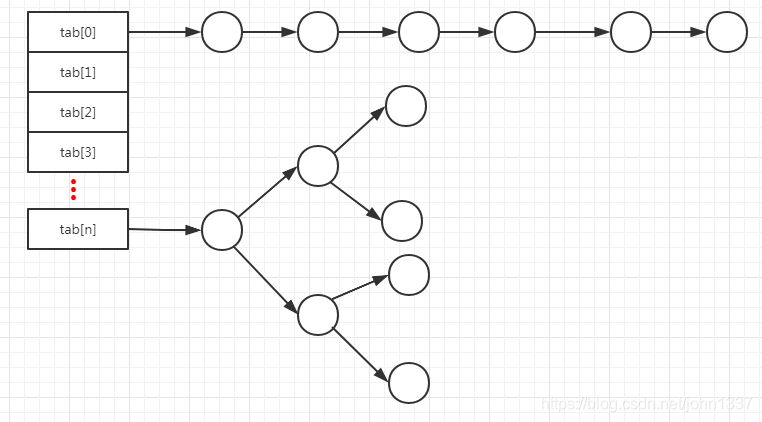
- [ref 1](https://blog.csdn.net/junqing_wu/article/details/104606619) - [ref 2](https://blog.csdn.net/john1337/article/details/104727895)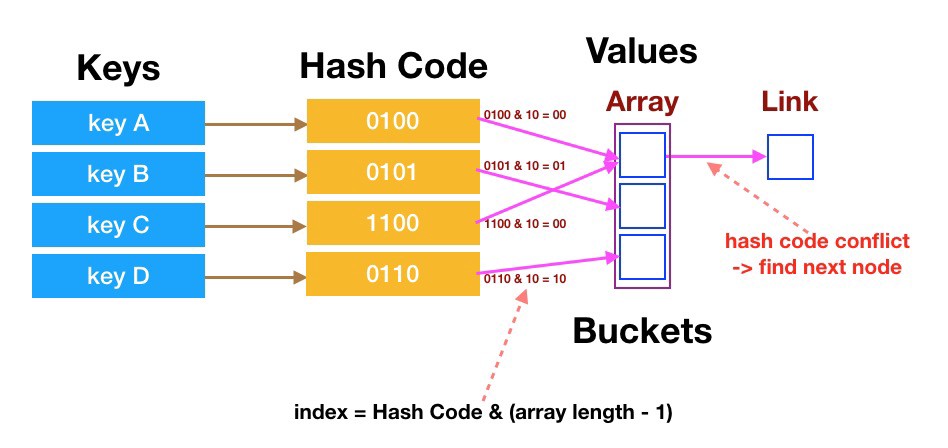
- 為什麼 hashmap 的搜尋時間複雜度 ~= O(1)?怎麼解釋?
什麼時候該用/不該用
-
該用的時候
- 需要 ~ O(1) 讀寫的場景
- 用快取換效能(空間換時間)
sum, pair, continuous這類題目- 想避開雙層迴圈(O(N^2))
-
不該用的時候
基本操作
get:從 dict 取值,鍵不存在時給預設值
In [10]: d = {'a': 1, 'b': 2}
    ...: d['a']
Out[10]: 1

In [11]: d.get('a')
Out[11]: 1

In [12]: d.get('c', 0)
Out[12]: 0

In [13]: d.get('z')

In [14]:
#-------------------------------------------------------------------------------
# setdefault : will creatte key if key NOT existed (with value as well if defined)
#-------------------------------------------------------------------------------

# syntax
d.setdefault(new_key)
d.setdefault(new_key, new_value)

# 662 Maximum Width of Binary Tree
car = {
  "brand": "Ford",
  "model": "Mustang",
  "year": 1964
}

# example 1) insert key "my_key", since my_key not existed, -> make it as new key and value as None (since not defined)
car.setdefault("my_key")
print (car)
# In [18]: car
# Out[18]: {'brand': 'Ford', 'model': 'Mustang', 'year': 1964, 'my_key': None}

# example 2) insert key "color", since my_key not existed, -> make it as new key and value as white
car.setdefault("color", "white")
print (car)
# Out[22]:
# {'brand': 'Ford',
#  'model': 'Mustang',
#  'year': 1964,
#  'my_key': None,
#  'color': 'white'}
- 對 hashmap (dict) 做排序
# https://stackoverflow.com/questions/613183/how-do-i-sort-a-dictionary-by-value

x = {1: 2, 3: 4, 4: 3, 2: 1, 0: 0}
In [11]: x.items()
Out[11]: dict_items([(1, 2), (3, 4), (4, 3), (2, 1), (0, 0)])

#----------------------------------
# Sort hashMap by key/value !!!
#----------------------------------
x = {1: 2, 3: 4, 4: 3, 2: 1, 0: 0}
# note : have to use sorted(xxx, key=yyy), instead of xxx.sorted(....)
### NOTE this !!! : x.items()
sorted_x = sorted(x.items(), key=lambda kv: kv[1])
print (sorted_x)
# [(0, 0), (2, 1), (1, 2), (4, 3), (3, 4)]

x = {1: 2, 3: 4, 4: 3, 2: 1, 0: 0}
sorted_x = sorted(x.items(), key=lambda kv: kv[0])
print (sorted_x)
# [(0, 0), (1, 2), (2, 1), (3, 4), (4, 3)]

# 451  Sort Characters By Frequency
import collections
class Solution(object):
    def frequencySort(self, s):
        count = collections.Counter(s)
        count_dict = dict(count)
        """
        NOTE this !!!
            1. use sorted()
            2. count_dict.items()
        """
        count_tuple_sorted = sorted(count_dict.items(), key=lambda kv : -kv[1])
        res = ''
        for item in count_tuple_sorted:
            res += item[0] * item[1]
        return res
# dict values -> array
In [6]:
   ...: mydict = {'a':['a1','a2','a3'], 'b':['b1','b2','b3']}
   ...:
   ...: res = [mydict[x] for x in mydict]
   ...:
   ...: print (res)
[['a1', 'a2', 'a3'], ['b1', 'b2', 'b3']]
參考資料
- Java HashMap
- 底層:陣列 + 鏈結串列/紅黑樹
- 鏈結串列長度 > 8 -> 把串列轉成紅黑樹
- 鏈結串列長度 < 6 -> 把紅黑樹轉回串列
- 底層:陣列 + 鏈結串列/紅黑樹
- N sum:
- LC 參考
- 其他
模板與演算法
模板對照表
| # | 模板 | map 的形狀 | 怎麼認出來 | 代表 LC |
|---|---|---|---|---|
| 1 | 頻率計數 | {item: count},或 {item: (first, last, count)} |
「count」、「frequency」、「anagram」、「top-K」、「所有出現位置都在同一個連續區塊」 | 242, 49, 347, 451, 4038 |
| 2 | 已見過的索引表 | {value: index} |
「找一組配對」、「湊出 target」、補數 | 1, 15, 532, 1010 |
| 3 | 用算出來的鍵分組 | {canonical_key: [items]},或 {(min, max): count} |
「group」、「同一條線」、「同一個特徵」、「(x, y) 等同 (y, x)」 |
49, 149, 609, 987, 4066 |
| 4 | 前綴和 → 計數表 | {prefixSum: count} / {prefixSum: firstIndex} / {startValue: minPrefix} |
「子陣列和等於 K/可被 K 整除」、「兩端滿足 … 的最大和」 | 560, 974, 525, 325, 3026 |
| 5 | 滑動視窗 + 字元計數 | {char: count in window} |
「最長/最短的子字串,使得 …」 | 3, 76, 424, 438, 567 |
| 6 | 排名表 | {value: rank} |
「依照 … 給定的順序」 | 953, 791, 105 |
| 7 | 雙射(兩個 map) | {x: y} 和 {y: x} |
「一對一」、「isomorphic」、「符合這個 pattern」 | 205, 290 |
| 8 | 快取/記憶化 | {state: result} |
「O(1) 的 get 和 put」、「把遞迴記憶化」 | 146, 460, 139, 322 |
| 9 | 圖/樹的節點表 | {node: neighbours}、{child: parent} |
「clone」、「父指標」、「序列化子樹」 | 133, 138, 652, 1257 |
| 10 | 虛擬映射(重新映射) | {badIndex: goodIndex} |
「隨機挑,但要排除 …」 | 710 |
| 11 | map + 另一個結構 | map + 堆積/堆疊/第二個 map | 「用堆積做 top-K」、「next greater」 | 347, 496, 739 |
那些其實是針對一兩題的深入討論 —— O(n) top-K 的桶排序、rolling hash、拆半探測的配對查找、最大頻率算術,以及有序 map(
TreeMap/SortedDict)—— 放在 hash_map_examples.md。
模板 1:頻率計數
# Universal Counting Template
def counting_pattern(arr):
    count = {}  # or collections.defaultdict(int)
    result = []

    # Count frequency
    for item in arr:
        count[item] = count.get(item, 0) + 1
        # or count[item] += 1 with defaultdict

    # Process based on frequency
    for key, freq in count.items():
        if meets_condition(freq):
            result.append(key)

    return result

# Examples: LC 49, LC 242, LC 451, LC 347, LC 692
變形:索引跨度表 —— span == count 證明連續 優先度 3/5 — 值得會 — 多半是必備模式的變形
模式:有時候題目問的不是某個值出現幾次,而是它出現在哪裡。改成記錄位置而不是次數,一條算術恆等式就能回答「這個值的所有出現位置是不是同一個連續區塊?」:
last_idx - first_idx + 1 == number_of_occurrences
關鍵想法:span 是「如果中間沒夾雜別的東西,這個值的區塊會佔幾格」。只要有任何別的值夾在兩次出現之間,span 就會變大、count 卻不變,所以 span > count ⇔ 區塊斷掉了。不用排序、不用走訪索引清單 —— 每個不同的值 O(1)。
# python
# LC 4038 - Count Integers Appearing in a Single Block
# IDEA: {val: [idx, ...]}, then a value is special iff its indices are consecutive
# time = O(n), space = O(n)
from collections import defaultdict

def countSpecialIntegers(nums: list) -> int:
    my_map = defaultdict(list)
    for i, v in enumerate(nums):
        my_map[v].append(i)

    cnt = 0
    for k in my_map:
        idxs = my_map[k]
        # NOTE !!! span == count  <=>  indices are consecutive
        if idxs[-1] - idxs[0] + 1 == len(idxs):
            cnt += 1
    return cnt

# [1,1,2,2,3] -> 1:[0,1] 2:[2,3] 3:[4]     -> every span == count -> 3
# [1,2,1]     -> 1:[0,2] -> 2-0+1 = 3 != 2 -> broken -> only 2 is special -> 1
一次掃描的改良版 —— 檢查只會讀三個數字,所以根本不需要索引清單。時間一樣 O(n),但只用 O(distinct) 格而不是 O(n):
# python
# LC 4038 - keep only (first_idx, last_idx, count) per value
# time = O(n), space = O(k), k = number of distinct values
def countSpecialIntegers(nums: list) -> int:
    info = {}                                  # {val: [first, last, cnt]}
    for i, v in enumerate(nums):
        if v not in info:
            info[v] = [i, i, 1]
        else:
            info[v][1] = i
            info[v][2] += 1
    return sum(1 for first, last, cnt in info.values() if last - first + 1 == cnt)
四個陷阱:
- 特判只出現一次的情況 —— 不需要任何分支:單一索引給出
span = last - first + 1 = 1且count = 1,跟其他區塊一樣通過同一條恆等式。 - 走訪(或排序)索引清單來檢查是否連續 —— 索引本來就是遞增進來的,
span == count只讀兩端。 - 數的是出現次數而不是值 —— 答案是通過檢查的不同鍵的數量,所以一個在同一區塊裡出現 5 次的值只算 1。
- 把連續的索引跟連續的值搞混 —— 這條恆等式講的是陣列中的位置。連續值的序列(LC 128)是另一份 cheatsheet 的招式(一個 set,再加上「
v-1在不在?」)。
變形(同一招「存位置,而不只是次數」):
| 題目 | LC# | 變化點 —— map 存的是什麼 |
|---|---|---|
| Partition Labels | 763 | {char: last index};由左往右掃,把區塊的結尾延伸到目前看過最遠的 last —— 恰好在 i == end 的地方切一刀 |
| Contains Duplicate II | 219 | {value: last index};命中的條件是 i - last <= k,所以只有最近一次的位置有意義 |
| Longest Consecutive Sequence | 128 | 對照組:跨度是在值上而不是索引上 —— 一個 set,加上「只從 v-1 不存在的地方開始」 |
模板 2:已見過的索引表(Two Sum 的形狀)
# Two Sum Pattern Template
def two_sum_pattern(nums, target):
    seen = {}  # {value: index}

    for i, num in enumerate(nums):
        complement = target - num

        if complement in seen:
            return [seen[complement], i]

        seen[num] = i

    return []

# Variations:
# - Multiple pairs: collect all instead of returning first
# - K-diff pairs: check for num+k and num-k
# - Examples: LC 1, LC 167, LC 15, LC 532, LC 1010
模板 3:用算出來的鍵分組
模式:拿元素的正規形式去雜湊,而不是元素本身 —— 所有共用同一個正規形式的東西就會落到同一個 bucket。最簡單的正規形式是排序後的字串(LC 49);一般化的情況則是某種關係的正規化不變量(LC 149)。
# LC 049 Group Anagrams
# IDEA : HASH TABLE
class Solution:
    def groupAnagrams(self, strs):
        res = {}
        for item in strs:
            k = ''.join(sorted(item))  # sort the string
            if k not in res:  #  check if exists in res
                res[k] = []
            res[k].append(item)  # if same, put all the same string into dict k
        return [res[x] for x in res]  # output the result
一般化:鍵就是一個正規化的不變量 優先度 4/5 — 高價值 — 這裡有缺口就會掉關
模式:map 的鍵不是原始的值 —— 它是值與值之間某種關係的正規形式。兩個元素會在 map 裡撞在一起,剛好就是它們共享你在意的那個性質。
關鍵想法(幾何):「通過錨點 P 的同一條線」⇔「同一個方向向量 (dx, dy)」。原始的 (dx, dy) 不能當鍵((1,2) 和 (2,4) 是同一條線),而 dy/dx 用浮點數會掉精度、遇到垂直線還會除以零。正規化:先除以 gcd,再強制統一符號。
// java
// LC 149 - Max Points on a Line
// IDEA: anchor at each point, group the others by a gcd-normalized slope key
// time = O(n^2), space = O(n)
public int maxPoints(int[][] points) {
    int n = points.length;
    if (n <= 2) return n;
    int best = 1;
    for (int i = 0; i < n; i++) {
        Map<String, Integer> slopeCount = new HashMap<>();
        for (int j = i + 1; j < n; j++) {
            int dx = points[j][0] - points[i][0];
            int dy = points[j][1] - points[i][1];
            int g = gcd(Math.abs(dx), Math.abs(dy));
            if (g != 0) { dx /= g; dy /= g; }
            // canonical direction: force dx > 0, or dx == 0 && dy > 0
            if (dx < 0 || (dx == 0 && dy < 0)) { dx = -dx; dy = -dy; }
            String key = dx + "/" + dy;
            int cnt = slopeCount.merge(key, 1, Integer::sum);
            best = Math.max(best, cnt + 1);   // +1 for the anchor point itself
        }
    }
    return best;
}

private int gcd(int a, int b) { return b == 0 ? a : gcd(b, a % b); }
# python
# LC 149 - Max Points on a Line
# IDEA: anchor at each point, group the others by a gcd-normalized slope key
# time = O(n^2), space = O(n)
from collections import defaultdict
from math import gcd

def maxPoints(points: list) -> int:
    n = len(points)
    if n <= 2:
        return n
    best = 1
    for i in range(n):
        slope_count = defaultdict(int)
        x1, y1 = points[i]
        for j in range(i + 1, n):
            dx, dy = points[j][0] - x1, points[j][1] - y1
            g = gcd(abs(dx), abs(dy))
            if g:
                dx, dy = dx // g, dy // g
            if dx < 0 or (dx == 0 and dy < 0):     # canonical sign
                dx, dy = -dx, -dy
            slope_count[(dx, dy)] += 1
            best = max(best, slope_count[(dx, dy)] + 1)   # +1 = anchor point
    return best
三個陷阱(都是面試常見的追問):
- 浮點斜率
dy/dx—— 精度會掉,垂直線還會ZeroDivisionError。改用約分後的整數配對。 - 忘了正規化符號 ——
(1,2)和(-1,-2)是同一條線,卻變成兩個不同的鍵。要強制成同一個方向。 - 忘了
+1—— map 數的是錨點的夥伴,錨點自己不在 map 裡。
變形(都是同一招「自己發明一個正規化的鍵」):
| 題目 | LC# | 變化點 —— 這個鍵編碼了什麼 |
|---|---|---|
| Minimum Area Rectangle | 939 | 鍵 = 放進 set 的點本身;走訪對角線配對 (x1,y1),(x2,y2)(x1!=x2 && y1!=y2),再檢查另外兩個角在不在 |
| Most Stones Removed with Same Row or Column | 947 | 鍵 = row 與 ~col(位元取反讓列與行落在互不重疊的 id 空間)→ 在 map 上跑併查集 |
| Vertical Order Traversal of a Binary Tree | 987 | 鍵 = 行偏移量 col(root = 0、左 = col-1、右 = col+1);值 = 待排序的 (row, val) 清單 |
模式:無序配對鍵 —— 用 (min, max) 不分順序地計數 {x, y} 優先度 3/5 — 值得會 — 多半是必備模式的變形
模式:當你要數的關係是對稱的 —— (x, y) 和 (y, x) 意思一樣 —— 就用排好順序的配對 (min(x, y), max(x, y)) 當 map 的鍵。兩個方向會落進同一個桶,桶裡的計數就是你真正要的數字。這是最小的一種正規化不變量:無序配對的正規形式。
pair = (min(x, y), max(x, y))      # (2, 5) and (5, 2) -> the same key (2, 5)
pair_count[pair] += 1
best = max(best, pair_count[pair]) # running max: counts only go up, so no second pass
關鍵想法(LC 4066):最多一次,把所有 x 換成 y,讓相等的相鄰對數最大。先問:一次替換 x -> y 對每一組相鄰對做了什麼?
(x, y) or (y, x)   -> (y, y)   unequal -> equal       +1
(x, x)             -> (y, y)   equal   -> equal        0   (never lost)
(x, a), a != y     -> (y, a)   unequal -> unequal      0
anything without x -> untouched                        0
所以原本相等的對永遠不會失去,而增加的量剛好等於「一邊是 x、一邊是 y」的相鄰位置數 —— 不分左右。這就是一個無序配對的計數:
answer = (adjacent pairs already equal) + max over x != y of (adjacent {x, y} pairs)
# python
# LC 4066 - Maximum Equal Adjacent Pairs After at Most One Replacement
# IDEA: already-equal pairs survive any replacement; x -> y gains one per adjacent {x, y},
#       so count adjacent unequal pairs under an unordered (min, max) key and take the max
# time = O(n), space = O(n)
from collections import defaultdict

def maxEqualAdjacentPairs(nums: list) -> int:
    already_equal = 0
    unequal_pair_cnt = defaultdict(int)   # {(smaller, larger): adjacent occurrences}
    max_newly_equal = 0                   # 0 = do no operation (e.g. [1, 1, 1])

    for i in range(len(nums) - 1):
        x, y = nums[i], nums[i + 1]
        if x == y:
            already_equal += 1
        else:
            # NOTE !!! (2, 5) and (5, 2) are fixed by the same replacement -> one key
            pair = (min(x, y), max(x, y))
            unequal_pair_cnt[pair] += 1
            max_newly_equal = max(max_newly_equal, unequal_pair_cnt[pair])

    return already_equal + max_newly_equal
// java
// LC 4066 - Maximum Equal Adjacent Pairs After at Most One Replacement
// IDEA: same unordered (min, max) key, packed into one long (values <= 10^9 fit in 32 bits)
// time = O(n), space = O(n)
public int maxEqualAdjacentPairs(int[] nums) {
    int alreadyEqual = 0;
    int maxNewlyEqual = 0;
    Map<Long, Integer> unequalPairCnt = new HashMap<>();

    for (int i = 0; i + 1 < nums.length; i++) {
        int x = nums[i];
        int y = nums[i + 1];
        if (x == y) {
            alreadyEqual++;
        } else {
            long small = Math.min(x, y);
            long large = Math.max(x, y);
            long pairKey = (small << 32) | large;   // canonical order, one key per {x, y}
            int cnt = unequalPairCnt.merge(pairKey, 1, Integer::sum);
            maxNewlyEqual = Math.max(maxNewlyEqual, cnt);
        }
    }
    return alreadyEqual + maxNewlyEqual;
}
nums = [1,2,1,2,1]
  i  pair    key     cnt   max_newly_equal
  0  (1,2)   (1,2)   1     1
  1  (2,1)   (1,2)   2     2      <- an ordered key would have started (2,1) at 1
  2  (1,2)   (1,2)   3     3
  3  (2,1)   (1,2)   4     4
  already_equal = 0  ->  answer = 0 + 4 = 4   (replace 1 -> 2: [2,2,2,2,2])

nums = [1,2,3,2]  -> {1,2}: 1, {2,3}: 2  -> 0 + 2 = 2
nums = [1,1,1]    -> already_equal = 2, map empty -> 2 + 0 = 2   (no operation)
四個陷阱:
- 用有序的鍵 —— 直接用
(x, y)會把[1,2,1,2,1]拆成(1,2): 2和(2,1): 2,答案變 2 而不是 4。替換不在乎x在哪一邊,鍵也不能在乎。 - 擔心替換會破壞原本相等的對 ——
(x, x)變成(y, y),依然相等。沒有任何東西要扣掉,所以答案就是單純相加。 - 最佳增量從 1 開始,或強制一定要操作 —— 「最多一次」代表可以不做;map 是空的時候貢獻必須是 0。
- Java 用字串當鍵 —— 沒有分隔符時
"1" + "23"和"12" + "3"會撞在一起(見分隔符陷阱)。值放得進 32 bits 時就打包成一個long,不然用x + "," + y。
為什麼邊走邊取 max 是安全的:每次遞增後做
max(best, cnt[pair]),會等於最終各計數的最大值,前提是計數永遠不會減少。在滑動視窗裡計數會下降,就要另外再掃一次,或用支援刪除的結構。
變形(同一種無序配對鍵):
| 題目 | LC# | 變化點 —— (min, max) 鍵數的是什麼 |
|---|---|---|
| Number of Equivalent Domino Pairs | 1128 | [a, b] ≡ [b, a];每個鍵數骨牌張數,再加 k*(k-1)/2 —— 或在每次遞增前先加上目前的計數 |
| Maximal Network Rank | 1615 | 把無向邊存成 (min, max) 鍵的 set,「u 和 v 有沒有相連?」就是一次 O(1) 查找,不管順序 |
模板 4:前綴和 → 計數表 優先度 5/5 — 必備 — 幾乎每一輪面試都會出現
先看前綴和陣列 —— nums[i..j] 的和 = preSum[j+1] - preSum[i]:
# (algorithm book (labu) p.350)
my_array = [1,2,3,4,5]
my_array_pre = [0] * (len(my_array)+1)
cur = 0
for i in range(len(my_array)):
    cur += my_array[i]
    my_array_pre[i+1] += cur

# In [17]: print ("my_array = " + str(my_array))
#     ...: print ("my_array_pre = " + str(my_array_pre))
# my_array = [1, 2, 3, 4, 5]
# my_array_pre = [0, 1, 3, 6, 10, 15]

#-----------------------------------------------
# Get sub array sum !!!!!!!
#    -> nums[i..j] sum = preSum[j+1] - preSum[i]
#-----------------------------------------------

# example 1 : sum of [1,2]
my_array_pre[1+1] - my_array_pre[0]  # 1's index is 0, and 2's index is 1. (my_array = [1, 2, 3, 4, 5])

# example 2 : sum of [2,3,4]
my_array_pre[3+1] - my_array_pre[1] # 2's index is 1, and 4's index is 3. (my_array = [1, 2, 3, 4, 5])
# Prefix Sum Pattern Template
def prefix_sum_pattern(nums, target):
    prefix_sum = 0
    sum_count = {0: 1}  # {sum: count/index}
    result = 0

    for num in nums:
        prefix_sum += num

        # Check if (prefix_sum - target) exists
        if prefix_sum - target in sum_count:
            result += sum_count[prefix_sum - target]

        # Update current prefix sum count
        sum_count[prefix_sum] = sum_count.get(prefix_sum, 0) + 1

    return result

# For max length problems, store index instead of count:
# sum_index = {0: -1}, then calculate i - sum_index[prefix_sum - target]
# Examples: LC 560, LC 325, LC 525, LC 523
依題型分的關鍵差異:
- 計數類(LC 560, 930, 974):存
{sum: count},先查再更新- LC 974 變形:改用餘數
{remainder: count},一定要處理負餘數!
- LC 974 變形:改用餘數
- 最大長度類(LC 325, 525):存
{sum: first_index},只在鍵是新的時候才寫入- LC 525 變形:先轉換問題(0→-1、1→+1),用
{0: -1}初始化,只記第一次出現的位置
- LC 525 變形:先轉換問題(0→-1、1→+1),用
- 存在性類(LC 523):存
{sum: any_index},找到一個就好
核心模式:數出所有和為 k 的子陣列 — LC 560
核心概念:用雜湊表在單層迴圈、O(N) 時間內,數出所有和等於 target 的子陣列組合。
關鍵洞見:
If we want subarray[i,j] to sum to k:
  presum[j] - presum[i-1] = k
  → presum[i-1] = presum[j] - k

So at index j, check if (presum[j] - k) exists in map!
實作上的關鍵細節:
-
存的是次數,不是索引:
javaMap<Integer, Integer> map = new HashMap<>(); // {prefixSum: count}- 同一個前綴和可能出現很多次
- 我們要數出所有合法子陣列,不是找到一個就好
- 例:
[1, -1, 1, -1]在 k=0 時有多組解
-
用
map.put(0, 1)初始化:javamap.put(0, 1); // Handle subarrays starting from index 0- 當
presum[j] == k時,presum[j] - k = 0 - 這是為了把從頭開始的那些子陣列也數進去
- 當
-
先查再更新(順序很關鍵):
javafor (int num : nums) { presum += num; // 1. CHECK first: count how many previous prefix sums = (presum - k) if (map.containsKey(presum - k)) { count += map.get(presum - k); // Add ALL occurrences } // 2. UPDATE after: add current prefix sum for future iterations map.put(presum, map.getOrDefault(presum, 0) + 1); }- 為什麼是這個順序? 避免當前這段子陣列跟自己配對
- 當前的前綴和只該被之後的迭代看到
為什麼這個模式能抓到所有組合:
- map 存了先前出現過的所有前綴和與各自的次數
- 查
presum - k時,拿到的是它先前出現的所有次數 - 每一次先前的出現,都代表一個合法的起點
count += map.get(presum - k)一次把所有以當前索引結尾的合法子陣列加進來
例子走查(nums = [1,1,1], k = 2):
i=0: num=1, presum=1
  - Check: (1-2)=-1 not in map → count=0
  - Update: map={0:1, 1:1}

i=1: num=1, presum=2
  - Check: (2-2)=0 in map, count += map[0] = 1 → count=1
  - Update: map={0:1, 1:1, 2:1}

i=2: num=1, presum=3
  - Check: (3-2)=1 in map, count += map[1] = 1 → count=2
  - Update: map={0:1, 1:1, 2:1, 3:1}

Result: count=2 (subarrays [1,1] and [1,1])
相關的 LC 題目(同一模式):
- LC 560: Subarray Sum Equals K(就是這個模式本身)
- LC 325: Maximum Size Subarray Sum Equals k(存索引而不是次數)
- LC 930: Binary Subarrays with Sum
- LC 974: Subarray Sums Divisible by K(改用餘數
{remainder: count},記得處理負數!)
什麼時候存次數、什麼時候存索引:
| 題型 | map 的值 | 例子 | 特別注意 |
|---|---|---|---|
| 數出所有子陣列 | count |
LC 560, 930, 974 | 先查再更新 |
| 計數(帶取餘) | count |
LC 974 | 用餘數當鍵;處理負數! |
| 找最長子陣列 | index(第一次出現) |
LC 325, 525 | 只存第一次出現 |
| 找最長(需先轉換) | index(第一次出現) |
LC 525 | 把 0→-1、1→+1;初始化 {0:-1} |
| 判斷是否存在 | boolean/index |
LC 523 | 任一次出現都可以 |
| 找最大和,條件落在兩端 | min prefix,以起點的值為鍵 |
LC 3026 | 鍵是 nums[i],不是前綴和 —— 見下面的變形 |
常見錯誤:
- ❌ 計數類的題目卻用了
{prefixSum: index} - ❌ 在查詢之前就更新 map(會把自己也數進去)
- ❌ 忘了
map.put(0, 1)這個初始化 - ❌ 沒處理「前綴和本身就等於 k」的情況
- ❌ [LC 974] 忘了處理負餘數(Java/Python 裡
-7 % 5 = -2,要加上 k 才會變成 3)
變形:以起點的值為鍵,存最小前綴 — LC 3026 優先度 3/5 — 值得會 — 多半是必備模式的變形
模式:條件落在子陣列的兩端,而不是它的和上,問的又是最大和。所以鍵換了,值也換了:
- 鍵 = 起點的值
nums[i],因為「good」(|nums[i] - nums[j]| == k)限定的是起點的值,不是它的前綴和; - 值 = 這個值目前見過的最小
pre[i],因為以j結尾的和是pre[j+1] - pre[i],pre[i]越小,和就越大。
sum(nums[i..j]) = pre[j+1] - pre[i]
fixed j  ->  maximise  = minimise pre[i]   over every i with nums[i] in {nums[j]-k, nums[j]+k}
best[v]  = min pre[i] over every i seen so far with nums[i] == v
關鍵想法:這就是 Kadane 的「減掉目前最小的前綴」(LC 53),只是按起點的值拆成一個值一個桶。計數表回答「有幾個」;最小前綴表回答「最多多少」。
# python
# LC 3026 - Maximum Good Subarray Sum
# IDEA: best[v] = min prefix sum just before an index holding v; close at x from v = x-k or x+k
# time = O(n), space = O(n)
def maximumSubarraySum(nums: list, k: int) -> int:
    best = {}                       # {start value: min prefix sum before it}
    res = float('-inf')
    pre = 0                         # pre = sum(nums[:j]), i.e. before x
    for x in nums:
        for v in (x - k, x + k):    # the two start values that make [i..j] good
            if v in best:
                res = max(res, pre + x - best[v])
        # NOTE !!! record x as a future START with the prefix BEFORE it
        if x not in best or pre < best[x]:
            best[x] = pre
        pre += x
    return 0 if res == float('-inf') else res
// java
// LC 3026 - Maximum Good Subarray Sum
// IDEA: same map; long, because n * |nums[i]| reaches 1e14
// time = O(n), space = O(n)
public long maximumSubarraySum(int[] nums, int k) {
    Map<Integer, Long> best = new HashMap<>();   // {start value: min prefix before it}
    long res = Long.MIN_VALUE, pre = 0;
    for (int x : nums) {
        for (int v : new int[]{x - k, x + k}) {      // |x ± k| <= 2e9 still fits an int
            Long p = best.get(v);
            if (p != null) res = Math.max(res, pre + x - p);
        }
        best.merge(x, pre, Math::min);
        pre += x;
    }
    return res == Long.MIN_VALUE ? 0 : res;
}
走查 —— nums = [-1,3,2,4,5], k = 3:
x    pre(before x)  look up x-k, x+k          candidate          best after
-1    0             -4, 2   -> none            -                  {-1:0}
 3   -1              0, 6   -> none            -                  {-1:0, 3:-1}
 2    2             -1, 5   -> -1: 2+2-0 = 4   4  ([-1,3,2])      {..., 2:2}
 4    4              1, 7   -> none            -                  {..., 4:4}
 5    8              2, 8   -> 2: 8+5-2 = 11   11 ([2,4,5])       {..., 5:8}
-> 11
四個陷阱:
res從 0 開始 —— good 子陣列的和可以是負的([-1,-2,-3,-4], k = 2→-6)。用-inf,只有在完全沒有 good 子陣列時才回傳 0。- 存了包含起點的前綴 —— 子陣列包含
nums[i],所以要減的是pre[i],也就是它之前的和。best[x]要在pre += x之前記下。 - 只存某個值最新或最早的前綴 —— 兩者都不一定是最好的起點。要存最小值,就像 LC 325 存第一次出現的索引那樣。
- Java 用
int—— 1e5 個 1e9 會溢位;前綴和答案都要用long(鍵x ± k落在 ±2e9 內,int放得下)。
變形(同一招「每個鍵存最好的起點」):
| 題目 | LC# | map 存什麼,為什麼 |
|---|---|---|
| Maximum Subarray | 53 | 每個起點都合格,所以整張表縮成一個全域最小前綴 —— 就是 Kadane 演算法 |
| Maximum Good Subarray Sum | 3026 | {起點的值: 最小前綴};查 x - k 和 x + k |
| Maximum Size Subarray Sum Equals k | 325 | {前綴和: 第一次出現的索引} —— 這裡「最好的起點」是最早的,因為要的是最長 |
模板 5:滑動視窗搭配雜湊表
# Sliding Window with HashMap Template
def sliding_window_hashmap(s, pattern):
    if len(pattern) > len(s):
        return []

    pattern_count = {}
    window_count = {}

    # Count pattern frequency
    for char in pattern:
        pattern_count[char] = pattern_count.get(char, 0) + 1

    left = 0
    result = []

    for right in range(len(s)):
        # Expand window
        char = s[right]
        window_count[char] = window_count.get(char, 0) + 1

        # Contract window if needed
        while window_size_condition_met():
            # Check if current window is valid
            if window_count == pattern_count:
                result.append(left)

            # Remove leftmost character
            left_char = s[left]
            window_count[left_char] -= 1
            if window_count[left_char] == 0:
                del window_count[left_char]
            left += 1

    return result

# Examples: LC 3, LC 76, LC 438, LC 567
map 直接比對的捷徑(LC 567 Permutation in String):視窗是固定大小時不需要 matched 計數器 —— 直接比較兩個頻率表就好。
// LC 567
// ...
     /** NOTE !!!
     *
     *  we use below trick to
     *
     *  -> 1) check if `new reached s2 val` is in s1 map
     *  -> 2) check if 2 map are equal
     *
     *  -> so we have more simple code, and clean logic
     */
    if (map2.equals(map1)) {
        return true;
    }
// ...
模板 6:排名表 —— 值對應到位置 優先度 5/5 — 必備 — 幾乎每一輪面試都會出現
模式:當題目自己定義了一套順序(「這套外星字母」、「這個排列」),先一次算好 value -> rank,之後每次比較就從 O(m) 的掃描變成 O(1) 的整數比較。
怎麼認出來:出現「依照 … 給定的順序」這種說法 —— 那就是排名表。
// java
// LC 953 - Verifying an Alien Dictionary
// IDEA: char -> rank map turns an arbitrary alphabet into comparable ints
// time = O(total chars), space = O(1)  (26 keys)
public boolean isAlienSorted(String[] words, String order) {
    int[] rank = new int[26];                       // char -> position in `order`
    for (int i = 0; i < order.length(); i++) rank[order.charAt(i) - 'a'] = i;
    for (int i = 0; i + 1 < words.length; i++) {
        if (!inOrder(words[i], words[i + 1], rank)) return false;
    }
    return true;
}

private boolean inOrder(String a, String b, int[] rank) {
    int n = Math.min(a.length(), b.length());
    for (int i = 0; i < n; i++) {
        int ra = rank[a.charAt(i) - 'a'], rb = rank[b.charAt(i) - 'a'];
        if (ra != rb) return ra < rb;
    }
    return a.length() <= b.length();                // prefix must come first: "app" < "apple"
}

// LC 791 - Custom Sort String  (counting sort, no comparator needed)
// time = O(n + m), space = O(1)
public String customSortString(String order, String s) {
    int[] cnt = new int[26];
    for (char c : s.toCharArray()) cnt[c - 'a']++;
    StringBuilder sb = new StringBuilder();
    for (char c : order.toCharArray()) {            // ranked chars first, in rank order
        while (cnt[c - 'a'] > 0) { sb.append(c); cnt[c - 'a']--; }
    }
    for (char c = 'a'; c <= 'z'; c++) {             // unranked chars: any order
        while (cnt[c - 'a'] > 0) { sb.append(c); cnt[c - 'a']--; }
    }
    return sb.toString();
}
# python
# LC 953 - Verifying an Alien Dictionary
# IDEA: map every word to a list of ranks, then plain list comparison does the lexicographic work
# time = O(total chars), space = O(total chars)
def isAlienSorted(words: list, order: str) -> bool:
    rank = {c: i for i, c in enumerate(order)}
    keys = [[rank[c] for c in w] for w in words]
    # python list compare == lexicographic compare, and [1,2] < [1,2,3] handles the prefix rule
    return all(keys[i] <= keys[i + 1] for i in range(len(keys) - 1))

# python
# LC 791 - Custom Sort String
# IDEA: rank map as a sort key; unranked chars get rank len(order) (stable sort keeps them last)
# time = O(n log n + m), space = O(n)
def customSortString(order: str, s: str) -> str:
    rank = {c: i for i, c in enumerate(order)}
    return "".join(sorted(s, key=lambda c: rank.get(c, len(order))))
前綴規則是每個人都會踩的坑:共同前綴比完之後,比較短的那個字必須排在前面。["apple", "app"] 不是排序好的。
變形 —— 用「值 → 索引」表切分陣列(LC 105 / LC 106):同一個 map,只是這裡的「排名」是在中序序列中的位置,把 O(n²) 的「掃中序找 root」變成 O(1),整個建樹變成 O(n)。
# python
# LC 105 - Construct Binary Tree from Preorder and Inorder Traversal
# IDEA: {value: index in inorder} → O(1) root split
# time = O(n), space = O(n)
def buildTree(preorder: list, inorder: list):
    idx = {v: i for i, v in enumerate(inorder)}   # values are unique (given)
    pre = [0]                                     # pointer into preorder

    def build(lo, hi):
        if lo > hi:
            return None
        node = TreeNode(preorder[pre[0]])
        pre[0] += 1
        mid = idx[node.val]                       # O(1) instead of inorder.index(...)
        node.left = build(lo, mid - 1)
        node.right = build(mid + 1, hi)
        return node

    return build(0, len(inorder) - 1)
模板 7:雙射(雙向映射)
模式:同時維護兩個 map(x→y 與 y→x),並兩個方向都檢查一致性。只要映射必須是一對一的就用得上(LC 205 Isomorphic Strings、LC 290 Word Pattern)。
為什麼要兩個 map? 一個 map 抓得到 a→b 的衝突;第二個才抓得到 b→a 的衝突(兩個不同的 x 對到同一個 y)。
# LC 205 Isomorphic Strings
def isIsomorphic(s: str, t: str) -> bool:
    s2t, t2s = {}, {}
    for a, b in zip(s, t):
        if s2t.get(a, b) != b or t2s.get(b, a) != a:
            return False
        s2t[a] = b
        t2s[b] = a
    return True

# LC 290 Word Pattern
def wordPattern(pattern: str, s: str) -> bool:
    words = s.split()
    if len(pattern) != len(words):
        return False
    p2w, w2p = {}, {}
    for p, w in zip(pattern, words):
        if p2w.get(p, w) != w or w2p.get(w, p) != p:
            return False
        p2w[p] = w
        w2p[w] = p
    return True
常見錯誤:只用一個 map —— 兩個鍵對到同一個值時就會出錯("aa" vs "ab")。
模板 8:用雜湊表做快取/記憶化
# Caching/Memoization Template
class CacheTemplate:
    def __init__(self, capacity):
        self.capacity = capacity
        self.cache = {}  # key -> value
        self.usage = {}  # key -> usage_info

    def get(self, key):
        if key in self.cache:
            self.update_usage(key)
            return self.cache[key]
        return -1

    def put(self, key, value):
        if len(self.cache) >= self.capacity:
            self.evict()

        self.cache[key] = value
        self.update_usage(key)

    def update_usage(self, key):
        # Update usage tracking
        pass

    def evict(self):
        # Remove least recently/frequently used
        pass

# Examples: LC 146 (LRU), LC 460 (LFU)
以子問題狀態當鍵、用 dict 做的 top-down DP(LC 139, 1048, 322)也是同一份模板 —— 完整寫在 hash_map_examples.md → Hash Map + Memoization / DP。
模板 9:用雜湊表解圖論題
# Graph with HashMap Template
def graph_hashmap_pattern(graph_input):
    # Build adjacency list/map
    graph = {}  # node -> [neighbors] or node -> {neighbor: weight}

    for edge in graph_input:
        node1, node2 = edge[0], edge[1]
        if node1 not in graph:
            graph[node1] = []
        if node2 not in graph:
            graph[node2] = []

        graph[node1].append(node2)
        graph[node2].append(node1)  # for undirected

    # Process using DFS/BFS with visited tracking
    visited = set()
    result = []

    def dfs(node):
        if node in visited:
            return

        visited.add(node)
        result.append(node)

        for neighbor in graph.get(node, []):
            dfs(neighbor)

    return result

# Examples: LC 133, LC 200, LC 694, LC 1257
模板 10:虛擬映射(重新映射)
核心想法
當你要從一個有洞的範圍裡隨機取樣(有些值被列入黑名單),與其用拒絕取樣(那會白白浪費很多次 random 呼叫),不如把壞掉的位置重新映射到合法的替代值,讓每次挑選都是 O(1)。
關鍵洞見:如果 [0, N) 裡有 M 個黑名單數字,那就剛好有 N - M 個合法數字。所以永遠只在 [0, N-M) 裡抽索引 —— 把這個上界叫做 bound。落在這個範圍內的黑名單索引,就改導向到從尾端 [bound, N) 取出的合法索引。
步驟
- 算出
bound = N - blacklist.length—— 這就是安全的隨機範圍。 - 建
blackSet以便 O(1) 判斷是否在黑名單中。 - 讓
last指標從N-1往下走,跳過黑名單值,收集可用的替代目標。 - 對每個
b < bound的黑名單值,映射b → last(下一個合法的尾端索引)。 pick()時:抽idx = random.nextInt(bound);回傳mapping.getOrDefault(idx, idx)。
圖解
n=10, blacklist=[2,3,5,8]   →   bound = 10 - 4 = 6

RANDOM RANGE  [0, bound)
|----|----|----|----|----|----|
  0    1    2    3    4    5
             X    X         X
             ↑bad inside range — must remap

TAIL RANGE  [bound, n)
|----|----|----|----|
  6    7    8    9
             X            ← also blacklisted, skip it

Remapping (last starts at 9, walks left skipping blacklisted):
  b=2  →  last=9 (valid)  → map 2→9,  last=8
  b=3  →  last=8 (blacklisted, skip) → last=7 (valid) → map 3→7, last=6
  b=5  →  last=6 (valid)  → map 5→6,  last=5

Final mapping: { 2→9, 3→7, 5→6 }

pick() result for each index in [0,5]:
  0 → 0   (not mapped, return directly)
  1 → 1
  2 → 9   (remapped)
  3 → 7   (remapped)
  4 → 4
  5 → 6   (remapped)

Valid numbers returned: {0,1,4,6,7,9} ✓ uniformly distributed
Java 模板
// LC 710 - Random Pick with Blacklist
class Solution {
    private Map<Integer, Integer> mapping = new HashMap<>();
    private Random random = new Random();
    private int bound;

    public Solution(int n, int[] blacklist) {
        bound = n - blacklist.length;

        Set<Integer> blackSet = new HashSet<>();
        for (int b : blacklist) blackSet.add(b);

        int last = n - 1;
        for (int b : blacklist) {
            if (b < bound) {
                // Skip tail values that are also blacklisted
                while (blackSet.contains(last)) last--;
                mapping.put(b, last);
                last--;
            }
        }
    }

    public int pick() {
        int idx = random.nextInt(bound);
        return mapping.getOrDefault(idx, idx);  // remap if blacklisted, else return directly
    }
}
Python 模板
import random

class Solution:
    def __init__(self, n: int, blacklist: list[int]):
        self.bound = n - len(blacklist)
        black_set = set(blacklist)
        self.mapping = {}

        last = n - 1
        for b in blacklist:
            if b < self.bound:
                while last in black_set:
                    last -= 1
                self.mapping[b] = last
                last -= 1

    def pick(self) -> int:
        idx = random.randrange(self.bound)
        return self.mapping.get(idx, idx)
複雜度
| 操作 | 時間 | 空間 |
|---|---|---|
| 建構子 | O(B),B = 黑名單大小 | O(B) |
pick() |
O(1) | O(1) |
為什麼這樣行得通
bound = N - B剛好是合法數字的個數,所以random.nextInt(bound)永遠落在合法的計數範圍內。- 落在
[0, bound)裡的黑名單索引就是少數的「壞位置」—— 剛好有 B 個需要重新映射。 - 尾端
[bound, N)也剛好有 B 個位置,其中不在黑名單的那些就是替代品。雙指標的走法保證這是一對一的配對。 [0, bound)裡不在黑名單的索引,會原封不動地從getOrDefault掉出來 → 沒有額外成本。
相似/相關的 LC 題目
| 題目 | LC# | 難度 | 關鍵想法 |
|---|---|---|---|
| Random Pick with Blacklist | 710 | Hard | 虛擬重新映射(就是這個模式) |
| Random Pick Index | 398 | Medium | 蓄水池抽樣 |
| Random Pick with Weight | 528 | Medium | 前綴和 + 二分搜尋 |
| Shuffle an Array | 384 | Medium | Fisher-Yates(原地交換映射) |
模板 11:把雜湊表跟其他結構組起來
1. 多個雜湊表
# Track multiple relationships simultaneously
def complex_problem(arr):
    index_map = {}      # value -> index
    freq_map = {}       # value -> frequency
    reverse_map = {}    # index -> value

    for i, val in enumerate(arr):
        index_map[val] = i
        freq_map[val] = freq_map.get(val, 0) + 1
        reverse_map[i] = val
2. 雜湊表 + 其他資料結構
# Hash Map + Priority Queue (Heap)
import heapq
from collections import defaultdict

def top_k_frequent(nums, k):
    count = defaultdict(int)
    for num in nums:
        count[num] += 1

    # Use heap with frequency
    heap = []
    for num, freq in count.items():
        heapq.heappush(heap, (-freq, num))  # Max heap using negative values

    result = []
    for _ in range(k):
        result.append(heapq.heappop(heap)[1])
    return result
top-K 不用堆積的 O(n) 解法,見 Bucket Sort via Hash Map;用單調堆疊算出
next greater再存進 map,見 Monotonic Stack + Hash Map。
總結與速查
題目 → 模式決策表
| 怎麼認出來 | 模式 | 模板 | 時間/空間 | 題目 |
|---|---|---|---|---|
| 元素、字元或 pattern 的出現次數;「出現最多次」、「anagram」、重複值,或某個值出現在哪裡(「同一個連續區塊」) | 計數/頻率表,含索引跨度變形 | T1 | O(n) / O(n) | 242, 49, 451, 347, 692, 387, 819, 811, 1207, 383, 299, 349, 350, 4038, 763, 219 |
| 湊出 target 的配對、三元組或補數;「two sum」、「k-diff」、「可被 60 整除」 | 已見過的索引表 | T2 | O(n) / O(n) | 1, 15, 16, 18, 167, 532, 653, 1010, 1679, 1711, 2006 |
依某種推導出來的形式歸為一類;「group」、「同一條線」、「同一列或同一行」;(x, y) 算作 (y, x) 的對稱配對 |
用算出來的鍵分組,含無序配對鍵 | T3 | O(n·k) / O(n) | 49, 149, 609, 939, 947, 987, 4066, 1128, 1615 |
| 子陣列的某個性質:和等於 k、和可被 k 整除、0 和 1 一樣多、剛好 k 個奇數;或兩端滿足某條件的子陣列的最大和 | 前綴和 → 計數表,含每個起點值存最小前綴的變形 | T4 | O(n) / O(n) | 560, 325, 523, 525, 930, 974, 1248, 724, 3026 |
| 一個視窗依字元上的某個條件時而擴張、時而收縮 | 滑動視窗 + 字元計數 | T5 | O(n) / O(k) | 3, 76, 424, 438, 567, 159, 340, 904, 1004, 1208, 1234 |
| 「依照 … 給定的順序」、自訂字母表、某個排列、依索引切分 | 排名表 | T6 | O(n) / O(n) | 953, 791, 105, 106 |
| 一個雙向都必須是一對一的映射 | 雙射(兩個 map) | T7 | O(n) / O(n) | 205, 290 |
| 「設計一個 cache」、O(1) get + put、淘汰機制,或值得記憶化的遞迴 | 快取/記憶化 | T8 | 攤還 O(1) / O(n) | 146, 460, 705, 706, 380, 381, 432, 355, 981, 1244, 139, 322, 1048 |
| 節點之間的關係:clone、父指標、子樹特徵、把等式當成邊 | 圖/樹的節點表 | T9 | O(n) / O(n) | 133, 138, 652, 721, 734, 399, 947, 1257 |
| 「均勻隨機挑一個,但絕不能挑到這些值」 | 虛擬映射(重新映射) | T10 | 每次挑 O(1) / O(B) | 710, 398, 528, 384 |
| 光有 map 不夠 —— 你還需要順序、堆積或堆疊 | map + 另一個結構 | T11 | 視情況 | 347, 496, 503, 739, 853, 729, 846, 352 |
上表每一列的最壞情況,在所有鍵都碰撞時都是每次操作 O(n)。逐題的表格(約 90 題,各自標難度與一句話洞見)在 hash_map_examples.md → Problems by Pattern。
關鍵洞見與辨識訊號
- 空間換時間:雜湊表用額外的 O(n) 空間換平均 O(1) 的查找
- 前綴和的魔法:
subarray[i,j] = prefixSum[j] - prefixSum[i-1] - 視窗狀態:用雜湊表有效率地維護視窗的性質
- 補數思維:不要窮舉所有配對,改成把元素存起來再查它的補數
- 索引還是值:想清楚 map 的值要存索引、存值,還是兩個都存
- 頻率計數:大部分字串/陣列題都能靠頻率分析解掉
面試時要留意的訊號:
- 「找重複/重複出現的子字串」→ rolling hash,或二分搜尋 + 雜湊
- 「把一組值一致地映射到另一組」→ 雙射(兩個 map)
- 「把每個
x換成y」/「(a, b)等同(b, a)」→ 無序配對鍵(min, max) - 「把快取最佳化」→ 用 OrderedDict/雙向鏈結串列做 LRU
- 追問「如果陣列非常大呢?」→ 省空間的雜湊(rolling hash、座標壓縮)
實作最佳實務
Python 最佳實務
# 1. Use defaultdict for cleaner counting code
from collections import defaultdict
count = defaultdict(int)  # No need for get(key, 0)

# 2. Use Counter for frequency problems
from collections import Counter
freq = Counter(arr)  # Automatically counts frequencies

# 3. Handle edge cases with dict.get()
value = my_dict.get(key, default_value)

# 4. Clean up zero counts to save space
if count[key] == 0:
    del count[key]

# 5. Use enumerate when you need both index and value
for i, val in enumerate(arr):
    ...        # use both i and val
Java 最佳實務
// 1. Use getOrDefault to avoid null checks
map.put(key, map.getOrDefault(key, 0) + 1);

// 2. Use containsKey for existence checks
if (map.containsKey(key)) { /* ... */ }

// 3. Initialize with appropriate capacity
Map<String, Integer> map = new HashMap<>(expectedSize);

// 4. Use putIfAbsent for first occurrence
map.putIfAbsent(key, index);  // Only puts if key doesn't exist
效能:
- 選對雜湊函式:Python 內建的 hash 通常已經夠好
- 避免不必要的 rehash:能預先給定大小就給
- 記得清理:頻率表裡計數歸零的項目要移除
- 用合適的負載因子:預設的 0.75 通常就是最佳解
該避開的常見錯誤
-
以為不會碰撞:記住最壞情況的時間複雜度是 O(n),不是 O(1)
-
索引越界:
python# Wrong: Can cause index errors if target - nums[i] in seen: return [i, seen[target - nums[i]]] seen[nums[i]] = i # Right: Check existence first if target - nums[i] in seen: return [seen[target - nums[i]], i] seen[nums[i]] = i -
在走訪過程中修改 dict:
python# Wrong: Can cause runtime errors for key in my_dict: if condition: del my_dict[key] # Right: Collect keys first to_delete = [k for k, v in my_dict.items() if condition] for k in to_delete: del my_dict[k] -
忽略邊界情況:
- 空陣列
- 只有一個元素的陣列
- 所有元素都相同
- target 根本湊不出來
-
選錯資料結構:
- 只要判斷存不存在就用
set() - 需要鍵值映射才用
dict() - 純粹算次數就用
Counter()
- 只要判斷存不存在就用
面試準備檢查清單
- [ ] 熟練全部 6 份模板,以及各自的使用時機
- [ ] 每個分類練 3-5 題
- [ ] 搞懂每個模式的時間/空間複雜度
- [ ] 知道常見的邊界情況,以及怎麼處理
- [ ] 能把雜湊碰撞的解法講清楚
- [ ] Python dict 和 Java HashMap 的 API 都要用得順
- [ ] 知道什麼時候不該用雜湊表(已排序的資料、範圍查詢等等)