堆積與優先佇列
範圍 — 堆積(heap,這個資料結構)以及它所實作的優先佇列(priority queue,這個抽象資料型別),Python 與 Java 兩種語言。本檔案原本拆成
heap.md+priority_queue.md,兩邊把同樣的題目各解了一遍。 另見 — 從本檔案拆出去的深入主題:heap_advanced.md — 延遲刪除、掃描線的「存活」堆積、後悔貪婪、資源池配置器、格子圖最佳優先搜尋;heap_examples.md — 完整解過的 LC 題庫,每題每語言一份標準解;heap_language_apis.md — 完整的heapq/PriorityQueueAPI 參考,以及「不 pop 就 peek」的規則。 鄰近文件:priority_queue.md — 轉址用的 stub;monotonic_queue.md — 什麼時候滑動視窗極值用雙端佇列比堆積好;Dijkstra.md — 最經典的優先佇列演算法;streaming_algorithms.md — 串流上的 top-k;sort.md — 放在排序脈絡下的堆積排序。
LeetCode 題目清單
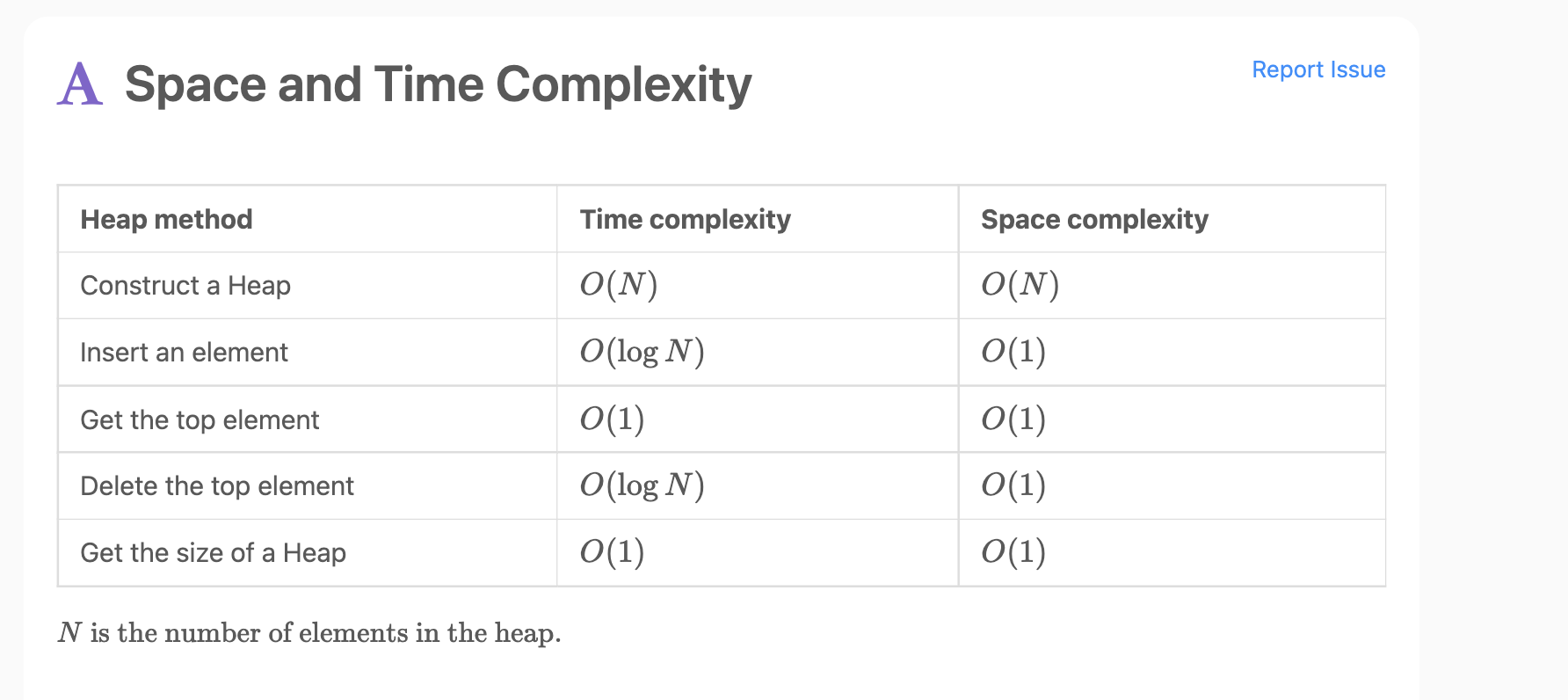
時間複雜度
| 資料結構 | 搜尋 | 插入 | 刪除 | 最小/最大 |
|---|---|---|---|---|
| 堆積(Heap) | O(n) | O(log n) | O(log n) | O(1) |
讀取堆頂元素(min-heap 取最小/max-heap 取最大)是 O(1);要找另一端的極值則是 O(n)。從
n個既有元素建堆,用 heapify 是 O(N) — 不是O(N log N)。空間為 O(N)。
總覽
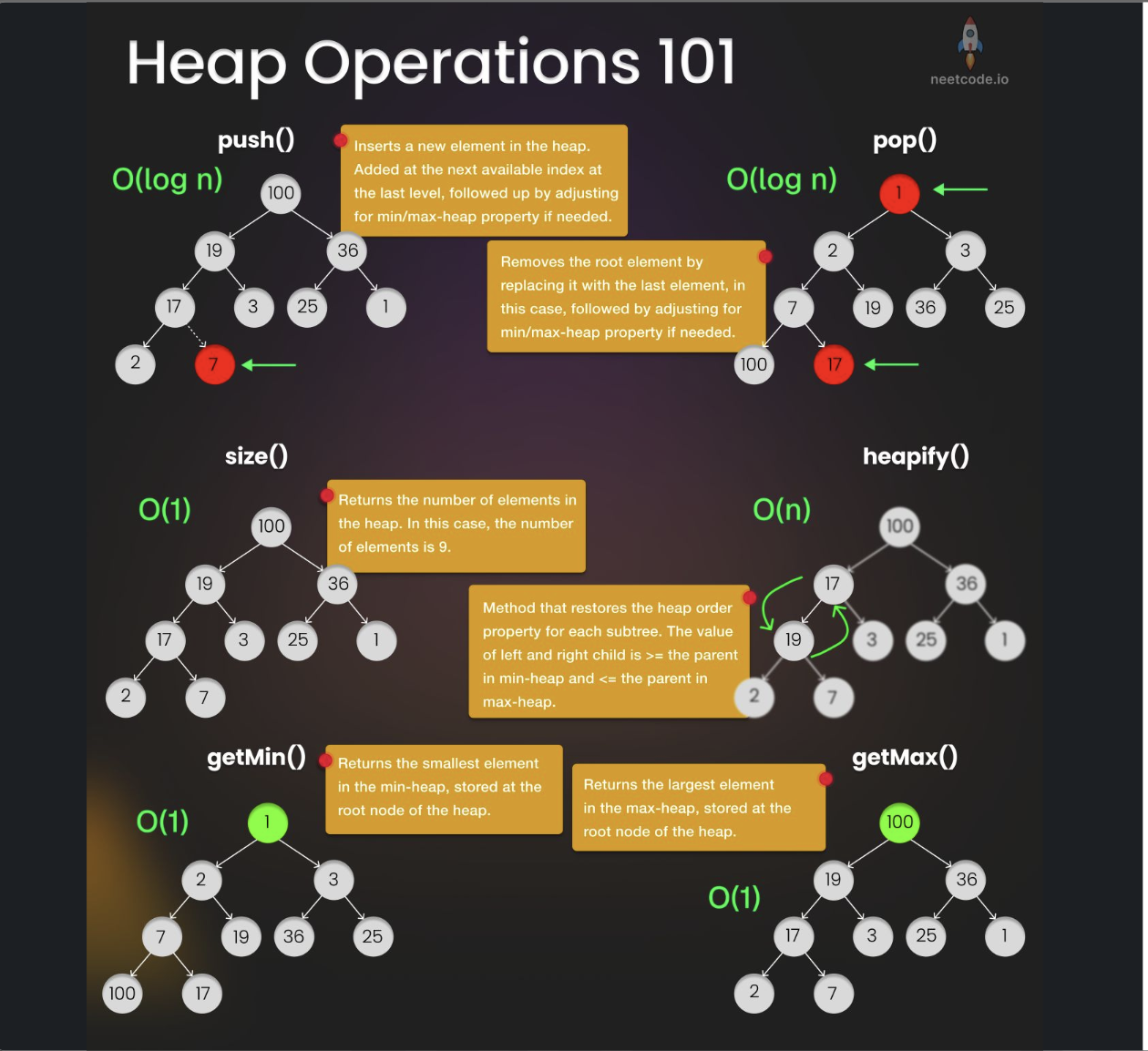
堆積(Heap) 是一棵滿足堆積性質的完全二元樹,因此非常適合用來高效存取資料集中的最大或最小元素。它是優先佇列與堆積排序演算法的基礎。
關鍵性質
- 複雜度:見上方的時間複雜度表格
- 核心想法:完全二元樹,且父子節點之間滿足堆積性質
- 什麼時候用:需要頻繁存取最小/最大元素、優先權排程、排序
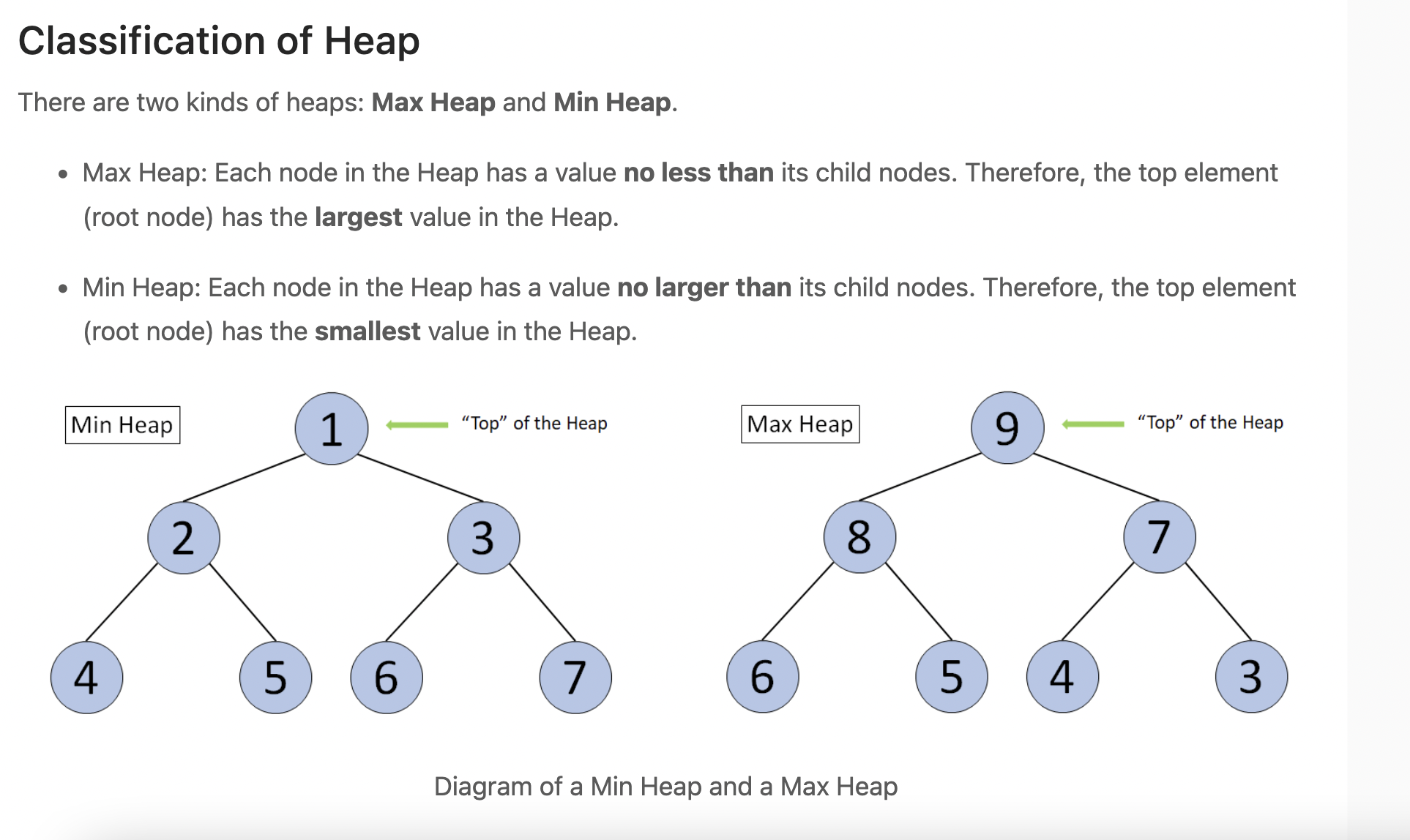
堆積的種類
- 最小堆積(Min Heap):父節點 ≤ 子節點(根是最小值)
- 最大堆積(Max Heap):父節點 ≥ 子節點(根是最大值)
與優先佇列的關係
- 優先佇列(Priority Queue):以優先權存取的抽象資料型別
- 堆積(Heap):優先佇列最常見的實作方式
- 關鍵差別:優先佇列是概念,堆積是實作
實作方式
- 通常用二元堆積(min-heap 或 max-heap)實作
- 需要進階操作時也可以用平衡二元搜尋樹或費氏堆積(Fibonacci heap)
- Python:
heapq模組(預設為 min-heap) - Java:
PriorityQueue類別(預設為 min-heap)
題型分類
模式 1:第 k 個元素問題
- 描述:在資料集中找第 k 大/第 k 小的元素
- 範例:LC 215、703、1492 - Kth Largest Element、Kth Largest in Stream、Kth Factor
- 模式:使用大小為 k 的 min/max heap,維持堆積性質
模式 2:Top K 問題
- 描述:找出頻率或數值最高/最低的前 k 個元素,或是讓所有頻率互不相同
- 範例:
- Top K:LC 347、692、973 - Top K Frequent Elements、Top K Words、K Closest Points
- 頻率唯一化:LC 1647、1481 - Make Frequencies Unique、Least Unique After K Removals
- 模式:先統計頻率,再用堆積維護 top k 結果或確保頻率唯一
模式 3:合併問題
- 描述:高效合併多個有序陣列/串列
- 範例:LC 23、373、378 - Merge k Lists、K Smallest Pairs、Kth Smallest in Matrix
- 模式:用 min heap 追蹤每個來源目前的最小值
模式 4:滑動視窗極值
- 描述:高效求出滑動視窗內的最小/最大值
- 範例:LC 239、480、1438 - Sliding Window Maximum、Sliding Median、Longest Subarray
- 模式:用堆積搭配延遲刪除,或用雙端佇列追蹤極值
模式 5:排程問題
- 描述:依優先權/時間安排任務或事件
- 範例:LC 1353、502、630、621、1834 - Max Events、IPO、Course Schedule III、Task Scheduler、Single-Threaded CPU
- 模式:用堆積依開始/結束時間或優先權維護事件
- 關鍵洞察(時間掃描 + 截止期限堆積):依視窗起點排序,讓元素按時間順序進堆積;堆積依視窗終點排序,這樣每個時間格都服務**最急迫(最早截止)**的元素;過期的堆頂用延遲刪除清掉
- 特徵:「每單位時間只能處理一件事」 + 「每件事有有效區間/截止期限」 → 見 heap_examples.md § LC 1353
- 陷阱:不要套用 LC 253 的計數掃描。在那題裡
[1,3]是佔用第 1~3 天;在這裡它只花掉{1,2,3}中的一天,而且每天最多一個事件 — 所以用最大重疊數會高估([[1,1],[1,1],[1,1]]→ 掃描得 3,答案是 1)。見 heap_examples.md § LC 1353
模式 6:資料串流問題
- 描述:處理連續資料串流上的最小/最大值查詢
- 範例:LC 295、480、1825 - Find Median、Sliding Median、Finding MK Average
- 模式:用兩個堆積(min + max)維持平衡結構
模式 7:可跳躍範圍的格子圖最短路徑
- 描述:在格子圖上求最短路徑,其中每個格子可以跳到一個範圍內的格子
- 範例:LC 2617 - Minimum Number of Visited Cells in a Grid
- 模式:DP + 每列/每行各一個優先佇列,搭配延遲刪除
- 關鍵洞察:一般 BFS 每個格子要 O(N²);用優先佇列可降到每格 O(log N)
- 相似題:LC 778(Swim in Rising Water)、LC 1631(Path With Minimum Effort)
模式 8:延遲刪除(堆積中的過期資料) 優先度 5/5 — 必備 — 幾乎每一輪面試都會出現
- 描述:堆積裡的值後來會被更新/失效,但二元堆積沒有 「decrease-key」/「移除任意元素」的操作 — 所以我們直接 push 新值,把舊的留在裡面
- 範例:LC 3092、2349、1834、480、1825、2336、621、1353、2406
- 模式:堆積 = 候選集合(可能過期) + 雜湊表 = 真值來源 → 只在讀取時清理堆頂,而且只清到堆頂有效為止
- 關鍵洞察:你從來不去堆積裡搜尋過期資料。你只檢查
heap[0], 而每筆過期資料整段執行下來最多被 pop 一次 → 攤還 O(log n) - 另見:heap_advanced.md § 延遲刪除 · heap_examples.md § LC 3092
- 同時要兩個極值(LC 2034):把堆積做成鏡像 — 一份真值對照表,加上存同樣
(price, ts)的 最大堆積與最小堆積,兩邊用同一個判定清理 → heap_advanced.md § LC 2034 變形 - 同一個想法在別處:雜湊表的墓碑、LSM-tree 的刪除、MVCC 的死列、Dijkstra 的
d > dist[u]跳過 → heap_advanced.md § 堆積之外
模式 9:掃描線 + 「存活」區間堆積 優先度 5/5 — 必備 — 幾乎每一輪面試都會出現
- 描述:掃描一個座標軸;堆積裡放的是當下覆蓋該座標的所有區間
- 範例:LC 218 The Skyline Problem、LC 1851 Minimum Interval to Include Each Query
- 模式:堆積存
(value, endCoordinate)→ 在起點插入,當end <= pos時在堆頂延遲驅逐,然後讀heap[0] - 特徵:「在每個 x,求所有覆蓋 x 的區間之最大/最小值」
- 另見:heap_advanced.md § 掃描線
模式 10:有上限的「後悔」堆積(k 次免費機會) 優先度 4/5 — 高價值 — 這裡有缺口就會掉關
- 描述:k 份免費資源 + 其餘部分的預算,而且要**線上(online)**決定
- 範例:LC 1642 Furthest Building You Can Reach、LC 1792 Maximum Average Pass Ratio
- 模式:樂觀地先給每個元素一次免費機會;min-heap 上限為 k;被擠掉的(最小的)那個改用預算支付
- 對照:LC 630 擠掉的是最大的(max-heap replace)— 同樣是「先承諾再後悔」的想法,只是比較器相反
- 另見:heap_advanced.md § 有上限的後悔堆積
模式 11:兩個堆積當資源池 優先度 4/5 — 高價值 — 這裡有缺口就會掉關
- 描述:配置器模擬 — 不是每一題「兩個堆積」都是中位數問題
- 範例:LC 1942 Smallest Unoccupied Chair、LC 1606 Find Servers、LC 1801 Orders in Backlog、LC 2073 Process Tasks Using Servers
- 模式:
free= 依資源編號排序的 min-heap,busy= 依釋放時間排序的 min-heap → 釋放 → 指派 → 佔用 - 另見:heap_advanced.md § 資源池
模式 12:帶限制的貪婪字串/序列建構 優先度 4/5 — 高價值 — 這裡有缺口就會掉關
- 描述:貪婪地用出現次數最多的元素來建構字串/序列,但當加進去會違反限制時(例如連續 3 個相同字元)就先跳過。用 max-heap 讓當前次數最多的元素隨時可取。
- 範例:LC 1405(Longest Happy String)、LC 767(Reorganize String)、LC 621(Task Scheduler)、LC 358(Rearrange String k Distance Apart)
- 模式:依計數排序的 max-heap;每一步先試堆頂元素 — 如果違反限制,就暫時改用第二個元素,再把第一個放回去
- 關鍵技巧:兩種情況的迴圈
- 情況 1 — 違反限制:poll 出
second,接上去、計數減一、若 > 0 再放回;然後把first放回(它沒有被消耗) - 情況 2 — 安全:接上
first、計數減一、若 > 0 再放回
- 情況 1 — 違反限制:poll 出
- 另見:Java 模板 7 — 連續上限(1 還是 2)就是 LC 767 和 LC 1405 的差別所在
模式 13:優先佇列 + 冷卻佇列(k 距離排程) 優先度 4/5 — 高價值 — 這裡有缺口就會掉關
- 描述:從 max-heap 貪婪地取出次數最多的元素,用完後把它鎖進冷卻佇列 k 步才能再被使用。這是「相同元素之間至少要相隔 k」這類題目的標準模式。
- 範例:LC 358(Rearrange String k Distance Apart)、LC 621(Task Scheduler)、LC 767(Reorganize String — k=2 的特例)
- 模式:max-heap 挑下一個元素;用完後該元素進入冷卻佇列並記
releaseTime = time + k;當time == releaseTime時再移回堆積 - 關鍵洞察:光靠優先佇列無法追蹤「上次使用位置」— 冷卻佇列扮演一條長度為 k 的延遲線,k 步之後自動讓元素重新可用
- 什麼時候用:
- 題目說「相同元素至少相隔 k」或「冷卻時間 k」
- 需要貪婪地挑出當前可用且次數最多的元素
- 元素在「可用 → 使用中 → 冷卻中 → 可用」之間循環
- 與模式 7 的差異:模式 7 檢查回看視窗並交換元素;模式 8 用一個明確的冷卻佇列來強制距離限制,對於可變的 k 來說更乾淨
參考資料
模板與演算法
模板對照表
標準模板放在這裡,而且是兩種語言都有。tier-4 的特化版本被拆到 heap_advanced.md — 右邊那一欄說明每個模板去了哪裡。
| 模板 | 使用情境 | 複雜度 | 位置 |
|---|---|---|---|
| 通用堆積 | 一般的最小/最大存取 | push/pop 為 O(log N) | 下方 |
| 第 k 個元素 | 第 k 大/第 k 小 | O(N log k) | 下方 |
| Top K 頻率 | 最常出現/最少出現 | O(N log k) | 下方 |
| 合併 K 個來源 | 合併有序陣列/串列 | O(N log k) | 下方 |
| 雙堆積系統 | 串流的中位數 | 每次操作 O(log N) | 下方 |
| 視窗極值(2 個堆積) | 可變視窗且同時需要最大與最小 | O(N log N) | 下方 |
| 區間排程 | 會議室、每天一個事件 | O(N log N) | 下方 |
| 貪婪 + 限制 | 建構不含連續 k 個相同字元的字串 | O(N log Σ) | 下方 |
| 優先佇列 + 冷卻佇列 | k 距離/任務排程 | O(N log Σ) | 下方 |
| 圖的最短路徑 | 用優先佇列的 Dijkstra | O(E log V) | Dijkstra.md |
| 延遲刪除 | push 進去的值會變動或過期 | 攤還 O(log N) | heap_advanced.md |
| 掃描 + 存活堆積 | 覆蓋 x 的區間之最大/最小值 | O(N log N) | heap_advanced.md |
| 有上限的後悔堆積 | k 次免費機會 + 預算 | O(N log k) | heap_advanced.md |
| 帶後悔的貪婪 | 撤銷過去最差的決定 | O(N log N) | heap_advanced.md |
| 資源池(2 個堆積) | 依編號的空閒池 + 依釋放時間的忙碌池 | O(N log N) | heap_advanced.md |
| 排序 + 固定大小堆積 | 目標式 = sum(A) × max/min(B) |
O(N log N) | heap_advanced.md |
| 格子圖最佳優先 | 展開代價最小的格子 | O(MN log MN) | heap_advanced.md |
| 格子圖範圍跳躍 | 每個格子跳到一個範圍 | O(MN log(M+N)) | heap_advanced.md |
| 頻率唯一化 | 讓所有頻率互不相同 | O(N + K log K) | heap_advanced.md |
| 堆積 + 去重集合 | 唯一性限制 | O(log N) | heap_advanced.md |
通用堆積模板
def solve_with_heap(nums, k=None):
    import heapq

    # Create heap (min heap by default in Python)
    heap = []

    # Build heap approach 1: Insert elements one by one
    for num in nums:
        heapq.heappush(heap, num)

    # Build heap approach 2: Heapify existing array
    # heapq.heapify(nums)  # O(N) time

    # Access min element (don't remove): heap[0]
    # Remove min element: heapq.heappop(heap)
    # Insert element: heapq.heappush(heap, value)

    # For max heap, use negative values
    # max_heap = [-x for x in nums]
    # heapq.heapify(max_heap)
    # max_val = -max_heap[0]  # Get max without removing
    # max_val = -heapq.heappop(max_heap)  # Remove and get max

    return heap
// Java Universal Template
public class HeapSolution {
    public void solveWithHeap(int[] nums, int k) {
        // Min Heap
        PriorityQueue<Integer> minHeap = new PriorityQueue<>();

        // Max Heap
        PriorityQueue<Integer> maxHeap = new PriorityQueue<>((a, b) -> Integer.compare(b, a));

        // Add elements
        for (int num : nums) {
            minHeap.offer(num);
        }

        // Access min: minHeap.peek()
        // Remove min: minHeap.poll()
        // Add element: minHeap.offer(value)
    }
}
各模式專用模板
1. 第 k 個元素模板
💡 關鍵洞察:
-
第 k 小的元素= 大小為 k 的 Max PQ 中最大的那個- 用大小為 k 的 max heap 找第 k 小
- max heap 的根(peek)就是第 k 小的元素
- 為什麼?因為只留下最小的 k 個元素;其中最大的那個就是整體第 k 小
-
第 k 大的元素= 大小為 k 的 Min PQ 中最小的那個- 用大小為 k 的 min heap 找第 k 大
- min heap 的根(peek)就是第 k 大的元素
- 為什麼?因為只留下最大的 k 個元素;其中最小的那個就是整體第 k 大
def find_kth_largest(nums, k):
    import heapq

    # Method 1: Min heap of size k
    heap = []
    for num in nums:
        if len(heap) < k:
            heapq.heappush(heap, num)
        elif num > heap[0]:
            heapq.heapreplace(heap, num)

    return heap[0]  # kth largest

def find_kth_smallest(nums, k):
    import heapq

    # Method 1: Max heap of size k (use negative values)
    heap = []
    for num in nums:
        if len(heap) < k:
            heapq.heappush(heap, -num)
        elif num < -heap[0]:
            heapq.heapreplace(heap, -num)

    return -heap[0]  # kth smallest
這個模板的變形(同樣的大小為 k 的不變量,只是比較器不同):
| LC | 題目 | 變化點 |
|---|---|---|
| 1985 | Find the Kth Largest Integer in the Array | 元素是數字字串 → 預設的字典序是錯的。要用 (len, string) 比較:字串越長數字越大,長度相同再退回字典序。大小為 k 的 min-heap,答案 = heap[0]。 |
| 1337 | The K Weakest Rows in a Matrix | push 元組 (soldierCount, rowIndex),讓平手時以列索引決勝;維持大小為 k 的 max-heap,最後讀出來。 |
# python
# LC 1985 - Find the Kth Largest Integer in the Array
# time = O(N log k), space = O(k)
# IDEA: kth largest -> min-heap of size k; key = (len, s) makes string order == numeric order
import heapq

def kthLargestNumber(nums, k):
    heap = []
    for s in nums:
        heapq.heappush(heap, (len(s), s))
        if len(heap) > k:
            heapq.heappop(heap)
    return heap[0][1]
// java
// LC 1985 - Find the Kth Largest Integer in the Array
// time = O(N log k), space = O(k)
// IDEA: min-heap of size k; comparator = length first, then lexicographic
public String kthLargestNumber(String[] nums, int k) {
    PriorityQueue<String> minHeap = new PriorityQueue<>(
        (a, b) -> a.length() != b.length() ? Integer.compare(a.length(), b.length()) : a.compareTo(b));

    for (String s : nums) {
        minHeap.offer(s);
        if (minHeap.size() > k) minHeap.poll();
    }
    return minHeap.peek();
}
2. Top K 頻率模板
def top_k_frequent(nums, k):
    from collections import Counter
    import heapq

    # Count frequencies
    count = Counter(nums)

    # Method 1: Min heap approach
    heap = []
    for num, freq in count.items():
        heapq.heappush(heap, (freq, num))
        if len(heap) > k:
            heapq.heappop(heap)

    return [item[1] for item in heap]

    # Method 2: Max heap approach
    # heap = [(-freq, num) for num, freq in count.items()]
    # heapq.heapify(heap)
    # return [heapq.heappop(heap)[1] for _ in range(k)]
這個模板的變形(先計數,再讓堆積替計數排序):
| LC | 題目 | 變化點 |
|---|---|---|
| 451 | Sort Characters By Frequency | 一樣是 Counter + max heap,但輸出的是 char * freq 而不只是 key。O(N) 的替代解法是桶排序。 |
| 1338 | Reduce Array Size to The Half | 計數的 max heap;不斷 pop 並累加,直到 removed >= n/2;答案 = pop 的次數。貪婪 = 永遠刪掉出現最多的那個值。 |
| 1405 | Longest Happy String | 依剩餘次數排序的 max heap + 一個「上次用過的字母」的檢查 — 形狀跟 LC 767 Reorganize String 一樣,但這裡允許同一個字母連續兩次(aab 合法,aaa 不合法)。 |
| 1054 | Distant Barcodes | 距離為 2 的 LC 767:依剩餘次數排序的 max heap,先填偶數索引再填奇數索引。 |
3. 合併 K 個來源模板
def merge_k_sorted_arrays(arrays):
    import heapq

    heap = []
    result = []

    # Initialize heap with first element from each array
    for i, arr in enumerate(arrays):
        if arr:  # Check if array is not empty
            heapq.heappush(heap, (arr[0], i, 0))

    while heap:
        val, array_idx, element_idx = heapq.heappop(heap)
        result.append(val)

        # Add next element from same array
        if element_idx + 1 < len(arrays[array_idx]):
            next_val = arrays[array_idx][element_idx + 1]
            heapq.heappush(heap, (next_val, array_idx, element_idx + 1))

    return result
變形 — 合併巢狀來源(LC 1439)或虛擬格子(LC 373 / 378),以及 LC 632「最小覆蓋範圍」的變化:heap_advanced.md § K 路合併變形。
4. 雙堆積系統模板(中位數)
class MedianFinder:
    def __init__(self):
        import heapq
        self.small = []  # max heap (use negative values)
        self.large = []  # min heap

    def addNum(self, num):
        import heapq

        # Add to appropriate heap
        if len(self.small) == len(self.large):
            heapq.heappush(self.large, -heapq.heappushpop(self.small, -num))
        else:
            heapq.heappush(self.small, -heapq.heappushpop(self.large, num))

    def findMedian(self):
        if len(self.small) == len(self.large):
            return (self.large[0] - self.small[0]) / 2.0
        else:
            return float(self.large[0])
5. 滑動視窗極值 — 兩個堆積 + 依索引過期 優先度 4/5 — 高價值 — 這裡有缺口就會掉關
核心想法
雙端佇列可以 O(1) 求滑動視窗最大值,但它只能追蹤一個極值,而且只適用固定大小的視窗。當視窗是可變大小,或你需要同時取得最大與最小時,就用兩個堆積並依索引讓資料過期:
maxHeap = (-value, index)     minHeap = (value, index)
stale  <=>  index < left      (the element has fallen out of the window)
left 前進時什麼都不用刪 — 只有當資料浮到堆頂時才會被丟掉。
實例演練 — LC 1438 Longest Continuous Subarray With Absolute Diff ≤ Limit
視窗合法的充要條件是 max(window) - min(window) <= limit。兩個堆積都留著;當視窗不合法時,把 left 跳到兩個違規極值中較早那一個之後(這是唯一能破壞違規配對的方式),然後對兩個堆積都做延遲清理。
# python
# LC 1438 - Longest Continuous Subarray With Absolute Diff Less Than or Equal to Limit
# time = O(N log N), space = O(N)
# IDEA: two heaps hold window max/min; shrink past the older extreme; purge stale indices lazily
import heapq

class Solution(object):
    def longestSubarray(self, nums, limit):
        max_h = []   # max-heap: (-val, idx)
        min_h = []   # min-heap: ( val, idx)
        left = 0
        res = 0

        for i, v in enumerate(nums):
            heapq.heappush(max_h, (-v, i))
            heapq.heappush(min_h, (v, i))

            # window invalid -> must drop at least one of the two extremes
            while -max_h[0][0] - min_h[0][0] > limit:
                # NOTE !!! move left PAST the earlier of the two extreme indices
                left = min(max_h[0][1], min_h[0][1]) + 1
                # lazy delete: anything left of the window is stale
                while max_h[0][1] < left:
                    heapq.heappop(max_h)
                while min_h[0][1] < left:
                    heapq.heappop(min_h)

            res = max(res, i - left + 1)

        return res
// java
// LC 1438 - Longest Continuous Subarray With Absolute Diff Less Than or Equal to Limit
// time = O(N log N), space = O(N)
// IDEA: max-heap + min-heap of {val, idx}; shrink past older extreme; lazy-purge stale indices
public int longestSubarray(int[] nums, int limit) {
    PriorityQueue<int[]> maxH = new PriorityQueue<>((a, b) -> Integer.compare(b[0], a[0]));  // {val, idx}
    PriorityQueue<int[]> minH = new PriorityQueue<>((a, b) -> Integer.compare(a[0], b[0]));

    int left = 0, res = 0;

    for (int i = 0; i < nums.length; i++) {
        maxH.offer(new int[]{nums[i], i});
        minH.offer(new int[]{nums[i], i});

        while (maxH.peek()[0] - minH.peek()[0] > limit) {
            left = Math.min(maxH.peek()[1], minH.peek()[1]) + 1;
            while (maxH.peek()[1] < left) maxH.poll();
            while (minH.peek()[1] < left) minH.poll();
        }

        res = Math.max(res, i - left + 1);
    }
    return res;
}
一次只縮一步 — 多數人第一次寫出來的形式,同樣正確:每次把 left 加 1,每一步之後都清理,而不是直接跳。複雜度一樣是 O(N log N) — left 總共最多移動 N 次 — 只是迴圈多跑幾圈。
# python
# LC 1438 - shrink form: left += 1 per step, purge stale tops after each step
# time = O(N log N), space = O(N)
            while -max_h[0][0] - min_h[0][0] > limit:
                left += 1
                while max_h[0][1] < left:
                    heapq.heappop(max_h)
                while min_h[0][1] < left:
                    heapq.heappop(min_h)
易錯點
- 比較時堆頂一定是新鮮的。 收縮迴圈每次結束時都已清理過兩個堆頂,而剛推入的元素絕不會過期,所以在
while之前(兩次 push 之後)再清理一次什麼也不會做。無害,但多餘。 - 清理迴圈不需要
heap and的防護。 剛推入的元素索引是right >= left,所以清理時任何一個堆積都不可能被清空。 - 兩個堆積都要清理,不能只清堆頂被移動的那個。 跳躍之後,另一個堆積的堆頂也可能落在新的
left左邊。
堆積 vs 單調雙端佇列:LC 1438 也有 O(N) 的雙 deque 解法 — monotonic_queue.md → Template 7。 當驅逐規則不是「最舊的先出」時(例如你是依值或依某個任意條件驅逐),就用堆積版本 — 單調雙端佇列表達不了這種規則。
這個模板的變形(同樣是「max-heap + 依索引/座標過期」的形狀):
| LC | 題目 | 變化點 |
|---|---|---|
| 1696 | Jump Game VI | dp[i] = nums[i] + max(dp[j]),其中 i-k <= j < i。存 (dp[j], j) 的 max-heap;讀取前先 pop 掉所有 j < i-k 的。堆積裡放的是 DP 值,不是原始輸入。 |
| 1499 | Max Value of Equation | 把 `y_i + y_j + |
Java 模板庫(PriorityQueue)
上面 5 個模板以 Python 為主。下面 8 個是同一片問題空間,改用 Java 的
PriorityQueue寫成。它們原本是獨立的priority_queue.md;下表把每個 Java 模板和它的 Python 對應版本配起來,兩邊都能對照著看。
| Java 模板(下方) | Python 對應版本(上方) | 代表題 |
|---|---|---|
| 模板 1:Top K Elements | 1. 第 k 個元素模板 | LC 215 |
| 模板 2:K 路合併 | 3. 合併 K 個來源模板 | LC 23 |
| 模板 3:雙堆積(中位數) | 4. 雙堆積系統模板 | LC 295 |
| 模板 4:區間排程 | (這裡沒有 Python 對應版本 — 見下方 LC 1353 的指引) | LC 253 |
| 模板 5:圖的最短路徑 | — 見 Dijkstra.md | LC 743 |
| 模板 6:自訂優先權 | 2. Top K 頻率模板 | LC 347 |
| 模板 7:貪婪字串建構 | (沒有 Python 對應版本) | LC 1405 |
| 模板 8:優先佇列 + 冷卻佇列 | (沒有 Python 對應版本) | LC 358 |
Java 模板對照表
| 模板類型 | 使用情境 | 堆積種類 | 複雜度 | 什麼時候用 |
|---|---|---|---|---|
| Top K Elements | 找最大/最小的 K 個 | Min/Max heap | O(n log k) | 固定 K 的挑選 |
| K 路合併 | 合併有序串列 | Min heap | O(n log k) | 多個有序來源 |
| 雙堆積 | 求中位數 | Min + Max heap | O(log n) | 串流中位數/百分位 |
| 區間排程 | 處理區間 | Min heap | O(n log n) | 會議室、事件 |
| 圖的最短路徑 | Dijkstra | Min heap | O(E log V) | 加權圖 |
| 自訂優先權 | 複雜的排序規則 | 自訂比較器 | O(log n) | 多重條件排序 |
| 貪婪 + 限制 | 建構避免連續重複的字串 | Max heap | O(n log k) | Reorganize/happy string |
| 優先佇列 + 冷卻佇列 | 相隔 k 距離的排程 | Max heap + Queue | O(n log k) | Rearrange k-dist、task scheduler |
模板 1:Top K Elements 模式 — LC 215
# Python - Find K largest elements
def topKElements(nums, k):
    import heapq

    # Min heap of size k for k largest
    min_heap = []

    for num in nums:
        heapq.heappush(min_heap, num)
        if len(min_heap) > k:
            heapq.heappop(min_heap)

    return min_heap  # Contains k largest elements

# With custom key for frequency
def topKFrequent(nums, k):
    from collections import Counter
    import heapq

    count = Counter(nums)
    # Use negative count for max heap effect
    return heapq.nlargest(k, count.keys(), key=count.get)
// Java - Top K elements with frequency
public int[] topKFrequent(int[] nums, int k) {
    Map<Integer, Integer> map = new HashMap<>();
    for (int n : nums) {
        map.put(n, map.getOrDefault(n, 0) + 1);
    }

    // Min heap based on frequency
    PriorityQueue<Integer> pq = new PriorityQueue<>(
        (a, b) -> Integer.compare(map.get(a), map.get(b))
    );

    for (int key : map.keySet()) {
        pq.add(key);
        if (pq.size() > k) {
            pq.poll();
        }
    }

    int[] result = new int[k];
    for (int i = k - 1; i >= 0; i--) {
        result[i] = pq.poll();
    }
    return result;
}
模板 2:K 路合併模式 — LC 23
# Python - Merge K sorted lists
def mergeKSortedLists(lists):
    import heapq

    min_heap = []

    # Initialize with first element from each list
    for i, lst in enumerate(lists):
        if lst:
            heapq.heappush(min_heap, (lst[0], i, 0))

    result = []
    while min_heap:
        val, list_idx, elem_idx = heapq.heappop(min_heap)
        result.append(val)

        # Add next element from same list
        if elem_idx + 1 < len(lists[list_idx]):
            next_val = lists[list_idx][elem_idx + 1]
            heapq.heappush(min_heap, (next_val, list_idx, elem_idx + 1))

    return result
// Java - Merge K sorted arrays
public int[] mergeKSortedArrays(int[][] arrays) {
    PriorityQueue<int[]> pq = new PriorityQueue<>(
        (a, b) -> Integer.compare(a[0], b[0])  // Compare values
    );

    int totalSize = 0;
    // Initialize PQ with first element from each array
    for (int i = 0; i < arrays.length; i++) {
        if (arrays[i].length > 0) {
            pq.offer(new int[]{arrays[i][0], i, 0});
            totalSize += arrays[i].length;
        }
    }

    int[] result = new int[totalSize];
    int idx = 0;

    while (!pq.isEmpty()) {
        int[] curr = pq.poll();
        result[idx++] = curr[0];

        int arrIdx = curr[1];
        int elemIdx = curr[2];

        if (elemIdx + 1 < arrays[arrIdx].length) {
            pq.offer(new int[]{
                arrays[arrIdx][elemIdx + 1],
                arrIdx,
                elemIdx + 1
            });
        }
    }

    return result;
}
這個骨架的變形(LC 632、355、373、378、1439): heap_advanced.md § K 路合併變形。
模板 3:雙堆積模式(求中位數)— LC 295
Python 版本:上方的 4. 雙堆積系統模板 — 同樣的 雙堆積不變量,只是改用
heappushpop而不是顯式重新平衡。
// Java - Two heaps for median
class MedianFinder {
    private PriorityQueue<Integer> small;  // Max heap
    private PriorityQueue<Integer> large;  // Min heap

    public MedianFinder() {
        small = new PriorityQueue<>(Collections.reverseOrder());
        large = new PriorityQueue<>();
    }

    public void addNum(int num) {
        small.offer(num);

        // Balance property
        if (!small.isEmpty() && !large.isEmpty() &&
            small.peek() > large.peek()) {
            large.offer(small.poll());
        }

        // Size property
        if (small.size() > large.size() + 1) {
            large.offer(small.poll());
        }
        if (large.size() > small.size() + 1) {
            small.offer(large.poll());
        }
    }

    public double findMedian() {
        if (small.size() > large.size()) {
            return small.peek();
        }
        if (large.size() > small.size()) {
            return large.peek();
        }
        return (small.peek() + large.peek()) / 2.0;
    }
}
模板 4:區間排程模式 — LC 253
# Python - Meeting rooms (minimum rooms needed)
def minMeetingRooms(intervals):
    import heapq

    if not intervals:
        return 0

    # Sort by start time
    intervals.sort(key=lambda x: x[0])

    # Min heap to track end times
    heap = []
    heapq.heappush(heap, intervals[0][1])

    for i in range(1, len(intervals)):
        # If current meeting starts after earliest end
        if intervals[i][0] >= heap[0]:
            heapq.heappop(heap)

        # Add current meeting end time
        heapq.heappush(heap, intervals[i][1])

    return len(heap)
// Java - Interval scheduling
public int minMeetingRooms(int[][] intervals) {
    if (intervals.length == 0) return 0;

    // Sort by start time
    Arrays.sort(intervals, (a, b) -> Integer.compare(a[0], b[0]));

    // Min heap for end times
    PriorityQueue<Integer> pq = new PriorityQueue<>();
    pq.offer(intervals[0][1]);

    for (int i = 1; i < intervals.length; i++) {
        // Room becomes free
        if (intervals[i][0] >= pq.peek()) {
            pq.poll();
        }
        pq.offer(intervals[i][1]);
    }

    return pq.size();
}
變形:Maximum Number of Events That Can Be Attended(LC 1353) — 變化點:堆積裡放的是目前開放中事件的結束日,而且你是一天一天掃描(不是一個區間一個區間),每天參加最早結束的那個事件。LC 253 數的是同時重疊的區間數;LC 1353 則是每天貪婪地挑一個。這兩題不是同一個掃描的變形:LC 253 的區間佔用整段期間,LC 1353 的區間只花掉裡面任一天,所以在這裡數重疊會高估。
// java
// LC 1353 - Maximum Number of Events That Can Be Attended
// IDEA: sort by start day; each day push all events that opened, drop expired ones,
//       then attend the one with the earliest end day (min-heap)
// time = O(n log n), space = O(n)
public int maxEvents(int[][] events) {
    Arrays.sort(events, (a, b) -> Integer.compare(a[0], b[0]));
    PriorityQueue<Integer> pq = new PriorityQueue<>();   // end days of open events
    int i = 0, n = events.length, res = 0, day = 0;

    while (i < n || !pq.isEmpty()) {
        // idle -> jump to the next start day, otherwise advance one day
        day = pq.isEmpty() ? events[i][0] : day + 1;

        while (i < n && events[i][0] <= day) pq.offer(events[i++][1]);   // now open
        while (!pq.isEmpty() && pq.peek() < day) pq.poll();              // expired

        if (!pq.isEmpty()) { pq.poll(); res++; }   // attend earliest-ending event
    }
    return res;
}
LC 1353 的 Python 版本,以及「跳日 vs 逐日掃描」的取捨分析: heap_examples.md § LC 1353。
模板 5:圖的最短路徑(Dijkstra)— LC 743
這屬於 Dijkstra.md 的範圍。優先佇列裡就只是 (distance, node),外加一個
延遲刪除的守衛 if d > dist[u]: continue;在這裡重寫一遍並不會多講出什麼跟堆積有關的東西。
模板 6:自訂優先權模式
# Python - Custom priority with multiple criteria
class Task:
    def __init__(self, name, priority, deadline):
        self.name = name
        self.priority = priority
        self.deadline = deadline

    def __lt__(self, other):
        # Higher priority first, then earlier deadline
        if self.priority != other.priority:
            return self.priority > other.priority
        return self.deadline < other.deadline

def processTasks(tasks):
    import heapq

    heap = []
    for task in tasks:
        heapq.heappush(heap, task)

    result = []
    while heap:
        task = heapq.heappop(heap)
        result.append(task.name)

    return result
// Java - Custom comparator for complex ordering
class Task {
    String name;
    int priority;
    int deadline;

    Task(String name, int priority, int deadline) {
        this.name = name;
        this.priority = priority;
        this.deadline = deadline;
    }
}

public List<String> processTasks(List<Task> tasks) {
    PriorityQueue<Task> pq = new PriorityQueue<>((a, b) -> {
        // Higher priority first
        if (a.priority != b.priority) {
            return Integer.compare(b.priority, a.priority);
        }
        // Earlier deadline first
        return Integer.compare(a.deadline, b.deadline);
    });

    for (Task task : tasks) {
        pq.offer(task);
    }

    List<String> result = new ArrayList<>();
    while (!pq.isEmpty()) {
        result.add(pq.poll().name);
    }

    return result;
}
模板 7:帶連續限制的貪婪字串建構 — LC 1405
// Java - Longest Happy String (LC 1405) / Reorganize String (LC 767)
// IDEA: Max-heap by count; two-case loop:
//   Case 1: top char would create 3 consecutive → use 2nd, put 1st back
//   Case 2: safe → use top char directly
// time = O((a+b+c) * log(3)) = O(n), space = O(1) heap size bounded by alphabet

class ValCnt {
    char val;
    int cnt;
    ValCnt(char val, int cnt) { this.val = val; this.cnt = cnt; }
}

public String longestDiverseString(int a, int b, int c) {
    PriorityQueue<ValCnt> pq = new PriorityQueue<>((x, y) -> Integer.compare(y.cnt, x.cnt));
    if (a > 0) pq.add(new ValCnt('a', a));
    if (b > 0) pq.add(new ValCnt('b', b));
    if (c > 0) pq.add(new ValCnt('c', c));

    StringBuilder sb = new StringBuilder();

    while (!pq.isEmpty()) {
        ValCnt first = pq.poll();
        int len = sb.length();

        // Case 1: adding `first` would create 3 consecutive → use second instead
        if (len >= 2
                && sb.charAt(len - 1) == first.val
                && sb.charAt(len - 2) == first.val) {

            if (pq.isEmpty()) break;          // no alternative → stop

            ValCnt second = pq.poll();        // use 2nd most frequent
            sb.append(second.val);
            second.cnt--;

            if (second.cnt > 0) pq.add(second);
            pq.add(first);                    // first was NOT used, put it back

        // Case 2: safe to use the most frequent character
        } else {
            sb.append(first.val);
            first.cnt--;
            if (first.cnt > 0) pq.add(first);
        }
    }

    return sb.toString();
}
重點觀察:
- 永遠貪婪地挑出現次數最多的(max-heap 保證這件事)。
- 當快要違反限制時,暫時跳過堆頂元素改用下一個 — 然後把堆頂原封不動放回去。
first只有在情況 2 才會被消耗;情況 1 會原樣重新插回。- 只要改一下回看視窗的檢查,就能套用到任何「最多連續 K 個」的限制。
變形:Reorganize String(LC 767)— 最多連續 1 個
// Only Case 1 check changes: len >= 1 && sb.charAt(len-1) == first.val
// Everything else is identical to the template above.
模板 8:優先佇列 + 冷卻佇列(k 距離排程)— LC 358
// Java - Rearrange String k Distance Apart (LC 358)
// IDEA: Max-heap picks most frequent available char;
//       cooldown queue locks used chars for k steps.
//
// Flow: PQ → poll → append → cooldown.offer([char, releaseTime])
//       when time == releaseTime → move back to PQ
//
// time = O(n log 26) = O(n), space = O(26) = O(1)

public String rearrangeString(String s, int k) {
    if (k <= 1) return s;

    int[] freq = new int[26];
    for (char c : s.toCharArray()) {
        freq[c - 'a']++;
    }

    // Max-heap ordered by remaining frequency
    PriorityQueue<Integer> pq = new PriorityQueue<>((a, b) -> Integer.compare(freq[b], freq[a]));
    for (int i = 0; i < 26; i++) {
        if (freq[i] > 0) pq.offer(i);
    }

    // Cooldown queue: [charIndex, remainingCount]
    // Size reaches k → front element has cooled for k steps → re-enable
    Queue<int[]> cooldown = new LinkedList<>();
    StringBuilder res = new StringBuilder();

    while (!pq.isEmpty()) {
        int idx = pq.poll();
        res.append((char) ('a' + idx));
        freq[idx]--;

        // Enter cooldown with current remaining count
        cooldown.offer(new int[]{idx, freq[idx]});

        // Release from cooldown after k steps
        if (cooldown.size() == k) {
            int[] ready = cooldown.poll();
            if (ready[1] > 0) {
                pq.offer(ready[0]);  // re-add to heap
            }
        }
    }

    return res.length() == s.length() ? res.toString() : "";
}
重點觀察:
- 冷卻佇列就是一條長度為 k 的固定大小延遲線。當它的大小達到 k 時,最舊的那筆剛好等滿 k 步,可以放行了。
- 如果
pq空了但cooldown還有東西 → 表示放不下任何字元 → 回傳""。 - 另一種冷卻寫法:存
[char, releaseTime],然後檢查cooldown.peek()[1] == time而不是檢查佇列大小。兩種寫法等價。 - 這個模式可以推廣:LC 621(Task Scheduler)用的是同一個想法,只是改成數閒置格;LC 767 則是 k=2 的特例。
比較:冷卻佇列 vs 跳過再交換(模板 7)
| 面向 | 冷卻佇列(模板 8) | 跳過再交換(模板 7) |
|---|---|---|
| 最適合 | 可變的 k、較大的 k | 較小的 k(k=2 或 k=3) |
| 機制 | 用明確的佇列延後重新進場 | 回看視窗 + 交換 |
| 無解偵測 | cooldown 非空時 pq.isEmpty() |
不適用(沒有選項時就停止) |
| 較適用於 | LC 358、LC 621 | LC 1405、LC 767 |
語言 API
完整參考 — 每一個 heapq 呼叫及其輸出、peek 規則、偏序陷阱:
heap_language_apis.md。
| 你需要什麼 | Python heapq |
Java PriorityQueue |
|---|---|---|
| Min-heap | h = [] |
new PriorityQueue<>() |
| Max-heap | push 取負的鍵值:heappush(h, -v) |
new PriorityQueue<>(Collections.reverseOrder()) |
| 從串列建堆 — O(N),不是 O(N log N) | heapq.heapify(lst) |
new PriorityQueue<>(collection) |
| Push | heapq.heappush(h, v) |
pq.offer(v) |
| Pop 堆頂 | heapq.heappop(h) |
pq.poll() |
| Peek 堆頂 — O(1) | h[0] — 沒有 peek() |
pq.peek() |
| 先 pop 再 push(只做一次 sift) | heapq.heapreplace(h, v) |
pq.poll(); pq.offer(v); |
| 先 push 再 pop(只做一次 sift) | heapq.heappushpop(h, v) |
pq.offer(v); pq.poll(); |
| 最大/最小的前 k 個 | heapq.nlargest(k, it) / nsmallest |
大小為 k 的 min-/max-heap,最後倒出來 |
| 判斷是否為空 | if h: |
pq.isEmpty() |
| 自訂順序 | 元組鍵值,或在類別上定義 __lt__ |
comparator lambda |
三條規則可以避開大部分堆積的 bug
- 只有索引
0有意義。h[1]、h[-1],以及走訪 Java 的PriorityQueue,得到的都是 偏序,不是排序好的順序。 - 比較器要用
Integer.compare(a, b)/Long.compare(a, b),絕不要用a - b— 遇到很大的 數或負數時減法會溢位。 - 守住空的情況。
h[0]會丟IndexError;Java 的peek()回傳null,而element()會拋例外。在while條件裡把是否為空的判斷放最前面,才能短路。
# python
# the size-k idiom, written once
import heapq

def k_largest(nums, k):                 # time = O(N log k), space = O(k)
    h = []
    for v in nums:
        if len(h) < k:
            heapq.heappush(h, v)
        elif v > h[0]:                  # peek, then replace in one sift
            heapq.heapreplace(h, v)
    return h                            # h[0] == the kth largest

def k_smallest(nums, k):                # max-heap = negate on the way in and out
    h = []
    for v in nums:
        heapq.heappush(h, -v)
        if len(h) > k:
            heapq.heappop(h)
    return [-x for x in h]              # -h[0] == the kth smallest
總結與快速參考
決策表 — 該用哪一種堆積模式?
由上往下讀;第一個吻合的列就是該用的模式。
| 如果題目說… | 就用 | 堆積的形狀 | 經典 LC |
|---|---|---|---|
| 「第 k 大」/「第 k 小」 | 第 k 個元素 | 第 k 大用大小為 k 的 min-heap;第 k 小用大小為 k 的 max-heap | 215、703、378、1492、1985、1337 |
| 「出現最多的前 k 個」/「最近的 k 個」 | Top K 頻率 | Counter → 依計數/距離排序、大小為 k 的堆積 |
347、692、973、658、451、1338、1054 |
| 「合併 k 個有序…」或一個有序的格子 | 合併 K 個來源 | 存 (value, sourceIdx, elemIdx) 的 min-heap |
23、373、378、632、786、1439 |
| 串流的「中位數」/「兩半平衡」 | 雙堆積系統 | 小的那一半用 max-heap + 大的那一半用 min-heap,兩者大小差不超過 1 | 295、480、1825 |
| 可變大小視窗且同時需要最大與最小 | 視窗極值(2 個堆積) | 兩個存 (value, index) 的堆積,index < left 即為過期 |
1438、1696、1499 |
| 「最少幾間會議室/幾組」— 數重疊 | 區間排程 | 依起點排序,結束時間放 min-heap,堆積大小就是答案 | 253、2406、1094 |
| 「每單位時間一件事」+ 截止期限 | 區間排程(逐日掃描) | 依起點排序,結束日放 min-heap,參加最早截止的 | 1353、1834、1705 |
| 「不能連續 k 個相同」/「相隔 k」 | 貪婪 + 限制,或優先佇列 + 冷卻佇列 | 依剩餘次數排序的 max-heap(+ 一條 k 格的延遲線) | 1405、767、621、358、1054 |
| 圖上的加權最短路徑 | Dijkstra — Dijkstra.md | 存 (distance, node) 的 min-heap |
743、787、1514、1631 |
| push 進去的值後來變動或過期 | 延遲刪除 — heap_advanced.md | 候選堆積 + 真值雜湊表;在讀取時清理堆頂 | 3092、2349、2034、480、1825、239 |
| 「在每個 x,求所有覆蓋 x 的區間之最大值」 | 掃描 + 存活堆積 — heap_advanced.md | 存 (value, end) 的 max-heap,end <= x 就驅逐 |
218、1851 |
| 「k 把梯子/k 次免費升級」+ 預算 | 有上限的後悔堆積 — heap_advanced.md | 上限為 k 的 min-heap;被擠掉的最小者改用預算支付 | 1642、1792 |
| 你要到後來才發現自己拿太多了 | 帶後悔的貪婪 — heap_advanced.md | 先全拿,再 poll() 掉最差的決定 |
871、630、502 |
| 「編號最小的空椅/伺服器/座位」 | 資源池 — heap_advanced.md | 依編號的空閒堆積 + 依釋放時間的忙碌堆積 | 1942、1606、1801、2073、2102 |
目標式是 sum(A) × max/min(B) |
排序 + 固定大小堆積 — heap_advanced.md | 依 B 排序,A 用大小為 k 的堆積 | 857、1383 |
| 格子圖上代價是 minimax 或累積型 | 格子圖最佳優先 — heap_advanced.md | 從邊界初始化的 min-heap,每次展開最便宜的 | 407、778、1631、1368、675 |
| 每個格子跳到一個範圍的格子 | 格子圖範圍跳躍 — heap_advanced.md | 每列一個、每行一個優先佇列,延遲 pop | 2617 |
| 「讓所有頻率互不相同」 | 頻率唯一化 — heap_advanced.md | max-heap 逐次遞減,或用已使用頻率的集合 | 1647、1481 |
| 固定大小視窗,而且只要最大值 | 不要用堆積 — monotonic_queue.md | 單調雙端佇列,攤還 O(1) | 239、1425 |
| 只問一次第 k 個元素,之後沒有更新 | 不要用堆積 — quickselect,平均 O(N) | — | 215 |
複雜度速查
| 操作 | 二元堆積 | 有序陣列 | 平衡 BST |
|---|---|---|---|
| 從 n 個元素建構 | O(n)(heapify) | O(n log n) | O(n log n) |
| 插入 | O(log n) | O(n) | O(log n) |
| 刪除最小/最大 | O(log n) | O(1) | O(log n) |
| 讀取最小/最大 | O(1) | O(1) | O(log n) |
| 搜尋/刪除任意元素 | O(n) | O(log n) / O(n) | O(log n) |
| 合併兩個結構 | O(n + m) | O(n + m) | O(n + m) |
| 空間 | O(n) | O(n) | O(n) |
面試時值得主動講出來的推論:
- 沒有 decrease-key,也不能移除任意元素。 heap_advanced.md 裡的所有技巧,存在的理由就是為了繞開這件事。
- 大小為 k 的堆積把
O(N log N)變成O(N log k),把O(N)空間變成O(k)。 - 另一端的極值是 O(n):min-heap 對它的最大值提供不了任何廉價資訊。
常見模式與技巧
Python 的 Max Heap(用取負數)
import heapq

# Create max heap by negating values
max_heap = [-x for x in nums]
heapq.heapify(max_heap)

# Insert into max heap
heapq.heappush(max_heap, -val)

# Get max value (remember to negate back)
max_val = -max_heap[0]  # peek
max_val = -heapq.heappop(max_heap)  # pop
搭配自訂物件的堆積
# Method 1: Using tuples (automatic comparison)
heap = []
heapq.heappush(heap, (priority, data))

# Method 2: Using custom class with __lt__
class Task:
    def __init__(self, priority, data):
        self.priority = priority
        self.data = data

    def __lt__(self, other):
        return self.priority < other.priority

heap = []
heapq.heappush(heap, Task(1, "high priority"))
平手時的決勝
# python
# a heap of (key, payload) compares the payload when keys tie -> unorderable types crash.
# push a monotone counter as the second element so the comparison never reaches the payload.
import heapq, itertools

counter = itertools.count()
heapq.heappush(pq, (priority, next(counter), payload))   # FIFO among equal priorities
常見錯誤與提示
🚫 常見錯誤
- 堆積方向搞反。 「第 k 大」用大小為 k 的 min-heap;「第 k 小」用大小為 k 的 max-heap。動手寫之前先把不變量唸出來:「堆積裡放的是目前看過最大的 k 個,所以堆頂就是答案。」
- 忘記負回去 — 在 Python 用取負來假裝 max-heap 時,push 和 讀取兩邊都要處理。
- 讓堆積無限長大:在第 k 個元素的題目裡,一旦
len(h) > k就要 pop,否則你白白付了O(N log N)。 - 雙堆積系統失衡。 每一次插入之後都要重新確立
|len(small) - len(large)| <= 1, 而不是等到要讀中位數時才做。 - Java 裡用
a - b當比較器 — 會溢位。請用Integer.compare/Long.compare。 - 在寫入時清理過期資料。 延遲刪除是在讀取時清理堆頂,用
while(過期資料可能疊好幾筆), 而且要加上空值守衛。 - 讀
h[1]/h[-1]以為會拿到第二小或最大值。堆積只有偏序。
✅ 最佳實務
- 對既有串列用
heapify— O(N) 勝過 N × O(log N)。 - 反正都要換掉堆頂時,就用
heapreplace/heappushpop(只做一次 sift)。 - push 元組時把第一個元素當排序鍵;加一個計數器來決勝平手。
- 先考慮替代方案:靜態資料用排序、一次性的第 k 個用 quickselect、
固定大小視窗用單調雙端佇列、真的需要任意刪除時用
TreeMap/SortedList。 - 測
k == 1、k == n、空輸入,以及所有元素相同的情況。
面試提示
- 先問清楚:允許重複值嗎?
k > n可能嗎?是串流還是靜態資料?值會被更新嗎? - 說出模式名稱(用上面的決策表),然後講出堆積的不變量 — 面試官在聽的就是這一句話。
- 用 k 來表達複雜度,而不只是用 n:
O(N log k)時間、O(k)空間,正是堆積勝過排序的全部理由。 - 預期會被追問:「如果值會變動呢?」(延遲刪除)、「如果視窗是固定的呢?」(單調雙端佇列)、 「如果要重複詢問第 k 個元素呢?」(把堆積留著)。
相關主題
- Dijkstra.md — 最經典的優先佇列演算法;它的
if d > dist[u]: continue就是一次延遲刪除 - monotonic_queue.md — 固定大小視窗極值的 O(1) 替代方案
- sort.md — 堆積排序,以及什麼時候排序勝過堆積
- streaming_algorithms.md — 無界串流上的 top-k
- greedy.md — 讓後悔類模式成立的交換論證
- intervals.md / scanning_line.md — 區間排程家族中 不用堆積的另一半
各語言注意事項
- Python
heapq— 只有 min-heap;要 max-heap 就取負;heappush、heappop、heapify、heapreplace、heappushpop、nlargest、nsmallest、merge。 - Java
PriorityQueue— 預設是 min-heap;要 max-heap 就用new PriorityQueue<>(Collections.reverseOrder())或用Integer.compare建的比較器;offer、poll、peek、size。 - C++
priority_queue— 預設是 max-heap;要 min-heap 請用priority_queue<int, vector<int>, greater<int>>。