Hash Map — Worked Examples
Scope — The worked-solution archive for the hash-map family: one canonical solution per problem, the pattern-specific templates that are really single-problem deep dives, and the ordered-map (Java
TreeMap/ PythonSortedDict) reference. See also — parent sheet: hash_map.md — the canonical templates, the problem→pattern decision table and the interview tips this archive backs. Neighbouring sheets: prefix_sum.md — the prefix-sum family in its own right; hashing.md — how hashing works, plus counting and rolling-hash idioms; set.md — membership only, no values.
LeetCode Problem Lists
Overview
This file is the long tail of hash_map.md. It holds three kinds of material that would otherwise bury the templates in the main sheet:
- Templates & Algorithms — patterns that are, in practice, a deep dive on one or two problems (bucket sort, rolling hash, split-and-probe, max-frequency arithmetic), plus the ordered-map reference (
TreeMap/SortedDict), which is a sorted map and therefore not what the main sheet owns. - LC Examples — the worked solutions, one canonical version per problem per language.
- Problems by Pattern — the full per-category problem tables.
Key Properties
- Complexity: see the Time Complexity table in the main sheet
- Core Idea: every section here is an application of one of the templates in the main sheet — the template is the thing to memorise, these are the rehearsals
- When to Use: after you know which template a problem needs and want to see it written out in full
Templates & Algorithms
Ordered Map — Java TreeMap / Python SortedDict
⚠️ Python has NO built-in
TreeMap— the stdlib ships no ordered map at all. The de-facto replacement isSortedDictfrom the third-partysortedcontainerspackage (preinstalled on LeetCode). See theSortedDictvsTreeMapcomparison below for where they actually differ.
# Python - SortedDict (from sortedcontainers)
from sortedcontainers import SortedDict

# TreeMap Pattern Template
def treemap_pattern(data, target):
    # SortedDict keeps keys in sorted order
    tree_map = SortedDict()

    # Basic operations
    tree_map[key] = value           # O(log n) insert
    value = tree_map.get(key)       # O(1) !! backed by a hash dict, NOT a tree walk
    del tree_map[key]               # O(log n) delete

    # Ordered access — keys() is an INDEXABLE sorted view (O(log n) random access)
    keys = tree_map.keys()
    first_key = keys[0]  if tree_map else None          # firstKey()
    last_key  = keys[-1] if tree_map else None          # lastKey()
    tree_map.peekitem(0)                                # firstEntry() -> (k, v)
    tree_map.peekitem(-1)                               # lastEntry()  -> (k, v)

    # Floor / Ceiling — use the SortedDict's OWN bisect methods.
    # ❌ do NOT do `bisect.bisect_left(list(tree_map.keys()), target)`
    #    -> list(...) copies every key = O(n), killing the O(log n) win
    i = tree_map.bisect_left(target)    # first index with key >= target
    j = tree_map.bisect_right(target)   # first index with key >  target

    ceil_key  = keys[i]     if i < len(tree_map) else None   # ceilingKey(target)
    floor_key = keys[j - 1] if j > 0             else None   # floorKey(target)

    # Range query: all keys in [lo, hi]
    for k in tree_map.irange(lo, hi):                   # subMap(lo, true, hi, true)
        process(k, tree_map[k])

    return tree_map

# Examples: LC 853, LC 729/731/732, LC 846, LC 352, LC 981
Java TreeMap → Python SortedDict API Mapping Priority 5 of 5 — Must know — expect it in almost every loop
Java TreeMap |
Python SortedDict |
Note |
|---|---|---|
firstKey() / lastKey() |
d.keys()[0] / d.keys()[-1] |
|
firstEntry() / lastEntry() |
d.peekitem(0) / d.peekitem(-1) |
returns (k, v) tuple |
floorKey(x) (largest ≤ x) |
d.keys()[d.bisect_right(x) - 1] |
guard idx >= 0 |
ceilingKey(x) (smallest ≥ x) |
d.keys()[d.bisect_left(x)] |
guard idx < len(d) |
lowerKey(x) (strictly < x) |
d.keys()[d.bisect_left(x) - 1] |
guard idx >= 0 |
higherKey(x) (strictly > x) |
d.keys()[d.bisect_right(x)] |
guard idx < len(d) |
subMap(lo, true, hi, true) |
d.irange(lo, hi) |
inclusive both ends |
headMap(hi, true) |
d.irange(maximum=hi) |
|
tailMap(lo, true) |
d.irange(minimum=lo) |
|
pollFirstEntry() / pollLastEntry() |
d.popitem(0) / d.popitem(-1) |
|
descendingMap() |
reversed(d) / d.keys()[::-1] |
|
new TreeMap<>(comparator) |
SortedDict(key_func) |
key transform, not a comparator |
⚠️ The #1 gotcha: Java’s floorKey/ceilingKey hand you a key (or null);
Python’s bisect_* hand you an index that can be -1 or len(d).
Always guard the index before subscripting:
# python — the safe floor/ceiling idiom
i = d.bisect_left(x)
ceil_key = d.keys()[i] if i < len(d) else None      # ceilingKey(x)

j = d.bisect_right(x) - 1
floor_key = d.keys()[j] if j >= 0 else None         # floorKey(x)
// Java - TreeMap Pattern
import java.util.*;

// TreeMap Pattern Template
public void treeMapPattern(int[] data) {
    // TreeMap maintains sorted order by key (Red-Black Tree)
    TreeMap<Integer, Integer> treeMap = new TreeMap<>();

    // Basic operations - O(log n)
    treeMap.put(key, value);        // Insert
    Integer value = treeMap.get(key);  // Search
    treeMap.remove(key);            // Delete

    // Ordered operations - O(log n)
    Integer firstKey = treeMap.firstKey();   // Min key
    Integer lastKey = treeMap.lastKey();     // Max key
    Integer floorKey = treeMap.floorKey(k);  // Largest key <= k
    Integer ceilKey = treeMap.ceilingKey(k); // Smallest key >= k

    // Lower/Higher (exclusive)
    Integer lower = treeMap.lowerKey(k);     // Largest key < k
    Integer higher = treeMap.higherKey(k);   // Smallest key > k

    // Range queries - O(k log n) where k is range size
    Map.Entry<Integer, Integer> firstEntry = treeMap.firstEntry();
    Map.Entry<Integer, Integer> lastEntry = treeMap.lastEntry();

    // Iterate in sorted order - O(n)
    for (Map.Entry<Integer, Integer> entry : treeMap.entrySet()) {
        int key = entry.getKey();
        int val = entry.getValue();
        // Process in sorted order
    }

    // SubMap views (range queries)
    SortedMap<Integer, Integer> subMap = treeMap.subMap(fromKey, toKey);
    SortedMap<Integer, Integer> headMap = treeMap.headMap(toKey);
    SortedMap<Integer, Integer> tailMap = treeMap.tailMap(fromKey);
}
SortedDict vs TreeMap: implementation differences
They solve the same problems, but they are not the same data structure:
Python SortedDict |
Java TreeMap |
|
|---|---|---|
| Source | pip install sortedcontainers — NOT stdlib (preinstalled on LeetCode) |
java.util, built-in |
| Implementation | dict + SortedList of keys (list-of-lists, B-tree-ish) |
Red-black tree (self-balancing BST) |
d[k] / get(k) |
O(1) — plain hash lookup | O(log n) — tree descent |
| insert / delete | O(log n) amortized | O(log n) |
| floor / ceiling | O(log n) via bisect_* (returns an index) |
O(log n) via floorKey/ceilingKey (returns a key or null) |
| k-th smallest key | O(log n) — d.keys()[k] ✅ |
❌ not supported (O(n) iteration) |
| Custom ordering | SortedDict(key_func) — a key transform only |
Comparator — arbitrary 2-arg logic |
| Duplicate keys | ❌ | ❌ |
| Thread-safe | ❌ | ❌ (use ConcurrentSkipListMap) |
Takeaways:
SortedDictis faster thanTreeMapfor plain value lookups (O(1) hash vs O(log n) walk).SortedDictsupports index access (keys()[k]) in O(log n) — great for “k-th smallest key” problems, whichTreeMapcannot do without an order-statistic tree.TreeMap’sComparatoris strictly more expressive thanSortedDict’s key function.- If imports are restricted to stdlib, fall back to
bisecton a plain list (O(log n) search, but O(n) insert due to list shifting) — fine for smalln.
TreeMap vs HashMap Comparison:
| Feature | HashMap | TreeMap |
|---|---|---|
| Ordering | No ordering | Sorted by key |
| Underlying Structure | Hash Table + Linked List/Red-Black Tree (collision) | Red-Black Tree |
| Insert/Delete/Search | O(1) average, O(n) worst | O(log n) |
| Iteration | No specific order | Sorted order by key |
| Floor/Ceiling | Not supported | O(log n) |
| Range Queries | Not supported | O(k log n) |
| Use Case | Fast lookups, no ordering needed | Ordered iteration, range queries, floor/ceiling |
| Memory | Less (hash table) | More (tree nodes + pointers) |
When to Use TreeMap:
- Need keys in sorted order
- Need floor/ceiling operations (closest key)
- Need range queries (all keys in [a, b])
- Need first/last key efficiently
- Problems involving intervals, ranges, or ordering constraints
When NOT to Use TreeMap:
- Only need fast O(1) lookups without ordering
- Memory is constrained (TreeMap uses more memory)
- Don’t need ordered operations (HashMap is faster)
Common TreeMap Patterns:
-
Pattern 1: Ordered Map for Sorting
java// LC 853 - Car Fleet // Convert HashMap to TreeMap for sorted iteration Map<Integer, Integer> map = new HashMap<>(); // ... populate map ... TreeMap<Integer, Integer> sorted = new TreeMap<>(map); -
Pattern 2: Interval Management
java// LC 729/731/732 - My Calendar series // Use TreeMap to check overlapping intervals TreeMap<Integer, Integer> calendar = new TreeMap<>(); public boolean book(int start, int end) { Integer prev = calendar.floorKey(start); Integer next = calendar.ceilingKey(start); if ((prev == null || calendar.get(prev) <= start) && (next == null || end <= next)) { calendar.put(start, end); return true; } return false; } -
Pattern 3: Consecutive Elements
java// LC 846 - Hand of Straights // Use TreeMap to process smallest elements first TreeMap<Integer, Integer> count = new TreeMap<>(); // ... count frequency ... while (!count.isEmpty()) { int first = count.firstKey(); // Process consecutive sequence starting from first } -
Pattern 4: Range/Stream Problems
java// LC 352 - Data Stream as Disjoint Intervals // Maintain disjoint intervals in sorted order TreeMap<Integer, int[]> intervals = new TreeMap<>(); public void addNum(int val) { Integer lower = intervals.floorKey(val); Integer higher = intervals.ceilingKey(val); // Merge intervals if needed }
Classic LeetCode Problems:
| Problem | LC# | Difficulty | Key TreeMap Operation |
|---|---|---|---|
| Car Fleet | 853 | Medium | Sort by position (key) |
| My Calendar I | 729 | Medium | floorKey/ceilingKey for overlap check |
| My Calendar II | 731 | Medium | Count overlapping bookings |
| My Calendar III | 732 | Hard | Maximum overlapping count |
| Hand of Straights | 846 | Medium | firstKey for smallest element |
| Data Stream as Disjoint Intervals | 352 | Hard | Merge intervals with floor/ceiling |
| Time Based Key-Value Store | 981 | Medium | floorKey for timestamp lookup |
| Count of Smaller Numbers After Self | 315 | Hard | Ordered iteration |
| Contains Duplicate III | 220 | Medium | floorKey/ceilingKey for range check |
| The Skyline Problem | 218 | Hard | Multiset with TreeMap |
Example: LC 853 - Car Fleet
# Python - LC 853 Car Fleet
def carFleet(target, position, speed):
    # Use sorted iteration (similar to TreeMap)
    cars = sorted(zip(position, speed), reverse=True)  # Sort by position descending

    stack = []
    for pos, spd in cars:
        time = (target - pos) / spd  # Time to reach target
        if not stack or time > stack[-1]:
            stack.append(time)

    return len(stack)

# Alternative using SortedDict
from sortedcontainers import SortedDict

def carFleet_v2(target, position, speed):
    car_map = SortedDict()
    for p, s in zip(position, speed):
        car_map[-p] = s  # Negative for reverse order

    fleets = 0
    prev_time = 0

    for neg_pos, spd in car_map.items():
        pos = -neg_pos
        time = (target - pos) / spd
        if time > prev_time:
            fleets += 1
            prev_time = time

    return fleets
// Java - LC 853 Car Fleet
/**
 * time = O(N log N)
 * space = O(N)
 */
public int carFleet(int target, int[] position, int[] speed) {
    // Build HashMap first
    Map<Integer, Integer> map = new HashMap<>();
    for (int i = 0; i < position.length; i++) {
        map.put(position[i], speed[i]);
    }

    // Convert to TreeMap for sorted iteration (descending order)
    TreeMap<Integer, Integer> treeMap = new TreeMap<>(Collections.reverseOrder());
    treeMap.putAll(map);

    int fleets = 0;
    double prevTime = 0;

    // Iterate from position closest to target (sorted order)
    for (Map.Entry<Integer, Integer> entry : treeMap.entrySet()) {
        int pos = entry.getKey();
        int spd = entry.getValue();
        double time = (double)(target - pos) / spd;

        // If current car takes longer, it forms a new fleet
        if (time > prevTime) {
            fleets++;
            prevTime = time;
        }
    }

    return fleets;
}
Example: LC 729 - My Calendar I
// Java - LC 729 My Calendar I
/**
 * time = O(log N) per operation
 * space = O(N)
 */
class MyCalendar {
    TreeMap<Integer, Integer> calendar;

    public MyCalendar() {
        calendar = new TreeMap<>();
    }

    public boolean book(int start, int end) {
        // Find largest start time <= current start
        Integer prev = calendar.floorKey(start);

        // Find smallest start time >= current start
        Integer next = calendar.ceilingKey(start);

        // Check no overlap with previous booking
        if (prev != null && calendar.get(prev) > start) {
            return false;
        }

        // Check no overlap with next booking
        if (next != null && next < end) {
            return false;
        }

        calendar.put(start, end);
        return true;
    }
}
# python
# LC 729 - My Calendar I
# V1) Closest 1:1 translation of the Java floorKey / ceilingKey solution
from sortedcontainers import SortedDict

class MyCalendar:
    # time = O(log N) per booking, space = O(N)
    def __init__(self):
        self.calendar = SortedDict()   # start -> end

    def book(self, start: int, end: int) -> bool:
        keys = self.calendar.keys()

        # floorKey(start): largest key <= start
        i = self.calendar.bisect_right(start)
        prev = keys[i - 1] if i > 0 else None

        # ceilingKey(start): smallest key >= start
        j = self.calendar.bisect_left(start)
        nxt = keys[j] if j < len(keys) else None

        if (prev is None or self.calendar[prev] <= start) and \
           (nxt is None or end <= nxt):
            self.calendar[start] = end
            return True
        return False
# python
# LC 729 - My Calendar I
# V2) More idiomatic — SortedList of (start, end) tuples.
#     ONE structure, no key/value split; the overlap check reads directly.
#     This is the version to write in an interview.
from sortedcontainers import SortedList

class MyCalendar:
    # time = O(log N) per booking, space = O(N)
    def __init__(self):
        self.books = SortedList()      # sorted list of (start, end)

    def book(self, start: int, end: int) -> bool:
        i = self.books.bisect_left((start, end))
        if i > 0 and self.books[i - 1][1] > start:            # prev event overlaps
            return False
        if i < len(self.books) and end > self.books[i][0]:    # next event overlaps
            return False
        self.books.add((start, end))
        return True
# python
# LC 729 - My Calendar I
# V3) Zero-dependency fallback (stdlib only) — search stays O(log N),
#     but list.insert() shifts elements => O(N) per booking.
#     Fine for LC 729's constraints (<= 1000 calls).
import bisect

class MyCalendar:
    # time = O(N) per booking, space = O(N)
    def __init__(self):
        self.books = []                # sorted list of (start, end)

    def book(self, start: int, end: int) -> bool:
        i = bisect.bisect_left(self.books, (start, end))
        if i > 0 and self.books[i - 1][1] > start:
            return False
        if i < len(self.books) and end > self.books[i][0]:
            return False
        self.books.insert(i, (start, end))
        return True
Interview Tips for TreeMap Problems:
-
Recognition Patterns:
- “sorted order”, “smallest/largest”, “floor/ceiling” → Think TreeMap
- “overlapping intervals” → TreeMap with floorKey/ceilingKey
- “consecutive elements” → TreeMap.firstKey() for greedy processing
- “range queries” → TreeMap.subMap()
-
Common Mistakes:
- Forgetting O(log n) complexity vs O(1) for HashMap
- Not handling null returns from floor/ceiling operations
- Using TreeMap when HashMap would suffice
- Not considering memory overhead of tree structure
- (Python) treating
bisect_left/rightoutput as a key — it’s an index; forgetting theidx >= 0/idx < len(d)guard →IndexErroror a silent wrap-around (keys()[-1]returns the MAX key, not “nothing”!) - (Python)
bisect.bisect_left(list(d.keys()), x)— thelist(...)copy is O(n); calld.bisect_left(x)instead
-
Optimization:
- If only need sorted iteration once, sort array instead (O(n log n) vs maintaining TreeMap)
- If range queries are rare, consider lazy sorting
- For Python,
sortedcontainerslibrary provides efficient SortedDict
-
Edge Cases:
- Empty TreeMap (firstKey/lastKey throw exceptions)
- Null values from floor/ceiling operations
- Duplicate keys (TreeMap doesn’t allow, use value as counter)
- Reverse order iteration (use descendingMap() in Java)
Bucket Sort via Hash Map (Top-K Frequency, O(n))
When asked for top-K frequent, ask: “Can you do O(n)?” — The bucket trick avoids a heap.
Idea: Create buckets where bucket[freq] holds all elements with that frequency. Scan buckets from highest freq down to collect top-K.
# LC 347 Top K Frequent Elements — O(n) bucket approach
from collections import Counter

def topKFrequent(nums: list, k: int) -> list:
    count = Counter(nums)
    # bucket[i] = list of numbers that appear exactly i times
    bucket = [[] for _ in range(len(nums) + 1)]
    for num, freq in count.items():
        bucket[freq].append(num)

    result = []
    for freq in range(len(bucket) - 1, 0, -1):
        result.extend(bucket[freq])
        if len(result) >= k:
            return result[:k]
    return result

# LC 692 Top K Frequent Words — bucket + sort within bucket
from collections import Counter

def topKFrequent_words(words: list, k: int) -> list:
    count = Counter(words)
    bucket = [[] for _ in range(len(words) + 1)]
    for word, freq in count.items():
        bucket[freq].append(word)

    result = []
    for freq in range(len(bucket) - 1, 0, -1):
        bucket[freq].sort()          # alphabetical within same frequency
        result.extend(bucket[freq])
        if len(result) >= k:
            return result[:k]
    return result
| Approach | Time | Space | When |
|---|---|---|---|
| Heap (nlargest) | O(n log k) | O(n) | Default |
| Bucket sort | O(n) | O(n) | When O(n) is explicitly required |
Hash Map + Memoization / DP
Pattern: Use a dict as a top-down DP cache (memoization). The key is the subproblem state (index, remaining target, visited set, etc.).
# LC 139 Word Break — {index: bool}
def wordBreak(s: str, wordDict: list) -> bool:
    word_set = set(wordDict)
    memo = {}

    def dp(i):
        if i == len(s):
            return True
        if i in memo:
            return memo[i]
        for j in range(i + 1, len(s) + 1):
            if s[i:j] in word_set and dp(j):
                memo[i] = True
                return True
        memo[i] = False
        return False

    return dp(0)

# LC 1048 Longest String Chain — {word: longest_chain_ending_here}
def longestStrChain(words: list) -> int:
    words.sort(key=len)
    dp = {}   # word -> longest chain ending at this word
    best = 1
    for word in words:
        dp[word] = 1
        for i in range(len(word)):
            prev = word[:i] + word[i+1:]   # remove one character
            if prev in dp:
                dp[word] = max(dp[word], dp[prev] + 1)
        best = max(best, dp[word])
    return best

# LC 322 Coin Change — classic DP, memo keyed by amount
def coinChange(coins: list, amount: int) -> int:
    memo = {}
    def dp(rem):
        if rem < 0: return float('inf')
        if rem == 0: return 0
        if rem in memo: return memo[rem]
        memo[rem] = min(dp(rem - c) + 1 for c in coins)
        return memo[rem]
    res = dp(amount)
    return res if res != float('inf') else -1
Key rule: Always check if state in memo: return memo[state] before computing. Store result before returning.
Monotonic Stack + Hash Map
Pattern: Use a stack to process elements in a monotonic order; use a hash map to record the answer for each element by index or value.
# LC 496 Next Greater Element I
# map each element of nums1 to its next-greater in nums2
def nextGreaterElement(nums1: list, nums2: list) -> list:
    next_greater = {}   # val -> next greater val in nums2
    stack = []          # monotonic decreasing stack

    for num in nums2:
        # pop all elements smaller than current — current is their next greater
        while stack and stack[-1] < num:
            next_greater[stack.pop()] = num
        stack.append(num)

    return [next_greater.get(n, -1) for n in nums1]

# LC 503 Next Greater Element II (circular array)
def nextGreaterElements(nums: list) -> list:
    n = len(nums)
    result = [-1] * n
    stack = []  # stores indices

    for i in range(2 * n):   # traverse twice for circular
        while stack and nums[stack[-1]] < nums[i % n]:
            result[stack.pop()] = nums[i % n]
        if i < n:
            stack.append(i)
    return result

# LC 739 Daily Temperatures — index-based answer map
def dailyTemperatures(temps: list) -> list:
    result = [0] * len(temps)
    stack = []  # monotonic decreasing stack of indices

    for i, t in enumerate(temps):
        while stack and temps[stack[-1]] < t:
            j = stack.pop()
            result[j] = i - j
        stack.append(i)
    return result
Recognition cues: “next greater/smaller”, “how many days until warmer”, “span of prices”, “largest rectangle”.
Rolling Hash (Rabin-Karp)
When: Find duplicate/matching substrings in O(n) expected time. Better than O(n²) naive substring comparison.
Idea: Hash each window using polynomial rolling hash. Slide the window by removing the leftmost character and adding the new rightmost one in O(1).
# LC 187 Repeated DNA Sequences — find all length-10 substrings appearing ≥ 2 times
def findRepeatedDnaSequences(s: str) -> list:
    if len(s) <= 10:
        return []
    seen, repeated = set(), set()
    for i in range(len(s) - 9):
        sub = s[i:i+10]
        if sub in seen:
            repeated.add(sub)
        seen.add(sub)
    return list(repeated)

# General Rabin-Karp rolling hash template
def rabin_karp(s: str, pattern: str) -> list:
    """Return all start indices where pattern occurs in s."""
    n, m = len(s), len(pattern)
    if m > n:
        return []

    BASE = 26
    MOD = (1 << 61) - 1   # Mersenne prime — minimises collisions

    def char_val(c):
        return ord(c) - ord('a')

    # Precompute BASE^(m-1) mod MOD
    power = pow(BASE, m - 1, MOD)

    # Hash of pattern and first window
    p_hash = 0
    w_hash = 0
    for i in range(m):
        p_hash = (p_hash * BASE + char_val(pattern[i])) % MOD
        w_hash = (w_hash * BASE + char_val(s[i])) % MOD

    result = []
    for i in range(n - m + 1):
        if w_hash == p_hash and s[i:i+m] == pattern:  # verify on hash match
            result.append(i)
        if i < n - m:
            # Roll: remove leftmost, add new rightmost
            w_hash = (w_hash - char_val(s[i]) * power) % MOD
            w_hash = (w_hash * BASE + char_val(s[i + m])) % MOD

    return result

# LC 1044 Longest Duplicate Substring — binary search + rolling hash
def longestDupSubstring(s: str) -> str:
    BASE, MOD = 31, (1 << 61) - 1

    def has_dup(length):
        if length == 0:
            return ""
        power = pow(BASE, length - 1, MOD)
        h = 0
        for c in s[:length]:
            h = (h * BASE + ord(c) - ord('a')) % MOD
        seen = {h: 0}
        for i in range(1, len(s) - length + 1):
            h = (h - (ord(s[i-1]) - ord('a')) * power) % MOD
            h = (h * BASE + ord(s[i+length-1]) - ord('a')) % MOD
            if h in seen:
                # verify (collision guard)
                start = seen[h]
                if s[start:start+length] == s[i:i+length]:
                    return s[i:i+length]
            seen[h] = i
        return ""

    lo, hi, ans = 0, len(s) - 1, ""
    while lo <= hi:
        mid = (lo + hi) // 2
        dup = has_dup(mid)
        if dup:
            ans = dup
            lo = mid + 1
        else:
            hi = mid - 1
    return ans
Collision guard: Always verify with s[i:i+m] == pattern when hashes match — hash collisions are rare but possible.
| Problem | LC# | Difficulty | Technique |
|---|---|---|---|
| Repeated DNA Sequences | 187 | Medium | Set of substrings / rolling hash |
| Longest Duplicate Substring | 1044 | Hard | Binary search + rolling hash |
| Rabin-Karp string match | - | - | Template above |
Word → Index Map for Pair Lookup (Split-and-Probe) Priority 4 of 5 — High value — a gap here costs you rounds
Pattern: To find pairs among n strings without an O(n²) double loop, put every string in a word -> index map, then for each word enumerate its O(k) split points and probe the map for the piece that would complete the answer. Cost drops from O(n^2 * k) to O(n * k^2).
Key Idea (LC 336): w = prefix + suffix. w + partner is a palindrome in exactly two shapes:
suffixis a palindrome →partner = reverse(prefix)sits on the rightprefixis a palindrome →partner = reverse(suffix)sits on the left
// java
// LC 336 - Palindrome Pairs
// IDEA: word -> index map; for each split point, probe for the reversed other half
// time = O(n * k^2), space = O(n * k)   (n words, k = max word length)
public List<List<Integer>> palindromePairs(String[] words) {
    Map<String, Integer> index = new HashMap<>();   // word -> its index
    for (int i = 0; i < words.length; i++) index.put(words[i], i);

    List<List<Integer>> res = new ArrayList<>();
    for (int i = 0; i < words.length; i++) {
        String w = words[i];
        for (int j = 0; j <= w.length(); j++) {
            String pref = w.substring(0, j), suf = w.substring(j);
            if (isPal(pref)) {                      // partner goes on the LEFT
                String back = new StringBuilder(suf).reverse().toString();
                Integer k = index.get(back);
                if (k != null && !back.equals(w)) res.add(Arrays.asList(k, i));
            }
            if (j != w.length() && isPal(suf)) {    // partner goes on the RIGHT
                String back = new StringBuilder(pref).reverse().toString();
                Integer k = index.get(back);
                if (k != null && !back.equals(w)) res.add(Arrays.asList(i, k));
            }
        }
    }
    return res;
}

private boolean isPal(String s) {
    int i = 0, j = s.length() - 1;
    while (i < j) if (s.charAt(i++) != s.charAt(j--)) return false;
    return true;
}
# python
# LC 336 - Palindrome Pairs
# IDEA: {word: index}; for each split point, probe for the reversed other half
# time = O(n * k^2), space = O(n * k)
def palindromePairs(words: list) -> list:
    index = {w: i for i, w in enumerate(words)}
    res = []
    for i, w in enumerate(words):
        n = len(w)
        for j in range(n + 1):
            pref, suf = w[:j], w[j:]
            if pref == pref[::-1]:                 # partner goes on the LEFT
                back = suf[::-1]
                if back in index and back != w:
                    res.append([index[back], i])
            if j != n and suf == suf[::-1]:        # partner goes on the RIGHT
                back = pref[::-1]
                if back in index and back != w:
                    res.append([i, index[back]])
    return res
Two guards that make it correct (both are dedup logic, and both are the interview follow-up):
back != w— a word must not pair with itself (words are guaranteed distinct).j != nin the second branch — without it, the empty-suffix split and the empty-prefix split of aw/reverse(w)pair each emit both ordered pairs, so every such pair is reported twice.
Handles the empty string for free: words = ["a", ""] yields both [0,1] and [1,0], because "" is a palindrome on both sides.
Frequency Map + Max-Frequency Arithmetic (Greedy Scheduling) Priority 4 of 5 — High value — a gap here costs you rounds
Pattern: A counting map whose individual counts don’t matter — only maxFreq and how many keys tie for it (countOfMax, a one-entry count-of-counts). The answer is then a closed-form formula, no simulation and no heap.
Key Idea (LC 621): the most frequent task dictates the layout. It creates maxFreq - 1 full frames of width n + 1, plus a final frame holding every task tied for the max.
tasks = AAABBB, n = 2   → maxFreq = 3, countOfMax = 2 (A and B)

  | A B idle | A B idle | A B
  \___ n+1 ___/\___ n+1 __/ \_countOfMax_/

  slots = (3-1)*(2+1) + 2 = 8
Recurrence: answer = max(len(tasks), (maxFreq - 1) * (n + 1) + countOfMax)
The max(len(tasks), ...) matters when there are so many distinct tasks that no idling is ever needed — the formula would under-count.
// java
// LC 621 - Task Scheduler
// IDEA: only the max frequency and how many tasks tie for it matter
// time = O(N), space = O(1)  (26 keys)
public int leastInterval(char[] tasks, int n) {
    int[] freq = new int[26];
    int maxFreq = 0;
    for (char t : tasks) maxFreq = Math.max(maxFreq, ++freq[t - 'A']);
    int countOfMax = 0;
    for (int f : freq) if (f == maxFreq) countOfMax++;
    int slots = (maxFreq - 1) * (n + 1) + countOfMax;
    return Math.max(tasks.length, slots);           // no idle time needed if tasks are diverse
}

// LC 767 - Reorganize String  (same max-frequency test, then even/odd fill)
// time = O(n), space = O(n)
public String reorganizeString(String s) {
    int[] cnt = new int[26];
    int maxFreq = 0, maxChar = 0;
    for (char c : s.toCharArray()) {
        cnt[c - 'a']++;
        if (cnt[c - 'a'] > maxFreq) { maxFreq = cnt[c - 'a']; maxChar = c - 'a'; }
    }
    int n = s.length();
    if (maxFreq > (n + 1) / 2) return "";           // impossible

    char[] res = new char[n];
    int i = 0;
    while (cnt[maxChar] > 0) {                      // most frequent char at even slots first
        res[i] = (char) ('a' + maxChar); i += 2; cnt[maxChar]--;
    }
    for (int c = 0; c < 26; c++) {
        while (cnt[c] > 0) {
            if (i >= n) i = 1;                      // wrap to odd slots
            res[i] = (char) ('a' + c); i += 2; cnt[c]--;
        }
    }
    return new String(res);
}
# python
# LC 621 - Task Scheduler
# IDEA: (maxFreq - 1) frames of width (n + 1), plus every task tied for maxFreq
# time = O(N), space = O(1)  (26 keys)
from collections import Counter

def leastInterval(tasks: list, n: int) -> int:
    freq = Counter(tasks)
    max_freq = max(freq.values())
    count_of_max = sum(1 for f in freq.values() if f == max_freq)
    return max(len(tasks), (max_freq - 1) * (n + 1) + count_of_max)

# python
# LC 767 - Reorganize String
# IDEA: feasible iff max_freq <= (n+1)//2; fill slots 0,2,4,... then 1,3,5,... in freq order
# time = O(n log 26) ~ O(n), space = O(n)
def reorganizeString(s: str) -> str:
    freq = Counter(s)
    if max(freq.values()) > (len(s) + 1) // 2:
        return ""
    res = [''] * len(s)
    i = 0
    for ch, cnt in freq.most_common():          # most frequent first — this is what makes it work
        for _ in range(cnt):
            if i >= len(s):
                i = 1                           # even slots exhausted → switch to odd slots
            res[i] = ch
            i += 2
    return "".join(res)
Why the even/odd fill works: two copies placed at i and i+2 are never adjacent, and the only risk is the wrap point — which is safe precisely because max_freq <= (n+1)//2 guarantees the most frequent char fits entirely in the even slots.
| Problem | LC# | What maxFreq decides |
|---|---|---|
| Task Scheduler | 621 | Total time = frames of the most frequent task |
| Reorganize String | 767 | Feasibility: maxFreq <= (n+1)/2 |
LC Examples
2-1) Contiguous Array (LC 525)
Core Pattern: Transform + Prefix Sum + HashMap
Key Concept
Finding if there are at least 2 indexes with SAME count (running sum).
This is the same as finding any 2 x-axis with same y-axis in the visualization below.
Pattern Breakdown
1. Problem Transformation:
Transform the binary array:
- Treat 0 as -1
- Treat 1 as +1

Why? Equal 0s and 1s → sum of transformed array = 0
2. HashMap Structure:
Map<Integer, Integer> map = new HashMap<>();
// {count: first_index_where_count_occurred}

map.put(0, -1); // Initialize for subarrays starting at index 0
3. Core Logic:
count: running sum (cumulative)
  - +1 for each 1
  - -1 for each 0

If count(i) == count(j) where i < j:
  → Elements between i and j sum to 0
  → Subarray [i+1, j] is balanced (equal 0s and 1s)
  → Length = j - i
4. Why Store FIRST Occurrence Only?
To maximize length, we want the earliest index with this count.
If count appears at indices [3, 7, 10]:
  - Store index 3
  - When we see count again at index 10, length = 10 - 3 = 7 (maximum)
5. Why Initialize map.put(0, -1)?
If from index 0 to i, count = 0:
  → Entire subarray [0, i] is balanced
  → Length = i - (-1) = i + 1 ✓

Without this initialization, we'd miss subarrays starting at index 0.
Visual Example
Sequence: [0, 0, 0, 0, 1, 1]
Count progression (0→-1, 1→+1): 0 → -1 → -2 → -3 → -4 → -3 → -2
The count returns to -2 at both index 2 and index 5. Length = 5 - 2 = 4, which is the subarray nums[3..5] = [0, 1, 1] — wait, let’s be precise: the subarray is nums[index2+1 .. index5] = nums[3..5] = [0,1,1]… actually the indices in the map represent where the running count was last seen, so length = i - map[count] = 5 - 1 = 4, giving subarray nums[2..5] = [0,0,1,1] (4 elements, 2 zeros and 2 ones ✓).
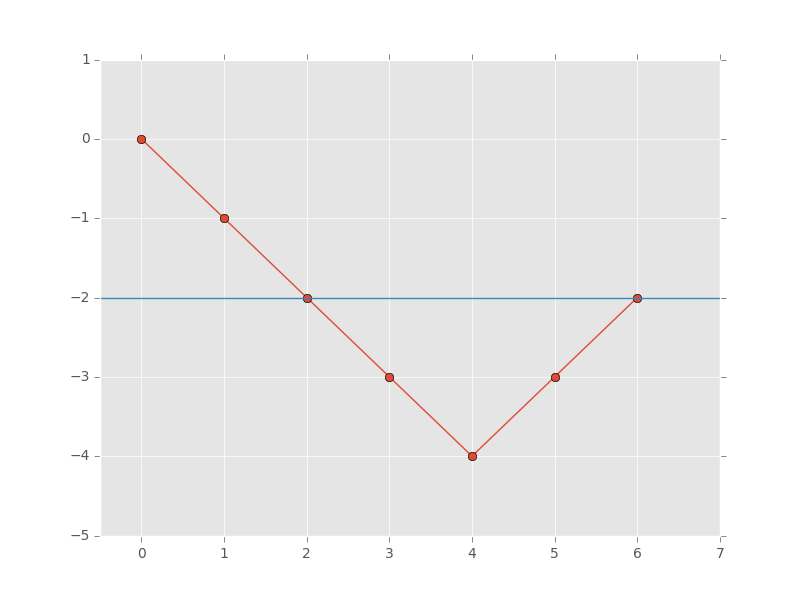
Mathematical Reasoning
Why Same Count Means Balanced Subarray:
Let count(i) = cumulative sum at index i

If count(i) == count(j) where i < j:
  count(j) - count(i) = 0

This means:
  sum of elements from index (i+1) to j = 0

In transformed array (0→-1, 1→+1):
  sum = 0 means equal number of -1s and +1s
  → equal number of 0s and 1s in original array
Implementation Template
// Java Template
public int findMaxLength(int[] nums) {
    // Map: {count: first_index_where_count_occurred}
    Map<Integer, Integer> map = new HashMap<>();

    // Initialize: handle subarrays starting at index 0
    map.put(0, -1);

    int maxLen = 0;
    int count = 0;

    for (int i = 0; i < nums.length; i++) {
        // Transform: 0 → -1, 1 → +1
        count += (nums[i] == 1) ? 1 : -1;

        // If count seen before: calculate subarray length
        if (map.containsKey(count)) {
            maxLen = Math.max(maxLen, i - map.get(count));
        } else {
            // Store FIRST occurrence only (for max length)
            map.put(count, i);
        }
    }

    return maxLen;
}
# Python Template
def findMaxLength(nums):
    # Map: {count: first_index_where_count_occurred}
    d = {0: -1}  # Initialize for subarrays starting at index 0

    max_len = 0
    count = 0

    for i, num in enumerate(nums):
        # Transform: 0 → -1, 1 → +1
        count += 1 if num == 1 else -1

        # If count seen before: calculate subarray length
        if count in d:
            max_len = max(max_len, i - d[count])
        else:
            # Store FIRST occurrence only (for max length)
            d[count] = i

    return max_len
Key Differences from LC 560 Pattern
| Aspect | LC 560 (Subarray Sum K) | LC 525 (Contiguous Array) |
|---|---|---|
| Goal | Count ALL subarrays | Find LONGEST subarray |
| Map Value | count (occurrences) |
index (first occurrence) |
| Map Update | Always increment count | Only if new count |
| Check Formula | presum - k |
Same count |
| Initialization | {0: 1} |
{0: -1} |
Related Problems (Same Pattern)
- LC 525: Contiguous Array (exactly this pattern)
- LC 1124: Longest Well-Performing Interval (similar transformation)
- LC 523: Continuous Subarray Sum (modulo transformation)
- LC 325: Maximum Size Subarray Sum Equals k (prefix sum + index)
2-1-1) Subarray Sums Divisible by K (LC 974)
Core Pattern: Prefix Sum + Modular Arithmetic + HashMap
Key Concept
Count ALL subarrays whose sum is divisible by K using remainder tracking.
If two prefix sums have the same remainder mod K, their difference is divisible by K.
Pattern Breakdown
1. Mathematical Foundation:
If prefix[i] % k == prefix[j] % k  (where j < i)

Then:
  (prefix[i] - prefix[j]) % k == 0

Which means:
  prefix[i] - prefix[j] = sum of nums[j+1 .. i]

Therefore:
  The subarray [j+1, i] has a sum divisible by k
2. HashMap Structure:
Map<Integer, Integer> map = new HashMap<>();
// {remainder: count}  ← Store COUNT, not index (similar to LC 560)

map.put(0, 1); // Initialize for subarrays starting from beginning
3. Why Store Remainder COUNT (Not Index)?
This is a "count ALL subarrays" problem (like LC 560).

If remainder 3 appears at indices [2, 5, 8]:
  - When we reach index 5: add 1 (subarray from index 2 to 5)
  - When we reach index 8: add 2 (subarrays from 2→8 and 5→8)

Total: 3 valid subarrays
4. Critical: Handle Negative Remainders
int remainder = prefixSum % k;

// MUST adjust negative remainders to positive
if (remainder < 0) {
    remainder += k;
}

// Or use this one-liner:
remainder = ((prefixSum % k) + k) % k;
Why? In Java/Python, -7 % 5 = -2, but we need remainder 3 (since -2 ≡ 3 mod 5).
5. Initialization: Why map.put(0, 1)?
If prefixSum % k == 0 at some index i:
  → The entire subarray [0, i] is divisible by k
  → We need to count this case

Without initialization, we'd miss these subarrays.
Visual Example
Input: nums = [4, 5, 0, -2, -3, 1], k = 5
Prefix sums: [4, 9, 9, 7, 4, 5]
Remainders (mod 5): [4, 4, 4, 2, 4, 0]
| Index | Num | PrefixSum | Remainder | Map State | Count Added | Total Count |
|---|---|---|---|---|---|---|
| - | - | 0 | 0 | {0:1} | - | 0 |
| 0 | 4 | 4 | 4 | {0:1, 4:1} | 0 | 0 |
| 1 | 5 | 9 | 4 | {0:1, 4:2} | +1 | 1 |
| 2 | 0 | 9 | 4 | {0:1, 4:3} | +2 | 3 |
| 3 | -2 | 7 | 2 | {0:1, 4:3, 2:1} | 0 | 3 |
| 4 | -3 | 4 | 4 | {0:1, 4:4, 2:1} | +3 | 6 |
| 5 | 1 | 5 | 0 | {0:2, 4:4, 2:1} | +1 | 7 |
Result: 7 subarrays with sum divisible by 5
Subarrays found:
[4,5,0,-2,-3,1](entire array, remainder 0 at end)[5](remainder 4 at indices 0 and 1)[5,0](remainder 4 at indices 0 and 2)[5,0,-2,-3](remainder 4 at indices 0 and 4)[0](remainder 4 at indices 1 and 2)[0,-2,-3](remainder 4 at indices 1 and 4)[-2,-3](remainder 4 at indices 2 and 4)
Implementation Template
// Java Template
public int subarraysDivByK(int[] nums, int k) {
    // Map: {remainder: count}
    Map<Integer, Integer> map = new HashMap<>();
    map.put(0, 1); // Handle subarrays from beginning

    int count = 0;
    int prefixSum = 0;

    for (int num : nums) {
        prefixSum += num;

        // Calculate remainder (handle negatives!)
        int remainder = prefixSum % k;
        if (remainder < 0) {
            remainder += k;
        }
        // Or: int remainder = ((prefixSum % k) + k) % k;

        // Add count of all previous same remainders
        count += map.getOrDefault(remainder, 0);

        // Update remainder count
        map.put(remainder, map.getOrDefault(remainder, 0) + 1);
    }

    return count;
}
# Python Template
def subarraysDivByK(nums, k):
    # Map: {remainder: count}
    remainder_count = {0: 1}

    count = 0
    prefix_sum = 0

    for num in nums:
        prefix_sum += num

        # Calculate remainder (Python % handles negatives correctly)
        remainder = prefix_sum % k

        # Add count of all previous same remainders
        count += remainder_count.get(remainder, 0)

        # Update remainder count
        remainder_count[remainder] = remainder_count.get(remainder, 0) + 1

    return count
Note: Python’s % operator always returns positive remainders, so no adjustment needed.
Optimization: Array Instead of HashMap
Since remainders are always in range [0, k-1], use an array for better performance:
public int subarraysDivByK(int[] nums, int k) {
    int[] remainderCount = new int[k];
    remainderCount[0] = 1;

    int count = 0;
    int prefixSum = 0;

    for (int num : nums) {
        prefixSum += num;
        int remainder = ((prefixSum % k) + k) % k;

        count += remainderCount[remainder];
        remainderCount[remainder]++;
    }

    return count;
}
Time Complexity: O(N) Space Complexity: O(K) instead of O(N)
Key Differences from Related Problems
| Aspect | LC 560 (Sum = K) | LC 974 (Divisible by K) | LC 525 (Equal 0/1) |
|---|---|---|---|
| Goal | Count subarrays | Count subarrays | Find longest |
| Map Key | prefixSum |
prefixSum % k |
count |
| Map Value | count |
count |
first_index |
| Check Formula | presum - k |
Same remainder |
Same count |
| Special Handling | None | Negative remainders! | Transform 0→-1 |
| Initialization | {0: 1} |
{0: 1} |
{0: -1} |
Critical: Why Negative Remainder Handling Matters
Example: nums = [-1, -2, -3], k = 5
Without adjustment:
prefixSum = -1: remainder = -1 (wrong!)
prefixSum = -3: remainder = -3 (wrong!)
prefixSum = -6: remainder = -1 (wrong!)
With adjustment:
prefixSum = -1: remainder = 4 (correct: -1 ≡ 4 mod 5)
prefixSum = -3: remainder = 2 (correct: -3 ≡ 2 mod 5)
prefixSum = -6: remainder = 4 (correct: -6 ≡ 4 mod 5)
Now remainders 4 match → subarray [-1] and [-2, -3] have the same remainder → subarray [-2, -3] has sum divisible by 5 ✓
Related Problems (Same Pattern)
- LC 974: Subarray Sums Divisible by K (exactly this pattern)
- LC 523: Continuous Subarray Sum (divisible, but length ≥ 2 constraint)
- LC 560: Subarray Sum Equals K (no modulo, simpler)
- LC 1248: Count Nice Subarrays (transform + count pattern)
2-1-2) Count Number of Nice Subarrays (LC 1248)
Core Pattern: Transform Odd Numbers → Prefix Sum Count (same as LC 560)
Key Concept
Count subarrays with exactly k odd numbers by treating each number as 0 (even) or 1 (odd), then applying the prefix sum + hashmap pattern.
Core Idea
Transform: Replace each element with num % 2 (1 if odd, 0 if even).
Now the problem becomes: count subarrays whose sum equals k — exactly LC 560!
map: {oddCount: frequency}
     → "How many times has this odd-count appeared so far?"

At index i with current oddCount:
  → Find how many previous positions had exactly (oddCount - k) odds
  → Those form subarrays with exactly k odds ending at i
Why map.put(0, 1)?
If oddCount == k at index i:
  → Entire subarray [0, i] has exactly k odds
  → oddCount - k = 0, must have {0: 1} pre-initialized
Implementation Template
// Java - LC 1248
public int numberOfSubarrays(int[] nums, int k) {
    // map: {oddCount: frequency}
    Map<Integer, Integer> map = new HashMap<>();
    map.put(0, 1);  // base case: 0 odds seen 1 time

    int res = 0, oddCount = 0;

    for (int num : nums) {
        if (num % 2 == 1) oddCount++;  // treat odd as +1

        // How many previous positions had (oddCount - k) odds?
        res += map.getOrDefault(oddCount - k, 0);

        // Update count AFTER checking (critical order!)
        map.put(oddCount, map.getOrDefault(oddCount, 0) + 1);
    }

    return res;
}
# python - LC 1248
# IDEA: prefix ODD-count + hashmap (same shape as LC 560)
# time: O(n), space: O(n)
# ref: leetcode_python/Array/count-number-of-nice-subarrays.py
class Solution:
    def numberOfSubarrays(self, nums, k):
        total_cnt = 0
        prefix_cnt = 0                 # running count of odd numbers so far

        cnt_map = {0: 1}              # {odd_count : frequency}; base case 0 odds seen once

        for val in nums:
            if val % 2 == 1:          # treat odd as +1 (even contributes 0)
                prefix_cnt += 1

            # NOTE: += get(prefix_cnt - k), NOT += 1
            #   there may be MULTIPLE earlier prefixes with the same odd count,
            #   each one gives a distinct valid subarray ending here
            total_cnt += cnt_map.get(prefix_cnt - k, 0)

            # record current prefix count AFTER checking (avoid self-count)
            cnt_map[prefix_cnt] = cnt_map.get(prefix_cnt, 0) + 1

        return total_cnt
Why
+= cnt_map.get(prefix_cnt - k, 0)and not+= 1?prefix_cnt - k(the “complement” odd-count) may have been reached at several earlier indices. Each of those start positions pairs with the current index to form a subarray with exactlykodds, so we add the full frequency — the same “2-sum on prefix values” trick as LC 560.
Alternative: Sliding Window (atMost trick)
// Exactly k = atMost(k) - atMost(k-1)
public int numberOfSubarrays(int[] nums, int k) {
    return atMost(nums, k) - atMost(nums, k - 1);
}

private int atMost(int[] nums, int k) {
    int l = 0, res = 0, oddCount = 0;
    for (int r = 0; r < nums.length; r++) {
        if (nums[r] % 2 == 1) oddCount++;
        while (oddCount > k) {
            if (nums[l] % 2 == 1) oddCount--;
            l++;
        }
        res += (r - l + 1);
    }
    return res;
}
Key Differences from Related Problems
| Aspect | LC 560 (Sum = K) | LC 930 (Binary Sum = K) | LC 1248 (Nice Subarrays) |
|---|---|---|---|
| Transform | None (use values directly) | Values are 0/1 already | num % 2 → 0 or 1 |
| Map Key | prefixSum |
prefixSum |
oddCount |
| Map Value | count |
count |
count |
| Init | {0: 1} |
{0: 1} |
{0: 1} |
Related Problems (Same Pattern)
- LC 560: Subarray Sum Equals K (exact same pattern, no transform)
- LC 930: Binary Subarrays with Sum (values are 0/1, same idea)
- LC 974: Subarray Sums Divisible by K (modulo variant)
- LC 1248: Count Nice Subarrays (this problem — transform to 0/1 then LC 560)
2-2) Continuous Subarray Sum — LC 523
- Similar concept as Contiguous Array (LC 525)
# 523 Continuous Subarray Sum
# IDEA : HASH TABLE
# -> if sum(nums[i:j]) % k == 0 for some i < j,
#   ->  then sum(nums[:j]) % k == sum(nums[:i]) % k  !!!!
#   -> So we just need to use a dict to keep track of sum(nums[:i]) % k
#   -> and the corresponding index i. Once some later sum(nums[:i']) % k == sum(nums[:i]) % k and i' - i > 1, so we return True.
class Solution(object):
    def checkSubarraySum(self, nums, k):
        """
        # _dict = {0:-1} : for edge case (need to find a continuous subarray of size AT LEAST two )
        # https://leetcode.com/problems/continuous-subarray-sum/discuss/236976/Python-solution
        # 0: -1 is for edge case that current sum mod k == 0
        # demo :
                In [93]: nums = [0]
                    ...: k = 1
                    ...:
                    ...:
                    ...: s = Solution()
                    ...: r = s.checkSubarraySum(nums, k)
                    ...: print (r)
                0
                i - _dict[tmp] = 1
                False
        """
        ### NOTE : we need to init _dict as {0:-1}
        _dict = {0:-1}
        tmp = 0
        for i in range(len(nums)):
            tmp += nums[i]
            if k != 0:
                ### NOTE : we get remainder of tmp by k
                tmp = tmp % k
            # if tmp in _dict, means there is the other sub part make sub array sum % k == 0
            if tmp in _dict:
                ### only if continuous sub array with length >= 2
                if i - _dict[tmp] > 1:
                    return True
            else:
                _dict[tmp] = i
        return False
2-3) Group Anagrams — LC 49
Idea: sort each string to build a canonical hash key; group strings sharing the key.
The canonical solution lives with the grouping template in hash_map.md → Template 3: Grouping by a Computed Key.
2-3’) Longest Substring Without Repeating Characters — LC 3
# LC 003
# IDEA : TWO POINTER + SLIDING WINDOW + DICT (NOTE this method !!!!)
#       -> use a hash table (d) record visited "element" (e.g. : a,b,c,...)
#          (but NOT sub-string)
class Solution(object):
    def lengthOfLongestSubstring(self, s):
        d = {}
        # left pointer
        l = 0
        res = 0
        """
        NOTE !!!

        we move right pointer first, then left pointer
        """
        # NOTE !!! right pointer
        for r in range(len(s)):
            """
            ### NOTE : deal with "s[r] in d" case ONLY !!!
            ### NOTE : if already visited, means "repeating"
            #      -> then we need to update left pointer (l)
            """
            if s[r] in d:
                """
                NOTE !!! this
                -> via max(l, d[s[r]] + 1) trick,
                   we can get the "latest" idx of duplicated s[r], and start from that one
                """
                l = max(l, d[s[r]] + 1)
            # if not visited yet, record the alphabet
            # and re-calculate the max length
            d[s[r]] = r
            res = max(res, r -l + 1)
        return res
2-4) Count Primes — LC 204
# LC 204 Count Primes
# IDEA : dict
# https://leetcode.com/problems/count-primes/discuss/1343795/python%3A-sieve-of-eretosthenes
# prime(x) : check if x is a prime
# prime(0) = 0
# prime(1) = 0
# prime(2) = 0
# prime(3) = 1
# prime(4) = 2
# prime(5) = 3
# python 3
class Solution:
    def countPrimes(self, n):
        # using sieve of eretosthenes algorithm
        if n < 2: return 0
        nonprimes = set()
        for i in range(2, round(n**(1/2))+1):
            if i not in nonprimes:
                for j in range(i*i, n, i):
                    nonprimes.add(j)
        return n - len(nonprimes) - 2  # remove prime(1), prime(2)
2-5) Valid Sudoku — LC 36
# python
# LC 036 Valid Sudoku
class Solution(object):
    def isValidSudoku(self, board):
        """
        :type board: List[List[str]]
        :rtype: bool
        """
        n = len(board)
        return self.isValidRow(board) and self.isValidCol(board) and self.isValidNineCell(board)

    def isValidRow(self, board):
        n = len(board)
        for r in range(n):
            row = [x for x in board[r] if x != '.']
            if len(set(row)) != len(row): # if not repetition
                return False
        return True

    def isValidCol(self, board):
        n = len(board)
        for c in range(n):
            col = [board[r][c] for r in range(n) if board[r][c] != '.']
            if len(set(col)) != len(col): # if not repetition
                return False
        return True

    def isValidNineCell(self, board):
        n = len(board)
        for r in range(0, n, 3):
            for c in range(0, n, 3):
                cell = []
                for i in range(3):
                    for j in range(3):
                        num = board[r + i][c + j]
                        if num != '.':
                            cell.append(num)
                if len(set(cell)) != len(cell): # if not repetition
                    return False
        return True
Note: LC 36 asks only whether the board as given is valid — it does not ask you to solve it. A backtracking solver answers a different question (that is LC 37) and can call an invalid board valid, because it never checks the pre-filled cells against each other.
// java
// LC 36 Valid Sudoku
// IDEA: one pass, three sets per index -- row, column and 3x3 box.
//       The box index is (r/3)*3 + c/3, which is the whole trick.
// time = O(81) = O(1), space = O(81) = O(1)
public boolean isValidSudoku(char[][] board) {
    Set<Character>[] rows = new HashSet[9];
    Set<Character>[] cols = new HashSet[9];
    Set<Character>[] boxes = new HashSet[9];
    for (int i = 0; i < 9; i++) {
        rows[i] = new HashSet<>();
        cols[i] = new HashSet<>();
        boxes[i] = new HashSet<>();
    }

    for (int r = 0; r < 9; r++) {
        for (int c = 0; c < 9; c++) {
            char v = board[r][c];
            if (v == '.') continue;

            /** NOTE !!! the box a cell belongs to */
            int b = (r / 3) * 3 + c / 3;

            // Set.add returns false when the value was already there -> duplicate
            if (!rows[r].add(v) || !cols[c].add(v) || !boxes[b].add(v)) {
                return false;
            }
        }
    }
    return true;
}
2-6) Pairs of Songs With Total Durations Divisible by 60 — LC 1010
# LC 1010. Pairs of Songs With Total Durations Divisible by 60
# IDEA : dict
# IDEA : NOTE : we only count "NUMBER OF PAIRS", instead get all pairs indexes
class Solution(object):
    def numPairsDivisibleBy60(self, time):
        rem = {}
        pairs = 0
        for t in time:
            #print ("rem = " + str(rem))
            t %= 60
            if (60 - t) % 60 in rem:
                """
                NOTE : this trick
                -> we append "all 60 duration combinations count" via the existing times of element "(60 - t) % 60"
                """
                pairs += rem[(60 - t) % 60]
            if t not in rem:
                rem[t] = 1
            else:
                ### NOTE : here : we plus 1 when an element already exist
                rem[t] += 1
        return pairs
2-7) Subarray Sum Equals K — LC 560
# LC 560 : Subarray Sum Equals K

# IDEA : HASH TABLE + sub array sum
# IDEA : https://blog.csdn.net/fuxuemingzhu/article/details/82767119
class Solution(object):
    def subarraySum(self, nums, k):
        n = len(nums)
        d = collections.defaultdict(int)
        d[0] = 1
        sum = 0
        res = 0
        for i in range(n):
            sum += nums[i]
            # if sum - k in d
            #  -> if sum - (every _ in d) == k
            if sum - k in d:
                res += d[sum - k]
            d[sum] += 1
        return res
// LC 560 : Subarray Sum Equals K
// java
// (algorithm book (labu) p.350)
// V1 : brute force + cum sum
int subarraySum(int[] nums, int k){
    int n = nums.length;
    // init pre sum
    int[] sum = new int[n+1];
    sum[0] = 0;
    for (int i = 0; i < n; i++){
        sum[i+1] = sum[i] + nums[i];
    }

    int ans = 0;
    // loop over all sub array
    for (int i=1; i <= n; i++){
        for (int j=0; j < i; j++){
            // sum of nums[j...i-1]
            if (sum[i] - sum[j] == k){
                ans += 1;
            }
        }
    }
    return ans;
}

// (algorithm book (labu) p.350)
// V2 : hash map + cum sum
int subarraySum(int[] nums, int k){
    int n = nums.length;
    // map :  key : prefix, value : prefix exists count
    // init hash map
    HashMap<Integer, Integer> preSum = new HashMap<Integer, Integer>();

    // base case
    preSum.put(0,1);

    int ans = 0;
    int sum0_i = 0;

    for (int i = 0; i < n; i++){
        sum0_i += nums[i];
        // for presum : nums[0..j]
        int sum0_j = sum0_i - k;
        // if there is already presum, update the ans directly
        if (preSum.containsKey(sum0_j)){
            ans += preSum.get(sum0_j);
        }
        // add prefix and nums[0..i] and record exists count
        preSum.put(sum0_i, preSum.getOrDefault(sum0_i,0) + 1);
    }
    return ans;
}
2-8) K-diff Pairs in an Array — LC 532
# LC 532 K-diff Pairs in an Array
# V0
# IDEA : HASH TABLE
import collections
class Solution(object):
    def findPairs(self, nums, k):
        answer = 0
        cnt = collections.Counter(nums)
        # NOTE THIS : !!! we use set(nums) for reduced time complexity, and deal with k == 0 case separately
        for num in set(nums):
            """
            # [b - a] = k
            #  -> b - a = +k or -k
            #  -> b = k + a or b = -k + a
            #  -> however, 0 <= k <= 10^7, so ONLY b = k + a is possible

            2 cases
                -> case 1) k > 0 and num + k in cnt
                -> case 2) k == 0 and cnt[num] > 1
            """
            # case 1) k > 0 and num + k in cnt
            if k > 0 and num + k in cnt: # | a - b | = k -> a - b = +k or -k, but here don't have to deal with "a - b = -k" case, since this sutuation will be covered when go through whole nums
                answer += 1
            # case 2) k == 0 and cnt[num] > 1
            if k == 0 and cnt[num] > 1:  # for cases k = 0 ->  pair like (1,1) will work. (i.e. 1 + (-1))
                answer += 1
        return answer

# V0'
# IDEA : SORT + BRUTE FORCE + BREAK
class Solution(object):
    def findPairs(self, nums, k):
        # edge case
        if not nums and k:
            return 0
        nums.sort()
        res = 0
        tmp = []
        for i in range(len(nums)):
            for j in range(i+1, len(nums)):
                if abs(nums[j] - nums[i]) == k:
                    cur = [nums[i], nums[j]]
                    cur.sort()
                    if cur not in tmp:
                        res += 1
                        tmp.append(cur)
                elif abs(nums[j] - nums[i]) > k:
                    break
        return res
2-9) Sentence Similarity — LC 734
# LC 734. Sentence Similarity
# V0'
# https://zxi.mytechroad.com/blog/hashtable/leetcode-734-sentence-similarity/
import collections
class Solution(object):
    def areSentencesSimilar(self, words1, words2, pairs):
        if len(words1) != len(words2): return False
        similars = collections.defaultdict(set)
        for w1, w2 in pairs:
            similars[w1].add(w2)
            similars[w2].add(w1)
        for w1, w2 in zip(words1, words2):
            if w1 != w2 and w2 not in similars[w1]:
                return False
        return True

# V0
# IDEA : array op
#   -> Apart from edge cases
#   -> there are cases we need to consider
#     -> 1) if sentence1[i] == sentence2[i]
#     -> 2) if sentence1[i] != sentence2[i] and
#           -> [sentence1[i], sentence2[i]] in similarPairs
#           -> [sentence2[i], sentence1[i]] in similarPairs
class Solution(object):
    def areSentencesSimilar(self, sentence1, sentence2, similarPairs):
        # edge case
        if sentence1 == sentence2:
            return True
        if len(sentence1) != len(sentence2):
            return False
        for i in range(len(sentence1)):
            tmp = [sentence1[i], sentence2[i]]
            """
            NOTE : below condition
                1) sentence1[i] != sentence2[i]
                  AND
                2) (tmp not in similarPairs and tmp[::-1] not in similarPairs)

                -> return false
            """
            if sentence1[i] != sentence2[i] and (tmp not in similarPairs and tmp[::-1] not in similarPairs):
                return False
        return True
2-10) LRU Cache — LC 146
# LC 146 LRU Cache
# note : there is also array/queue approach
# IDEA : Ordered dictionary
# https://leetcode.com/problems/lru-cache/solution/
# IDEA :
#       -> There is a structure called ordered dictionary, it combines behind both hashmap and linked list.
#       -> In Python this structure is called OrderedDict
#       -> and in Java LinkedHashMap.
from collections import OrderedDict
class LRUCache(OrderedDict):

    def __init__(self, capacity):
        """
        :type capacity: int
        """
        self.capacity = capacity

    def get(self, key):
        """
        :type key: int
        :rtype: int
        """
        if key not in self:
            return - 1

        self.move_to_end(key)
        return self[key]

    def put(self, key, value):
        """
        :type key: int
        :type value: int
        :rtype: void
        """
        if key in self:
            self.move_to_end(key)
        self[key] = value
        if len(self) > self.capacity:
            self.popitem(last = False)
2-11) Find All Anagrams in a String — LC 438
# LC 438. Find All Anagrams in a String
# IDEA : SLIDING WINDOW + collections.Counter()
class Solution(object):
    def findAnagrams(self, s, p):
        ls, lp = len(s), len(p)
        cp = collections.Counter(p)
        cs = collections.Counter()
        ans = []
        for i in range(ls):
            cs[s[i]] += 1
            if i >= lp:
                cs[s[i - lp]] -= 1
                ### BE AWARE OF IT
                if cs[s[i - lp]] == 0:
                    del cs[s[i - lp]]
            if cs == cp:
                ans.append(i - lp + 1)
        return ans
2-12) Brick Wall — LC 554
# LC 554. Brick Wall
# IDEA : HASH TABLE + COUNTER UPDATE (looping every element in the list and cumsum and
import collections
class Solution(object):
    def leastBricks(self, wall):
        _counter = collections.Counter()
        count = 0
        # go through every sub-wall in wall
        for w in wall:
            cum_sum = 0
            # go through every element in sub-wall
            for i in range(len(w) - 1):
                cum_sum += w[i]
                ### NOTE we can update collections.Counter() via below
                _counter.update([cum_sum])
                count = max(count, _counter[cum_sum])
        return len(wall) - count
2-13) Maximum Size Subarray Sum Equals k — LC 325
// LC 325 — prefix sum + hashmap, store FIRST occurrence (max length variant)
// Key: prefixSum[j] - prefixSum[i] = k  →  check if (curSum - k) exists in map
public int maxSubArrayLen(int[] nums, int k) {
    Map<Integer, Integer> preSumMap = new HashMap<>();
    preSumMap.put(0, -1); // handle subarrays starting at index 0

    int curSum = 0, maxSize = 0;
    for (int i = 0; i < nums.length; i++) {
        curSum += nums[i];
        if (preSumMap.containsKey(curSum - k)) {
            maxSize = Math.max(maxSize, i - preSumMap.get(curSum - k));
        }
        preSumMap.putIfAbsent(curSum, i); // store FIRST occurrence only
    }
    return maxSize;
}
2-14) Smallest Common Region — LC 1257
// java
// LC 1257

// IDEA: HASHMAP (fixed by gpt)
// TODO: validate
public String findSmallestRegion_0_1(List<List<String>> regions, String region1, String region2) {

    // Map each region to its parent
    /**
     *  NOTE !!!
     *
     *   map : {child : parent}
     *
     *   -> so the key is child, and the value is its parent
     *
     */
    Map<String, String> parentMap = new HashMap<>();

    for (List<String> regionList : regions) {
        String parent = regionList.get(0);
        for (int i = 1; i < regionList.size(); i++) {
            parentMap.put(regionList.get(i), parent);
        }
    }

    // Track ancestors of region1
    /**  NOTE !!!
     *
     *  we use `set` to track `parents` (ancestors)
     *  if exists, add it to set,
     *  and set `current region` as its `parent`
     *
     */
    Set<String> ancestors = new HashSet<>();
    while (region1 != null) {
        ancestors.add(region1);
        region1 = parentMap.get(region1);
    }

    // Traverse region2’s ancestors until we find one in region1’s ancestor set
    while (!ancestors.contains(region2)) {
        region2 = parentMap.get(region2);
    }

    return region2;
}
2-15) Tuple with Same Product (LC 1726)
Core Idea: Pair Product Frequency → Combination Counting
Given an array of distinct positive integers, count tuples (a, b, c, d) such that a * b = c * d.
Key Insight
- Compute every pair product
nums[i] * nums[j]for alli < j - Count how many pairs share the same product
- If a product appears
ntimes, choose any 2 pairs →C(n, 2) = n*(n-1)/2combinations - Each pair combination generates 8 tuples (permutations of
(a,b,c,d))
Why 8? Given two pairs (a,b) and (c,d) with a*b = c*d:
- Swap within pair 1:
(a,b)or(b,a)→ 2 choices - Swap within pair 2:
(c,d)or(d,c)→ 2 choices - Swap which pair is
(a,b)vs(c,d)→ 2 choices - Total:
2 × 2 × 2 = 8
Pattern
Step 1: Build productCount map
  for i in [0, n):
    for j in (i, n):
      productCount[nums[i]*nums[j]]++

Step 2: For each count n >= 2:
  ans += C(n, 2) * 8
       = n*(n-1)/2 * 8
       = 4 * n * (n-1)
Java Implementation
// LC 1726 - Tuple with Same Product
// Time: O(N^2)  Space: O(N^2)
public int tupleSameProduct(int[] nums) {
    Map<Integer, Integer> productCount = new HashMap<>();

    // Step 1: count frequency of each pair product
    for (int i = 0; i < nums.length; i++) {
        for (int j = i + 1; j < nums.length; j++) {
            int product = nums[i] * nums[j];
            productCount.put(product, productCount.getOrDefault(product, 0) + 1);
        }
    }

    // Step 2: for each product with n pairs, C(n,2) * 8 tuples
    int ans = 0;
    for (int count : productCount.values()) {
        if (count >= 2) {
            ans += count * (count - 1) / 2 * 8;
            // equivalent: ans += 4 * count * (count - 1);
        }
    }
    return ans;
}
Key Formula Equivalence
C(n,2) * 8
= n*(n-1)/2 * 8
= 4 * n * (n-1)
Both forms are correct. The 4 * count * (count - 1) form avoids integer division.
Related Problems (Same Pattern)
| Problem | LC# | Difficulty | Pattern |
|---|---|---|---|
| Tuple with Same Product | 1726 | Medium | Pair product → C(n,2) × 8 |
| Number of Good Pairs | 1512 | Easy | Pair count → C(n,2) |
| Number of Boomerangs | 447 | Medium | Pair distance frequency → n*(n-1) |
| Count Number of Texts | 2266 | Medium | Frequency → combination count |
Key Difference from LC 1512 (Good Pairs):
- LC 1512: count pairs where
nums[i] == nums[j]→C(n,2)per value - LC 1726: count tuples from pairs sharing product →
C(n,2) * 8per product
2-16) Minimum Operations to Sort Binary Tree by Level (LC 2471)
Core Pattern: BFS per level + Minimum Swaps to Sort via {value: index} HashMap
LC 2471 - Minimum Number of Operations to Sort a Binary Tree by Level https://leetcode.com/problems/minimum-number-of-operations-to-sort-a-binary-tree-by-level/
Key Concept
Each operation swaps any two nodes’ values within the same level. To sort the whole tree level-by-level, the answer is simply the sum, over every level, of the minimum number of swaps needed to sort that level’s value array.
So the problem decomposes into two independent pieces:
- BFS to collect each level’s values into an array.
- Min-swaps-to-sort each array — this is where the hashmap shines.
The HashMap Trick: Minimum Swaps to Sort an Array
Key Idea: To sort an array using the fewest swaps, repeatedly place the
correct value at each index in one swap. To do an O(1) swap, we must know
where each value currently lives → that’s the {value: index} hashmap.
pos = {value: current_index}   # O(1) lookup of "where is value v right now?"

For each index i (left → right):
  correct_val = sorted_arr[i]            # what SHOULD be at index i
  if arr[i] != correct_val:
     swap_idx = pos[correct_val]         # where correct_val currently is
     # 1) UPDATE the map BEFORE swapping (critical!)
     pos[arr[i]]      = swap_idx         # the value we move away keeps its new home
     pos[correct_val] = i                # correct_val is now at i
     # 2) swap in the array
     arr[i], arr[swap_idx] = arr[swap_idx], arr[i]
     swaps += 1
⚠️ Critical: update the map BEFORE the swap. After swapping, arr[i] no longer
holds the displaced value, so you can’t recover its old key. Record both new
positions in the map first, then mutate the array.
Why this is minimal: every successful swap puts at least one element into its
final sorted position, so we never “waste” a swap. (This is the cycle-decomposition
result: an array needs n - (#cycles) swaps; the greedy index pass realizes exactly
that count.)
Implementation
# python - LC 2471
from collections import deque

class Solution(object):
    def minimumOperations(self, root):
        # time  = O(N log M)  (M = widest level; sorting dominates per level)
        # space = O(M)
        q = deque([root])
        ops = 0

        while q:
            size = len(q)
            level = []
            for _ in range(size):
                node = q.popleft()
                level.append(node.val)
                if node.left:
                    q.append(node.left)
                if node.right:
                    q.append(node.right)

            ops += self.min_swaps(level)   # add this level's cost

        return ops

    def min_swaps(self, arr):
        # min swaps to sort `arr` via {value: index} hashmap
        n = len(arr)
        sorted_arr = sorted(arr)
        pos = {v: i for i, v in enumerate(arr)}   # {value: current index}
        swaps = 0

        for i in range(n):
            correct_val = sorted_arr[i]
            if arr[i] != correct_val:
                swap_idx = pos[correct_val]

                # update map BEFORE swapping (so we don't lose arr[i]'s key)
                pos[arr[i]] = swap_idx
                pos[correct_val] = i

                # swap
                arr[i], arr[swap_idx] = arr[swap_idx], arr[i]
                swaps += 1

        return swaps
// java - LC 2471
/**
 * time  = O(N log M)   // M = widest level; sorting dominates
 * space = O(M)
 */
public int minimumOperations(TreeNode root) {
    Queue<TreeNode> q = new LinkedList<>();
    q.offer(root);
    int ops = 0;

    while (!q.isEmpty()) {
        int size = q.size();
        List<Integer> level = new ArrayList<>();
        for (int i = 0; i < size; i++) {
            TreeNode node = q.poll();
            level.add(node.val);
            if (node.left != null)  q.offer(node.left);
            if (node.right != null) q.offer(node.right);
        }
        ops += minSwaps(level);
    }
    return ops;
}

// min swaps to sort via {value: index} map
private int minSwaps(List<Integer> arr) {
    int n = arr.size();
    Integer[] sorted = arr.toArray(new Integer[0]);
    Arrays.sort(sorted);

    Map<Integer, Integer> pos = new HashMap<>();   // {value: current index}
    for (int i = 0; i < n; i++) pos.put(arr.get(i), i);

    int swaps = 0;
    for (int i = 0; i < n; i++) {
        int correctVal = sorted[i];
        if (!arr.get(i).equals(correctVal)) {
            int swapIdx = pos.get(correctVal);

            // update map BEFORE swapping
            pos.put(arr.get(i), swapIdx);
            pos.put(correctVal, i);

            // swap
            int tmp = arr.get(i);
            arr.set(i, arr.get(swapIdx));
            arr.set(swapIdx, tmp);
            swaps++;
        }
    }
    return swaps;
}
Visual Trace — min_swaps([3, 1, 2])
sorted = [1, 2, 3]
pos    = {3:0, 1:1, 2:2}

i=0: correct=1, arr[0]=3 (mismatch)
     swap_idx = pos[1] = 1
     update map: pos[3]=1, pos[1]=0  → pos = {3:1, 1:0, 2:2}
     swap arr[0],arr[1] → arr = [1, 3, 2]   swaps=1

i=1: correct=2, arr[1]=3 (mismatch)
     swap_idx = pos[2] = 2
     update map: pos[3]=2, pos[2]=1  → pos = {3:2, 1:0, 2:1}
     swap arr[1],arr[2] → arr = [1, 2, 3]   swaps=2

i=2: correct=3, arr[2]=3 (match) → skip

Result: 2 swaps
Why a HashMap (not a linear scan)?
Without the map, finding swap_idx (where correct_val lives) is an O(n) scan,
making min_swaps O(n²). The {value: index} map turns that lookup into O(1), so
each level costs O(n log n) (sorting) instead of O(n²).
| Approach | Find swap target | min_swaps total |
|---|---|---|
| Linear scan each step | O(n) | O(n²) |
{value: index} hashmap |
O(1) | O(n log n) |
Related Problems (Same “Min Swaps to Sort” Idea)
| Problem | LC# | Notes |
|---|---|---|
| Min Operations to Sort Tree by Level | 2471 | BFS level + min swaps per level |
| Minimum Swaps to Group All 1’s Together | 1151 / 2134 | Sliding window variant |
| Couples Holding Hands | 765 | Cycle/union-find min swaps |
| First Missing Positive | 41 | Index-placement swap idea |
2-17) Maximum Swap (LC 670)
Core Pattern: {digit: last index} HashMap + greedy left-to-right scan
LC 670 - Maximum Swap https://leetcode.com/problems/maximum-swap/ Given an integer, swap two digits at most once to get the maximum value.
Core Idea
To maximize the number with a single swap, we want to bring the largest possible digit as far left as possible. Scanning left-to-right, at the first position whose digit can be beaten by a larger digit appearing later, swap it with the last (rightmost) occurrence of that larger digit — and stop.
The hashmap is the enabler: precompute {digit: last index} for digits 0-9 so
that “does a larger digit exist to my right, and where is its rightmost copy?” is an
O(1) lookup instead of an O(n) scan.
Why LAST occurrence of the larger digit?
  - Moving a big digit further LEFT raises the most significant place → biggest gain.
  - Among equal large digits, taking the RIGHTMOST one leaves larger digits to the
    left untouched, keeping the tail as large as possible.

Why the FIRST improvable position (and stop)?
  - The leftmost place we can increase dominates all lower places → one swap there
    beats any swap further right. Only one swap is allowed, so return immediately.
Since there are only 10 distinct digits, the map has ≤ 10 keys → effectively O(1) space.
Visual Trace — num = 2736
digits = [2, 7, 3, 6]

Step 1 — build {digit: last index}:
  {2:0, 7:1, 3:2, 6:3}

Step 2 — scan left→right, for each digit look for a larger digit later:
  i=0, cur=2: check d=9..3 → d=7 exists at last[7]=1 > 0  ✓
              swap digits[0] and digits[1] → [7, 2, 3, 6]
              return 7236   (stop — only one swap allowed)

Result: 7236
num = 9973 → every digit already has no larger digit to its right → no swap → 9973.
Pattern (Python)
# python
# LC 670 - Maximum Swap
# IDEA: {digit: last index} hashmap + greedy left scan
# time = O(n)  (n = number of digits), space = O(1)  (<= 10 keys)
class Solution(object):
    def maximumSwap(self, num):
        digits = list(str(num))

        # last occurrence index of each digit
        last = {int(d): i for i, d in enumerate(digits)}

        for i in range(len(digits)):
            cur = int(digits[i])
            # try the biggest digit (9..cur+1) that appears LATER
            for d in range(9, cur, -1):
                if last.get(d, -1) > i:
                    j = last[d]
                    digits[i], digits[j] = digits[j], digits[i]
                    return int("".join(digits))   # only ONE swap → stop

        return num   # already maximal
Pattern (Java)
// java
// LC 670 - Maximum Swap
// time = O(n), space = O(1)  (<= 10 keys)
public int maximumSwap(int num) {
    char[] digits = String.valueOf(num).toCharArray();

    // last occurrence index of each digit 0-9
    int[] last = new int[10];
    for (int i = 0; i < digits.length; i++) {
        last[digits[i] - '0'] = i;
    }

    for (int i = 0; i < digits.length; i++) {
        int cur = digits[i] - '0';
        // try the biggest digit (9..cur+1) that appears LATER
        for (int d = 9; d > cur; d--) {
            if (last[d] > i) {
                // swap and return (only one swap allowed)
                char tmp = digits[i];
                digits[i] = digits[last[d]];
                digits[last[d]] = tmp;
                return Integer.parseInt(new String(digits));
            }
        }
    }
    return num; // already maximal
}
Alternative — 3 pointers (no hashmap)
Track max_idx (rightmost index of the largest digit seen so far) while scanning
right-to-left, and remember the best (left, right) pair to swap. Same O(n) time,
O(1) space, but the hashmap version reads more directly.
# python — 3-pointer variant
def maximumSwap(num):
    digits = list(str(num))
    left = right = 0
    max_idx = len(digits) - 1
    for i in range(len(digits) - 1, -1, -1):
        if digits[i] > digits[max_idx]:
            max_idx = i                 # new largest digit to the right
        elif digits[i] < digits[max_idx]:
            left, right = i, max_idx    # candidate swap (keep the leftmost such i)
    digits[left], digits[right] = digits[right], digits[left]
    return int("".join(digits))
Approach Comparison
| Approach | Time | Space | Note |
|---|---|---|---|
| Brute force (try every pair) | O(n²) | O(n) | Simple, keep max candidate |
{digit: last index} hashmap |
O(n) | O(1) | Greedy: first improvable pos → last-larger digit |
3 pointers (left/right/max_idx) |
O(n) | O(1) | Right-to-left, no map |
Similar Problems
| Problem | LC# | Relation |
|---|---|---|
| Maximum Swap | 670 | {digit: last index} + greedy left scan |
| Next Greater Element III | 556 | Digit rearrangement for next larger number |
| Next Permutation | 31 | Pivot + successor + reverse suffix (adjacent idea) |
| Remove K Digits | 402 | Greedy monotonic stack on digits |
| Largest Number | 179 | Custom sort of number strings |
| Create Maximum Number | 321 | Greedy digit selection across arrays |
2-18) Longest Repeating Character Replacement (LC 424)
Core Pattern: Sliding Window + HashMap (frequency count) + max_freq tracking
Key Concept
Given string s and integer k, you may replace at most k characters. Return the length of the longest substring made of a single repeating letter you can achieve.
Key Insight: For any window, the number of characters we must replace is:
replacements_needed = window_size - (count of the most frequent char)
                    = (r - l + 1) - max_freq
A window is valid when replacements_needed <= k. Keep the largest valid window.
Pattern Breakdown
- Expand
r, updatecnt_map[s[r]] += 1. - Track
max_freq= highest single-char count seen in the window. - Shrink
lwhile(r - l + 1) - max_freq > k(too many replacements needed). - Record
max_len = max(max_len, r - l + 1).
Order matters: update the hash map first, then validate with the
whileloop. This differs from prefix-sum hashmap problems (LC 523, 525) where you check before updating.
Two Variants of the Validity Check
| Variant | Check | Cost | Note |
|---|---|---|---|
max_freq tracker |
(r-l+1) - max_freq > k |
O(1) per step | Preferred — no scan of map values |
max(cnt_map.values()) |
(r-l+1) - max(cnt_map.values()) > k |
O(26) per step | Simpler to reason about; still O(n) since values bounded by 26 |
Why we don’t need to decrease
max_freqwhen shrinking:max_freqonly ever reflects the best window found so far. Even if it becomes “stale” (larger than the true current max), the answer stays correct —max_lencan only grow when a genuinely longer valid window appears, which requires a new, highermax_freq.
Implementation Template
# Python — Sliding Window + max_freq  (from leetcode_python/Hash_table/longest-repeating-character-replacement.py)
# time = O(n), space = O(1)  (only 26 uppercase letters)
class Solution:
    def characterReplacement(self, s, k):
        cnt_map = {}       # {char: count in current window}
        l = 0
        max_freq = 0       # highest single-char freq seen in the window
        max_len = 0

        for r in range(len(s)):
            # 1. update hash map FIRST
            cnt_map[s[r]] = cnt_map.get(s[r], 0) + 1

            # 2. track max frequency
            max_freq = max(max_freq, cnt_map[s[r]])

            # 3. shrink while replacements needed exceed k
            #    (no need to update max_freq here — removing s[l] can't raise it)
            while (r - l + 1) - max_freq > k:
                cnt_map[s[l]] -= 1
                l += 1

            # 4. record best valid window
            max_len = max(max_len, r - l + 1)

        return max_len
// Java — Sliding Window + maxFreq
// time = O(n), space = O(1)  (26 letters)
public int characterReplacement(String s, int k) {
    int[] cnt = new int[26];
    int l = 0, maxFreq = 0, maxLen = 0;

    for (int r = 0; r < s.length(); r++) {
        cnt[s.charAt(r) - 'A']++;
        maxFreq = Math.max(maxFreq, cnt[s.charAt(r) - 'A']);

        // shrink window when too many replacements needed
        while ((r - l + 1) - maxFreq > k) {
            cnt[s.charAt(l) - 'A']--;
            l++;
        }
        maxLen = Math.max(maxLen, r - l + 1);
    }
    return maxLen;
}
Complexity
Time  = O(n)   -> r moves n times; l only moves forward (at most n times total)
Space = O(1)   -> hash map holds at most 26 uppercase letters
Why O(n) — the two-pointer argument
r advances 0 -> n-1 exactly once.
l NEVER moves backward; across the whole run it advances at most n times.
Total work = O(n + n) = O(n).
Contrast with Other Sliding-Window Hash Map Problems
| Problem | LC# | Window valid when | Map role |
|---|---|---|---|
| Longest Repeating Char Replacement | 424 | size - max_freq <= k |
Frequency of window chars |
| Longest Substring w/o Repeating | 3 | no duplicate char | {char: last index} |
| Max Consecutive Ones III | 1004 | zeros in window <= k |
Count of zeros (same idea, binary) |
| Min Window Substring | 76 | window covers target | Need vs. have counts |
Related Problems (Same Pattern)
- LC 424: Longest Repeating Character Replacement (this pattern)
- LC 1004: Max Consecutive Ones III (binary special case:
size - ones <= k) - LC 1493: Longest Subarray of 1’s After Deleting One Element
- LC 340: Longest Substring with At Most K Distinct Characters
2-19) Partition Labels — LC 763
Idea: a {char: last index} map turns “where does this letter last appear?” into an O(1) lookup; then a greedy left-to-right scan extends the current partition to the furthest last-index seen so far and cuts the moment the scan index reaches it.
# LC 763 Partition Labels
# IDEA : GREEDY
class Solution(object):
    def partitionLabels(self, S):
        # note : this trick for get max index for each element in S
        lindex = { c: i for i, c in enumerate(S) }
        j = anchor = 0
        ans = []
        for i, c in enumerate(S):
            ### NOTE : trick here
            #          -> via below line of code, we can get the max idx of current substring which "has element only exist in itself"
            #          -> e.g. the index we need to do partition
            j = max(j, lindex[c])
            print ("i = " + str(i) + "," + " c = " + str(c) + "," +   " j = " + str(j) + "," +  " ans = " + str(ans))
            if i == j:
                ans.append(j - anchor + 1)
                anchor = j + 1
        return ans
Problems by Pattern
Category 1: Counting and Frequency (25 problems)
| Problem | LC# | Difficulty | Template | Key Insight |
|---|---|---|---|---|
| Valid Anagram | 242 | Easy | Counting | Compare character frequencies |
| Group Anagrams | 49 | Medium | Counting | Sort string as key |
| Sort Characters by Frequency | 451 | Medium | Counting | Sort by frequency |
| Top K Frequent Elements | 347 | Medium | Counting + Heap | Count + priority queue |
| Top K Frequent Words | 692 | Medium | Counting + Heap | Count + custom comparator |
| Most Common Word | 819 | Easy | Counting | Clean input, count words |
| Subdomain Visit Count | 811 | Easy | Counting | Split domains, count visits |
| Find All Anagrams in String | 438 | Medium | Sliding Window | Window frequency matching |
| Word Pattern | 290 | Easy | Counting | Bijection between pattern & words |
| Isomorphic Strings | 205 | Easy | Counting | Character mapping |
| First Unique Character | 387 | Easy | Counting | Find first with freq=1 |
| Unique Number of Occurrences | 1207 | Easy | Counting | Frequency of frequencies |
| Find Anagram Mappings | 760 | Easy | Counting | Index mapping |
| Vowels of All Substrings | 2063 | Medium | Counting | Contribution of each vowel |
| Maximum Number of Balloons | 1189 | Easy | Counting | Count limiting character |
| Number of Good Pairs | 1512 | Easy | Counting | n*(n-1)/2 pairs |
| Decode the Message | 2325 | Easy | Counting | Character substitution |
| Sort Array by Frequency | 1636 | Easy | Counting | Sort by frequency then value |
| Check if Two Strings are Equivalent | 1662 | Easy | Counting | Build strings and compare |
| Baseball Game | 682 | Easy | Counting | Simulate game rules |
| Number of Arithmetic Triplets | 2367 | Easy | Counting | Check differences |
| Count Elements | 1426 | Easy | Counting | Count x where x+1 exists |
| Distribute Candies | 575 | Easy | Counting | Min of types and n/2 |
| Intersection of Two Arrays | 349 | Easy | Counting | Set intersection |
| Intersection of Two Arrays II | 350 | Easy | Counting | Frequency intersection |
Category 2: Two Sum Variants (15 problems)
| Problem | LC# | Difficulty | Template | Key Insight |
|---|---|---|---|---|
| Two Sum | 1 | Easy | Two Sum | Store complement indices |
| Two Sum II | 167 | Easy | Two Pointers | Sorted array advantage |
| 3Sum | 15 | Medium | Two Sum | Fix one, find pairs |
| 3Sum Closest | 16 | Medium | Two Sum | Track closest sum |
| 4Sum | 18 | Medium | Two Sum | Fix two, find pairs |
| Two Sum IV - BST | 653 | Easy | Two Sum | In-order + hash set |
| K-diff Pairs in Array | 532 | Medium | Two Sum | Handle k=0 case |
| Pairs of Songs with Total Duration Divisible by 60 | 1010 | Medium | Two Sum | Modular arithmetic |
| Count Number of Pairs with Absolute Difference K | 2006 | Easy | Two Sum | Check num+k, num-k |
| Find All K-Distant Indices | 2200 | Easy | Two Sum | Distance constraint |
| Max Number of K-Sum Pairs | 1679 | Medium | Two Sum | Remove pairs greedily |
| Two Sum Less Than K | 1099 | Easy | Two Sum | Track maximum valid sum |
| Two Sum - Data Structure | 170 | Easy | Design | Add/Find operations |
| Count Good Meals | 1711 | Medium | Two Sum | Powers of 2 as targets |
| Count Pairs With XOR in Range | 1803 | Hard | Trie + Two Sum | XOR properties |
Category 3: Prefix Sum and Subarray (17 problems)
| Problem | LC# | Difficulty | Template | Key Insight |
|---|---|---|---|---|
| Subarray Sum Equals K | 560 | Medium | Prefix Sum | {sum: count} pattern, check before update |
| Maximum Size Subarray Sum Equals k | 325 | Medium | Prefix Sum | Store first occurrence index |
| Continuous Subarray Sum | 523 | Medium | Prefix Sum | Modular arithmetic, store index |
| Contiguous Array | 525 | Medium | Prefix Sum + Transform | Transform 0→-1, 1→+1; store {count: first_index} |
| Binary Subarrays with Sum | 930 | Medium | Prefix Sum | Same as LC 560, count pattern |
| Subarray Sums Divisible by K | 974 | Medium | Prefix Sum + Modulo | {remainder: count}; MUST handle negative remainders! |
| Count Number of Nice Subarrays | 1248 | Medium | Prefix Sum | Transform odd→1, even→0 |
| Subarray Sum Equals K II | 1074 | Hard | Prefix Sum | 2D matrix version |
| Minimum Size Subarray Sum | 209 | Medium | Sliding Window | Contract when sum ≥ target |
| Number of Subarrays with Bounded Maximum | 795 | Medium | Prefix Sum | Inclusion-exclusion |
| Shortest Subarray with Sum at Least K | 862 | Hard | Deque | Monotonic deque optimization |
| Count of Range Sum | 327 | Hard | Merge Sort | Count inversions variant |
| Range Sum Query - Immutable | 303 | Easy | Prefix Sum | Precompute prefix sums |
| Range Sum Query 2D | 304 | Medium | Prefix Sum | 2D prefix sum array |
| Subarray Product Less Than K | 713 | Medium | Sliding Window | Contract when product ≥ k |
| Maximum Average Subarray I | 643 | Easy | Sliding Window | Fixed window size |
| Find Pivot Index | 724 | Easy | Prefix Sum | Left sum = right sum |
Category 4: Sliding Window with Hash Map (12 problems)
| Problem | LC# | Difficulty | Template | Key Insight |
|---|---|---|---|---|
| Longest Substring Without Repeating Characters | 3 | Medium | Sliding Window | Track last occurrence |
| Minimum Window Substring | 76 | Hard | Sliding Window | Contract when valid |
| Permutation in String | 567 | Medium | Sliding Window | Fixed window size |
| Find All Anagrams in String | 438 | Medium | Sliding Window | Match frequency maps |
| Longest Substring with At Most Two Distinct Characters | 159 | Medium | Sliding Window | Track character count |
| Longest Substring with At Most K Distinct Characters | 340 | Medium | Sliding Window | Generalize distinct limit |
| Fruit Into Baskets | 904 | Medium | Sliding Window | At most 2 types |
| Longest Repeating Character Replacement | 424 | Medium | Sliding Window | Track max frequency — detailed pattern |
| Get Equal Substrings Within Budget | 1208 | Medium | Sliding Window | Cost constraint |
| Max Consecutive Ones III | 1004 | Medium | Sliding Window | Flip at most K zeros |
| Substring with Concatenation of All Words | 30 | Hard | Sliding Window | Multiple word matching |
| Replace the Substring for Balanced String | 1234 | Medium | Sliding Window | Make all frequencies ≤ n/4 |
Category 5: Design and Caching (10 problems)
| Problem | LC# | Difficulty | Template | Key Insight |
|---|---|---|---|---|
| LRU Cache | 146 | Medium | OrderedDict | Combine hash + doubly linked list |
| LFU Cache | 460 | Hard | Hash + Heap | Track frequency and recency |
| Design HashMap | 706 | Easy | Array + Chaining | Handle collisions |
| Design HashSet | 705 | Easy | Array + Chaining | Similar to HashMap |
| All O(1) Data Structure | 432 | Hard | Hash + DLL | Complex multi-level structure |
| Insert Delete GetRandom O(1) | 380 | Medium | Hash + Array | Maintain index mapping |
| Insert Delete GetRandom O(1) - Duplicates | 381 | Hard | Hash + Array | Handle duplicates |
| Design Twitter | 355 | Medium | Hash + Heap | User feeds and following |
| Time Based Key-Value Store | 981 | Medium | Hash + Binary Search | Timestamp-based storage |
| Design A Leaderboard | 1244 | Medium | Hash + Sort | Score tracking |
Category 6: Graph and Tree with Hash Map (8 problems)
| Problem | LC# | Difficulty | Template | Key Insight |
|---|---|---|---|---|
| Clone Graph | 133 | Medium | Hash + DFS | Node mapping during traversal |
| Copy List with Random Pointer | 138 | Medium | Hash + DFS | Node mapping for random pointers |
| Find Duplicate Subtrees | 652 | Medium | Hash + DFS | Serialize subtrees as keys |
| Sentence Similarity | 734 | Easy | Hash + Set | Bidirectional similarity mapping |
| Accounts Merge | 721 | Medium | Hash + Union Find | Email to account mapping |
| Evaluate Division | 399 | Medium | Hash + DFS | Build equation graph |
| Most Stones Removed | 947 | Medium | Hash + Union Find | Connect same row/col stones |
| Smallest Common Region | 1257 | Medium | Hash + Set | Parent mapping + LCA |
Other High-Frequency Hash-Map Problems (No New Template)
| Problem | LC# | Diff | One-line takeaway |
|---|---|---|---|
| Find Duplicate File in System | 609 | Medium | Group-by-canonical-key (Template 1) where the key is file content and the value is the list of paths |
| Degree of an Array | 697 | Easy | One pass building value -> (count, first_index, last_index); answer = shortest span among max-count values |
| First Unique Character in a String | 387 | Easy | Count pass, then a second pass in original order — the second pass is what preserves “first” |
| Ransom Note | 383 | Easy | Counter subtraction; Counter(ransom) <= Counter(mag) in Python |
| Bulls and Cows | 299 | Medium | Bulls in pass 1; cows = sum(min(count_secret[d], count_guess[d])) over non-bull digits |
| Roman to Integer / Integer to Roman | 13 / 12 | Easy / Medium | Static lookup map + greedy; the subtractive pairs (IV, IX, …) belong in the map |
| Jewels and Stones | 771 | Easy | The canonical “membership map beats nested loop” warm-up |
Summary & Quick Reference
| Looking for | Go to |
|---|---|
| Which template a problem needs | hash_map.md → Problem → Pattern Decision Table |
| A canonical template to memorise | hash_map.md → Templates & Algorithms |
| A full worked solution | LC Examples above |
| Every problem in a category | Problems by Pattern above |
| Sorted-map operations (floor/ceiling/range) | Ordered Map — Java TreeMap / Python SortedDict above |
| Interview tips and common mistakes | hash_map.md → Summary & Quick Reference |