Prefix Sum
Scope — Prefix / running sums — subarray sums, 2D prefix sums, prefix + hashmap counting. See also: prefix_sum_advanced.md — templates 9–14, the ones that borrow another structure; prefix_sum_examples.md — the worked problems no template already solves; difference_array.md — range updates instead of range queries; binary_indexed_tree.md — when the array also changes; kadane_algorithm.md — max subarray without prefix sums; tree_backtrack.md — the root→leaf path DFS that template 14 generalises.
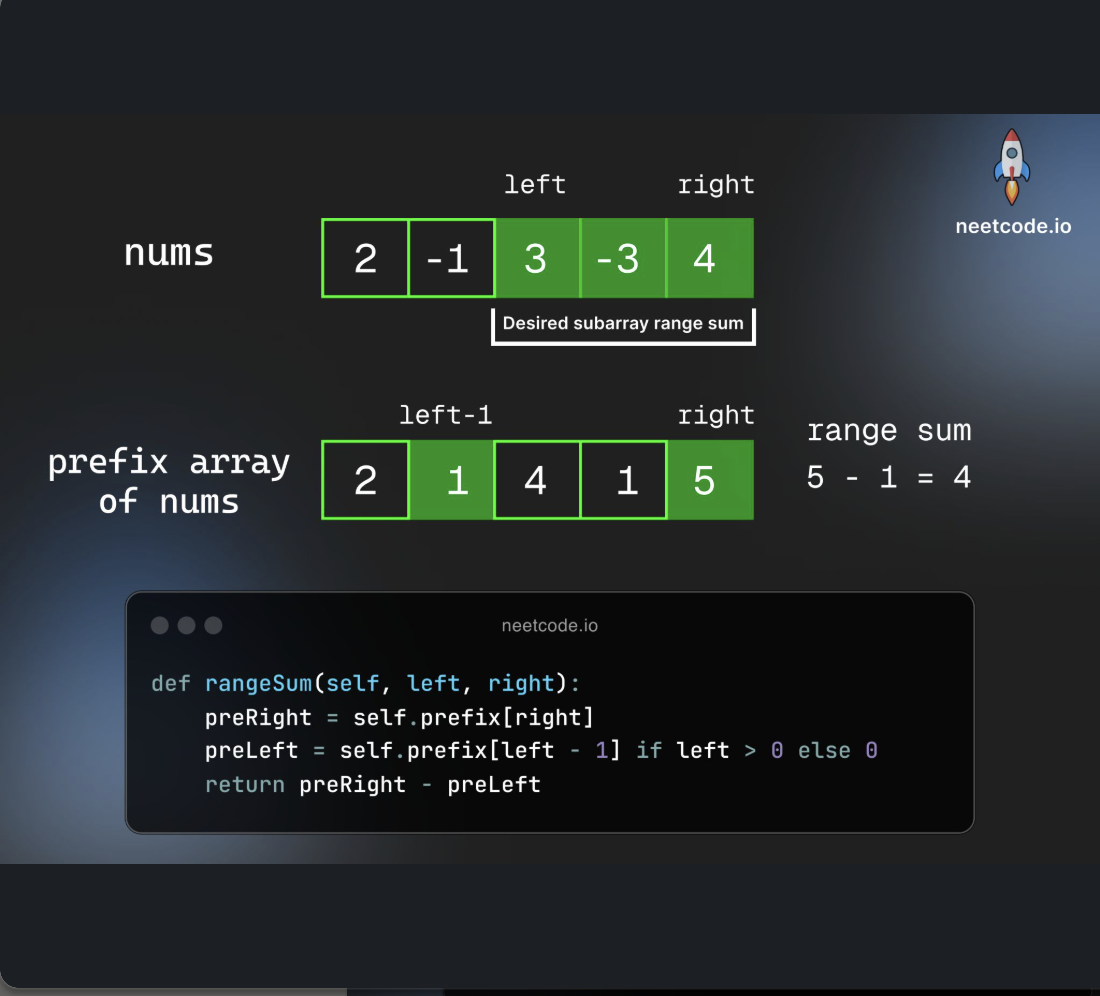
LeetCode Problem Lists
Overview
Prefix Sum is a preprocessing technique that allows us to compute the sum of any subarray in O(1) time after O(n) preprocessing. The core idea is to precompute cumulative sums from the beginning of the array to each position.
Key Properties
- Time Complexity:
- Preprocessing: O(n)
- Query subarray sum: O(1)
- Overall: O(n) preprocessing + O(1) per query
- Space Complexity: O(n) for storing prefix sums
- Core Idea:
prefixSum[i] = nums[0] + nums[1] + ... + nums[i-1] - Subarray Sum:
sum(i, j) = prefixSum[j+1] - prefixSum[i] - When to Use:
- Multiple range sum queries
- Subarray problems with conditions
- Converting O(n²) to O(n) with HashMap
- 2D range sum queries
References
- Fucking Algorithm - Prefix Sum
- LeetCode Prefix Sum Problems
- LeetCode Problem Set Discussion
- Hash Map Cheatsheet
Problem Categories
Pattern 1: Basic Range Sum — LC 303
- Description: Calculate sum of elements in any given range [i, j]
- Examples: LC 303 - Range Sum Query, LC 304 - Range Sum Query 2D
- Pattern: Direct application of prefix sum formula
- Key Insight:
sum[i:j] = prefixSum[j+1] - prefixSum[i]
Pattern 2: Subarray Sum Equals Target — LC 560
- Description: Find/count subarrays with sum equal to target value
- Examples: LC 560 - Subarray Sum Equals K, LC 325 - Maximum Size Subarray Sum Equals k
- Pattern: Use HashMap to store prefix sums and check if
(current_sum - target)exists - Key Insight: If
prefixSum[j] - prefixSum[i] = k, thenprefixSum[i] = prefixSum[j] - k
Pattern 3: Subarray with Divisibility/Modulo — LC 523
- Description: Problems involving divisibility, remainders, or modulo operations
- Examples: LC 523 - Continuous Subarray Sum, LC 974 - Subarray Sums Divisible by K
- Pattern: Store remainders instead of actual sums in HashMap
- Key Insight: If
(prefixSum[j] - prefixSum[i]) % k = 0, thenprefixSum[j] % k = prefixSum[i] % k
Pattern 4: Range Addition/Difference Array — LC 370
- Description: Efficiently apply range updates to arrays
- Examples: LC 370 - Range Addition, LC 1094 - Car Pooling
- Pattern: Use difference array technique with prefix sum
- Key Insight: Add at start, subtract at end+1, then compute prefix sum
Pattern 5: 2D Prefix Sum — LC 304
- Description: Calculate sum of any rectangular region in 2D matrix
- Examples: LC 304 - Range Sum Query 2D, LC 1314 - Matrix Block Sum
- Pattern: Build 2D prefix sum matrix, use inclusion-exclusion principle
- Key Insight:
sum = total - left - top + topleft
Pattern 6: Transform and Count — LC 1248
- Description: Transform array elements and use prefix sum for counting
- Examples: LC 1248 - Count Nice Subarrays, LC 926 - Flip String to Monotone
- Pattern: Convert elements to 0/1, then apply prefix sum with conditions
- Key Insight: Transform problem to simpler prefix sum problem
Pattern 7: Sum of Distances (Left-Right Split) — LC 2615
- Description: Calculate sum of absolute differences between indices efficiently
- Examples: LC 2615 - Sum of Distances (LC 2121 - Intervals Between Identical Elements is the same problem), LC 1685 - Sum of Absolute Differences, LC 2602 - Minimum Operations to Make All Array Elements Equal
- Pattern: Group by value, then split each group into left/right parts and use the
count * value - sumformula - Key Insight: For index
idxat rankkin its group, distance =(idx * countLeft - sumLeft) + (sumRight - idx * countRight), which collapses tototal - 2*prefix[k] + idx*(2*k - m)
Pattern 8: Prefix Maximum (Greedy Chunk / Partition) — LC 769
- Description: Track the running maximum of the array. When
maxSoFar == i, the prefix[0..i]contains exactly the elements{0, 1, ..., i}and can form an independent sorted chunk. - Examples: LC 769 - Max Chunks To Make Sorted, LC 768 - Max Chunks To Make Sorted II, LC 2012 - Sum of Beauty in the Array
- Pattern: Single pass with a
maxSoFarvariable; increment chunk count whenevermaxSoFar == currentIndex - Key Insight: Because the array is a permutation of
[0, n-1], if the max value seen so far equals the current index, all values needed for positions0..iare already present inarr[0..i]
Pattern 9: Prefix + Suffix Split (Minimax over a Split Point) — LC 2017
- Description: The whole choice the problem offers collapses to one index; what lies left of it is a prefix sum and what lies right of it is a suffix sum, so every candidate is scored in one pass
- Examples: LC 2017 - Grid Game, LC 724 - Find Pivot Index, LC 238 - Product of Array Except Self, LC 1422 - Maximum Score After Splitting a String, LC 2483 - Minimum Penalty for a Shop
- Pattern: Sweep the split left to right holding two running sums — shrink the suffix before the compare, grow the prefix after it, so the split cell belongs to neither side
- Key Insight: Once “a choice” is reduced to “an index”,
min/maxover all choices is an O(n) scan, not a search — no DP and no graph algorithm (see Template 15)
0) Concept
How to Build the Prefix Sum Array (核心)
The whole technique rests on one core line. Memorize this and the rest follows:
for i in range(len(cnt)):
    prefix[i + 1] = prefix[i] + cnt[i]
Step-by-step:
cnt = [1, 0, 1, 1, 1]

# Step 1: allocate size n+1, fill with 0
#   the leading prefix[0] = 0 is the "empty sum" sentinel
#   -> lets sum(0, r) work without a special case
prefix = [0] * (len(cnt) + 1)
# prefix = [0, 0, 0, 0, 0, 0]

# Step 2: each prefix[i+1] = running total up to (and including) cnt[i]
for i in range(len(cnt)):
    prefix[i + 1] = prefix[i] + cnt[i]

# prefix = [0, 1, 1, 2, 3, 4]
Trace (why the index is i + 1, not i):
cnt:        [ 1,  0,  1,  1,  1 ]
index i:      0   1   2   3   4

prefix[0] = 0                 ← sentinel (empty prefix)
prefix[1] = prefix[0] + cnt[0] = 0 + 1 = 1
prefix[2] = prefix[1] + cnt[1] = 1 + 0 = 1
prefix[3] = prefix[2] + cnt[2] = 1 + 1 = 2
prefix[4] = prefix[3] + cnt[3] = 2 + 1 = 3
prefix[5] = prefix[4] + cnt[4] = 3 + 1 = 4

prefix = [0, 1, 1, 2, 3, 4]
          ↑                 ↑
       empty sum        sum of ALL cnt
Key:
prefixis one element LONGER thancnt.prefix[i+1]answers “sum of the firsti+1elements” =cnt[0] + ... + cnt[i].
One-liner alternative (itertools.accumulate with a leading 0):
from itertools import accumulate
prefix = list(accumulate(cnt, initial=0))   # [0, 1, 1, 2, 3, 4]
Why sum(l, r) = prefix[r+1] - prefix[l]
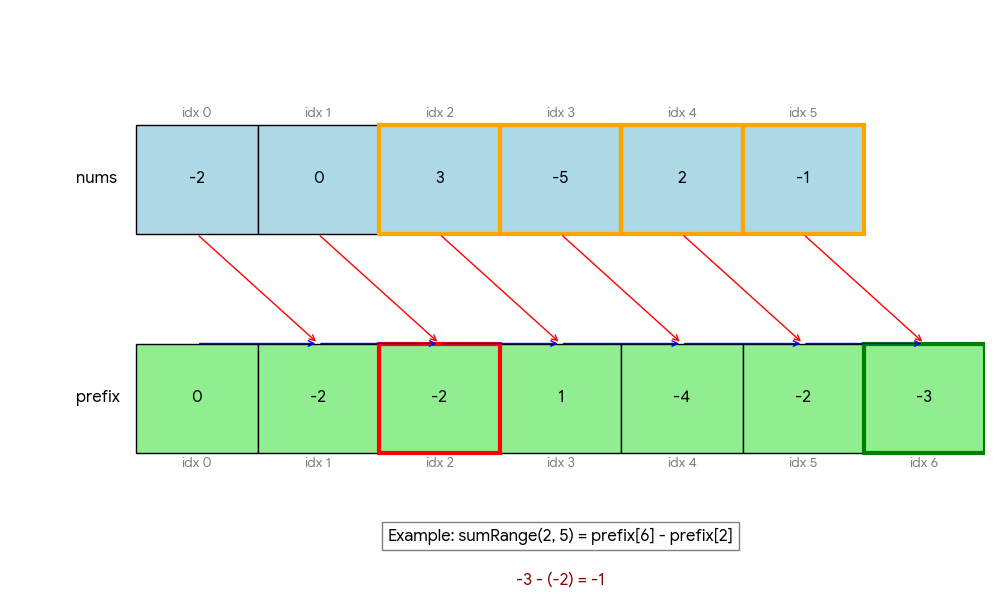
Given nums:    [ a,  b,  c,  d,  e ]
Index:           0   1   2   3   4

Build prefix array (size n+1, prefix[0] = 0):

prefix[0] = 0
prefix[1] = a
prefix[2] = a + b
prefix[3] = a + b + c
prefix[4] = a + b + c + d
prefix[5] = a + b + c + d + e

Visual:

prefix:  0 |  a  | a+b | a+b+c | a+b+c+d | a+b+c+d+e |
index:   0    1      2      3        4          5

To get sum(l=1, r=3) = nums[1] + nums[2] + nums[3] = b + c + d:

prefix[r+1] = prefix[4] = a + b + c + d
prefix[l]   = prefix[1] = a
                           ─────────────
prefix[4] - prefix[1]   =     b + c + d  ✓

Visually (what gets cancelled out):

prefix[4]:  [ a | b | c | d ]
prefix[1]:  [ a ]
            ─────────────────
difference:     [ b | c | d ]   ← this is sum(1, 3)
Why size n+1? The extra prefix[0] = 0 handles the edge case when l = 0:
sum(0, 2) = prefix[3] - prefix[0]
          = (a + b + c) - 0
          = a + b + c  ✓
Without it, we’d need special if (left == 0) checks (see V0 in LC 303).
Concrete Example — LC 303
nums = [-2, 0, 3, -5, 2, -1]

Step 1: Build prefix array
prefix = [0, -2, -2, 1, -4, -2, -3]
              ↑    ↑  ↑   ↑   ↑   ↑
              -2  -2+0 ...        sum of all

Step 2: Query
sumRange(0, 2) = prefix[3] - prefix[0] = 1 - 0 = 1       ✓  (-2+0+3)
sumRange(2, 5) = prefix[6] - prefix[2] = -3 - (-2) = -1  ✓  (3-5+2-1)
sumRange(0, 5) = prefix[6] - prefix[0] = -3 - 0 = -3     ✓  (-2+0+3-5+2-1)
Two Styles Comparison
| Style | Prefix Size | Build | Query sum(l, r) |
Edge Case |
|---|---|---|---|---|
Size n+1 (recommended) |
n + 1 |
prefix[i+1] = prefix[i] + nums[i] |
prefix[r+1] - prefix[l] |
No special case needed |
Size n |
n |
prefix[i] = prefix[i-1] + nums[i] |
prefix[r] - (l > 0 ? prefix[l-1] : 0) |
Need if (l == 0) check |
Templates & Algorithms
Template Comparison Table
| Template Type | Use Case | Key Data Structure | When to Use |
|---|---|---|---|
| Basic Prefix Sum | Range sum queries | Array | Need multiple range sum calculations |
| HashMap + Prefix Sum | Subarray with target sum | HashMap | Find/count subarrays with specific sum |
| Modulo Prefix Sum | Divisibility problems | HashMap with remainders | Subarray sum divisible by k |
| Difference Array | Range updates | Array with start/end markers | Multiple range additions |
| 2D Prefix Sum | Rectangle sum queries | 2D matrix | 2D range sum calculations |
| Sum of Distances | Absolute difference sums | HashMap + Prefix Sum | Sum of |
| Prefix + Suffix Split | Best split point / minimax | Two running sums | The whole answer is decided by one index |
Universal Template
def prefix_sum_solve(nums, target):
    """
    Universal prefix sum template for most problems
    """
    # Step 1: Initialize prefix sum and result
    prefix_sum = 0
    result = 0

    # Step 2: HashMap for storing prefix sums (if needed)
    prefix_map = {0: 1}  # Handle subarrays starting from index 0

    # Step 3: Iterate through array
    for num in nums:
        # Update prefix sum
        prefix_sum += num

        # Check condition based on problem type
        if prefix_sum - target in prefix_map:
            result += prefix_map[prefix_sum - target]

        # Update map
        prefix_map[prefix_sum] = prefix_map.get(prefix_sum, 0) + 1

    return result
Template 1: Basic Prefix Sum (Range Queries) — LC 303
class PrefixSum:
    def __init__(self, nums):
        """Build prefix sum array for range queries"""
        self.prefix = [0] * (len(nums) + 1)
        for i in range(len(nums)):
            self.prefix[i + 1] = self.prefix[i] + nums[i]

    def range_sum(self, left, right):
        """Get sum of elements from index left to right (inclusive)"""
        return self.prefix[right + 1] - self.prefix[left]
// Java implementation
class PrefixSum {
    private int[] prefix;

    public PrefixSum(int[] nums) {
        prefix = new int[nums.length + 1];
        for (int i = 0; i < nums.length; i++) {
            prefix[i + 1] = prefix[i] + nums[i];
        }
    }

    public int rangeSum(int left, int right) {
        return prefix[right + 1] - prefix[left];
    }
}
Template 2: HashMap + Prefix Sum (Subarray Target Sum) — LC 560
def subarray_sum_equals_k(nums, k):
    """Count subarrays with sum equal to k"""
    count = 0
    prefix_sum = 0
    prefix_map = {0: 1}  # Important: initialize with {0: 1}

    for num in nums:
        prefix_sum += num

        # Check if (prefix_sum - k) exists
        if prefix_sum - k in prefix_map:
            count += prefix_map[prefix_sum - k]

        # Update map
        prefix_map[prefix_sum] = prefix_map.get(prefix_sum, 0) + 1

    return count
// Java implementation
public int subarraySum(int[] nums, int k) {
    int count = 0, prefixSum = 0;
    Map<Integer, Integer> map = new HashMap<>();
    map.put(0, 1);  // Handle subarrays starting from index 0

    for (int num : nums) {
        prefixSum += num;

        if (map.containsKey(prefixSum - k)) {
            count += map.get(prefixSum - k);
        }

        map.put(prefixSum, map.getOrDefault(prefixSum, 0) + 1);
    }

    return count;
}
Why the map stores a count, not an index — the same prefix sum can be reached at many positions, and every one of them starts a valid subarray ending here. Storing the latest index would count one of them; storing how many times the sum has been seen counts all of them, which is why the update is
map[sum] += 1and the read iscount += map[sum - k].
Template 3: Modulo Prefix Sum (Divisibility Problems) — LC 974
Core Mathematical Insight:
Let prefix[i] = sum of nums[0..i]

A subarray sum nums[j+1..i] is divisible by k:
  (prefix[i] - prefix[j]) % k == 0

This implies:
  prefix[i] % k == prefix[j] % k

So if we see the SAME remainder again at index i vs a previous index j,
the subarray nums[j+1..i] has sum divisible by k.

map stores: { remainder -> earliest index }

If the current remainder already exists in the map
AND the distance (i - map[remainder]) >= 2, we found a valid subarray.
def subarray_divisible_by_k(nums, k):
    """Count subarrays with sum divisible by k"""
    count = 0
    prefix_sum = 0
    remainder_map = {0: 1}  # remainder -> count

    for num in nums:
        prefix_sum += num
        remainder = prefix_sum % k

        # Handle negative remainders
        if remainder < 0:
            remainder += k

        if remainder in remainder_map:
            count += remainder_map[remainder]

        remainder_map[remainder] = remainder_map.get(remainder, 0) + 1

    return count
Template 4: Difference Array (Range Updates) — LC 370
def range_addition(length, updates):
    """Apply multiple range additions efficiently"""
    # Step 1: Create difference array
    diff = [0] * (length + 1)

    # Step 2: Apply range updates to difference array
    for start, end, val in updates:
        diff[start] += val
        diff[end + 1] -= val

    # Step 3: Compute prefix sum to get final result
    result = []
    current_sum = 0
    for i in range(length):
        current_sum += diff[i]
        result.append(current_sum)

    return result
Template 5: 2D Prefix Sum — LC 304
class NumMatrix:
    def __init__(self, matrix):
        """Build 2D prefix sum matrix"""
        if not matrix or not matrix[0]:
            return

        m, n = len(matrix), len(matrix[0])
        self.prefix = [[0] * (n + 1) for _ in range(m + 1)]

        for i in range(1, m + 1):
            for j in range(1, n + 1):
                self.prefix[i][j] = (matrix[i-1][j-1] +
                                   self.prefix[i-1][j] +
                                   self.prefix[i][j-1] -
                                   self.prefix[i-1][j-1])

    def sumRegion(self, row1, col1, row2, col2):
        """Calculate sum of rectangle from (row1,col1) to (row2,col2)"""
        return (self.prefix[row2+1][col2+1] -
                self.prefix[row1][col2+1] -
                self.prefix[row2+1][col1] +
                self.prefix[row1][col1])
Template 6: Transform and Count — LC 1248
def count_nice_subarrays(nums, k):
    """Count subarrays with exactly k odd numbers"""
    # Transform: odd -> 1, even -> 0
    transformed = [1 if x % 2 == 1 else 0 for x in nums]

    # Now it's subarray sum equals k problem
    count = 0
    prefix_sum = 0
    prefix_map = {0: 1}

    for val in transformed:
        prefix_sum += val

        if prefix_sum - k in prefix_map:
            count += prefix_map[prefix_sum - k]

        prefix_map[prefix_sum] = prefix_map.get(prefix_sum, 0) + 1

    return count
You do not have to materialise the transformed array.
transformedabove makes the “odd → 1, even → 0” step visible, but testingx % 2inside the same loop that maintains the prefix sum is the form to write under time pressure — the transform is one predicate, not a pass.
Template 7: Sum of Distances (Left-Right Split) — LC 2615
This pattern efficiently calculates sum of absolute differences |i - j| between indices.
Core Idea
Two moves, in this order:
- Group the indices by value (
{value: [indices]}), because|i - j|only ever runs between equal values — every group is an independent, self-contained sub-problem. - Inside a group, drop the absolute value by splitting at the pivot. Everything to the left is
pivot - other, everything to the right isother - pivot; no bars survive, and each half iscount * pivot ∓ sum— a prefix sum away.
The group’s indices arrive sorted for free. You append
iwhile scanning left to right, so each list is already increasing. That is what makes the whole thingO(n)— sorting the groups would costO(n log n)and buys nothing. Never sort here; it is the giveaway that the grouping step was not understood.
The Derivation
Setup — the notation the rest of this section uses
indices = [i_0, i_1, i_2, ..., i_{m-1}]   the sorted indices of ONE value
m       = len(indices)

For the element at RANK k inside that group:
  idx       = indices[k]      its position in the ORIGINAL array
  left_cnt  = k               how many equal values sit before it
  right_cnt = m - 1 - k       how many sit after it

Prefix sum over the group (size m+1, leading sentinel):
  prefix[0]     = 0                                  the empty sum
  prefix[k]     = i_0 + i_1 + ... + i_{k-1}          first k     → everything LEFT of rank k
  prefix[k + 1] = i_0 + i_1 + ... + i_k              first k + 1 → the left part, plus idx itself
  prefix[m]     = i_0 + i_1 + ... + i_{m-1}          the whole group
Two different indices are in play, and confusing them is the classic slip.
kis the rank within the group — it indexesindicesandprefix.idx = indices[k]is the position innums— it is the value being summed over, and it is where the answer is written (res[idx], neverres[k]).
Reading a prefix index — the one rule the whole derivation leans on
prefixSum[i] = nums[0] + nums[1] + ... + nums[i-1]

  -> so, when we say prefixSum[i],
     we are summing the values in [0, i-1]   ← i is EXCLUSIVE, i itself is NOT in the sum

Applied to a group's indices:

  -> i_0 + i_1 + ... + i_{k-1}          is   prefix[k]
     (everything strictly LEFT of rank k)          upper end k is excluded, so idx is out ✓

  -> i_{k+1} + i_{k+2} + ... + i_{m-1}  is   prefix[m] - prefix[k + 1]
     (everything strictly RIGHT of rank k)         whole group, minus the first k+1 (which ends AT idx)
Concrete example — group [2, 5, 8, 12], m = 4, so prefix = [0, 2, 7, 15, 27]:
rank k:      0   1   2    3
indices:     2   5   8   12
prefix:  0   2   7  15   27
         ↑                ↑
    prefix[0]         prefix[4] = prefix[m]

At rank k = 2  (idx = 8):

  left part  = i_0 + i_1                  = 2 + 5  = 7
             = prefix[k]  = prefix[2]     = 7                       ✓ (8 is NOT included)

  right part = i_3                        = 12
             = prefix[m] - prefix[k + 1]
             = prefix[4] - prefix[3]      = 27 - 15 = 12            ✓ (8 is NOT included)

Contrast the off-by-one:
  prefix[m] - prefix[k] = 27 - 7 = 20 = 8 + 12   ← still carries idx itself, hence prefix[k+1]
1) Left distance — every index to the left is smaller, so |idx - i| = idx - i and the bars drop:
left = (idx - i_0) + (idx - i_1) + ... + (idx - i_{k-1})

     = (idx + idx + ... + idx)  -  (i_0 + i_1 + ... + i_{k-1})
       └─── k copies of idx ──┘     └── sum of the first k ──┘

     = idx * k - (i_0 + ... + i_{k-1})

     = idx * left_cnt - prefix[k]
2) Right distance — every index to the right is larger, so |idx - i| = i - idx:
right = (i_{k+1} - idx) + (i_{k+2} - idx) + ... + (i_{m-1} - idx)

      = (i_{k+1} + i_{k+2} + ... + i_{m-1})  -  (idx + ... + idx)
        └───── sum of the right part ──────┘     └ m-1-k copies ┘

      = (total_sum - sum_up_to_and_including_idx) - idx * (m - 1 - k)

      = (prefix[m] - prefix[k + 1]) - idx * right_cnt
Why the right part subtracts
prefix[k + 1]and notprefix[k].prefix[k]stops beforeidx, soprefix[m] - prefix[k]still containsidx— pairing that withright_cnt = m - 1 - kovershoots the answer by exactlyidx. The sum and the count have to agree on whether the pivot is in the right part;prefix[k + 1]withm - 1 - ksays it is not.
3) Total distance
res[idx] = left + right
         = (idx * left_cnt - prefix[k])  +  ((prefix[m] - prefix[k + 1]) - idx * right_cnt)
That is O(1) per element after an O(m) prefix pass over the group, so O(n) overall — against
O(n^2) for comparing every pair.
Visual Explanation
One group's indices: [2, 5, 8, 12]        m = 4
rank k:               0  1  2   3

prefix = [0, 2, 7, 15, 27]
          ↑                ↑
       empty sum        prefix[m] = whole group

Take rank k = 2  →  idx = 8, left_cnt = 2, right_cnt = m-1-k = 1

  left  = idx * left_cnt - prefix[k]
        = 8 * 2 - prefix[2]                    prefix[2] = 2 + 5 = 7
        = 16 - 7 = 9                           → |8-2| + |8-5| = 6 + 3 = 9 ✓

  right = (prefix[m] - prefix[k+1]) - idx * right_cnt
        = (27 - 15) - 8 * 1                    prefix[3] = 2 + 5 + 8 = 15
        = 12 - 8 = 4                           → |12-8| = 4 ✓

  res[8] = 9 + 4 = 13
End to end on the LC 2615 example — nums = [1,3,1,1,2], expected [5,0,3,4,0]:
groups:  1 -> [0, 2, 3]      3 -> [1]      2 -> [4]

Group [0, 2, 3]:  m = 3,  prefix = [0, 0, 2, 5]

 k=0  idx=0  left_cnt=0 right_cnt=2   left = 0*0 - prefix[0] = 0
                                      right = (5 - prefix[1]) - 0*2 = 5 - 0 = 5   res[0] = 5 ✓
 k=1  idx=2  left_cnt=1 right_cnt=1   left = 2*1 - prefix[1] = 2 - 0 = 2
                                      right = (5 - prefix[2]) - 2*1 = 3 - 2 = 1   res[2] = 3 ✓
 k=2  idx=3  left_cnt=2 right_cnt=0   left = 3*2 - prefix[2] = 6 - 2 = 4
                                      right = (5 - prefix[3]) - 3*0 = 0           res[3] = 4 ✓

Single-index groups keep res = 0  →  res[1] = res[4] = 0 ✓
Python Template
def sum_of_distances(nums):
    """
    LC 2615: Calculate sum of |i - j| for all j where nums[j] == nums[i]
    Time: O(n), Space: O(n)
    """
    from collections import defaultdict

    n = len(nums)
    result = [0] * n

    # Step 1: Group indices by value
    index_map = defaultdict(list)
    for i, num in enumerate(nums):
        index_map[num].append(i)

    # Step 2: For each group, calculate distances using prefix sum
    for indices in index_map.values():
        m = len(indices)
        if m == 1:
            continue  # Single element has distance 0

        # prefix[k] = sum of the first k indices  (size m+1, prefix[0] = 0)
        prefix = [0] * (m + 1)
        for k in range(m):
            prefix[k + 1] = prefix[k] + indices[k]

        # Calculate distance for each index in group
        for k in range(m):
            idx = indices[k]

            # Left part: idx * left_cnt - prefix[k]
            left_cnt = k
            left_dist = idx * left_cnt - prefix[k]

            # Right part: (prefix[m] - prefix[k+1]) - idx * right_cnt
            right_cnt = m - 1 - k
            right_dist = (prefix[m] - prefix[k + 1]) - idx * right_cnt

            result[idx] = left_dist + right_dist

    return result
Java Template
// LC 2615 - Sum of Distances
public long[] distance(int[] nums) {
    int n = nums.length;
    long[] res = new long[n];
    Map<Integer, List<Integer>> map = new HashMap<>();

    // Step 1: Group indices by value
    for (int i = 0; i < n; i++) {
        map.computeIfAbsent(nums[i], k -> new ArrayList<>()).add(i);
    }

    // Step 2: Calculate distances using prefix sum
    for (List<Integer> indices : map.values()) {
        int m = indices.size();
        if (m == 1) continue;

        // prefix[k] = sum of the first k indices  (size m+1, prefix[0] = 0)
        long[] prefix = new long[m + 1];
        for (int k = 0; k < m; k++) {
            prefix[k + 1] = prefix[k] + indices.get(k);
        }

        // Calculate distance for each index
        for (int k = 0; k < m; k++) {
            int idx = indices.get(k);

            // Left: idx * left_cnt - prefix[k]
            long left = (long) idx * k - prefix[k];

            // Right: (prefix[m] - prefix[k+1]) - idx * right_cnt
            long right = (prefix[m] - prefix[k + 1]) - (long) idx * (m - 1 - k);

            res[idx] = left + right;
        }
    }

    return res;
}
Alternative: Running Sum Approach (No Prefix Array)
def sum_of_distances_optimized(nums):
    """Space-optimized version using running sums"""
    from collections import defaultdict

    n = len(nums)
    result = [0] * n
    index_map = defaultdict(list)

    for i, num in enumerate(nums):
        index_map[num].append(i)

    for indices in index_map.values():
        m = len(indices)
        if m == 1:
            continue

        # Calculate total sum once
        total_sum = sum(indices)

        prefix_sum = 0
        for i, idx in enumerate(indices):
            # Left: idx * i - prefix_sum
            # Right: (total_sum - prefix_sum - idx) - idx * (m - i - 1)
            left_dist = idx * i - prefix_sum
            right_dist = (total_sum - prefix_sum - idx) - idx * (m - i - 1)

            result[idx] = left_dist + right_dist
            prefix_sum += idx

    return result
The Same Thing in One Line (the identity worth memorising)
The left/right split is how you derive the answer at the whiteboard, but the two halves collapse
algebraically into a single expression — no branch, no countLeft / countRight bookkeeping:
left  = idx * i           - prefixSum
right = (total - prefixSum - idx) - idx * (m - i - 1)

left + right
  = idx*i - prefixSum + total - prefixSum - idx - idx*m + idx*i + idx
  = total - 2 * prefixSum + idx * (2*i - m)
                             ↑
                    the -idx and +idx cancel
# python
# LC 2615 - Sum of Distances  (collapsed form)
# IDEA: total - 2*prefix[k] + idx*(2k - m) is exactly leftDist + rightDist  (k = rank, m = group size)
# time = O(n), space = O(n)
from collections import defaultdict

def distance(nums):
    groups = defaultdict(list)
    for i, v in enumerate(nums):
        groups[v].append(i)

    res = [0] * len(nums)
    for group in groups.values():
        total, prefix_sum, m = sum(group), 0, len(group)
        for i, idx in enumerate(group):
            res[idx] = total - prefix_sum * 2 + idx * (2 * i - m)
            prefix_sum += idx
    return res
The
m == 1guard becomes unnecessary. For a single-occurrence group the formula readsidx - 0 + idx*(0 - 1) = 0on its own, which is the answer the problem asks for. The split form needsif m == 1: continueonly because it is written as two pieces.
Formula Summary
At rank k of a group of size m, with idx = indices[k] and prefix the size-m+1 prefix sum:
| Component | Formula | Meaning |
|---|---|---|
| Left count / sum | left_cnt = k, sum_left = prefix[k] |
the k equal values before idx |
| Right count / sum | right_cnt = m - 1 - k, sum_right = prefix[m] - prefix[k + 1] |
the equal values after idx, pivot excluded |
| Left Distance | idx * left_cnt - prefix[k] |
Sum of (idx - smaller_idx) |
| Right Distance | (prefix[m] - prefix[k + 1]) - idx * right_cnt |
Sum of (larger_idx - idx) |
| Total Distance | left + right → res[idx] |
Sum of all |idx - other_idx| |
Similar Problems — the count * value − sum family
Every one of these is the same identity; what changes is what the sorted list holds and where it comes from.
| Problem | The sorted list is… | Difference from LC 2615 |
|---|---|---|
| LC 2121 Intervals Between Identical Elements | indices grouped by value | The identical problem. LC 2615’s statement says so outright — same input, same output, different title |
| LC 1685 Sum of Absolute Differences in a Sorted Array | the values, already sorted | no grouping and no hash map — the array itself is the group, so it is the one-group case |
| LC 2602 Minimum Operations to Make All Array Elements Equal | the sorted values, plus a prefix array | the pivot is a query, not an element, so binary search for its insertion point first, then apply the same two halves |
| LC 2448 Minimum Cost to Make Array Equal | values sorted, carrying weights | each element counts w times: the counts become weight sums, so prefix over w and over w*v |
| LC 462 Minimum Moves to Equal Array Elements II | the sorted values | asks only for the minimum over pivots, which the median gives — no per-element pass needed |
| LC 834 Sum of Distances in Tree | — | the “line” is a tree, so the left/right split becomes subtree / everything-else, computed by re-rooting |
Recognising it in the room. The trigger is a sum of
|x − y|over a set you can sort. Sorting removes the absolute value — everything before the pivot subtracts, everything after adds — and once the bars are gone, each half iscount × pivot ∓ sum, which prefix sums answer inO(1). Say that sentence and theO(n^2)brute force is already behind you.
Template 8: Prefix Maximum (Greedy Chunk / Partition) — LC 769
Core Idea: For a permutation of [0, n-1], the prefix arr[0..i] can be an independent sorted chunk if and only if max(arr[0..i]) == i. Track this with a single maxSoFar variable.
// Java — LC 769 Max Chunks To Make Sorted
// Time: O(n)  Space: O(1)
public int maxChunksToSorted(int[] arr) {
    int chunks = 0, maxSoFar = 0;
    for (int i = 0; i < arr.length; i++) {
        maxSoFar = Math.max(maxSoFar, arr[i]);
        if (maxSoFar == i) chunks++;   // all values 0..i are present in arr[0..i]
    }
    return chunks;
}
# Python — LC 769
def maxChunksToSorted(arr):
    chunks = max_so_far = 0
    for i, val in enumerate(arr):
        max_so_far = max(max_so_far, val)
        if max_so_far == i:
            chunks += 1
    return chunks
Equivalent prefix-sum formulation (also O(n)/O(1)):
// prefixSum of arr == prefixSum of sorted arr  →  same multiset in [0..i]
int chunks = 0, prefixSum = 0, sortedPrefixSum = 0;
for (int i = 0; i < arr.length; i++) {
    prefixSum += arr[i];
    sortedPrefixSum += i;           // sorted array is [0,1,2,...,n-1]
    if (prefixSum == sortedPrefixSum) chunks++;
}
Why comparing sums is enough for LC 769. The values are a permutation of
0..n-1, so a prefix ofarrcan only have the same sum as the same-length prefix of the sorted array if it holds the same set of values — in some order. That is exactly the condition for the prefix to be a self-contained chunk, which is why the sum test needs no sorting.
When to upgrade to PrefixMax + SuffixMin (LC 768, general arrays):
// If values are NOT a permutation, use:
// max(arr[0..i-1]) < min(arr[i..n-1])  →  valid cut point
int[] prefixMax = arr.clone(), suffixMin = arr.clone();
for (int i = 1; i < n; i++) prefixMax[i] = Math.max(prefixMax[i-1], prefixMax[i]);
for (int i = n-2; i >= 0; i--) suffixMin[i] = Math.min(suffixMin[i+1], suffixMin[i]);
int chunks = 0;
for (int i = 0; i < n; i++)
    if (i == 0 || suffixMin[i] > prefixMax[i-1]) chunks++;
The same pair asked about an element, not a cut. LC 2012 keeps
prefixMaxandsuffixMinbut testsprefixMax[i] < nums[i] < suffixMin[i], and only the suffix side needs an array — worked through in prefix_sum_examples.md § Prefix max / suffix min scans.
Template 15: Prefix + Suffix Split — Minimax over a Split Point — LC 2017Priority 4 of 5 — High value — a gap here costs you rounds
Numbered 15 because 9–14 are the advanced set in the next section; this one belongs with the core templates.
Core Idea
Some problems read like a search over paths or partitions, but the entire choice collapses to one index. The moment it does, the two sides of that index are a prefix sum and a suffix sum, and the best choice is a single linear scan — no DP, no graph search.
LC 2017 is the cleanest instance. The grid is 2 x n, and a legal path goes right along row 0,
drops exactly once, then goes right along row 1 — so a path IS its turning column i.
There are only n paths, not exponentially many.
grid = [[2, 5, 4],
        [1, 5, 1]]        robot 1 turns down at column i = 1

        col:   0     1     2
row 0:       [ 2 ] [ 5 ]   4        4 survives   ->  TOP    = suffix of row 0
row 1:         1   [ 5 ] [ 1 ]      1 survives   ->  BOTTOM = prefix of row 1
                     ^
        [ ] = zeroed by robot 1     column i is on robot 1's own path -> in NEITHER block
Robot 1 turning at i zeroes row0[0..i] and row1[i..n-1], so robot 2 is left exactly two
untouched blocks — and they sit on opposite sides of i:
| Block | Cells | Which sum |
|---|---|---|
| top | row0[i+1 ... n-1] |
suffix of row 0 |
| bottom | row1[0 ... i-1] |
prefix of row 1 |
Robot 2 also drops exactly once, so it can reach only one of the two blocks; since every
value is >= 1 it takes that block whole (drop at column n-1 for the top, at column 0 for
the bottom). So robot 2 scores max(top, bottom), and robot 1 picks the i that minimises it:
answer = min over i of   max( sum(row0[i+1 ... n-1]) ,  sum(row1[0 ... i-1]) )
                              └──── suffix, shrinks ─┘   └──── prefix, grows ─┘
The Pattern
Two running sums moving in opposite directions, and the order of the three statements inside the loop is the whole template:
top    = sum(row 0)          the suffix, starts whole
bottom = 0                   the prefix, starts empty

for i in 0 .. n-1:
    top    -= row0[i]        1. shrink the suffix FIRST  -> column i leaves the top block
    res     = min(res, max(top, bottom))   2. score this split
    bottom += row1[i]        3. grow the prefix AFTER    -> column i joins the bottom block
                                              only for the NEXT split
Do step 3 before step 2 and column i is double-counted into the bottom block; do step 1 after
step 2 and it is still counted in the top block. Either slip scores a path that does not exist.
# python
# LC 2017 - Grid Game
# IDEA: a path in a 2 x n grid IS its turning column, so scan the column and keep
#       suffix(row 0) and prefix(row 1) as two running sums
# time = O(n), space = O(1)
class Solution(object):
    def gridGame(self, grid):
        top = sum(grid[0])      # suffix row0[i+1 ... n-1] once shrunk
        bottom = 0              # prefix row1[0   ... i-1] once grown
        res = float('inf')

        for i in range(len(grid[0])):
            top -= grid[0][i]                    # column i leaves the top block
            res = min(res, max(top, bottom))     # robot 2 takes the bigger block
            bottom += grid[1][i]                 # column i joins the bottom block

        return res
// java
// LC 2017 - Grid Game
// IDEA: minimise, over the turning column, the max of (row 0 suffix, row 1 prefix)
// time = O(n), space = O(1)
public long gridGame(int[][] grid) {
    long top = 0, bottom = 0, res = Long.MAX_VALUE;
    for (int v : grid[0]) top += v;              // n <= 5e4, v <= 1e5 -> 5e9, so long

    for (int i = 0; i < grid[0].length; i++) {
        top -= grid[0][i];
        res = Math.min(res, Math.max(top, bottom));
        bottom += grid[1][i];
    }
    return res;
}
Visual Trace — grid = [[2,5,4],[1,5,1]]
top starts at 2+5+4 = 11, bottom at 0

 i | top -= row0[i] | bottom | max(top, bottom) | res | bottom += row1[i]
---+----------------+--------+------------------+-----+------------------
 0 | 11 - 2 =  9    |   0    |        9         |  9  | 0 + 1 = 1
 1 |  9 - 5 =  4    |   1    |        4    <--  |  4  | 1 + 5 = 6
 2 |  4 - 4 =  0    |   6    |        6         |  4  | 6 + 1 = 7

answer = 4   (robot 1 turns at column 1, robot 2 takes the lone 4 on the top row) ✓
Traps
- This is minimax, not greedy. Robot 1 does not maximise its own take. Grabbing the richest
path can hand robot 2 an even richer leftover — the objective is
min(max(...)), and only the scan over allnsplits sees that. - Do not reach for a graph algorithm. Dijkstra / longest-path answers “best route for me”,
which is the wrong objective, and the
2 x nshape means there is nothing to search: the decision is one column index. - The split cell is on neither side. See the ordering note above — it is the only real bug in this template.
- Overflow in Java.
n <= 5 * 10^4and values<= 10^5put the row total at5 * 10^9; accumulate inlong.
Product Variant — No Inverse, So Build Both Sides (LC 238) Priority 5 of 5 — Must know — expect it in almost every loop
Which precondition breaks. Template 15 never builds the suffix: it starts top at the
total and subtracts its way down, because subtraction undoes addition. For a product that
undo is a division — which LC 238 forbids outright, and which is undefined the moment the
array holds a 0. So the suffix has to be accumulated in its own right-to-left pass, and
that second pass is the whole difference.
ans[i] = product(nums[0 .. i-1])  ×  product(nums[i+1 .. n-1])
         └──── prefix, exclusive ┘    └──── suffix, exclusive ┘
               left-to-right pass           right-to-left pass

both sides start at 1 (the empty product), and index i is on NEITHER side —
the same split-cell rule as LC 2017
Why division is a trap rather than a shortcut: total / nums[i] needs casework for exactly one
zero (every other index is 0, the zero’s index is the product of the rest) and for two or more
zeros (everything is 0). The two-pass form handles all three cases with no branch at all.
Two arrays — the version to derive first, because each array has a one-line definition:
# python
# LC 238 - Product of Array Except Self
# IDEA: ans[i] = (product left of i) * (product right of i), each built in its own pass
# time = O(n), space = O(n)
class Solution(object):
    def productExceptSelf(self, nums):
        n = len(nums)
        prefix = [1] * n                      # prefix[i] = nums[0] * ... * nums[i-1]
        for i in range(1, n):
            prefix[i] = prefix[i - 1] * nums[i - 1]
        suffix = [1] * n                      # suffix[i] = nums[i+1] * ... * nums[n-1]
        for i in range(n - 2, -1, -1):        # stop is -1, so index 0 is filled
            suffix[i] = suffix[i + 1] * nums[i + 1]
        return [prefix[i] * suffix[i] for i in range(n)]
O(1) extra space — the follow-up, and a genuinely different bound: the output array holds the prefix, and the suffix shrinks to one running variable. Inside each loop the order is write, then absorb — the same “split cell on neither side” ordering as Template 15:
# python
# LC 238 - Product of Array Except Self
# IDEA: store the prefix in ans itself, then sweep back with one running suffix product
# time = O(n), space = O(1) extra (the output array does not count)
class Solution(object):
    def productExceptSelf(self, nums):
        n = len(nums)
        ans = [1] * n
        left = 1
        for i in range(n):
            ans[i] = left          # 1. write: product of nums[0 .. i-1]
            left *= nums[i]        # 2. THEN absorb nums[i], for index i+1
        right = 1
        for i in range(n - 1, -1, -1):
            ans[i] *= right        # 1. multiply in: product of nums[i+1 .. n-1]
            right *= nums[i]       # 2. THEN absorb nums[i], for index i-1
        return ans
// java
// LC 238 - Product of Array Except Self
// IDEA: prefix product stored in ans, suffix product as one running int
// time = O(n), space = O(1) extra
public int[] productExceptSelf(int[] nums) {
    int n = nums.length;
    int[] ans = new int[n];
    int left = 1;
    for (int i = 0; i < n; i++) {
        ans[i] = left;             // product of nums[0 .. i-1]
        left *= nums[i];
    }
    int right = 1;
    for (int i = n - 1; i >= 0; i--) {
        ans[i] *= right;           // times product of nums[i+1 .. n-1]
        right *= nums[i];
    }
    return ans;
}
Visual Trace — nums = [-1, 1, 0, -3, 3]
pass 1 (->): ans[i] = left, then left *= nums[i]

 i | nums[i] | ans[i] = left | left after
---+---------+---------------+-----------
 0 |   -1    |       1       |    -1
 1 |    1    |      -1       |    -1
 2 |    0    |      -1       |     0
 3 |   -3    |       0       |     0
 4 |    3    |       0       |     0        ans = [1, -1, -1, 0, 0]  (= prefix)

pass 2 (<-): ans[i] *= right, then right *= nums[i]

 i | right before | ans[i]          | right after
---+--------------+-----------------+------------
 4 |      1       |  0 *  1 =  0    |     3
 3 |      3       |  0 *  3 =  0    |    -9
 2 |     -9       | -1 * -9 =  9    |     0
 1 |      0       | -1 *  0 =  0    |     0
 0 |      0       |  1 *  0 =  0    |     0

answer = [0, 0, 9, 0, 0]  ✓   only index 2 skips the zero, so only it survives
Traps
- Write before you absorb. Swap the two lines in either loop and
ans[i]includesnums[i]— an inclusive prefix, which is the ordinary Template 1 array and the wrong answer. - Start at
1, not0.1is the empty product; a0start zeroes the whole output. - The reverse loop stops at
-1.range(n - 1, 0, -1)never visits index 0, soans[0]keeps only its (empty) prefix. In the two-array form the loop starts atn - 2becausesuffix[n-1] = 1is already set. - Do not reach for
total / nums[i]. It is forbidden here, and even where it is allowed the zero cases make it longer than the two passes. - When there is a modulus, this is the only way. LC 2906 takes products mod
12345, which is not prime, so no modular inverse exists either — prefix × suffix is the answer there too.
Similar Problems — the split-point family
Same shape every time: one index decides the answer, the left of it is a prefix and the right a suffix.
| Problem | LC # | What the split index is | Difference from LC 2017 |
|---|---|---|---|
| Find Pivot Index | 724 | the pivot | the plain case: find a split where prefix == suffix, no min/max |
| Product of Array Except Self | 238 | every index in turn | products have no inverse, so the suffix gets its own pass — the product variant above |
| Construct Product Matrix | 2906 | every cell, row-major | LC 238 on the flattened grid, mod 12345 — not prime, so no modular inverse either |
| Maximum Score After Splitting a String | 1422 | the cut | maximise zeros-left + ones-right — one scan, same two counters |
| Minimum Penalty for a Shop | 2483 | the closing hour | minimise customers-lost-before + no-customer-hours-after |
| Flip String to Monotone Increasing | 926 | the 0 → 1 boundary |
minimise ones-left + zeros-right; already a Template 6 transform |
| Partition Array Into Three Parts With Equal Sum | 1013 | two splits | prefix must hit total/3 twice — a scan with two checkpoints |
| Ways to Split Array Into Three Subarrays | 1712 | two splits | the second split is monotone in the first, so binary search it |
| Trapping Rain Water | 42 | every index | prefix max / suffix max rather than sums (cf. Template 8) |
| Maximum Trailing Zeros in a Cornfield Path | 2245 | the turning cell in a grid | LC 2017’s “one turn” in a full grid: four directions, prefix counts of factors 2 and 5 |
Recognising it in the room. Ask: how many genuinely different choices are there? If the answer is “one per index” — one turning column, one cut, one pivot — stop looking for DP and write the two-running-sum scan. In LC 2017 the giveaway is
grid.length == 2: two rows and one allowed drop mean a path has no other degree of freedom.
Advanced Templates
Templates 9–14 moved to prefix_sum_advanced.md. They are the ones that stop being “build the array, subtract two entries” and start borrowing another structure:
| # | Template | The borrowed idea | LC |
|---|---|---|---|
| 9 | Complement trick — total − middle window ⭐⭐⭐⭐⭐ | a wrap-around choice becomes one contiguous window to exclude | 1423 |
| 10 | Prefix sum + monotonic deque | a deque, because negatives break the two-pointer window | 862 |
| 11 | Row-pair compression ⭐⭐⭐⭐ | collapse 2D to 1D by fixing a pair of rows | 363, 1074 |
| 12 | Prefix XOR ⭐⭐⭐⭐ | XOR is its own inverse, so the same subtraction identity holds | 1310 |
| 13 | Sparse difference array via HashMap ⭐⭐⭐⭐⭐ | a hash map instead of an array, when the coordinates are huge | 2021 |
| 14 | Prefix sum on a tree ⭐⭐⭐⭐⭐ | the DFS stack is the array — Template 2 plus an undo on the way back up | 437 |
Problems by Pattern
Pattern-Based Problem Classification
Pattern 1: Basic Range Sum Problems
| Problem | LC # | Key Technique | Difficulty | Template |
|---|---|---|---|---|
| Range Sum Query - Immutable | 303 | Basic prefix sum array | Easy | Template 1 |
| Range Sum Query 2D - Immutable | 304 | 2D prefix sum | Medium | Template 5 |
| Running Sum of 1d Array | 1480 | Direct prefix sum | Easy | Template 1 |
| Find Pivot Index | 724 | Left sum vs right sum | Easy | Template 1 |
Pattern 2: Subarray Sum Equals Target Problems
| Problem | LC # | Key Technique | Difficulty | Template |
|---|---|---|---|---|
| Subarray Sum Equals K | 560 | HashMap + prefix sum | Medium | Template 2 |
| Maximum Size Subarray Sum Equals k | 325 | HashMap with indices | Medium | Template 2 |
| Subarray Product Less Than K | 713 | Product version — positive values, so a sliding window (or log turns it into sums) |
Medium | Modified Template 2 |
| Binary Subarrays With Sum | 930 | Transform to sum equals | Medium | Template 6 |
| Number of Subarrays with Bounded Maximum | 795 | Range sum technique | Medium | Template 2 |
| Longest Well-Performing Interval | 1124 | First-occurrence map + score-1 trick | Medium | Template 2 variant |
| Maximum Good Subarray Sum | 3026 | {start value: min prefix} — max sum, condition on the endpoints (hash_map.md) |
Medium | Template 2 variant |
Pattern 3: Subarray with Divisibility/Modulo Problems
| Problem | LC # | Key Technique | Difficulty | Template |
|---|---|---|---|---|
| Subarray Sums Divisible by K | 974 | Modulo prefix sum | Medium | Template 3 |
| Continuous Subarray Sum | 523 | Modulo with length check | Medium | Template 3 |
| Make Sum Divisible by P | 1590 | Advanced modulo technique | Medium | Template 3 |
| Check If Array Pairs Are Divisible by k | 1497 | Frequency of remainders | Medium | Modified Template 3 |
Pattern 4: Range Addition/Updates Problems
| Problem | LC # | Key Technique | Difficulty | Template |
|---|---|---|---|---|
| Range Addition | 370 | Difference array | Medium | Template 4 |
| Car Pooling | 1094 | Timeline simulation | Medium | Template 4 |
| Corporate Flight Bookings | 1109 | Range updates | Medium | Template 4 |
| Maximum Population Year | 1854 | Event processing | Easy | Template 4 |
| Meeting Rooms II | 253 | Overlap counting | Medium | Template 4 |
| Brightest Position on Street | 2021 | Sparse diff array (HashMap) | Medium | Template 13 |
| Describe the Painting | 1943 | Sparse diff array (HashMap) | Medium | Template 13 |
Pattern 5: 2D Matrix Problems
| Problem | LC # | Key Technique | Difficulty | Template |
|---|---|---|---|---|
| Range Sum Query 2D | 304 | 2D prefix sum | Medium | Template 5 |
| Matrix Block Sum | 1314 | 2D range queries | Medium | Template 5 |
| Number of Submatrices That Sum to Target | 1074 | 2D + HashMap | Hard | Template 5 + 2 |
| Maximum Side Length Square | 1292 | Binary search + 2D prefix | Medium | Template 5 |
Pattern 6: Transform and Count Problems
| Problem | LC # | Key Technique | Difficulty | Template |
|---|---|---|---|---|
| Count Number of Nice Subarrays | 1248 | Transform odd/even | Medium | Template 6 |
| Flip String to Monotone Increasing | 926 | Transform 0/1 counting | Medium | Template 6 |
| Max Chunks To Make Sorted | 769 | Sum comparison | Medium | Template 6 |
| Longest Arithmetic Subsequence | 1027 | Transform differences | Medium | Template 6 |
Pattern 7: Sum of Distances Problems
| Problem | LC # | Key Technique | Difficulty | Template |
|---|---|---|---|---|
| Sum of Distances | 2615 | Group + left-right split | Medium | Template 7 |
| Intervals Between Identical Elements | 2121 | The same problem as 2615, different title | Medium | Template 7 |
| Sum of Absolute Differences in a Sorted Array | 1685 | One group — the array is already sorted, no map | Medium | Template 7 |
| Minimum Operations to Make All Array Elements Equal | 2602 | Pivot is a query: binary search its rank, then the same two halves | Medium | Template 7 + binary search |
| Minimum Cost to Make Array Equal | 2448 | Weighted — prefix over w and over w*v |
Hard | Template 7 weighted |
| Minimum Moves to Equal Array Elements II | 462 | Only the best pivot is wanted, and that is the median | Medium | Template 7 (median shortcut) |
| Sum of Distances in Tree | 834 | Tree version (DFS + reroot) | Hard | Template 7 + DFS |
| Minimum Total Distance Traveled | 2463 | DP + distance calculation | Hard | Template 7 + DP |
Pattern 8: Prefix Maximum Problems
| Problem | LC # | Key Technique | Difficulty | Template |
|---|---|---|---|---|
| Max Chunks To Make Sorted | 769 | Prefix max == index | Medium | Template 8 |
| Max Chunks To Make Sorted II | 768 | PrefixMax + SuffixMin arrays | Hard | Template 8 |
| Find the Longest Turbulent Subarray | 978 | Running state tracking | Medium | Modified Template 8 |
| Sum of Beauty in the Array | 2012 | PrefixMax + SuffixMin, per element | Medium | Template 8 variant |
Pattern 9: Prefix + Suffix Split Problems
| Problem | LC # | Key Technique | Difficulty | Template |
|---|---|---|---|---|
| Grid Game | 2017 | Turning column + suffix(row 0) / prefix(row 1), minimax | Medium | Template 15 |
| Find Pivot Index | 724 | Split where prefix == suffix | Easy | Template 15 (plain case) |
| Product of Array Except Self | 238 | Prefix product × suffix product, two passes, no division | Medium | Template 15 (product variant) |
| Construct Product Matrix | 2906 | LC 238 on a flattened grid, mod 12345 | Medium | Template 15 (product variant) |
| Maximum Score After Splitting a String | 1422 | Maximise zeros-left + ones-right | Easy | Template 15 |
| Minimum Penalty for a Shop | 2483 | Minimise loss-before + idle-after | Medium | Template 15 |
| Partition Array Into Three Parts With Equal Sum | 1013 | Two splits at total/3 |
Easy | Template 15 (two cuts) |
| Ways to Split Array Into Three Subarrays | 1712 | Two splits + binary search the second | Medium | Template 15 + binary search |
| Trapping Rain Water | 42 | Prefix max / suffix max per index | Hard | Template 15 (max, not sum) |
| Maximum Trailing Zeros in a Cornfield Path | 2245 | One turn in a grid, prefix counts of 2s and 5s | Medium | Template 15 (grid) |
Advanced/Mixed Pattern Problems
| Problem | LC # | Key Technique | Difficulty | Template |
|---|---|---|---|---|
| Maximum Sum of Two Non-Overlapping Subarrays | 1031 | Multiple prefix arrays | Medium | Template 1 + DP |
| Subarrays with K Different Integers | 992 | At most K technique | Hard | Template 2 |
| Minimum Window Subsequence | 727 | Sliding window + prefix | Hard | Template 2 + SW |
| Split Array With Same Average | 805 | Subset sum problem | Hard | Template 2 |
| Largest Rectangle in Histogram | 84 | Stack + prefix sum | Hard | Template 1 + Stack |
Additional Practice Problems
Easy Problems (Foundation Building)
| Problem | LC # | Focus Area | Template |
|---|---|---|---|
| Two Sum | 1 | HashMap fundamentals | Modified Template 2 |
| Contains Duplicate II | 219 | Sliding window + map | Template 2 |
| Maximum Average Subarray I | 643 | Fixed size subarray | Template 1 |
| Degree of an Array | 697 | Element frequency | Template 2 |
Medium Problems (Core Patterns)
| Problem | LC # | Focus Area | Template |
|---|---|---|---|
| Contiguous Array | 525 | Balance 0s and 1s | Template 6 |
| Shortest Unsorted Continuous Subarray | 581 | Array analysis | Template 1 |
| Random Pick with Weight | 528 | Weighted random | Template 1 |
| Path Sum III | 437 | Tree + prefix sum | Template 14 |
Hard Problems (Advanced Techniques)
| Problem | LC # | Focus Area | Template |
|---|---|---|---|
| Count of Range Sum | 327 | Merge sort + prefix | Advanced |
| Reverse Pairs | 493 | Merge sort technique | Advanced |
| Create Maximum Number | 321 | Greedy + prefix | Advanced |
| Count Different Palindromic Subsequences | 730 | DP + prefix | Advanced |
Pattern Selection Strategy
Decision Framework for Prefix Sum Problems
Problem Analysis Flowchart:

1. Need multiple range sum queries?
   ├── YES → Use Template 1 (Basic Prefix Sum)
   └── NO → Continue to 2

2. Looking for subarrays with specific sum/count?
   ├── YES → Continue to 2a
   └── NO → Continue to 3

   2a. Exact sum target?
       ├── YES → Use Template 2 (HashMap + Prefix Sum)
       └── NO → Continue to 2b

   2b. Divisibility or modulo involved?
       ├── YES → Use Template 3 (Modulo Prefix Sum)
       └── NO → Continue to 2c

   2c. Count odd/even or binary transformation?
       ├── YES → Use Template 6 (Transform and Count)
       └── NO → Use Template 2

3. Multiple range updates needed?
   ├── YES → Use Template 4 (Difference Array)
   └── NO → Continue to 4

4. 2D matrix operations?
   ├── YES → Use Template 5 (2D Prefix Sum)
   └── NO → Continue to 5

5. Is every candidate answer described by ONE index (a cut, a pivot, a turning column)?
   ├── YES → Use Template 15 (Prefix + Suffix Split), even when the ask is min(max(...))
   └── NO → Continue to 6

6. Special cases:
   ├── Product instead of sum, "except self" → Template 15 product variant (no division: build the suffix in its own pass)
   ├── Tree path sums → Template 2 + Tree traversal
   ├── Sliding window + prefix → Combine templates
   └── Advanced merge/sort → Custom approach
Template Selection Guide
| Problem Keywords | Recommended Template | Example Problems |
|---|---|---|
| “range sum”, “query” | Template 1 | LC 303, 304 |
| “subarray sum equals”, “count subarrays” | Template 2 | LC 560, 325 |
| “divisible by”, “remainder”, “modulo” | Template 3 | LC 974, 523 |
| “range addition”, “updates”, “intervals” | Template 4 | LC 370, 1094 |
| “2D”, “matrix”, “rectangle” | Template 5 | LC 304, 1314 |
| “odd numbers”, “binary”, “transform” | Template 6 | LC 1248, 926 |
“sum of distances”, “absolute differences”, “identical elements”, any sum of |x-y| over a sortable set |
Template 7 | LC 2615, 2121, 1685, 2602 |
| “max chunks”, “partition to sort”, “split into sorted segments” | Template 8 | LC 769, 768 |
| “take from both ends”, “remove from left or right” | Template 9 | LC 1423, 1658 |
| “shortest subarray with sum ≥ K” and negatives allowed | Template 10 | LC 862 (vs LC 209 window) |
| “submatrix sum ≤ k”, “count submatrices”, “rectangle + condition” | Template 11 | LC 363, 1074 |
| “XOR of subarray”, “even count of every letter”, “parity” | Template 12 | LC 1310, 1915, 1738 |
| “2 x n grid”, “one turn”, “best split point”, “both play optimally” | Template 15 | LC 2017, 724, 1422, 2483 |
| “except self”, “without using division”, product of everything else | Template 15 (product variant) | LC 238, 2906 |
Templates 9–14 are written out in prefix_sum_advanced.md.
Problem Identification Patterns
Identify Template 1 Usage:
- Problem mentions: “range sum query”, “immutable array”, “multiple queries”
- Input: Array + multiple (left, right) queries
- Output: Sum of elements in range [left, right]
Identify Template 2 Usage:
- Problem mentions: “subarray sum equals K”, “count subarrays”, “target sum”
- Key insight: Need to find pairs (i, j) where
prefixSum[j] - prefixSum[i] = target - HashMap stores:
{prefixSum: count}or{prefixSum: index}
Identify Template 3 Usage:
- Problem mentions: “divisible by K”, “remainder”, “modulo”, “continuous sum”
- Key insight:
(prefixSum[j] - prefixSum[i]) % k = 0means same remainders - HashMap stores:
{remainder: count}or{remainder: index}
Identify Template 4 Usage:
- Problem mentions: “range updates”, “add value to range”, “difference array”
- Multiple operations of type: “add val to indices [start, end]”
- Key insight: Mark start/end points, then compute prefix sum
- If the coordinate range is huge or negative → use Template 13 (HashMap) instead
Identify Template 5 Usage:
- Problem mentions: “2D matrix”, “rectangle sum”, “submatrix”
- Need sum of rectangle from (r1,c1) to (r2,c2)
- Formula:
total - left - top + topleft
Identify Template 6 Usage:
- Problem mentions: “count odd/even”, “binary conditions”, “transform array”
- First transform array (e.g., odd→1, even→0), then apply prefix sum
- Reduces to simpler prefix sum problem
Identify Template 7 Usage:
- Problem mentions: “sum of distances”, “absolute differences”, “identical elements”
- The real trigger is broader: a sum of
|x - y|over a set you are allowed to sort. Sorting removes the absolute value, and each side is thencount * pivot ∓ sum - Need to calculate
sum of |i - j|for elements with same value - Key insight: Split into left/right parts, use
count * value - sumformula - HashMap stores:
{value: [list of indices]}— and the lists come out sorted for free, so do not sort them - Time complexity reduces from O(n²) to O(n)
- If the pivot is a query rather than an element (LC 2602), binary search for its rank first — the two halves are unchanged
Identify Template 8 Usage:
- Problem mentions: “max chunks”, “partition array so each part can be sorted independently”, “split to sort”
- Input array is a permutation of
[0, n-1](or can be generalized with prefix/suffix arrays) - Key insight:
maxSoFar == imeans prefix[0..i]is a complete, self-contained set ready to sort - Equivalent check: prefix sum of
arr[0..i]equals prefix sum of sorted array[0..i]
Identify Template 15 Usage:
- Problem mentions: “split the array”, “pivot”, “turning point”, “close the shop at hour i”, “both robots play optimally”
- The real trigger: the set of candidate answers is one per index. A
2 x ngrid with a single allowed drop, a string cut in two, a partition into a left and a right part - Key insight: left of the index is a prefix sum, right of it is a suffix sum — scan the index and score both sides in O(1)
- Watch the ordering: shrink the suffix before scoring, grow the prefix after, so the split cell lands on neither side
- If the operation has no inverse (product with division banned or zeros present, a non-prime
modulus), the suffix cannot be
total - prefix— build it in a second, right-to-left pass (LC 238) - If the objective is
min(max(...))ormax(min(...)), it is minimax — a greedy “take the best for me” pass is the wrong objective, not just a weaker one
Worked Examples
Eight problems live in prefix_sum_examples.md — the ones the templates above do not already solve end to end:
| Group | Problems |
|---|---|
| Subarray sums with a HashMap | LC 325, 523, 1124, 926 |
| Fixed and paired windows | LC 1031 |
| 2D prefix sums | LC 1292 |
| Range updates | LC 1094 |
| Prefix max / suffix min scans | LC 2012 |
Five problems that used to have their own example section do not: LC 370, 560, 769, 1248 and 2615 are each solved by the template that names them, and the second copies added nothing the template lacked. What the copies did have — the reasoning about why the map counts rather than indexes, why the sum test is enough for LC 769, and why the transform need not be materialised — is grafted into the templates as notes.
Summary & Quick Reference
Complexity Quick Reference
| Operation | Time | Space | Notes |
|---|---|---|---|
| Build prefix sum array | O(n) | O(n) | One-time preprocessing |
| Range sum query | O(1) | O(1) | After preprocessing |
| Subarray sum with HashMap | O(n) | O(n) | Average case, O(n²) worst case |
| 2D prefix sum build | O(mn) | O(mn) | For m×n matrix |
| 2D range query | O(1) | O(1) | After preprocessing |
| Difference array updates | O(k) | O(n) | k updates, n array size |
| Prefix + suffix split scan | O(n) | O(1) | Two running sums, no array kept |
| Prefix × suffix product (LC 238) | O(n) | O(1) extra | Prefix stored in the output, suffix as one variable |
Template Quick Reference
| Template | Pattern | Key Code Snippet |
|---|---|---|
| Template 1 | Basic Range Sum | prefix[i+1] = prefix[i] + nums[i] |
| Template 2 | HashMap + Target | if prefix_sum - k in map: count += map[prefix_sum - k] |
| Template 3 | Modulo/Divisibility | remainder = prefix_sum % k; if remainder in map... |
| Template 4 | Range Updates | diff[start] += val; diff[end+1] -= val |
| Template 5 | 2D Matrix | prefix[i][j] = val + left + top - topleft |
| Template 6 | Transform Count | transform array first, then apply prefix sum |
| Template 7 | Sum of Distances | left = idx*countLeft - sumLeft; right = sumRight - idx*countRight — or in one line, total - 2*prefix[k] + idx*(2*k - m) (k = rank in the group, m = group size) |
| Template 8 | Prefix Maximum | maxSoFar = max(maxSoFar, arr[i]); if (maxSoFar == i) chunks++ |
| Template 9 | Complement (both ends) | ans = total - min(window of length n-k) |
| Template 10 | Monotonic Deque (negatives) | while p[i]-p[dq[0]]>=k: ans=min(ans,i-dq.popleft()) |
| Template 11 | Row-Pair Compression | for top: for bot: colSum[c]+=mat[bot][c] → 1D solver |
| Template 12 | Prefix XOR | p[i+1] = p[i] ^ a[i]; xor(l,r) = p[r+1] ^ p[l] |
| Template 13 | Sparse Diff (HashMap) | d[start]+=v; d[end+1]-=v; for k in sorted(d): cur+=d[k] |
| Template 15 | Prefix + Suffix Split | top-=a[i]; res=min(res,max(top,bottom)); bottom+=b[i] |
| Template 15 (product) | Except-self product | ans[i]=left; left*=a[i] → then backwards ans[i]*=right; right*=a[i] |
Templates 9–14 are written out in prefix_sum_advanced.md.
Core Mathematical Insights
Prefix Sum Formula
# For 1D array: sum of subarray [i, j] (inclusive)
subarray_sum = prefix[j + 1] - prefix[i]

# For 2D matrix: sum of rectangle from (r1,c1) to (r2,c2)
rectangle_sum = prefix[r2+1][c2+1] - prefix[r1][c2+1] - prefix[r2+1][c1] + prefix[r1][c1]
HashMap Key Insights
# If prefix_sum[j] - prefix_sum[i] = k
# Then prefix_sum[i] = prefix_sum[j] - k
# So check if (current_prefix_sum - k) exists in map

# For divisibility: if (sum[j] - sum[i]) % k = 0
# Then sum[j] % k = sum[i] % k
# So check if (current_sum % k) exists in remainder map
Common Patterns & Tricks
Pattern 1: Two Sum Extended
# Convert "find subarray with sum = k" to "find two prefix sums with diff = k"
def subarray_sum_equals_k(nums, k):
    prefix_sum = 0
    count = 0
    prefix_map = {0: 1}  # Critical: handle subarrays from index 0

    for num in nums:
        prefix_sum += num
        count += prefix_map.get(prefix_sum - k, 0)
        prefix_map[prefix_sum] = prefix_map.get(prefix_sum, 0) + 1

    return count
Pattern 2: Difference Array Magic
# Apply multiple range updates [start, end, val] efficiently
def range_addition(length, updates):
    diff = [0] * (length + 1)  # Extra space for end+1 indexing

    for start, end, val in updates:
        diff[start] += val      # Mark start
        diff[end + 1] -= val    # Mark end+1 (undo effect)

    # Convert difference array to result using prefix sum
    result = []
    current = 0
    for i in range(length):
        current += diff[i]      # This is prefix sum computation!
        result.append(current)

    return result
Pattern 3: Transform Before Sum
# Many problems can be reduced to simpler prefix sum problems
def count_nice_subarrays(nums, k):
    # Transform: odd numbers → 1, even numbers → 0
    # Problem becomes: count subarrays with sum = k
    binary_array = [1 if x % 2 == 1 else 0 for x in nums]
    return subarray_sum_equals_k(binary_array, k)
Problem-Solving Steps
-
Identify the Pattern
- Read problem carefully for keywords (range, subarray, sum, count, etc.)
- Check if multiple queries or single pass needed
- Look for mathematical relationships (divisibility, modulo, etc.)
-
Choose the Right Template
- Use decision flowchart to select appropriate template
- Consider time/space complexity requirements
- Check if transformation needed before applying prefix sum
-
Handle Edge Cases
- Empty arrays or single elements
- Negative numbers (especially for modulo operations)
- Integer overflow for large sums
- Zero values and their impact on divisibility
-
Optimize Implementation
- Initialize HashMap with base case (usually
{0: 1}) - Handle negative remainders in modulo operations
- Use one-pass algorithm when possible
- Consider space optimization if only counts needed
- Initialize HashMap with base case (usually
Common Mistakes & Tips
🚫 Common Mistakes:
- Forgetting base case: Not initializing HashMap with
{0: 1}for subarray problems - Off-by-one errors: Incorrect indexing in prefix sum arrays
- Negative remainders: Not handling
remainder < 0in modulo operations - HashMap timing: Adding to map before vs after checking condition
- 2D indexing: Confusing row/column indices in 2D prefix sum
- Range updates: Forgetting to subtract at
end+1in difference array
✅ Best Practices:
- Always initialize prefix sum arrays with size
n+1for 1-based indexing - Always add
{0: 1}to HashMap for subarray problems to handle edge cases - Double-check the order: check condition first, then update HashMap
- Handle negatives: Use
remainder = (remainder % k + k) % kfor modulo - Validate bounds: Check array bounds when using
end+1indexing - Test edge cases: Empty arrays, single elements, all negatives
Interview Tips
-
Pattern Recognition
- If you see “subarray sum equals K” → immediate HashMap + prefix sum
- If you see “range queries” → basic prefix sum array
- If you see “divisible by K” → modulo technique with HashMap
- If you see “multiple range updates” → difference array
- If the choice is one index (a cut, a pivot, a turning column) → prefix + suffix scan
-
Communication Strategy
- Explain the mathematical insight: “We’re looking for pairs of prefix sums”
- Draw examples showing how prefix sums work
- Mention time complexity improvement: “This reduces O(n²) to O(n)”
- Discuss space-time tradeoffs
-
Implementation Tips
- Start with brute force to verify understanding
- Then optimize using appropriate prefix sum template
- Explain why HashMap initialization matters
- Walk through a small example step by step
-
Follow-up Discussions
- Discuss variations: “What if we need maximum length instead of count?”
- Explain extension to 2D: “How would this work for matrices?”
- Consider constraints: “What if numbers are very large?” (overflow)
Related Topics
- HashMap/Hash Table: Essential for most advanced prefix sum problems
- Sliding Window: Can be combined with prefix sum for optimization
- Two Sum: Many prefix sum problems are extensions of two sum
- Dynamic Programming: Prefix sums often used as DP optimization
- Binary Search: Can be combined with prefix sum for range queries
- Segment Trees: Alternative for range sum with updates
- Monotonic Stack: Sometimes combined with prefix sum for optimization
- Tree DFS: a root→node chain is an array, so Template 2 counts downward paths — Template 14, LC 437
Advanced Extensions
- Sparse Arrays: Use coordinate compression with prefix sum
- Online Queries: Segment trees or Fenwick trees for updates + queries
- 2D Range Updates: 2D difference arrays with 2D prefix sum
- Weighted Prefix Sum: Handle different weights for elements
- Circular Arrays: Modify templates to handle circular conditions
This comprehensive cheatsheet covers all major prefix sum patterns and provides systematic approaches for solving 40+ LeetCode problems efficiently.