Hash Map
Scope — Key→value problem patterns — lookup, grouping, index maps, prefix-sum maps, remapping. See also — deep dives split out of this file: hash_map_examples.md — the worked-solution archive, the single-problem deep dives (bucket sort, rolling hash, split-and-probe, max-frequency arithmetic) and the ordered-map (Java
TreeMap/ PythonSortedDict) reference. Neighbouring sheets: hashing.md — how hashing works, plus counting and rolling-hash idioms; set.md — membership only, no values; Collection.md — picking a container in the first place.
LeetCode Problem Lists
Time Complexity
| Data structure | Search | Insert | Delete | Min/Max |
|---|---|---|---|---|
| Hash Map (avg) | O(1) | O(1) | O(1) | O(n) |
Average case shown. Worst case (all keys collide): O(n). Min/Max requires a full scan since hashing imposes no ordering.
Overview
Hash Map (Hash Table/Dictionary) is a fundamental data structure that provides efficient key-value storage and retrieval operations.
Key Properties
- Complexity: see the Time Complexity table above; space is O(n)
- Implementation: Array + Linked List/Red-Black Tree (Java HashMap)
- Hash Collisions: Handled via chaining or open addressing
When Hash Collisions Occur
- Load Factor > 0.75: Performance degrades
- Poor Hash Function: Many keys map to same bucket
- Java HashMap: Converts linked list to red-black tree when length > 8
- Resolution: chaining (a list or tree per bucket) or open addressing — see hash_map_collision.md

Why Lookup Is O(1)
- FAQ
- why hashmap search time complexity ~= O(1) ? explain ?
- TL;DR : O(1) is avg and best case. worst case could be O(N) (hash collision)
- hash func matters -> how to storage data & possible hash collision happens
- OP
- insert
- get key, get hash val via hash func
- find bucket in memory based on hash val
- save key and value in the bucket
- query
- get index based on key
- find bucket location based on index
- NOTE !!! use bit op (
int pos = (n - 1) & hash), so this op can be O(1) time complexity. (find bucket address directly, NO need to loop over all items)
- NOTE !!! use bit op (
- loop over all elements under that key (if there is one element, then do once)
- return value
- insert
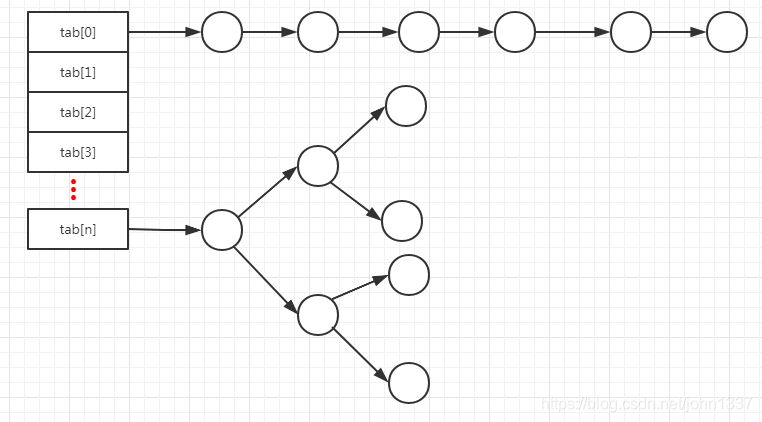
- [ref 1](https://blog.csdn.net/junqing_wu/article/details/104606619) - [ref 2](https://blog.csdn.net/john1337/article/details/104727895)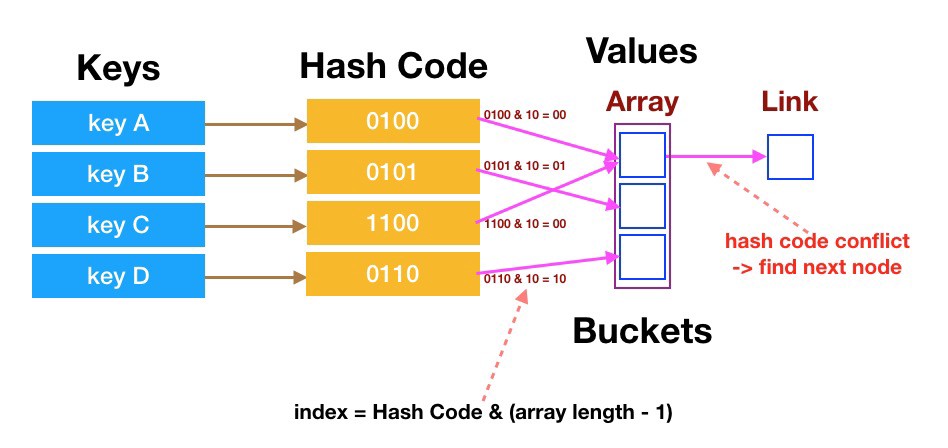
- why hashmap search time complexity ~= O(1) ? explain ?
When to Use / When Not to Use
-
When to use
- Use case that need data IO with ~ O(1) time complexity
- optimization via cache (space - time tradeoff)
sum, pair, continuous- avoid double loop (O(N^2))
-
When Not to use
- When data is time sequence
- When data is in ordering
- https://www.reddit.com/r/learnprogramming/comments/29t4s4/when_is_it_bad_to_use_a_hash_table/
Basic Operations
get: get value from dict with default value if key not existed
In [10]: d = {'a': 1, 'b': 2}
    ...: d['a']
Out[10]: 1

In [11]: d.get('a')
Out[11]: 1

In [12]: d.get('c', 0)
Out[12]: 0

In [13]: d.get('z')

In [14]:
#-------------------------------------------------------------------------------
# setdefault : will creatte key if key NOT existed (with value as well if defined)
#-------------------------------------------------------------------------------

# syntax
d.setdefault(new_key)
d.setdefault(new_key, new_value)

# 662 Maximum Width of Binary Tree
car = {
  "brand": "Ford",
  "model": "Mustang",
  "year": 1964
}

# example 1) insert key "my_key", since my_key not existed, -> make it as new key and value as None (since not defined)
car.setdefault("my_key")
print (car)
# In [18]: car
# Out[18]: {'brand': 'Ford', 'model': 'Mustang', 'year': 1964, 'my_key': None}

# example 2) insert key "color", since my_key not existed, -> make it as new key and value as white
car.setdefault("color", "white")
print (car)
# Out[22]:
# {'brand': 'Ford',
#  'model': 'Mustang',
#  'year': 1964,
#  'my_key': None,
#  'color': 'white'}
Sorton hashmap (dict)
# https://stackoverflow.com/questions/613183/how-do-i-sort-a-dictionary-by-value

x = {1: 2, 3: 4, 4: 3, 2: 1, 0: 0}
In [11]: x.items()
Out[11]: dict_items([(1, 2), (3, 4), (4, 3), (2, 1), (0, 0)])

#----------------------------------
# Sort hashMap by key/value !!!
#----------------------------------
x = {1: 2, 3: 4, 4: 3, 2: 1, 0: 0}
# note : have to use sorted(xxx, key=yyy), instead of xxx.sorted(....)
### NOTE this !!! : x.items()
sorted_x = sorted(x.items(), key=lambda kv: kv[1])
print (sorted_x)
# [(0, 0), (2, 1), (1, 2), (4, 3), (3, 4)]

x = {1: 2, 3: 4, 4: 3, 2: 1, 0: 0}
sorted_x = sorted(x.items(), key=lambda kv: kv[0])
print (sorted_x)
# [(0, 0), (1, 2), (2, 1), (3, 4), (4, 3)]

# 451  Sort Characters By Frequency
import collections
class Solution(object):
    def frequencySort(self, s):
        count = collections.Counter(s)
        count_dict = dict(count)
        """
        NOTE this !!!
            1. use sorted()
            2. count_dict.items()
        """
        count_tuple_sorted = sorted(count_dict.items(), key=lambda kv : -kv[1])
        res = ''
        for item in count_tuple_sorted:
            res += item[0] * item[1]
        return res
# dict values -> array
In [6]:
   ...: mydict = {'a':['a1','a2','a3'], 'b':['b1','b2','b3']}
   ...:
   ...: res = [mydict[x] for x in mydict]
   ...:
   ...: print (res)
[['a1', 'a2', 'a3'], ['b1', 'b2', 'b3']]
References
- Java HashMap
- Low level : Array + Linked list / red-black tree
- if Linked list length > 8 -> transform Linked list to red-black tree
- if Linked list length < 6 -> transform red-black tree back to Linked list
- Low level : Array + Linked list / red-black tree
- N sum:
- LC Ref
- Ref
Templates & Algorithms
Template Comparison Table
| # | Template | Map shape | Recognise it by | Typical LC |
|---|---|---|---|---|
| 1 | Frequency counter | {item: count}, or {item: (first, last, count)} |
“count”, “frequency”, “anagram”, “top-K”, “all occurrences in one contiguous block” | 242, 49, 347, 451, 4038 |
| 2 | Seen-before index map | {value: index} |
“find a pair”, “target sum”, complement | 1, 15, 532, 1010 |
| 3 | Grouping by a computed key | {canonical_key: [items]}, or {(min, max): count} |
“group”, “same line”, “same signature”, “(x, y) same as (y, x)” |
49, 149, 609, 987, 4066 |
| 4 | Prefix sum → count map | {prefixSum: count} / {prefixSum: firstIndex} / {startValue: minPrefix} |
“subarray sum equals / divisible by K”, “max sum where the ends satisfy …” | 560, 974, 525, 325, 3026 |
| 5 | Sliding window + char counts | {char: count in window} |
“longest / shortest substring such that …” | 3, 76, 424, 438, 567 |
| 6 | Rank map | {value: rank} |
“according to the order given in …” | 953, 791, 105 |
| 7 | Bijection (two maps) | {x: y} and {y: x} |
“one-to-one”, “isomorphic”, “follows the pattern” | 205, 290 |
| 8 | Caching / memoization | {state: result} |
“O(1) get and put”, “memoize the recursion” | 146, 460, 139, 322 |
| 9 | Graph / tree node map | {node: neighbours}, {child: parent} |
“clone”, “parent pointer”, “serialize a subtree” | 133, 138, 652, 1257 |
| 10 | Virtual map (remapping) | {badIndex: goodIndex} |
“pick at random, excluding …” | 710 |
| 11 | Map + another structure | map + heap / stack / second map | “top-K with a heap”, “next greater” | 347, 496, 739 |
Patterns that are really a deep dive on one or two problems — bucket sort for O(n) top-K, rolling hash, split-and-probe pair lookup, max-frequency arithmetic, and the ordered map (
TreeMap/SortedDict) — live in hash_map_examples.md.
Template 1: Frequency Counter
# Universal Counting Template
def counting_pattern(arr):
    count = {}  # or collections.defaultdict(int)
    result = []

    # Count frequency
    for item in arr:
        count[item] = count.get(item, 0) + 1
        # or count[item] += 1 with defaultdict

    # Process based on frequency
    for key, freq in count.items():
        if meets_condition(freq):
            result.append(key)

    return result

# Examples: LC 49, LC 242, LC 451, LC 347, LC 692
Variation: index-span map — span == count proves contiguity Priority 3 of 5 — Worth knowing — usually a variant of a must-know pattern
Pattern: sometimes the question is not how many times a value appears but where it appears. Record the positions instead of the count, and one arithmetic identity settles “are all occurrences of this value one contiguous block?”:
last_idx - first_idx + 1 == number_of_occurrences
Key Idea: the span is the number of slots the value’s block would occupy if nothing else were inside it. Any foreign value sitting between two occurrences widens the span while leaving the count alone, so span > count ⇔ the block is broken. No sorting, no walking the index list — O(1) per distinct value.
# python
# LC 4038 - Count Integers Appearing in a Single Block
# IDEA: {val: [idx, ...]}, then a value is special iff its indices are consecutive
# time = O(n), space = O(n)
from collections import defaultdict

def countSpecialIntegers(nums: list) -> int:
    my_map = defaultdict(list)
    for i, v in enumerate(nums):
        my_map[v].append(i)

    cnt = 0
    for k in my_map:
        idxs = my_map[k]
        # NOTE !!! span == count  <=>  indices are consecutive
        if idxs[-1] - idxs[0] + 1 == len(idxs):
            cnt += 1
    return cnt

# [1,1,2,2,3] -> 1:[0,1] 2:[2,3] 3:[4]     -> every span == count -> 3
# [1,2,1]     -> 1:[0,2] -> 2-0+1 = 3 != 2 -> broken -> only 2 is special -> 1
The one-pass refinement — the check only ever reads three numbers, so the index list is never needed. Same O(n) time, but O(distinct) cells instead of O(n):
# python
# LC 4038 - keep only (first_idx, last_idx, count) per value
# time = O(n), space = O(k), k = number of distinct values
def countSpecialIntegers(nums: list) -> int:
    info = {}                                  # {val: [first, last, cnt]}
    for i, v in enumerate(nums):
        if v not in info:
            info[v] = [i, i, 1]
        else:
            info[v][1] = i
            info[v][2] += 1
    return sum(1 for first, last, cnt in info.values() if last - first + 1 == cnt)
Four traps:
- Special-casing a single occurrence — no branch is needed: one index gives
span = last - first + 1 = 1andcount = 1, so it passes the same identity every block does. - Walking (or sorting) the index list to test consecutiveness — the indices arrive in increasing order already, and
span == countreads only the ends. - Counting occurrences instead of values — the answer is the number of distinct keys that pass, so a value appearing 5 times in one block contributes 1.
- Confusing consecutive indices with consecutive values — this identity is about positions in the array. Runs of consecutive values (LC 128) are a different sheet’s trick (a set, plus “is
v-1present?”).
Variations (same “store position, not just count” move):
| Problem | LC# | The twist — what the map stores |
|---|---|---|
| Partition Labels | 763 | {char: last index}; sweep left→right extending the block’s end to the furthest last seen — a cut happens exactly where i == end |
| Contains Duplicate II | 219 | {value: last index}; a hit needs i - last <= k, so only the most recent position matters |
| Longest Consecutive Sequence | 128 | The contrast case: spans over values, not indices — a set plus “start only where v-1 is absent” |
Template 2: Seen-Before Index Map (Two-Sum Shape)
# Two Sum Pattern Template
def two_sum_pattern(nums, target):
    seen = {}  # {value: index}

    for i, num in enumerate(nums):
        complement = target - num

        if complement in seen:
            return [seen[complement], i]

        seen[num] = i

    return []

# Variations:
# - Multiple pairs: collect all instead of returning first
# - K-diff pairs: check for num+k and num-k
# - Examples: LC 1, LC 167, LC 15, LC 532, LC 1010
Template 3: Grouping by a Computed Key
Pattern: hash the canonical form of an item, not the item itself — everything that shares that form lands in the same bucket. The simplest canonical form is a sorted string (LC 49); the general case is any normalized invariant of a relationship (LC 149).
# LC 049 Group Anagrams
# IDEA : HASH TABLE
class Solution:
    def groupAnagrams(self, strs):
        res = {}
        for item in strs:
            k = ''.join(sorted(item))  # sort the string
            if k not in res:  #  check if exists in res
                res[k] = []
            res[k].append(item)  # if same, put all the same string into dict k
        return [res[x] for x in res]  # output the result
Generalized: the key is a normalized invariant Priority 4 of 5 — High value — a gap here costs you rounds
Pattern: The map key is not a raw value — it is a canonical form of a relationship between values. Two items collide in the map exactly when they share the property you care about.
Key Idea (geometry): “Same line through anchor P” ⇔ “same direction vector (dx, dy)”. Raw (dx, dy) is not a valid key ((1,2) and (2,4) are the same line), and dy/dx as a float loses precision / divides by zero. Normalize: divide by gcd, then force a canonical sign.
// java
// LC 149 - Max Points on a Line
// IDEA: anchor at each point, group the others by a gcd-normalized slope key
// time = O(n^2), space = O(n)
public int maxPoints(int[][] points) {
    int n = points.length;
    if (n <= 2) return n;
    int best = 1;
    for (int i = 0; i < n; i++) {
        Map<String, Integer> slopeCount = new HashMap<>();
        for (int j = i + 1; j < n; j++) {
            int dx = points[j][0] - points[i][0];
            int dy = points[j][1] - points[i][1];
            int g = gcd(Math.abs(dx), Math.abs(dy));
            if (g != 0) { dx /= g; dy /= g; }
            // canonical direction: force dx > 0, or dx == 0 && dy > 0
            if (dx < 0 || (dx == 0 && dy < 0)) { dx = -dx; dy = -dy; }
            String key = dx + "/" + dy;
            int cnt = slopeCount.merge(key, 1, Integer::sum);
            best = Math.max(best, cnt + 1);   // +1 for the anchor point itself
        }
    }
    return best;
}

private int gcd(int a, int b) { return b == 0 ? a : gcd(b, a % b); }
# python
# LC 149 - Max Points on a Line
# IDEA: anchor at each point, group the others by a gcd-normalized slope key
# time = O(n^2), space = O(n)
from collections import defaultdict
from math import gcd

def maxPoints(points: list) -> int:
    n = len(points)
    if n <= 2:
        return n
    best = 1
    for i in range(n):
        slope_count = defaultdict(int)
        x1, y1 = points[i]
        for j in range(i + 1, n):
            dx, dy = points[j][0] - x1, points[j][1] - y1
            g = gcd(abs(dx), abs(dy))
            if g:
                dx, dy = dx // g, dy // g
            if dx < 0 or (dx == 0 and dy < 0):     # canonical sign
                dx, dy = -dx, -dy
            slope_count[(dx, dy)] += 1
            best = max(best, slope_count[(dx, dy)] + 1)   # +1 = anchor point
    return best
Three traps (all are the usual interview follow-ups):
- Float slope
dy/dx— precision loss +ZeroDivisionErroron vertical lines. Use the reduced pair instead. - Missing sign normalization —
(1,2)and(-1,-2)are the same line but two different keys. Force one canonical direction. - Forgetting
+1— the map counts partners of the anchor; the anchor itself is not in the map.
Variations (same “invent a canonical key” move):
| Problem | LC# | The twist — what the key encodes |
|---|---|---|
| Minimum Area Rectangle | 939 | Key = the point itself in a set; iterate diagonal pairs (x1,y1),(x2,y2) with x1!=x2 && y1!=y2 and test whether the other two corners exist |
| Most Stones Removed with Same Row or Column | 947 | Key = row and ~col (bitwise-not keeps rows and cols in disjoint id spaces) → union-find over a map |
| Vertical Order Traversal of a Binary Tree | 987 | Key = column offset col (root = 0, left = col-1, right = col+1); value = list of (row, val) to sort |
Pattern: unordered-pair key — (min, max) counts {x, y} in either order Priority 3 of 5 — Worth knowing — usually a variant of a must-know pattern
Pattern: when the relationship you are counting is symmetric — (x, y) means the same thing as (y, x) — key the map by the pair in canonical order, (min(x, y), max(x, y)). Both orientations then land in one bucket, and the bucket’s count is the number you actually want. It is the smallest normalized invariant there is: the canonical form of an unordered pair.
pair = (min(x, y), max(x, y))      # (2, 5) and (5, 2) -> the same key (2, 5)
pair_count[pair] += 1
best = max(best, pair_count[pair]) # running max: counts only go up, so no second pass
Key Idea (LC 4066): replace every x with y, at most once, to maximise equal adjacent pairs. Ask what one replacement x -> y does to each adjacent pair:
(x, y) or (y, x)   -> (y, y)   unequal -> equal       +1
(x, x)             -> (y, y)   equal   -> equal        0   (never lost)
(x, a), a != y     -> (y, a)   unequal -> unequal      0
anything without x -> untouched                        0
So no equal pair is ever lost, and the gain is exactly the number of adjacent positions holding one x and one y — in either order. That is an unordered-pair count:
answer = (adjacent pairs already equal) + max over x != y of (adjacent {x, y} pairs)
# python
# LC 4066 - Maximum Equal Adjacent Pairs After at Most One Replacement
# IDEA: already-equal pairs survive any replacement; x -> y gains one per adjacent {x, y},
#       so count adjacent unequal pairs under an unordered (min, max) key and take the max
# time = O(n), space = O(n)
from collections import defaultdict

def maxEqualAdjacentPairs(nums: list) -> int:
    already_equal = 0
    unequal_pair_cnt = defaultdict(int)   # {(smaller, larger): adjacent occurrences}
    max_newly_equal = 0                   # 0 = do no operation (e.g. [1, 1, 1])

    for i in range(len(nums) - 1):
        x, y = nums[i], nums[i + 1]
        if x == y:
            already_equal += 1
        else:
            # NOTE !!! (2, 5) and (5, 2) are fixed by the same replacement -> one key
            pair = (min(x, y), max(x, y))
            unequal_pair_cnt[pair] += 1
            max_newly_equal = max(max_newly_equal, unequal_pair_cnt[pair])

    return already_equal + max_newly_equal
// java
// LC 4066 - Maximum Equal Adjacent Pairs After at Most One Replacement
// IDEA: same unordered (min, max) key, packed into one long (values <= 10^9 fit in 32 bits)
// time = O(n), space = O(n)
public int maxEqualAdjacentPairs(int[] nums) {
    int alreadyEqual = 0;
    int maxNewlyEqual = 0;
    Map<Long, Integer> unequalPairCnt = new HashMap<>();

    for (int i = 0; i + 1 < nums.length; i++) {
        int x = nums[i];
        int y = nums[i + 1];
        if (x == y) {
            alreadyEqual++;
        } else {
            long small = Math.min(x, y);
            long large = Math.max(x, y);
            long pairKey = (small << 32) | large;   // canonical order, one key per {x, y}
            int cnt = unequalPairCnt.merge(pairKey, 1, Integer::sum);
            maxNewlyEqual = Math.max(maxNewlyEqual, cnt);
        }
    }
    return alreadyEqual + maxNewlyEqual;
}
nums = [1,2,1,2,1]
  i  pair    key     cnt   max_newly_equal
  0  (1,2)   (1,2)   1     1
  1  (2,1)   (1,2)   2     2      <- an ordered key would have started (2,1) at 1
  2  (1,2)   (1,2)   3     3
  3  (2,1)   (1,2)   4     4
  already_equal = 0  ->  answer = 0 + 4 = 4   (replace 1 -> 2: [2,2,2,2,2])

nums = [1,2,3,2]  -> {1,2}: 1, {2,3}: 2  -> 0 + 2 = 2
nums = [1,1,1]    -> already_equal = 2, map empty -> 2 + 0 = 2   (no operation)
Four traps:
- An ordered key —
(x, y)as-is splits[1,2,1,2,1]into(1,2): 2and(2,1): 2and answers 2 instead of 4. The replacement does not care which sidexis on, so neither may the key. - Fearing the replacement breaks equal pairs —
(x, x)becomes(y, y), still equal. Nothing is subtracted, which is why the answer is a plain sum. - Starting the best gain at 1, or requiring an operation — “at most once” allows none; a map with no entries must contribute 0.
- A string key in Java —
"1" + "23"and"12" + "3"collide without a delimiter (the delimiter trap). Pack into alongwhen the values fit in 32 bits, or usex + "," + y.
Why the running max is safe:
max(best, cnt[pair])after each increment equals the max over the final counts only because counts never decrease. In a sliding window, where counts drop, keep a separate pass or a structure that supports removal.
Variations (same unordered-pair key):
| Problem | LC# | The twist — what the (min, max) key counts |
|---|---|---|
| Number of Equivalent Domino Pairs | 1128 | [a, b] ≡ [b, a]; count dominoes per key, then add k*(k-1)/2 — or add the running count before each increment |
| Maximal Network Rank | 1615 | Undirected edges as a set of (min, max) keys, so “are u and v connected?” is one O(1) lookup regardless of order |
Template 4: Prefix Sum → Count Map Priority 5 of 5 — Must know — expect it in almost every loop
The prefix-sum array first — nums[i..j] sum = preSum[j+1] - preSum[i]:
# (algorithm book (labu) p.350)
my_array = [1,2,3,4,5]
my_array_pre = [0] * (len(my_array)+1)
cur = 0
for i in range(len(my_array)):
    cur += my_array[i]
    my_array_pre[i+1] += cur

# In [17]: print ("my_array = " + str(my_array))
#     ...: print ("my_array_pre = " + str(my_array_pre))
# my_array = [1, 2, 3, 4, 5]
# my_array_pre = [0, 1, 3, 6, 10, 15]

#-----------------------------------------------
# Get sub array sum !!!!!!!
#    -> nums[i..j] sum = preSum[j+1] - preSum[i]
#-----------------------------------------------

# example 1 : sum of [1,2]
my_array_pre[1+1] - my_array_pre[0]  # 1's index is 0, and 2's index is 1. (my_array = [1, 2, 3, 4, 5])

# example 2 : sum of [2,3,4]
my_array_pre[3+1] - my_array_pre[1] # 2's index is 1, and 4's index is 3. (my_array = [1, 2, 3, 4, 5])
# Prefix Sum Pattern Template
def prefix_sum_pattern(nums, target):
    prefix_sum = 0
    sum_count = {0: 1}  # {sum: count/index}
    result = 0

    for num in nums:
        prefix_sum += num

        # Check if (prefix_sum - target) exists
        if prefix_sum - target in sum_count:
            result += sum_count[prefix_sum - target]

        # Update current prefix sum count
        sum_count[prefix_sum] = sum_count.get(prefix_sum, 0) + 1

    return result

# For max length problems, store index instead of count:
# sum_index = {0: -1}, then calculate i - sum_index[prefix_sum - target]
# Examples: LC 560, LC 325, LC 525, LC 523
Key Differences by Problem Type:
- Count problems (LC 560, 930, 974): Store
{sum: count}, check then update- LC 974 variant: Use modulo
{remainder: count}, MUST handle negative remainders!
- LC 974 variant: Use modulo
- Max length problems (LC 325, 525): Store
{sum: first_index}, only update if new- LC 525 variant: Transform problem (0→-1, 1→+1), initialize with
{0: -1}, store first occurrence only
- LC 525 variant: Transform problem (0→-1, 1→+1), initialize with
- Existence problems (LC 523): Store
{sum: any_index}, just need to find one
Core Pattern: Count ALL Subarrays Summing to k — LC 560
Core Concept: Use hashmap to count ALL subarray combinations that sum to target in O(N) time with single loop.
Key Insight:
If we want subarray[i,j] to sum to k:
  presum[j] - presum[i-1] = k
  → presum[i-1] = presum[j] - k

So at index j, check if (presum[j] - k) exists in map!
Critical Implementation Details:
-
Use Count, NOT Index:
javaMap<Integer, Integer> map = new HashMap<>(); // {prefixSum: count}- Same prefix sum can occur MULTIPLE times
- We need to count ALL valid subarrays, not just find one
- Example:
[1, -1, 1, -1]with k=0 has multiple solutions
-
Initialize with
map.put(0, 1):javamap.put(0, 1); // Handle subarrays starting from index 0- When
presum[j] == k, thenpresum[j] - k = 0 - Need to count these subarrays starting from beginning
- When
-
Check BEFORE Update (Critical Order):
javafor (int num : nums) { presum += num; // 1. CHECK first: count how many previous prefix sums = (presum - k) if (map.containsKey(presum - k)) { count += map.get(presum - k); // Add ALL occurrences } // 2. UPDATE after: add current prefix sum for future iterations map.put(presum, map.getOrDefault(presum, 0) + 1); }- Why this order? Prevents counting current subarray with itself
- Current prefix sum should only be available for FUTURE iterations
Why This Pattern Gets ALL Combinations:
- Map stores ALL previously seen prefix sums with their counts
- When we check
presum - k, we get count of ALL previous occurrences - Each previous occurrence represents a valid starting point
count += map.get(presum - k)adds ALL valid subarrays ending at current index
Example Walkthrough (nums = [1,1,1], k = 2):
i=0: num=1, presum=1
  - Check: (1-2)=-1 not in map → count=0
  - Update: map={0:1, 1:1}

i=1: num=1, presum=2
  - Check: (2-2)=0 in map, count += map[0] = 1 → count=1
  - Update: map={0:1, 1:1, 2:1}

i=2: num=1, presum=3
  - Check: (3-2)=1 in map, count += map[1] = 1 → count=2
  - Update: map={0:1, 1:1, 2:1, 3:1}

Result: count=2 (subarrays [1,1] and [1,1])
Related LC Problems (Same Pattern):
- LC 560: Subarray Sum Equals K (exact pattern)
- LC 325: Maximum Size Subarray Sum Equals k (store index instead of count)
- LC 930: Binary Subarrays with Sum
- LC 974: Subarray Sums Divisible by K (use modulo
{remainder: count}, handle negatives!)
When to Use Count vs Index:
| Problem Type | Map Value | Example | Special Notes |
|---|---|---|---|
| Count ALL subarrays | count |
LC 560, 930, 974 | Check before update |
| Count (with modulo) | count |
LC 974 | Use remainder as key; handle negatives! |
| Find LONGEST subarray | index (first occurrence) |
LC 325, 525 | Store only first occurrence |
| Find LONGEST (with transformation) | index (first occurrence) |
LC 525 | Transform 0→-1, 1→+1; init {0:-1} |
| Find if EXISTS | boolean/index |
LC 523 | Any occurrence works |
| Find MAX SUM, condition on the endpoints | min prefix, keyed by the start value |
LC 3026 | Key is nums[i], not the prefix sum — see the variation below |
Common Mistakes:
- ❌ Using
{prefixSum: index}for counting problems - ❌ Updating map before checking (causes self-counting)
- ❌ Forgetting
map.put(0, 1)initialization - ❌ Not handling the case where prefix sum itself equals k
- ❌ [LC 974] Forgetting to handle negative remainders (Java/Python
-7 % 5 = -2, need to add k to get 3)
Variation: key by the start’s value, keep the min prefix — LC 3026 Priority 3 of 5 — Worth knowing — usually a variant of a must-know pattern
Pattern: the condition is on the subarray’s endpoints, not on its sum, and the question asks for the max sum. So the key changes and so does the value:
- key = the value at the start,
nums[i], because “good” (|nums[i] - nums[j]| == k) pins the start’s value, not its prefix sum; - value = the smallest
pre[i]seen for that value, because the sum ending atjispre[j+1] - pre[i], and a smallerpre[i]always gives a bigger sum.
sum(nums[i..j]) = pre[j+1] - pre[i]
fixed j  ->  maximise  = minimise pre[i]   over every i with nums[i] in {nums[j]-k, nums[j]+k}
best[v]  = min pre[i] over every i seen so far with nums[i] == v
Key Idea: this is Kadane’s “subtract the smallest prefix so far” (LC 53), split into one bucket per start value. A count map answers “how many”; a min-prefix map answers “how much”.
# python
# LC 3026 - Maximum Good Subarray Sum
# IDEA: best[v] = min prefix sum just before an index holding v; close at x from v = x-k or x+k
# time = O(n), space = O(n)
def maximumSubarraySum(nums: list, k: int) -> int:
    best = {}                       # {start value: min prefix sum before it}
    res = float('-inf')
    pre = 0                         # pre = sum(nums[:j]), i.e. before x
    for x in nums:
        for v in (x - k, x + k):    # the two start values that make [i..j] good
            if v in best:
                res = max(res, pre + x - best[v])
        # NOTE !!! record x as a future START with the prefix BEFORE it
        if x not in best or pre < best[x]:
            best[x] = pre
        pre += x
    return 0 if res == float('-inf') else res
// java
// LC 3026 - Maximum Good Subarray Sum
// IDEA: same map; long, because n * |nums[i]| reaches 1e14
// time = O(n), space = O(n)
public long maximumSubarraySum(int[] nums, int k) {
    Map<Integer, Long> best = new HashMap<>();   // {start value: min prefix before it}
    long res = Long.MIN_VALUE, pre = 0;
    for (int x : nums) {
        for (int v : new int[]{x - k, x + k}) {      // |x ± k| <= 2e9 still fits an int
            Long p = best.get(v);
            if (p != null) res = Math.max(res, pre + x - p);
        }
        best.merge(x, pre, Math::min);
        pre += x;
    }
    return res == Long.MIN_VALUE ? 0 : res;
}
Trace — nums = [-1,3,2,4,5], k = 3:
x    pre(before x)  look up x-k, x+k          candidate          best after
-1    0             -4, 2   -> none            -                  {-1:0}
 3   -1              0, 6   -> none            -                  {-1:0, 3:-1}
 2    2             -1, 5   -> -1: 2+2-0 = 4   4  ([-1,3,2])      {..., 2:2}
 4    4              1, 7   -> none            -                  {..., 4:4}
 5    8              2, 8   -> 2: 8+5-2 = 11   11 ([2,4,5])       {..., 5:8}
-> 11
Four traps:
- Starting
resat 0 — a good subarray can have a negative sum ([-1,-2,-3,-4], k = 2→-6). Use-inf, and fall back to 0 only when no good subarray exists. - Storing the prefix including the start — the subarray contains
nums[i], so subtractpre[i], the sum before it. Recordbest[x]beforepre += x. - Keeping the latest or first prefix for a value — neither is the best start. Keep the minimum, the way LC 325 keeps the first index.
intin Java — 1e5 values of 1e9 overflow; the prefix and the answer arelong(the keysx ± kstay within ±2e9 and fit anint).
Variations (same “best start per key” move):
| Problem | LC# | What the map keeps, and why |
|---|---|---|
| Maximum Subarray | 53 | Every start qualifies, so the map collapses to one global min prefix — Kadane’s algorithm |
| Maximum Good Subarray Sum | 3026 | {start value: min prefix}; look up x - k and x + k |
| Maximum Size Subarray Sum Equals k | 325 | {prefix sum: first index} — “best start” means earliest, because the goal is the longest |
Template 5: Sliding Window with Hash Map
# Sliding Window with HashMap Template
def sliding_window_hashmap(s, pattern):
    if len(pattern) > len(s):
        return []

    pattern_count = {}
    window_count = {}

    # Count pattern frequency
    for char in pattern:
        pattern_count[char] = pattern_count.get(char, 0) + 1

    left = 0
    result = []

    for right in range(len(s)):
        # Expand window
        char = s[right]
        window_count[char] = window_count.get(char, 0) + 1

        # Contract window if needed
        while window_size_condition_met():
            # Check if current window is valid
            if window_count == pattern_count:
                result.append(left)

            # Remove leftmost character
            left_char = s[left]
            window_count[left_char] -= 1
            if window_count[left_char] == 0:
                del window_count[left_char]
            left += 1

    return result

# Examples: LC 3, LC 76, LC 438, LC 567
The map-equality shortcut (LC 567 Permutation in String): for a fixed-size window you do not need a “matched” counter — compare the two frequency maps directly.
// LC 567
// ...
     /** NOTE !!!
     *
     *  we use below trick to
     *
     *  -> 1) check if `new reached s2 val` is in s1 map
     *  -> 2) check if 2 map are equal
     *
     *  -> so we have more simple code, and clean logic
     */
    if (map2.equals(map1)) {
        return true;
    }
// ...
Template 6: Rank Map — Value to Position Priority 5 of 5 — Must know — expect it in almost every loop
Pattern: When the problem defines its own ordering (“this alien alphabet”, “this permutation”), precompute value -> rank once, then every comparison becomes an O(1) integer compare instead of an O(m) scan.
Recognize it: the phrase “according to the order given in …” — that’s a rank map.
// java
// LC 953 - Verifying an Alien Dictionary
// IDEA: char -> rank map turns an arbitrary alphabet into comparable ints
// time = O(total chars), space = O(1)  (26 keys)
public boolean isAlienSorted(String[] words, String order) {
    int[] rank = new int[26];                       // char -> position in `order`
    for (int i = 0; i < order.length(); i++) rank[order.charAt(i) - 'a'] = i;
    for (int i = 0; i + 1 < words.length; i++) {
        if (!inOrder(words[i], words[i + 1], rank)) return false;
    }
    return true;
}

private boolean inOrder(String a, String b, int[] rank) {
    int n = Math.min(a.length(), b.length());
    for (int i = 0; i < n; i++) {
        int ra = rank[a.charAt(i) - 'a'], rb = rank[b.charAt(i) - 'a'];
        if (ra != rb) return ra < rb;
    }
    return a.length() <= b.length();                // prefix must come first: "app" < "apple"
}

// LC 791 - Custom Sort String  (counting sort, no comparator needed)
// time = O(n + m), space = O(1)
public String customSortString(String order, String s) {
    int[] cnt = new int[26];
    for (char c : s.toCharArray()) cnt[c - 'a']++;
    StringBuilder sb = new StringBuilder();
    for (char c : order.toCharArray()) {            // ranked chars first, in rank order
        while (cnt[c - 'a'] > 0) { sb.append(c); cnt[c - 'a']--; }
    }
    for (char c = 'a'; c <= 'z'; c++) {             // unranked chars: any order
        while (cnt[c - 'a'] > 0) { sb.append(c); cnt[c - 'a']--; }
    }
    return sb.toString();
}
# python
# LC 953 - Verifying an Alien Dictionary
# IDEA: map every word to a list of ranks, then plain list comparison does the lexicographic work
# time = O(total chars), space = O(total chars)
def isAlienSorted(words: list, order: str) -> bool:
    rank = {c: i for i, c in enumerate(order)}
    keys = [[rank[c] for c in w] for w in words]
    # python list compare == lexicographic compare, and [1,2] < [1,2,3] handles the prefix rule
    return all(keys[i] <= keys[i + 1] for i in range(len(keys) - 1))

# python
# LC 791 - Custom Sort String
# IDEA: rank map as a sort key; unranked chars get rank len(order) (stable sort keeps them last)
# time = O(n log n + m), space = O(n)
def customSortString(order: str, s: str) -> str:
    rank = {c: i for i, c in enumerate(order)}
    return "".join(sorted(s, key=lambda c: rank.get(c, len(order))))
The prefix rule is the bug everyone hits: after the common prefix matches, the shorter word must come first. ["apple", "app"] is not sorted.
Variation — value → index map to split an array (LC 105 / LC 106): same map, but the “rank” is position in inorder, which turns the O(n²) “scan inorder for the root” into O(1) and the whole build into O(n).
# python
# LC 105 - Construct Binary Tree from Preorder and Inorder Traversal
# IDEA: {value: index in inorder} → O(1) root split
# time = O(n), space = O(n)
def buildTree(preorder: list, inorder: list):
    idx = {v: i for i, v in enumerate(inorder)}   # values are unique (given)
    pre = [0]                                     # pointer into preorder

    def build(lo, hi):
        if lo > hi:
            return None
        node = TreeNode(preorder[pre[0]])
        pre[0] += 1
        mid = idx[node.val]                       # O(1) instead of inorder.index(...)
        node.left = build(lo, mid - 1)
        node.right = build(mid + 1, hi)
        return node

    return build(0, len(inorder) - 1)
Template 7: Bijection (Two-Way Mapping)
Pattern: Maintain two maps (x→y and y→x) and check consistency in both directions. Required any time the mapping must be one-to-one (LC 205 Isomorphic Strings, LC 290 Word Pattern).
Why two maps? One map catches a→b conflicts; the second catches b→a conflicts (two different x values mapping to the same y).
# LC 205 Isomorphic Strings
def isIsomorphic(s: str, t: str) -> bool:
    s2t, t2s = {}, {}
    for a, b in zip(s, t):
        if s2t.get(a, b) != b or t2s.get(b, a) != a:
            return False
        s2t[a] = b
        t2s[b] = a
    return True

# LC 290 Word Pattern
def wordPattern(pattern: str, s: str) -> bool:
    words = s.split()
    if len(pattern) != len(words):
        return False
    p2w, w2p = {}, {}
    for p, w in zip(pattern, words):
        if p2w.get(p, w) != w or w2p.get(w, p) != p:
            return False
        p2w[p] = w
        w2p[w] = p
    return True
Common mistake: Using only one map — fails when two keys map to the same value ("aa" vs "ab").
Template 8: Hash Map for Caching / Memoization
# Caching/Memoization Template
class CacheTemplate:
    def __init__(self, capacity):
        self.capacity = capacity
        self.cache = {}  # key -> value
        self.usage = {}  # key -> usage_info

    def get(self, key):
        if key in self.cache:
            self.update_usage(key)
            return self.cache[key]
        return -1

    def put(self, key, value):
        if len(self.cache) >= self.capacity:
            self.evict()

        self.cache[key] = value
        self.update_usage(key)

    def update_usage(self, key):
        # Update usage tracking
        pass

    def evict(self):
        # Remove least recently/frequently used
        pass

# Examples: LC 146 (LRU), LC 460 (LFU)
Top-down DP with a dict keyed on the subproblem state (LC 139, 1048, 322) is the same template — worked out in hash_map_examples.md → Hash Map + Memoization / DP.
Template 9: Graph Problems with Hash Map
# Graph with HashMap Template
def graph_hashmap_pattern(graph_input):
    # Build adjacency list/map
    graph = {}  # node -> [neighbors] or node -> {neighbor: weight}

    for edge in graph_input:
        node1, node2 = edge[0], edge[1]
        if node1 not in graph:
            graph[node1] = []
        if node2 not in graph:
            graph[node2] = []

        graph[node1].append(node2)
        graph[node2].append(node1)  # for undirected

    # Process using DFS/BFS with visited tracking
    visited = set()
    result = []

    def dfs(node):
        if node in visited:
            return

        visited.add(node)
        result.append(node)

        for neighbor in graph.get(node, []):
            dfs(neighbor)

    return result

# Examples: LC 133, LC 200, LC 694, LC 1257
Template 10: Virtual Map (Remapping)
Core Idea
When you need to randomly sample from a range with holes (blacklisted values), instead of rejection-sampling (which wastes calls to random), remap the bad slots to valid replacements in O(1) pick time.
Key insight: If there are M blacklisted numbers in [0, N), there are exactly N - M valid numbers. So only ever pick a random index in [0, N-M) — call this bound. Any blacklisted index that falls inside that range gets redirected to a valid index pulled from the tail [bound, N).
Pattern Steps
- Compute
bound = N - blacklist.length— this is the safe random range. - Build
blackSetfor O(1) membership tests. - Walk
lastpointer fromN-1downward, skipping blacklisted values, to collect valid replacement targets. - For every blacklisted
b < bound, mapb → last(the next valid tail index). - On
pick(): drawidx = random.nextInt(bound); returnmapping.getOrDefault(idx, idx).
Visualization
n=10, blacklist=[2,3,5,8]   →   bound = 10 - 4 = 6

RANDOM RANGE  [0, bound)
|----|----|----|----|----|----|
  0    1    2    3    4    5
             X    X         X
             ↑bad inside range — must remap

TAIL RANGE  [bound, n)
|----|----|----|----|
  6    7    8    9
             X            ← also blacklisted, skip it

Remapping (last starts at 9, walks left skipping blacklisted):
  b=2  →  last=9 (valid)  → map 2→9,  last=8
  b=3  →  last=8 (blacklisted, skip) → last=7 (valid) → map 3→7, last=6
  b=5  →  last=6 (valid)  → map 5→6,  last=5

Final mapping: { 2→9, 3→7, 5→6 }

pick() result for each index in [0,5]:
  0 → 0   (not mapped, return directly)
  1 → 1
  2 → 9   (remapped)
  3 → 7   (remapped)
  4 → 4
  5 → 6   (remapped)

Valid numbers returned: {0,1,4,6,7,9} ✓ uniformly distributed
Java Template
// LC 710 - Random Pick with Blacklist
class Solution {
    private Map<Integer, Integer> mapping = new HashMap<>();
    private Random random = new Random();
    private int bound;

    public Solution(int n, int[] blacklist) {
        bound = n - blacklist.length;

        Set<Integer> blackSet = new HashSet<>();
        for (int b : blacklist) blackSet.add(b);

        int last = n - 1;
        for (int b : blacklist) {
            if (b < bound) {
                // Skip tail values that are also blacklisted
                while (blackSet.contains(last)) last--;
                mapping.put(b, last);
                last--;
            }
        }
    }

    public int pick() {
        int idx = random.nextInt(bound);
        return mapping.getOrDefault(idx, idx);  // remap if blacklisted, else return directly
    }
}
Python Template
import random

class Solution:
    def __init__(self, n: int, blacklist: list[int]):
        self.bound = n - len(blacklist)
        black_set = set(blacklist)
        self.mapping = {}

        last = n - 1
        for b in blacklist:
            if b < self.bound:
                while last in black_set:
                    last -= 1
                self.mapping[b] = last
                last -= 1

    def pick(self) -> int:
        idx = random.randrange(self.bound)
        return self.mapping.get(idx, idx)
Complexity
| Operation | Time | Space |
|---|---|---|
| Constructor | O(B) where B = blacklist size | O(B) |
pick() |
O(1) | O(1) |
Why This Works
bound = N - Bequals the count of valid numbers, sorandom.nextInt(bound)always hits a valid slot count.- Blacklisted indices inside
[0, bound)are rare “bad slots” — exactly B of them need remapping. - The tail
[bound, N)also has exactly B slots total, and the non-blacklisted ones among them are the replacements. The two-pointer walk guarantees a 1-to-1 pairing. - Non-blacklisted indices in
[0, bound)fall throughgetOrDefaultunchanged → no extra cost.
Similar / Related LC Problems
| Problem | LC# | Difficulty | Key Idea |
|---|---|---|---|
| Random Pick with Blacklist | 710 | Hard | Virtual remap (this pattern) |
| Random Pick Index | 398 | Medium | Reservoir sampling |
| Random Pick with Weight | 528 | Medium | Prefix sum + binary search |
| Shuffle an Array | 384 | Medium | Fisher-Yates (in-place swap map) |
Template 11: Combining Hash Maps with Other Structures
1. Multiple Hash Maps
# Track multiple relationships simultaneously
def complex_problem(arr):
    index_map = {}      # value -> index
    freq_map = {}       # value -> frequency
    reverse_map = {}    # index -> value

    for i, val in enumerate(arr):
        index_map[val] = i
        freq_map[val] = freq_map.get(val, 0) + 1
        reverse_map[i] = val
2. Hash Map + Other Data Structures
# Hash Map + Priority Queue (Heap)
import heapq
from collections import defaultdict

def top_k_frequent(nums, k):
    count = defaultdict(int)
    for num in nums:
        count[num] += 1

    # Use heap with frequency
    heap = []
    for num, freq in count.items():
        heapq.heappush(heap, (-freq, num))  # Max heap using negative values

    result = []
    for _ in range(k):
        result.append(heapq.heappop(heap)[1])
    return result
For the O(n) heap-free answer to top-K, see Bucket Sort via Hash Map; for
next greateranswers keyed by a monotonic stack, see Monotonic Stack + Hash Map.
Summary & Quick Reference
Problem → Pattern Decision Table
| Recognise it by | Pattern | Template | Time / Space | Problems |
|---|---|---|---|---|
| Frequency of elements, characters or patterns; “most frequent”, “anagram”, duplicates, or where a value occurs (“one contiguous block”) | Counting / frequency map, incl. the index-span variation | T1 | O(n) / O(n) | 242, 49, 451, 347, 692, 387, 819, 811, 1207, 383, 299, 349, 350, 4038, 763, 219 |
| A pair, triplet or complement that hits a target; “two sum”, “k-diff”, “divisible by 60” | Seen-before index map | T2 | O(n) / O(n) | 1, 15, 16, 18, 167, 532, 653, 1010, 1679, 1711, 2006 |
Items that belong together under some derived form; “group”, “same line”, “same row or column”; a symmetric pair where (x, y) counts as (y, x) |
Grouping by a computed key, incl. the unordered-pair key | T3 | O(n·k) / O(n) | 49, 149, 609, 939, 947, 987, 4066, 1128, 1615 |
| A subarray property: sum equals k, sum divisible by k, equal 0s and 1s, exactly k odds; or the max sum of a subarray whose ends satisfy a condition | Prefix sum → count map, incl. the min-prefix-per-start variation | T4 | O(n) / O(n) | 560, 325, 523, 525, 930, 974, 1248, 724, 3026 |
| A window that grows and shrinks on a condition over characters | Sliding window + char counts | T5 | O(n) / O(k) | 3, 76, 424, 438, 567, 159, 340, 904, 1004, 1208, 1234 |
| “According to the order given in …”, a custom alphabet, a permutation, an index split | Rank map | T6 | O(n) / O(n) | 953, 791, 105, 106 |
| A mapping that must be one-to-one in both directions | Bijection (two maps) | T7 | O(n) / O(n) | 205, 290 |
| “Design a cache”, O(1) get + put, eviction, or a recursion worth memoizing | Caching / memoization | T8 | O(1) amortised / O(n) | 146, 460, 705, 706, 380, 381, 432, 355, 981, 1244, 139, 322, 1048 |
| Node relationships: clone, parent pointers, subtree signatures, equations as edges | Graph / tree node map | T9 | O(n) / O(n) | 133, 138, 652, 721, 734, 399, 947, 1257 |
| “Pick uniformly at random, but never these values” | Virtual map (remapping) | T10 | O(1) per pick / O(B) | 710, 398, 528, 384 |
| The map alone is not enough — you also need order, a heap, or a stack | Map + another structure | T11 | varies | 347, 496, 503, 739, 853, 729, 846, 352 |
Worst case for every row above is O(n) per operation if all keys collide. Per-problem tables (difficulty and a one-line insight for each of ~90 problems) are in hash_map_examples.md → Problems by Pattern.
Key Insights and Recognition Cues
- Space-Time Tradeoff: Hash maps trade extra O(n) space for O(1) average lookup time
- Prefix Sum Magic:
subarray[i,j] = prefixSum[j] - prefixSum[i-1] - Sliding Window State: Use hash map to maintain window properties efficiently
- Complement Thinking: Instead of checking all pairs, store elements and check complements
- Index vs Value: Decide whether to store indices, values, or both as hash map values
- Frequency Counting: Most string/array problems can be solved with frequency analysis
Interview signals to watch for:
- “Find duplicate / repeated substring” → rolling hash or binary search + hash
- “Map one set of values to another consistently” → bijection (two maps)
- “Replace every
xwithy” / “(a, b)is the same as(b, a)” → unordered-pair key(min, max) - “Optimize caching” → LRU with OrderedDict / doubly-linked list
- Follow-up “What if the array is very large?” → space-efficient hash (rolling hash, coordinate compression)
Implementation Best Practices
Python Best Practices
# 1. Use defaultdict for cleaner counting code
from collections import defaultdict
count = defaultdict(int)  # No need for get(key, 0)

# 2. Use Counter for frequency problems
from collections import Counter
freq = Counter(arr)  # Automatically counts frequencies

# 3. Handle edge cases with dict.get()
value = my_dict.get(key, default_value)

# 4. Clean up zero counts to save space
if count[key] == 0:
    del count[key]

# 5. Use enumerate when you need both index and value
for i, val in enumerate(arr):
    ...        # use both i and val
Java Best Practices
// 1. Use getOrDefault to avoid null checks
map.put(key, map.getOrDefault(key, 0) + 1);

// 2. Use containsKey for existence checks
if (map.containsKey(key)) { /* ... */ }

// 3. Initialize with appropriate capacity
Map<String, Integer> map = new HashMap<>(expectedSize);

// 4. Use putIfAbsent for first occurrence
map.putIfAbsent(key, index);  // Only puts if key doesn't exist
Performance:
- Choose Right Hash Function: Python’s built-in hash is usually optimal
- Avoid Unnecessary Rehashing: Pre-size maps when possible
- Memory Cleanup: Remove zero-count entries in frequency maps
- Use Appropriate Load Factor: Default 0.75 is usually optimal
Common Mistakes to Avoid
-
Hash Collision Assumption: Remember that worst-case time complexity is O(n), not O(1)
-
Index Out of Bounds:
python# Wrong: Can cause index errors if target - nums[i] in seen: return [i, seen[target - nums[i]]] seen[nums[i]] = i # Right: Check existence first if target - nums[i] in seen: return [seen[target - nums[i]], i] seen[nums[i]] = i -
Modifying Dict During Iteration:
python# Wrong: Can cause runtime errors for key in my_dict: if condition: del my_dict[key] # Right: Collect keys first to_delete = [k for k, v in my_dict.items() if condition] for k in to_delete: del my_dict[k] -
Ignoring Edge Cases:
- Empty input arrays
- Single element arrays
- All elements the same
- Target not achievable
-
Wrong Data Structure Choice:
- Use
set()for existence checks only - Use
dict()when you need key-value mapping - Use
Counter()for frequency counting
- Use
Interview Preparation Checklist
- [ ] Master all 6 templates and when to use each
- [ ] Practice 3-5 problems from each category
- [ ] Understand time/space complexity for each pattern
- [ ] Know common edge cases and how to handle them
- [ ] Practice explaining hash collision resolution
- [ ] Be comfortable with both Python dict and Java HashMap APIs
- [ ] Understand when NOT to use hash maps (sorted data, range queries, etc.)