回溯(Backtracking)
範圍 — 帶「復原」動作的系統性搜尋:choose/explore/un-choose 骨架、
start_idx的控制、跳過重複、剪枝,以及每個必會題型剛好一份的標準模板 — 大量的實作解答與 hard 級的帶狀態模板放在兩個衛星檔裡。 另見:backtrack_examples.md — 這些模板對應的 LC 實作解;backtrack_advanced.md — 用 Trie 剪枝的格子搜尋、運算式建構、刪除次數預算、記憶化切分;dfs.md — 沒有復原步驟的走訪;recursion.md — 遞迴的機制;tree_backtrack.md — 根到葉的路徑問題;dp.md — 什麼時候把搜尋記憶化比硬搜划算。
LeetCode 題目清單
總覽
回溯就是在決策樹上做暴力搜尋:每一步做一個選擇、往下遞迴,然後把選擇復原(「回溯」)再試下一個。 要產生所有子集/排列/組合,或是在限制條件下找出任一組可行解(N 皇后、數獨、單字搜尋), 第一個該想到的就是它。
關鍵性質
- 核心想法:
選擇 → 探索(遞迴)→ 取消選擇(復原) - 時間複雜度:指數級 —
O(b^d),b= 分支數,d= 決策樹深度 - 空間複雜度:
O(d)的遞迴深度(不算輸出的清單) - 什麼時候用:題目問所有/每一種/有幾種配置,或是要在限制下擺放/填滿/切分
- 最佳化路線:回溯(暴力)→ 加上剪枝 → 常常再進一步 → DP(把重疊子問題記憶化)
- 演算法:DFS + 遞迴
- 常用資料結構:
dict(去重用的 counter)、set(visited/限制條件)、array/list(路徑)
每個回溯都要追蹤的 3 件事
| 元素 | 意義 |
|---|---|
| 路徑(Route) | 到目前為止做過的選擇(也就是當前路徑) |
| 選擇清單(Choice list) | 此刻還能做的選擇 |
| 結束條件 | 決策樹的葉節點 — 記下路徑然後返回 |
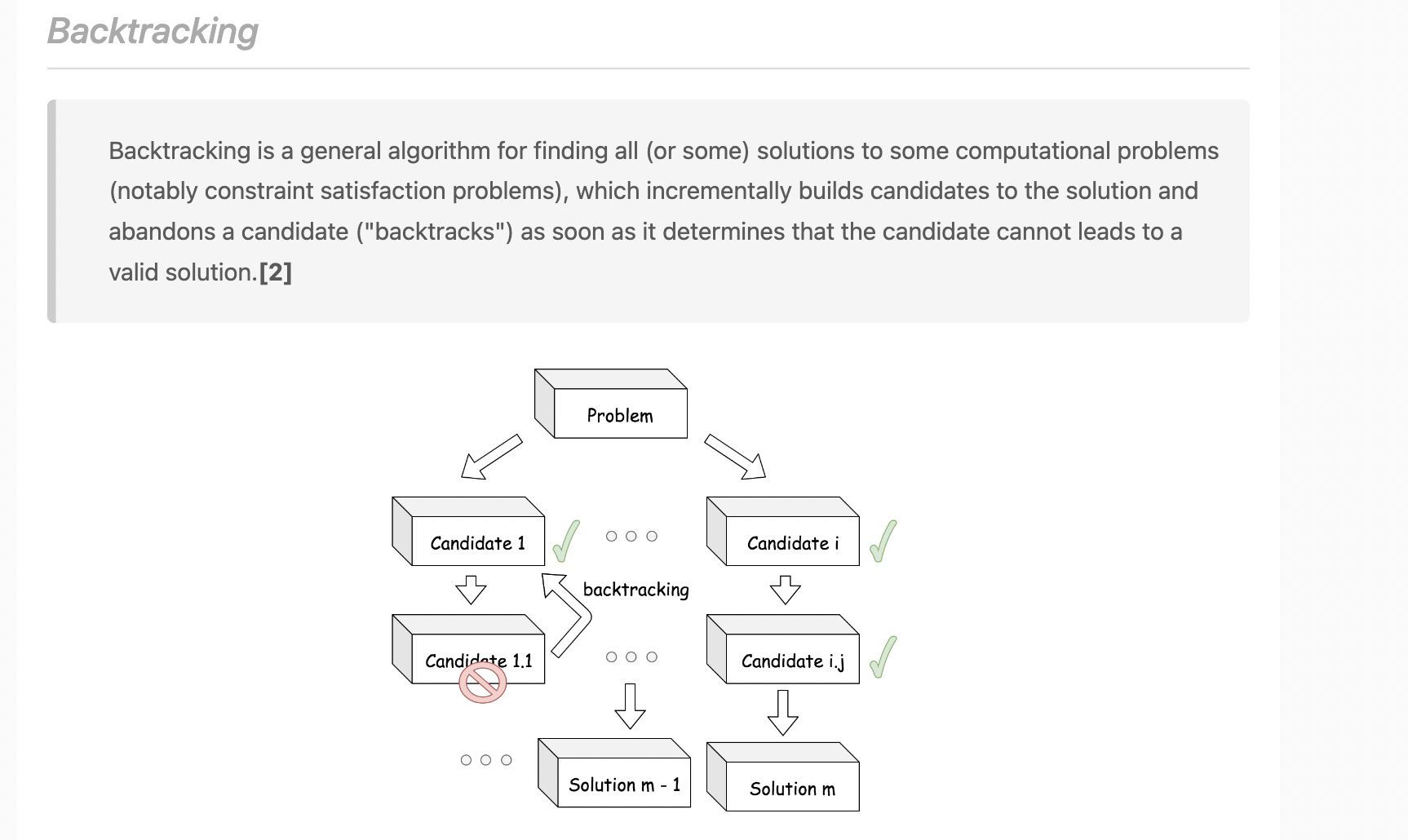
上面那三列直接對應到 Template 1 —
path是路徑,for迴圈是選擇清單,最上面那個if是結束條件。
各題型的時間複雜度
| 題型 | 典型時間 | 空間(不含輸出) | 範例 |
|---|---|---|---|
| 子集 | O(2^n · n) | O(n) | LC 78, 90 |
| 排列 | O(n! · n) | O(n) | LC 46, 47 |
| 組合 | O(C(n,k) · k) | O(k) | LC 77 |
| 組合總和 | 指數級 | O(target / min) | LC 39, 40 |
| 切分 | O(2^n · n) | O(n) | LC 131 |
| N 皇后 | O(n!) | O(n) | LC 51 |
後面那個
· n/· k是把每條合法路徑複製進結果的成本。 剪枝砍掉分支、也砍掉常數項,但不會改變最壞情況的量級。
參考資料
- labuladong — Backtracking framework
- labuladong — Two views of backtracking
- LeetCode — A general approach to backtracking (Java)
題型分類
四種形狀幾乎涵蓋所有回溯題。下面這張分類表決定你該拿哪份模板; 程式碼在 Templates & Algorithms, 完整解答在 backtrack_examples.md。
| # | 形狀 | 要 start_idx 嗎? |
標準模板 | LC |
|---|---|---|---|---|
| 1 | 子集(Subsets) | ✅ i + 1 |
Template 3 / Template 4 | 78, 90 |
| 2 | 排列(Permutations) | ❌ visited[] |
Template 5 | 46, 47 |
| 3 | 組合(Combinations) | ✅ i + 1 |
Template 6 | 77, 216 |
| 4 | 組合總和 | ✅ i(可重複用)或 i + 1 |
Template 7 | 39, 40 |
| 5 | 切分 | ✅ 在子字串/桶上用 i + 1 |
Template 8 / Template 13 | 131, 698, 473 |
| 6 | 格子/單字搜尋 | ❌ 標記格子再還原 | Template 9 | 79, 980, 1219 |
| 7 | 限制條件滿足 | ❌ 每層處理一列/一格 | Template 10 / Template 11 | 51, 37 |
| 8 | 括號/字串建構 | ❌ 用計數器當限制 | backtrack_examples.md | 20, 22, 93 |
各型態筆記
每種形狀的隨手筆記 — 迴圈主體的口訣,以及會踩到的坑。
-
型態 1) :
Subsets(子集)- 題目 : LC 78, 90, 17
- 代碼隨想錄 - 0078.子集
- (用 for 迴圈呼叫輔助函式)+ start_idx + for 迴圈 + pop(-1)
- 回溯。找最小情況,把問題轉成
樹的問題。用start把已經用過的數字排掉,回傳所有情況 - 需要
!cur.contains(nums[i])-> 才不會加進重複的元素
-
Subsets II- LC 90
- start idx + 回溯 + 去重(seen)
- 去重 : 用 dict counter 或用索引都行
-
型態 2) :
Permutations(排列組合)(全排列)- 題目 : LC 46, 47
- (用 for 迴圈呼叫輔助函式)+ contains + pop(-1)
- 回溯。用
contains把已經用過的數字排掉,回傳所有情況 - 不需要用 start_idx
-
型態 3) :
Combinations(組成)- LC 77
- (用 for 迴圈呼叫輔助函式)+ start_idx + for 迴圈 + 檢查 len == k + pop(-1)
-
型態 4) :
Others -
括號(Parentheses,括弧)
- LC 20, LC 22
模板與演算法
模板對照表
| 模板 | 形狀 | 迴圈/下一個索引 | 復原 | LC |
|---|---|---|---|---|
| 1 | 選擇 → 探索 → 取消選擇 | for i in start..n |
path.pop() |
— |
| 2 | start_idx 控制 |
i(可重用)vs i + 1(只用一次) |
— | 39 vs 40 |
| 3 | 子集 | 每個節點都記錄,用 i + 1 |
remove(last) |
78 |
| 4 | 子集 II | i > start && a[i] == a[i-1] 就跳過 |
remove(last) |
90 |
| 5 | 排列 | 掃全部,跳過 visited[i] |
pop() + visited[i] = False |
46, 47 |
| 6 | 組合 | len(path) == k 就停 |
pop() |
77 |
| 7 | 組合總和 | i 可重用/i + 1 只用一次,加 break 剪枝 |
pop() |
39, 40 |
| 8 | 回文切分 | for end in start+1..n,過回文這關 |
remove(last) |
131 |
| 9 | 格子/單字搜尋 | 每格往四個方向走 | 還原該格 | 79 |
| 10 | N 皇后 | 每層放一列,三個限制集合 | 三個集合都要移除 | 51 |
| 11 | 數獨 | 每層填一個空格,列/行/宮格集合 | 重設格子與集合 | 37 |
| 12 | 剪枝 | 遞迴前先 break / continue |
— | 39, 40 |
| 13 | k 桶切分 | 對每個桶試一次,先由大到小排序 | buckets[i] -= v |
698, 473 |
| 14 | 可變 vs 不可變狀態 | — | 只有可變狀態要復原 | 113, 1740 |
Template 1: choose → explore → un-choose 優先度 5/5 — 必備 — 幾乎每一輪面試都會出現
標準的「選擇 → 探索 → 取消選擇」骨架,拿去改就能用:
# python
# time = O(b^d * w), space = O(d)   b = branching factor, d = depth, w = work done at a leaf
def backtrack(start_idx, path):
    if end_condition:            # e.g. len(path) == k, or start_idx == len(s)
        res.append(path[:])      # NOTE: copy the path, not the reference
        return
    for i in range(start_idx, n):
        path.append(nums[i])         # 1) choose
        backtrack(i + 1, path)       # 2) explore  (i -> reuse, i+1 -> use once)
        path.pop()                   # 3) un-choose (undo)

res = []
backtrack(0, [])
// java
// time = O(b^d * w), space = O(d)   b = branching factor, d = depth, w = work done at a leaf
private void backtrack(int startIdx, List<Integer> path, int[] nums, List<List<Integer>> res) {
    if (endCondition) {                       // e.g. path.size() == k
        res.add(new ArrayList<>(path));       // NOTE: copy the path, not the reference
        return;
    }
    for (int i = startIdx; i < nums.length; i++) {
        path.add(nums[i]);                    // 1) choose
        backtrack(i + 1, path, nums, res);    // 2) explore (i -> reuse, i+1 -> use once)
        path.remove(path.size() - 1);         // 3) un-choose (undo)
    }
}
只要轉兩個旋鈕,這份模板就能變成所有變體:
start_idx— 控制搜尋空間(組合/子集 vs 排列)- 提早結束/剪枝 — 砍掉不可能得到合法答案的分支
跳過重複 — 同一層才跳的規則 優先度 5/5 — 必備 — 幾乎每一輪面試都會出現
我們不是每個重複值都跳 — 只跳出現在同一層遞迴的重複值。 同一條規則的三種寫法(片段,不是可直接執行的類別):
// time = O(2^n * n), space = O(n)   every subset, each copied out
// LC 40
// java
// ...

/**
*  NOTE !!!   skip a duplicate at the same recursive level.
*
*   -> Key idea of the duplicate-skipping logic
*       •    We do not skip all duplicates.
*       •    We only skip a duplicate at the same recursive level.
*/

if (i > startIdx && candidates[i] == candidates[i - 1]) {
    continue;
}

// ...
// time = O(2^n * n), space = O(n)   every subset, each copied out
// LC 90
// java

// ...
for (int j = i; j < nums.length; j++) {
    /**
     *  NOTE !!! below !!
     *
     *  via below, we avoid add `duplicated` element
     *
     */
    if (j > i && nums[j] == nums[j - 1]) {
        continue;
    }
    // ...
}
// ...
// java
// time = O(n! * n), space = O(n)    every permutation, each copied out
// LC 47
// ...

// Skip duplicates in the same recursion layer
if (i > 0 && nums[i] == nums[i - 1] && !used[i - 1])
    continue;

// ...
Template 2: start_idx — i vs i + 1 優先度 5/5 — 必備 — 幾乎每一輪面試都會出現
start_idx(或叫 index 之類的)是用來控制搜尋空間的 — 用來避免重複,並讓產生的結果保持順序。
-> 什麼時候要用 start_idx:
- 你在產生組合/子集
- 你想避免重複
- 你想保留選擇的順序
一旦確定需要 start_idx,下一個問題就是下一層要傳什麼當起始索引 —
i(可以重複用當前元素)還是 i + 1(跳過它)。
| 傳什麼 | 意義 | 類比 | 例子 |
|---|---|---|---|
i |
同一個元素可以再用一次 | 完全背包(數量無限) | LC 39 (Combination Sum), LC 518 (Coin Change II), LC 377 |
i + 1 |
每個元素最多用一次 | 0/1 背包、子集 | LC 40 (Combination Sum II), LC 78/90 (Subsets), LC 131, LC 494 |
排列兩個都不用 — 它會回頭用前面的元素,所以改成維護一個
visited[]陣列/contains檢查,而不是start_idx(見 Problem Categories)。
// time = O(n^(T/M + 1)), space = O(T/M)   T = target, M = smallest candidate
// LC 39 Combination Sum — reuse allowed → pass i
for (int i = start; i < candidates.length; i++) {
    backtrack(i, remain - candidates[i]);      // can pick candidates[i] again
}

// LC 40 Combination Sum II — each used once → pass i + 1
for (int i = start; i < candidates.length; i++) {
    backtrack(i + 1, remain - candidates[i]);  // move past candidates[i]
}
重點:可以重複用 →
i;只能用一次 →i + 1。
Template 3: Subsets — LC 78 優先度 5/5 — 必備 — 幾乎每一輪面試都會出現
在每個節點都把路徑記下來(前序),並且傳 i + 1,讓每個元素只用一次。
那些 // ... 是省略掉的樣板碼,不是真的程式碼。
// java
// time = O(2^n * n), space = O(n)   2^n subsets, O(n) to copy each
// LC 78 - Subsets
public List<List<Integer>> subsets(int[] nums) {
    // ...
    this.getSubSet(start_idx, nums, cur, res);
    //System.out.println("(after) res = " + res);
    return res;
}

public void getSubSet(int start_idx, int[] nums, List<Integer> cur, List<List<Integer>> res){

    if (!res.contains(cur)){
        // NOTE !!! init new list via below
        res.add(new ArrayList<>(cur));
    }

    if (cur.size() > nums.length){
        return;
    }

    for (int i = start_idx; i < nums.length; i++){
        /**
         * NOTE !!!
         *
         *  for subset,
         *  we need "!cur.contains(nums[i])"
         *  -> to NOT add duplicated element
         */
        if (!cur.contains(nums[i])){
            cur.add(nums[i]);
            /**
             *  NOTE !!!
             *
             *   at LC 78 subset, we need to use `i+1` idx
             *   in recursive call
             *
             *   while at LC 39 Combination Sum,
             *   we use `i` directly
             *
             *
             *   e.g. next start_idx is ` i+1`
             */
            this.getSubSet(i+1, nums, cur, res);
            // undo
            cur.remove(cur.size()-1);
        }
    }
}
# python
# time = O(2^n * n), space = O(n)   2^n subsets, O(n) to copy each
# LC 78 - Subsets
# IDEA : DFS
class Solution(object):
    def subsets(self, nums):
        def dfs(layer, start, tmp):
            if tmp not in res:
                res.append(tmp)
            if layer == len(nums):
                return
            ### NOTE : we have if condition first, then for loop
            for i in range(start, len(nums)):
                ### NOTE below can make loop start `start idx` updated each time
                dfs(layer+1, i+1, tmp + [nums[i]])
        nums.sort()
        res = []
        dfs(0, 0, [])
        return res
Template 4: Subsets II (skip same-level duplicates) — LC 90 優先度 5/5 — 必備 — 幾乎每一輪面試都會出現
// java
// time = O(2^n * n), space = O(n)   the sort is O(n log n) and is dominated
// LC 90
private void backtrack(List<List<Integer>> list, List<Integer> tempList, int [] nums, int start){
    list.add(new ArrayList<>(tempList));
    for(int i = start; i < nums.length; i++){
        // skip duplicates
        /**
         *  NOTE !!!
         *
         *   below is the key shows how to simply skip duplicates
         *   (instead of using hashmap counter)
         */
        if(i > start && nums[i] == nums[i-1]){
            continue;
        }
        tempList.add(nums[i]);
        backtrack(list, tempList, nums, i + 1);
        tempList.remove(tempList.size() - 1);
    }
}
Template 5: Permutations — LC 46 優先度 5/5 — 必備 — 幾乎每一輪面試都會出現
# python
# time = O(n! * n), space = O(n)     n! permutations, O(n) to copy each
# LC 46 - Permutations
# IDEA : BACKTRACK with a `visited` array (instead of `contains`)
class Solution(object):
    def permute(self, nums):
        res = []
        visited = [False] * len(nums)

        def dfs(path):
            if len(path) == len(nums):
                res.append(path[:])          # NOTE: copy the path
                return
            for i in range(len(nums)):
                if visited[i]:
                    continue
                visited[i] = True            # choose
                path.append(nums[i])
                dfs(path)                    # explore
                path.pop()                   # un-choose
                visited[i] = False

        dfs([])
        return res
// java
// time = O(n! * n), space = O(n)    n! permutations, O(n) to copy each
// LC 46. Permutations
    List<List<Integer>> ans = new ArrayList<>();

    // IDEA : BACKTRACK
    public List<List<Integer>> permute(int[] nums) {

        if (nums.length == 1){
            List<List<Integer>> _ans = new ArrayList<>();
            List<Integer> cur = new ArrayList<>();
            cur.add(nums[0]);
            _ans.add(cur);
            return _ans;
        }

        List<Integer> cur = new ArrayList<>();
        /** NOTE !!! we don't need to set idx param */
        helper(nums, cur);

        return this.ans;
    }

    private void helper(int[] nums, List<Integer> cur){

        if (cur.size() > nums.length){
            return;
        }

        if (!this.ans.contains(cur) && cur.size() == nums.length){

            /** NOTE !!! we use below to add current ArrayList instance to ans */
            this.ans.add(new ArrayList<>(cur));
        }


        for (int i = 0; i < nums.length; i++){
            int val = nums[i];
            // input nums is array with distinct integers
            /** NOTE !!! ONLY do recursive, backtrack when meet distinct element */
            if(!cur.contains(val)){
                cur.add(val);
                // recursive call
                helper(nums, cur);
                // undo last op
                cur.remove(cur.size()-1); // NOTE !!! remove last element
            }
        }
    }
有重複元素的排列 — LC 47
用 Counter 取代 visited[]:選的時候減一,取消選擇時加回去。
另一種寫法(排序 + i > 0 and a[i] == a[i-1] and not used[i-1])就是
跳過重複裡的那段 Java。
# python
# time = O(n! * n), space = O(n)     duplicates only prune, they do not change the bound
# LC 47 - Permutations II
# IDEA : BACKTRACK with a Counter (decrement on choose, increment back on un-choose)
class Solution(object):
    def permuteUnique(self, nums):
        def help(res, cur, cnt):
            if len(cur) == len(nums):
                if cur not in res:
                    res.append(cur[:])
                    return
            if len(cur) > len(nums):
                return
            for x in _cnt:
                #print ("i = " + str(i) + " cur = " + str(cur))
                #if i not in cur:
                if _cnt[x] > 0:
                    cur.append(x)
                    _cnt[x] -= 1
                    help(res, cur, _cnt)
                    """
                    NOTE !!! : we UNDO the last op we just made (pop last element we put into array)
                    """
                    cur.pop(-1)
                    _cnt[x] += 1
        # edge case
        if not nums:
            return [[]]
        _cnt = Counter(nums)
        #print ("_cnt = " + str(_cnt))
        res = []
        cur = []
        help(res, cur, _cnt)
        return res
Template 6: Combinations — LC 77
start_idx 加上一個長度關卡。一旦 len(path) == k 就停。
# python
# time = O(C(n,k) * k), space = O(k) one copy per combination
# LC 77. Combinations
# IDEA : BACKTRACK
class Solution(object):
    def combine(self, n, k):
        def dfs(current, start):
            if(len(current) == k):
                """
                Both of below approach are OK

                list(current) : transform current reference to list
                current[:] : shallow copy
                """
                result.append(list(current))
                return

            for i in range(start, n + 1):
                current.append(i)
                dfs(current, i + 1)
                current.pop()

        result = []
        dfs([], 1)
        return result
Template 7: Combination Sum — LC 39 / LC 40 優先度 4/5 — 高價值 — 這裡有缺口就會掉關
遞迴呼叫傳 i 代表可以重複用(LC 39);傳 i + 1 代表只能用一次(LC 40)。
LC 40 還額外需要同一層的重複跳過。
// java
// time = O(n^(T/M + 1)), space = O(T/M)   reuse allowed, so depth is bounded by T/M
// https://leetcode.com/problems/subsets/solutions/27281/a-general-approach-to-backtracking-questions-in-java-subsets-permutations-combination-sum-palindrome-partitioning/
// LC 39 - Combination Sum
public List<List<Integer>> combinationSum(int[] nums, int target) {
    List<List<Integer>> list = new ArrayList<>();
    Arrays.sort(nums);
    backtrack(list, new ArrayList<>(), nums, target, 0);
    return list;
}

private void backtrack(List<List<Integer>> list, List<Integer> tempList, int [] nums, int remain, int start){
    if(remain < 0) return;
    else if(remain == 0) list.add(new ArrayList<>(tempList));
    else{
        for(int i = start; i < nums.length; i++){
            tempList.add(nums[i]);
            /** NOTE !!!
             *
             *   use i, since we need to use start from current (i) index in recursion call
             *    (reuse current index)
             */
            backtrack(list, tempList, nums, remain - nums[i], i);
            tempList.remove(tempList.size() - 1);
        }
    }
}
// java
// time = O(2^n * n), space = O(n)   each candidate used at most once
// https://leetcode.com/problems/subsets/solutions/27281/a-general-approach-to-backtracking-questions-in-java-subsets-permutations-combination-sum-palindrome-partitioning/
// LC 40 - Combination Sum II
 public List<List<Integer>> combinationSum2(int[] nums, int target) {
    List<List<Integer>> list = new ArrayList<>();
    Arrays.sort(nums);
    backtrack(list, new ArrayList<>(), nums, target, 0);
    return list;

}

private void backtrack(List<List<Integer>> list, List<Integer> tempList, int [] nums, int remain, int start){
    if(remain < 0) return;
    else if(remain == 0) list.add(new ArrayList<>(tempList));
    else{
        for(int i = start; i < nums.length; i++){
            if(i > start && nums[i] == nums[i-1]) continue; // skip duplicates
            tempList.add(nums[i]);
            backtrack(list, tempList, nums, remain - nums[i], i + 1);
            tempList.remove(tempList.size() - 1);
        }
    }
}
Python — LC 40,兩種剪枝都上(先 sort(),break 才合法):
# python
# time = O(2^n * n), space = O(n)    each candidate used at most once
# LC 40 - Combination Sum II
def combinationSum2(candidates, target):
    def backtrack(start, path, current_sum):
        if current_sum == target:
            result.append(path[:])
            return

        for i in range(start, len(candidates)):
            # Pruning: skip duplicates at same level
            if i > start and candidates[i] == candidates[i-1]:
                continue

            # Pruning: early termination
            if current_sum + candidates[i] > target:
                break

            path.append(candidates[i])
            backtrack(i + 1, path, current_sum + candidates[i])
            path.pop()

    candidates.sort()
    result = []
    backtrack(0, [], 0)
    return result
Template 8: Palindrome Partitioning — LC 131 優先度 5/5 — 必備 — 幾乎每一輪面試都會出現
核心想法 — 選的是「切在哪」,不是「拿哪個」
這一頁其他每份模板選的都是要拿哪個元素,切分題選的則是要切在哪裡。站在索引
start 上,選擇清單就是剩餘字串的每一個前綴 —— end 從 start+1 跑到 n 的
s[start:end]。只有通過合法性關卡(這裡是:它是迴文嗎?)的前綴才拿,然後從 end
往下對剩下的部分遞迴。字串用完了,代表每一段都過了關卡,這條路徑就是一組完整解。
這個重新框定就是整題的全部。長度 n 的字串在字元之間有 n - 1 個縫隙,一個切分
其實就是挑一個要切開的縫隙子集 —— 所以 LC 131 是
LC 78 Subsets 換了層皮,只是多了 isPalindrome
這個過濾器。複雜度也是從這裡來的:2^(n-1) 種候選切分,每種花 O(n) 檢查與複製
→ O(2^n · n)。
s = "aab"        gaps:  a|a|b  ->  2 gaps  ->  2^2 = 4 candidate partitions

start=0  "a"   ✔ ─┬─ start=1  "a"   ✔ ── start=2  "b" ✔ ── start=3 ✅ ["a","a","b"]
                  └─ start=1  "ab"  ✘  (not a palindrome — branch dies here)
start=0  "aa"  ✔ ─── start=2  "b"   ✔ ─────────────────── start=3 ✅ ["aa","b"]
start=0  "aab" ✘  (not a palindrome)
模式 — 一個關卡,三個旋鈕
形狀是固定的;轉動三個旋鈕就能變成其他每一道切分題:
| 旋鈕 | LC 131 | 換成⋯ |
|---|---|---|
關卡 is_valid(piece) |
piece == piece[::-1] |
0 <= int(piece) <= 255 且不能有前導零 → LC 93;piece in wordDict → LC 140 |
切分範圍 for end in … |
每一個前綴,start+1 .. n |
有長度上限 —— IP 的每段 <= 3,字典斷詞 <= maxWordLen |
| 結束條件 | start == n |
start == n 而且 len(path) == 4(LC 93 要求剛好四段) |
真的會出錯的兩件事:
- 要從
end遞迴,不是從start + 1。 切掉一段 2 個字元的片段後,start + 1會把它的第二個字元再吃一次。這就是切分題版本的 Template 2ivsi + 1問題。 - 在葉節點要複製路徑(
path[:]/new ArrayList<>(path))。下面的 Python 版本 用傳path + [piece]繞過這件事 —— 每次呼叫都是全新的 list,這也是它不需要pop()的原因;見 Template 14。
// java
// time = O(2^n * n), space = O(n)   2^(n-1) cut positions, O(n) per palindrome check+copy
// https://leetcode.com/problems/subsets/solutions/27281/a-general-approach-to-backtracking-questions-in-java-subsets-permutations-combination-sum-palindrome-partitioning/
// LC 131 - Palindrome Partitioning
public List<List<String>> partition(String s) {
   List<List<String>> list = new ArrayList<>();
   backtrack(list, new ArrayList<>(), s, 0);
   return list;
}

public void backtrack(List<List<String>> list, List<String> tempList, String s, int start){
   if(start == s.length())
      list.add(new ArrayList<>(tempList));
   else{
      for(int i = start; i < s.length(); i++){
         if(isPalindrome(s, start, i)){
            tempList.add(s.substring(start, i + 1));

            // NOTE !!! `i+1`
            backtrack(list, tempList, s, i + 1);
            tempList.remove(tempList.size() - 1);
         }
      }
   }
}

public boolean isPalindrome(String s, int low, int high){
   while(low < high)
      if(s.charAt(low++) != s.charAt(high--)) return false;
   return true;
}
# python
# time = O(2^n * n), space = O(n)    2^(n-1) cut positions, O(n) per palindrome check+copy
# LC 131 Palindrome Partitioning
# IDEA : BACKTRCK, similar as LC 046 permutations
class Solution(object):
    def partition(self, s):
        def help(s, res, path):
            # NOTE !!! no remaining string -> every piece passed the gate -> record
            if not s:
                res.append(path)
                return
            # NOTE !!! `range(1, len(s)+1)` — every prefix, INCLUDING the whole of s
            for i in range(1, len(s)+1):
                if s[:i] == s[:i][::-1]:
                    # NOTE !!! recurse on the REST (`s[i:]`), and pass a NEW list
                    #          (`path + [s[:i]]`), so there is nothing to undo
                    help(s[i:], res, path + [s[:i]])
        # edge case
        if not s:
            return
        res = []
        path = []
        help(s, res, path)
        return res
Python 這種寫法是切字串(
s[i:])而不是帶著索引走。讀起來比較乾淨,但每次切片都是 一次O(n)的複製 —— 在 Java 就照上面那樣傳start,用s.substring(start, i + 1)。
讓關卡變成 O(1) — 預先算好的迴文表 優先度 3/5 — 值得會 — 多半是必備模式的變形
關卡位在最內層迴圈,每次呼叫要花 O(n)。先用 O(n^2) 把
dp[i][j] = 「s[i..j] 是不是迴文」 算好,之後每次檢查就只要 O(1)。輸出量本身仍是
指數等級,所以複雜度等級不會改變 —— 但這是實實在在的常數項優化,而且講得出這一點
正是面試官在等的追問。
# python
# time = O(2^n * n), space = O(n^2)   the O(n^2) table replaces an O(n) check per cut
# LC 131 - Palindrome Partitioning (precomputed palindrome table)
# IDEA : BACKTRACK + DP gate. dp[i][j] is built bottom-up so dp[i+1][j-1] is already known.
def partition(s):
    n = len(s)
    dp = [[False] * n for _ in range(n)]
    for i in range(n - 1, -1, -1):          # i descends so the inner span is ready
        for j in range(i, n):
            dp[i][j] = s[i] == s[j] and (j - i < 2 or dp[i + 1][j - 1])

    res, path = [], []

    def backtrack(start):
        if start == n:
            res.append(path[:])             # NOTE: copy — `path` is one shared list here
            return
        for end in range(start, n):
            if dp[start][end]:              # O(1) gate
                path.append(s[start:end + 1])
                backtrack(end + 1)          # NOTE !!! `end + 1`, not `start + 1`
                path.pop()

    backtrack(0)
    return res
類似題 — 切分題家族
| LC | 題目 | 跟 LC 131 差在哪 |
|---|---|---|
| 93 | Restore IP Addresses | 關卡 = 0..255 且無前導零;切分長度上限 3;結束條件還要求剛好 4 段(實作解) |
| 140 | Word Break II | 關卡 = piece in wordDict;要對 start 做記憶化,否則 "aaaa…aaab" 會爆掉(實作解) |
| 139 | Word Break | 同一套搜尋,但它只問能不能 —— 把路徑拿掉就塌縮成對 start 的 DP/BFS |
| 132 | Palindrome Partitioning II | 問的是最少切幾刀,不是所有切法 —— 什麼都不用列舉,直接對 start 做 DP |
| 842 | Split Array into Fibonacci Sequence | 關卡 = 「這一段等於前兩段相加」,所以遞迴要帶著前兩個值當狀態 |
| 306 | Additive Number | LC 842 的是非題雙胞胎 —— 第一次成功就回傳,不用收集 |
| 816 | Ambiguous Coordinates | 兩層切分:先切成 2 段,再在每一段裡面插小數點 |
| 291 | Word Pattern II | 切分 + 一個 char -> piece 的雙射,回溯時必須復原 |
| 698 | Partition to K Equal Sum Subsets | 切的是多重集合分成 k 桶,不是把序列切成連續片段 —— 是另一份模板(Template 13) |
LC 131 → LC 132 就是 Key Properties 裡那個典型的 回溯 → DP 轉折:問題一旦不再要所有切分、而是要最好的那一個,把它們全部列舉 出來就是浪費。
Template 9: Grid / Word Search — LC 79 優先度 4/5 — 高價值 — 這裡有缺口就會掉關
標記格子、往四個方向遞迴、再把格子還原。用 visited[][] 矩陣的版本,以及
計數/取最大值的變體(LC 980、LC 1219),放在
backtrack_examples.md §3。
# python
# time = O(m * n * 4^L), space = O(L)   L = len(word); 4 directions, minus the one we came from
# LC 079 Word Search
# IDEA : DFS + backtracking
class Solution(object):
    def exist(self, board, word):
        if not board or not board[0]:
            return False

        self.rows = len(board)
        self.cols = len(board[0])

        for r in range(self.rows):
            for c in range(self.cols):
                if self.dfs(board, word, r, c, 0):
                    return True

        return False

    def dfs(self, board, word, r, c, idx):
        if r < 0 or r >= self.rows or c < 0 or c >= self.cols:
            return False
        if board[r][c] != word[idx]:
            return False
        if idx == len(word) - 1:
            return True

        # Mark current cell as visited
        temp = board[r][c]
        board[r][c] = "#"

        # Explore 4 directions
        found = (
            self.dfs(board, word, r + 1, c, idx + 1) or
            self.dfs(board, word, r - 1, c, idx + 1) or
            self.dfs(board, word, r, c + 1, idx + 1) or
            self.dfs(board, word, r, c - 1, idx + 1)
        )

        # NOTE !!! MUST save `found` first, THEN backtrack, THEN return found.
        # -> The restore (backtrack) must happen before return.
        # -> Returning directly from the recursive call skips the restore:
        #
        #   WRONG pattern:
        #     board[r][c] = "#"
        #     return (self.dfs(...) or self.dfs(...) or ...)
        #     board[r][c] = temp   # NEVER REACHED
        #
        #   CORRECT pattern:
        #     board[r][c] = "#"
        #     found = (self.dfs(...) or ...)   # collect result
        #     board[r][c] = temp               # backtrack (restore)
        #     return found                     # return after restore

        # Backtrack: restore original value
        board[r][c] = temp

        return found
Template 10: N-Queens — LC 51
經典回溯,搜尋空間 O(n!),靠追蹤行與對角線來剪枝。
# python
# time = O(n!), space = O(n^2)       n choices, then n-1, ...; the board is the space
# LC 51 - N-Queens
def solveNQueens(n):
    result = []
    cols = set()
    diag1 = set()   # row - col (top-left to bottom-right)
    diag2 = set()   # row + col (top-right to bottom-left)

    def backtrack(row, board):
        if row == n:
            result.append(["".join(r) for r in board])
            return
        for col in range(n):
            if col in cols or (row - col) in diag1 or (row + col) in diag2:
                continue
            cols.add(col); diag1.add(row - col); diag2.add(row + col)
            board[row][col] = 'Q'
            backtrack(row + 1, board)
            board[row][col] = '.'; cols.remove(col)
            diag1.remove(row - col); diag2.remove(row + col)

    backtrack(0, [['.']*n for _ in range(n)])
    return result
關鍵剪枝:三個 O(1) 的集合取代了 O(n) 的行/對角線掃描。時間:O(n!),空間:O(n)。
Template 11: Sudoku Solver — LC 37
一格一格回溯;用列/行/宮格集合剪枝。
# python
# time = O(9^m), space = O(1)        m = blank cells; the board is a fixed 81 slots
# LC 37 - Sudoku Solver
def solveSudoku(board):
    rows = [set() for _ in range(9)]
    cols = [set() for _ in range(9)]
    boxes = [set() for _ in range(9)]

    empty = []
    for r in range(9):
        for c in range(9):
            if board[r][c] != '.':
                d = board[r][c]
                rows[r].add(d); cols[c].add(d); boxes[(r//3)*3+c//3].add(d)
            else:
                empty.append((r, c))

    def backtrack(idx):
        if idx == len(empty): return True
        r, c = empty[idx]
        box = (r//3)*3 + c//3
        for d in '123456789':
            if d in rows[r] or d in cols[c] or d in boxes[box]: continue
            board[r][c] = d
            rows[r].add(d); cols[c].add(d); boxes[box].add(d)
            if backtrack(idx + 1): return True
            board[r][c] = '.'; rows[r].remove(d); cols[c].remove(d); boxes[box].remove(d)
        return False

    backtrack(0)
再往前推一步 — 一放下數字就把它從同伴格的候選中消掉,某格候選歸零就立刻宣告失敗 — 那就是限制傳播(constraint propagation),在 backtrack_advanced.md。
Template 12: Pruning Techniques 優先度 4/5 — 高價值 — 這裡有缺口就會掉關
定義:透過砍掉不可能通往合法解的分支,來縮小搜尋空間的最佳化手法。
剪枝的種類:
1. 限制條件剪枝
- 一違反限制就提早結束
- 遞迴呼叫前先檢查合法性
2. 界限剪枝
- 用上界/下界排除掉不夠好的路徑
- 分支界限法(branch and bound)
3. 對稱性剪枝
- 跳過等價的狀態以避免重複
- 排序輸入來處理排列
4. 記憶化剪枝
- 把子問題的結果快取起來
- 避免重算同樣的狀態
常見剪枝樣式 — 這是大綱不是可執行的程式碼:current_sum、target_length、
is_valid 與 result 都是佔位,實際由題目決定。
# python
def backtrack_with_pruning(path, choices, target):
    # Early termination (constraint pruning)
    if current_sum > target:
        return  # No need to continue

    # Bound pruning
    if current_sum + min_remaining > target:
        return  # Cannot reach target

    # Base case
    if len(path) == target_length:
        if is_valid(path):
            result.append(path[:])
        return

    # Symmetry pruning
    for i in range(start_idx, len(choices)):
        # Skip duplicates (symmetry pruning)
        if i > start_idx and choices[i] == choices[i-1]:
            continue

        # Make choice
        path.append(choices[i])

        # Recursive call with pruning
        backtrack_with_pruning(path, choices, target)

        # Undo choice
        path.pop()
實作剪枝 — LC 39 Combination Sum(先 sort() 才能用 break):
# python
# time = O(n^(T/M + 1)), space = O(T/M)   sorting first is what makes the early break sound
# LC 39 - Combination Sum (with sum + sorted-break pruning)
def combinationSum(candidates, target):
    def backtrack(start, path, current_sum):
        # Pruning: if current sum exceeds target
        if current_sum > target:
            return

        if current_sum == target:
            result.append(path[:])
            return

        for i in range(start, len(candidates)):
            # Pruning: if adding current number exceeds target
            if current_sum + candidates[i] > target:
                break  # Since array is sorted

            path.append(candidates[i])
            backtrack(i, path, current_sum + candidates[i])
            path.pop()

    candidates.sort()  # Enable break pruning
    result = []
    backtrack(0, [], 0)
    return result
Template 13: k-Bucket Partitioning — LC 698 / LC 473
把每個數字分配到 k 個桶的其中一個。三個剪枝讓它變得可行:sum % k != 0 直接失敗、
由大到小排序讓大數字提早爆掉,以及用 break 而不是再去試第二個空桶
(那只是把同一種分法換個標籤而已)。
# python
# time = O(k * 2^n), space = O(2^n)  memoised on the used-mask; O(k^n) without it
# LC 698 - Partition to K Equal Sum Subsets
def canPartitionKSubsets(nums, k):
    total = sum(nums)
    if total % k != 0:
        return False

    target = total // k
    nums.sort(reverse=True)  # Start with larger numbers

    def backtrack(index, buckets):
        if index == len(nums):
            return True

        for i in range(k):
            # Pruning techniques
            if buckets[i] + nums[index] > target:
                continue
            if i > 0 and buckets[i] == buckets[i-1]:
                continue

            buckets[i] += nums[index]
            if backtrack(index + 1, buckets):
                return True
            buckets[i] -= nums[index]

        return False

    return backtrack(0, [0] * k)
變體 — LC 473 (Matchsticks to Square):就是同一份 k 桶模板,只是把
k寫死成 4,且target = 周長 // 4。同樣的三個剪枝照用:sum % 4 != 0或max(nums) > target就直接失敗、先由大到小排序,以及復原之後if buckets[i] == 0: break(再去試第二個空桶只是把同一種分法換個標籤)。
一成功就立刻把 true 往上回傳
判定型問題(「到底能不能切分?」)只要有一條分支成功就馬上回傳 —
不要拿到 true 之後還繼續跑迴圈:
// java
// time = O(k * 2^n), space = O(2^n)  memoised on the used-mask; O(k^n) without it
// LC  698

// ...
if (backtrack_(nums, j + 1, k, subsetSum + nums[j], used)){
            return true;
        }

// ...
Template 14: When to Undo — Mutable vs Immutable State 優先度 4/5 — 高價值 — 這裡有缺口就會掉關
// java
// time = O(m * n * 4^L), space = O(L)   L = len(word)
// LC 79

// https://github.com/yennanliu/CS_basics/blob/master/leetcode_java/src/main/java/LeetCodeJava/BackTrack/WordSearch.java#L133


// In Java, primitive types like int are passed by value. This means when you do:

// dfsFind(board, word, x+1, y, visited, start_idx + 1)

//  1) You're passing a copy of start_idx + 1 to the recursive function. So, inside the recursive call, start_idx is a new variable, and changes to it won't affect the start_idx in the calling function.


// 2) We don't need start_idx -= 1; because start_idx is passed by value, not by reference. So modifying it in the recursive call doesn't affect the caller's start_idx. We're already handling the correct index in each recursive call by passing start_idx + 1.
重要提醒:什麼時候「不需要」回溯
// time = O(n), space = O(h)         one pass over the tree, h = height
// LC 1740
// NOTE !!! we don't need a `backtrack` below,
// since `int` is a `primitive dtype in java
//  ->     Each recursive call gets its own copy of move.
// if we use dtype such as Mutable shared state (e.g. List, Set)
// we need a backtrack (undo)

private int getPathLen(TreeNode root, int target, int dist) {
    if (root == null) {
        return -1;  // not found
    }
    if (root.val == target) {
        return dist;
    }
    int left = getPathLen(root.left, target, dist + 1);

    if (left != -1) {
        return left;
    }
    int right = getPathLen(root.right, target, dist + 1);

    // NOTE !!! we don't need a `backtrack` below,
    // since `int` is a `primitive dtype in java
    //  ->  Each recursive call gets its own copy of move.
    // if we use dtype such as Mutable shared state (e.g. List, Set)
    // we need a backtrack (undo)
    return right;
}
什麼時候要回溯(復原):
| 資料型別 | 需要回溯? | 原因 |
|---|---|---|
基本型別(int、char、boolean 等) |
❌ 不用 | 傳值;每次遞迴呼叫都有自己的副本 |
可變物件(List、Set、Map、StringBuilder 等) |
✅ 要 | 傳參考;改動會影響到所有遞迴呼叫 |
不可變物件(String、Integer 等) |
❌ 不用 | 改動會產生新的實例 |
Python 版的對照 — int 累加值 vs list 路徑(LC 113 Path Sum II) ⭐
同一條規則在 Python 也成立。在一個同時帶著累計總和(cur_sum,一個 int)
和路徑(cache,一個 list)的 DFS 裡,我們會 cache.pop(),但從來不去
「減回」cur_sum:
cur_sum(int)— 不用回溯。 整數是不可變的。cur_sum += root.val並不會就地改掉父層的整數;它是把本地的cur_sum重新綁定到一個全新的 int 物件。子層的 frame 結束後,父層的cur_sum完全沒被動到。cache(list)— 需要回溯。 整棵遞迴樹從頭到尾只有一個 list 實例。 子層的append父層看得到,所以我們必須pop()才能把狀態還原給兄弟分支。
# python
# time = O(n^2), space = O(n)        O(n) root-to-leaf paths, O(n) to copy each
# LC 113 - Path Sum II
# https://github.com/yennanliu/CS_basics/blob/master/leetcode_python/Depth-First-Search/path-sum-ii.py
class Solution(object):
    def pathSum(self, root, targetSum):
        self.res = []
        if not root:
            return self.res
        self.helper(root, targetSum, 0, [])
        return self.res

    def helper(self, root, targetSum, cur_sum, cache):
        if not root:
            return

        cur_sum += root.val        # int  -> rebinds LOCAL name to a NEW int (immutable)
        cache.append(root.val)     # list -> mutates the ONE shared list

        if not root.left and not root.right and cur_sum == targetSum:
            self.res.append(cache[:])   # snapshot, else later pops corrupt it

        self.helper(root.left,  targetSum, cur_sum, cache)
        self.helper(root.right, targetSum, cur_sum, cache)

        cache.pop()                # MUST backtrack the list ...
        # NOTE: NO `cur_sum -= root.val` — the int never changed for the parent
記憶體走一遍 — 父層在 cur_sum = 5、cache = [5],往下走進一個值為 3 的子節點:
| 往下走進子節點 | 回到父層 | |
|---|---|---|
cache(list) |
cache.append(3) → [5, 3](同一個物件) |
沒有 pop() 就會停在 [5, 3] → 父層被汙染 → 一定要回溯 |
cur_sum(int) |
cur_sum + 3 → 8(新的 int,是區域變數) |
子層 frame 被銷毀 → 父層的 cur_sum 還是 5 → 不需要回溯 |
另見 python_trick.md §1-54 —
str/tuple/int(不可變,不用回溯)vslist.append(可變,需要pop)。
為什麼一定要 cache.pop() — 拿一棵三個節點的樹走一遍:
假設樹長這樣:
    1
   / \
  2   3
沒有 cache.pop():
visit 1: cache = [1]
visit 2: cache = [1,2]
return
visit 3: cache = [1,2,3]   # Wrong! 2 leaked into 3's path
有 cache.pop():
visit 1: cache = [1]
visit 2: cache = [1,2]
return -> pop() => [1]
visit 3: cache = [1,3]     # Correct
另一種寫法(不用明確 pop): 每次呼叫都傳一份新的 list(
path + [node.val]),這樣每條分支都有自己的副本 — 就不需要pop()了;tree_backtrack.md 用的就是這種形式。代價是多了複製成本,換掉的是「共用一個 list 加回溯」。
總結與速查
決策表 — 該用哪種回溯形狀? 優先度 5/5 — 必備 — 幾乎每一輪面試都會出現
| 題型 | 要用 start_idx 嗎? |
範例題 |
|---|---|---|
| 子集 | ✅ 要 | Leetcode 78 |
| 組合 | ✅ 要 | Leetcode 77 |
| 組合總和 | ✅ 要 | Leetcode 39 |
| 排列 | ❌ 不用 | Leetcode 46 |
| N 皇后 | ❌ 不用 | Leetcode 51 |
| 切分 | ✅ 要 | Leetcode 131 |
排序、去重、剪枝 — 什麼時候做
| 問題 | 答案 |
|---|---|
| 要先排序輸入嗎? | 只要你必須跳過重複(LC 40, 47, 90, 996),或想在排序過的候選集上用 break 剪枝(LC 39, 216),就要 |
| 怎麼跳過重複? | 只跳同一層:i > start && a[i] == a[i-1](用索引,LC 40/90)或 i > 0 && a[i] == a[i-1] && !used[i-1](用 visited,LC 47/996);Counter 是第三種寫法 |
用 break 還是 continue? |
候選集已排序且一超出就代表後面整串都沒救時用 break(LC 39, 216);只有這一個候選不合法時用 continue(LC 698 桶滿了) |
| 剪枝要放哪? | 遞迴之前 — 在做選擇的當下檢查限制,而不是到葉節點才檢查(LC 526, 996) |
| 什麼時候該停止剪枝、改成記憶化? | 當重複出現的是同一個狀態(而不是同一條路徑)時 — 那就是 DP 的分界線 |
需要 start_idx 的題目
組合、子集,以及元素可重複使用的題型:順序不重要,而且前面的選擇不該再被走一次。
| 題目 | 是否用 start_idx |
為什麼? |
|---|---|---|
Subsets (Leetcode 78) |
✅ 要 | 避免產生重複的子集 |
Combination Sum (Leetcode 39) |
✅ 要 | 可以重複用,但要照順序 |
Combination Sum II (Leetcode 40) |
✅ 要 | 不能重複用,還要跳過重複值 |
Combinations (Leetcode 77) |
✅ 要 | 從 n 個裡照順序選 k 個 |
Palindrome Partitioning |
✅ 要 | 從 start 開始往後試子字串 |
不用 start_idx 的題目
排列型的題目:順序有意義,每一種排法都是不同的答案,而且前面的選擇還會被再次使用。
| 題目 | 是否用 start_idx |
為什麼不用? |
|---|---|---|
Permutations (Leetcode 46) |
❌ 不用 | 所有排法都合法 |
Permutations II (Leetcode 47) |
❌ 不用 | 只要聰明地跳過重複值就好 |
N-Queens |
❌ 不用 | 每層遞迴處理一列 |
Word Break II |
❌ 不用 | 選擇取決於子字串能不能配到字 |
終止條件的樣式
三種基底條件的形狀(片段 — 挑一個跟題目的「做完了」條件對得上的):
# python
if len(current) == target_length:   # fixed-size result (permutations, combinations of size k)
    result.append(current[:])
    return

if sum(current) == target:          # value-based result (subset sum, coin change)
    result.append(current[:])
    return

if index == len(input):             # exhausted input (string partition, IP addresses)
    if is_valid(current):
        result.append(result_repr)
    return
分支數與剪枝速查
| 題目 | 分支數 | 深度 | 剪枝 | 最壞情況 |
|---|---|---|---|---|
| 子集 | 2 | n | 無 | O(2^n) |
| 排列 | n, n-1, … | n | used 集合 | O(n!) |
| 組合 | n-k+1 | k | 起始索引 | O(C(n,k)) |
| N 皇后 | n | n | 3 個集合 | O(n!) → 實務上好很多 |
| 數獨 | 9 | 81 | 列/行/宮格 | O(9^81) → 實務上每盤約 O(1) |
最壞情況的量級在上面的 Time Complexity by Problem Type 表格裡;這張表講的是靠什麼把它剪掉。
面試訊號 → 模式
| 聽到這種話… | 就拿出… |
|---|---|
| 「所有可能的組合/排列」 | 標準回溯 + result.append(copy) |
| 「擺 N 個互不攻擊的皇后」 | N 皇后加三個剪枝集合 |
| 「在有限制的格子裡填東西」 | 數獨式解法 + 列/行/宮格集合 |
| 「把字串切成合法的片段」 | 用索引的回溯加上 is_valid 檢查 |
| 「產生合法的括號」 | 把左右括號的計數當作限制 |
| 「太慢了?剪得更狠一點」 | 遞迴前先做限制傳播 |
相關主題
- backtrack_examples.md — 這裡每份模板對應的 LC 實作解
- backtrack_advanced.md — 用 Trie 剪枝的格子搜尋(LC 212)、運算式建構(LC 282)、刪除次數預算(LC 301)、記憶化/通用切分
- tree_backtrack.md — 在明確的樹上做根到葉的路徑回溯
- dfs.md — 沒有復原步驟的 DFS 走訪
- dp.md / knapsack.md — 同一套搜尋的記憶化版本