JVM FAQ
Scope — how the JVM stores, executes and reclaims: runtime memory areas, object creation, garbage collection and collectors, reference strengths, class loading, JIT, and the flags/tools used to diagnose a sick JVM. See also:
jmm.md— the memory model (visibility and ordering across threads, a different topic from the memory areas below);faq_performance_tune.md— tuning method.
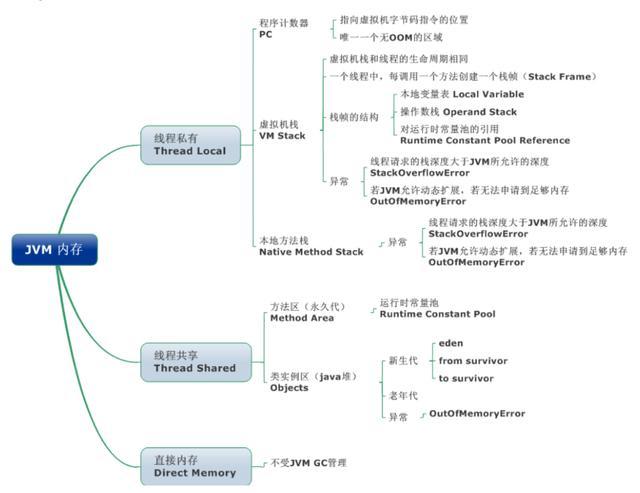
1) Runtime Memory Areas Priority 5 of 5 — Must know — expect it in almost every loop
┌──────────────────────── JVM process ────────────────────────┐
│  Per thread (created and destroyed with the thread)         │
│   ├── PC register      current bytecode address; the only   │
│   │                    area that never throws OOM           │
│   ├── JVM stack        one frame per method call:           │
│   │                    local vars, operand stack, return    │
│   │                    address, dynamic linking             │
│   └── Native method    the same, for native (JNI) calls     │
│                                                             │
│  Shared by all threads                                      │
│   ├── Heap             every object and array. GC lives here│
│   └── Method area      class metadata, static fields, the   │
│       (Metaspace 8+)   runtime constant pool, JIT code      │
│                                                             │
│  Off-heap: direct byte buffers, thread stacks, code cache   │
└─────────────────────────────────────────────────────────────┘
| Area | Shared? | Holds | Failure |
|---|---|---|---|
| PC register | Per thread | Address of the current instruction | — |
| JVM stack | Per thread | Stack frames | StackOverflowError when one thread’s stack cannot grow; OutOfMemoryError: unable to create new native thread is a different failure — the OS refused a new thread (native memory or an OS/cgroup thread limit), not a deep call chain |
| Native stack | Per thread | Native frames | Same |
| Heap | Shared | Objects, arrays | OutOfMemoryError: Java heap space |
| Metaspace | Shared | Class metadata, statics, constant pool | OutOfMemoryError: Metaspace |
| Direct memory | Shared | ByteBuffer.allocateDirect, NIO |
OutOfMemoryError: Direct buffer memory |
Stack vs heap — the question behind most memory questions:
| Stack | Heap | |
|---|---|---|
| Scope | One thread, one frame | Whole JVM |
| Lifetime | Popped when the method returns | Until unreachable, then GC |
| Contains | Primitives and references | The objects those references point to |
| Size | Small (-Xss, ~512 KB–1 MB) |
Large (-Xms/-Xmx) |
| Managed by | Push/pop, free | The garbage collector |
Java 8 removed PermGen. Class metadata moved to Metaspace, which lives in native
memory and grows on demand (bounded by -XX:MaxMetaspaceSize), so the classic
OutOfMemoryError: PermGen space from redeploying a web app repeatedly is gone —
though a classloader leak now exhausts native memory instead.
2) How an Object Is Created Priority 3 of 5 — Worth knowing — usually a variant of a must-know pattern
new Foo() runs these steps:
- Resolve the symbolic reference in the constant pool; load/link/initialise the class if it has not been (see §6).
- Allocate memory. Either bump the pointer (compacting collectors keep the heap contiguous) or take from a free list. Concurrency is handled by a per-thread allocation buffer (TLAB) so allocation is a pointer bump with no locking.
- Zero the memory — which is why fields have default values (
0,false,null). - Set the object header: mark word (hash, GC age, lock state) and the class pointer.
- Run
<init>: field initialisers and the constructor body, aftersuper().
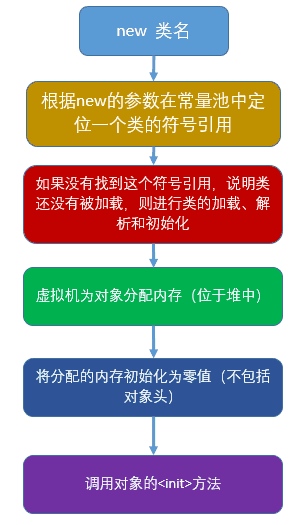
An object is therefore header + instance fields + padding (aligned to 8 bytes).
-XX:+UseCompressedOops (default under 32 GB heaps) stores 64-bit references as 32-bit
offsets, cutting object size and cache pressure — which is why a heap of 31 GB can hold
more objects than one of 33 GB.
Escape analysis may prove an object never escapes its method and then remove the allocation entirely (scalar replacement) or elide its locks.
3) Garbage Collection Priority 5 of 5 — Must know — expect it in almost every loop
What is garbage?
Not “unreferenced” — unreachable. The JVM traverses from GC roots (stack locals, static fields, JNI references, active monitors); anything not reached is collectable.
Reference counting is not used: it cannot collect cycles (a.b = b; b.a = a), which is
exactly why Java does tracing instead.
The three base algorithms
| Algorithm | How | Pros | Cons |
|---|---|---|---|
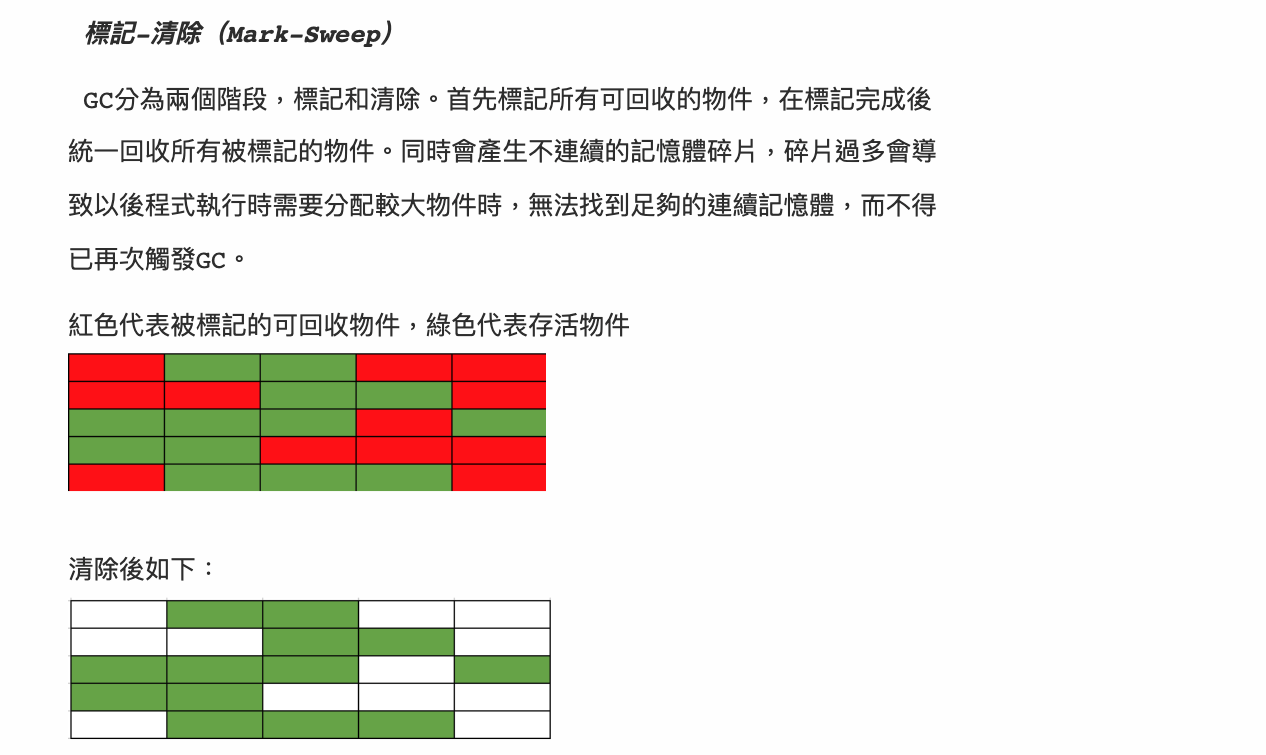
| Mark-Sweep | Mark live, free the rest in place | Simple, no moving | Fragmentation; two passes |
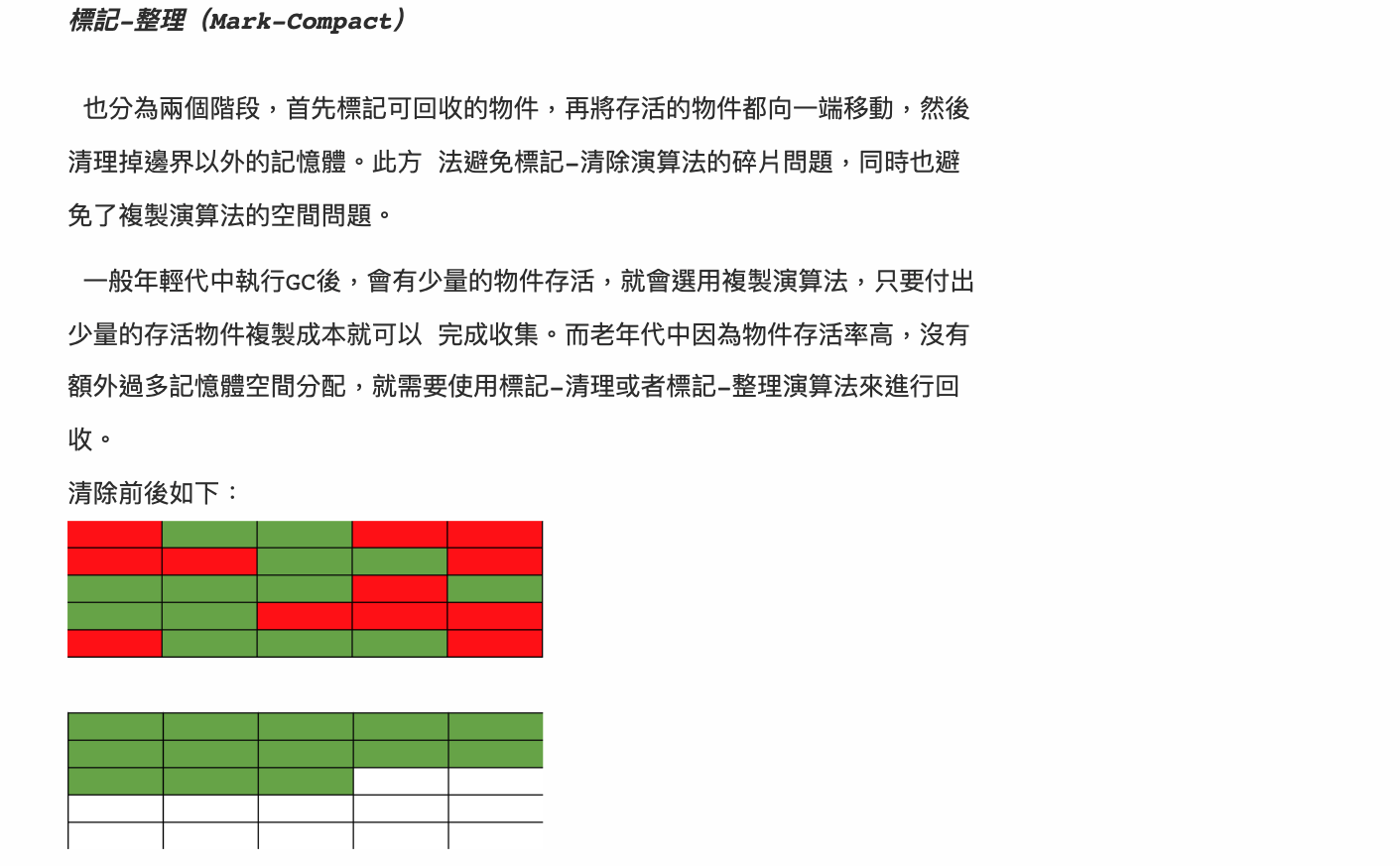
| Mark-Compact | Mark, then slide survivors together | No fragmentation, fast allocation | Moving objects costs time |
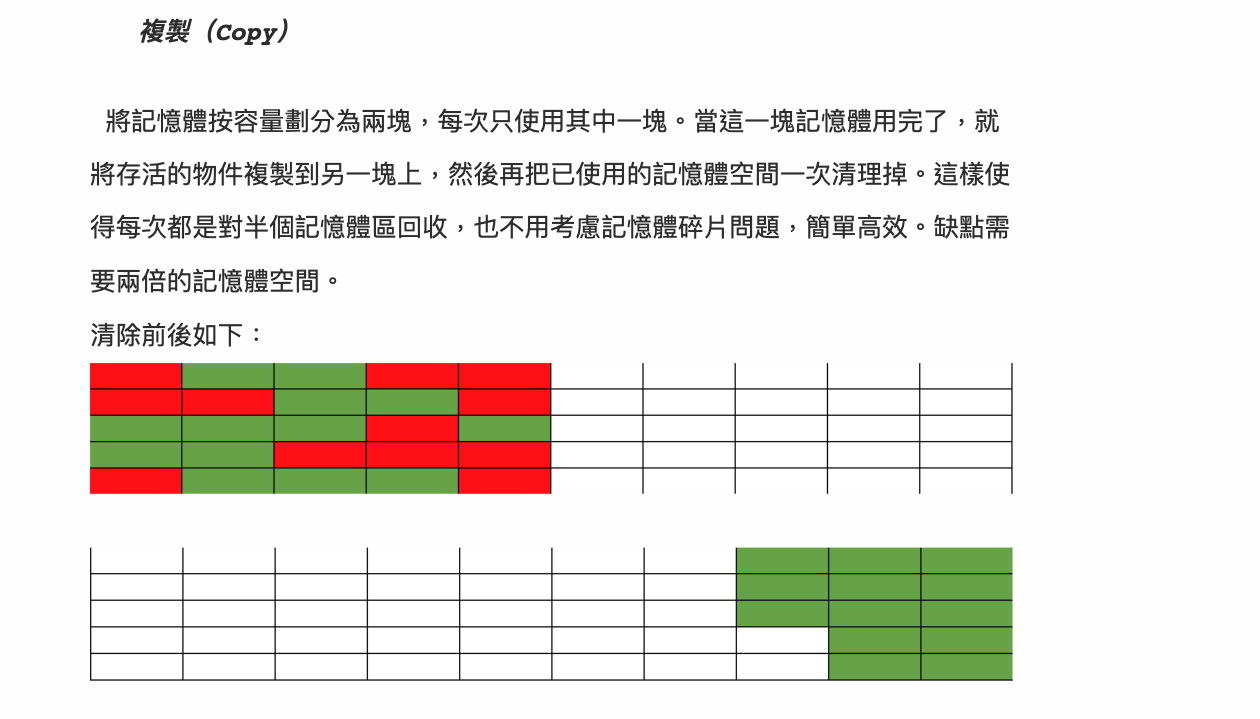
| Copying | Copy survivors to an empty half | Very fast when few survive, no fragmentation | Wastes half the space |
Generational collection
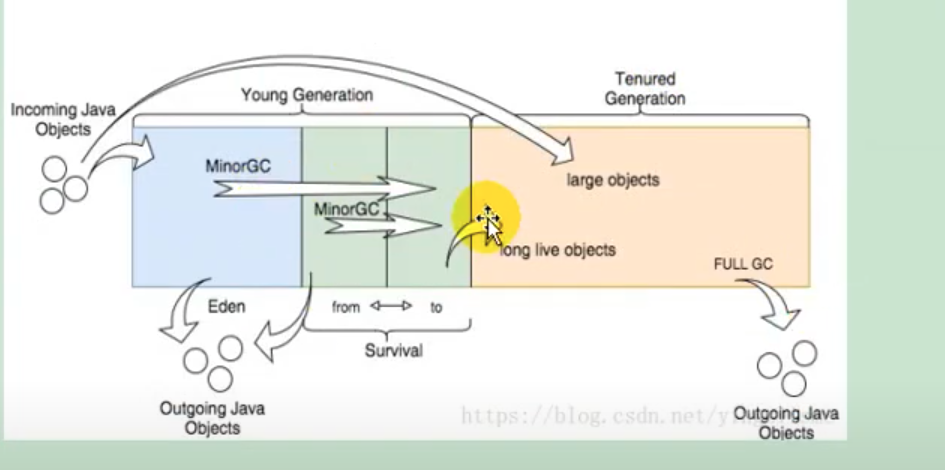
Two empirical facts drive the design: most objects die young, and few old objects reference young ones. So the heap is split and each part gets the algorithm that suits it — copying for the young generation (few survivors), compaction for the old.
Classic generational layout (Serial / Parallel). G1 and later collectors keep the
same generational *idea* but implement it with same-sized regions, not fixed spaces.

┌──────────── Young generation ────────────┐┌──── Old generation ────┐
│   Eden (80%)   │  S0 (10%)  │  S1 (10%)  ││   long-lived objects   │
└────────────────┴────────────┴────────────┘└────────────────────────┘
    ↑ new objects      ↑ survivors ping-pong      ↑ promoted after
      allocate here      between S0 and S1          enough survivals
- Allocation goes to Eden (in a TLAB).
- Eden fills → minor GC: live objects are copied to the empty survivor space, all ages +1; Eden and the other survivor are wiped wholesale.
- The object is promoted to the old generation once it is old enough — after
-XX:MaxTenuringThresholdsurvivals (15 is the maximum, and collectors lower it adaptively), or earlier if the survivor space cannot hold it. Objects too large for Eden are allocated straight into the old generation / a humongous region. - The old generation fills → major / full GC, which is much more expensive.
Stop-the-world
To look at the object graph without it changing underneath, a collector brings the application threads to a safepoint. What differs is how much work happens inside that pause. Serial and Parallel do everything there. G1 keeps several phases concurrent but still evacuates in a pause. ZGC and Shenandoah do marking, reference processing and relocation concurrently behind load barriers, leaving only short fixed-cost pauses (and Epsilon never collects at all).
Pauses are a classic cause of p99 latency spikes — throughput looks fine while one request in a thousand waited for a collection — but they are not the only one, so read the GC log before blaming GC (§8).
Collectors
| Collector | Young / Old | Flag | Character |
|---|---|---|---|
| Serial | Copying / Mark-Compact | -XX:+UseSerialGC |
One thread, full STW. Small heaps, containers with 1 CPU |
| Parallel (Throughput) | Copying / Mark-Compact | -XX:+UseParallelGC |
Multi-threaded STW. Maximum throughput, pauses not bounded. Default through Java 8 |
| CMS (removed in 14) | Copying / concurrent Mark-Sweep | -XX:+UseConcMarkSweepGC |
Historic low-pause option; fragments, needs a fallback full GC |
| G1 | Region-based, both | -XX:+UseG1GC |
Default since Java 9. Heap split into equal-sized regions (G1HeapRegionSize, chosen ergonomically as a power of two in 1–32 MB, targeting ~2048 regions); collects the regions with most garbage first (“garbage first”) to hit a pause target (-XX:MaxGCPauseMillis=200) |
| ZGC | Region-based, concurrent | -XX:+UseZGC |
Sub-millisecond pauses on multi-TB heaps; almost everything concurrent (coloured pointers, load barriers) |
| Shenandoah | Region-based, concurrent | -XX:+UseShenandoahGC |
Same goal as ZGC, concurrent compaction via Brooks pointers |
| Epsilon | None | -XX:+UseEpsilonGC |
No-op collector for benchmarking |
Choosing: batch/throughput work → Parallel. Ordinary services → G1 (leave it alone unless a pause target is missed). Large heaps with strict latency SLOs → ZGC/Shenandoah.
System.gc()merely suggests a full GC. It is disabled by-XX:+DisableExplicitGCin most production configs — never call it in application code.
4) Reference Strengths Priority 3 of 5 — Worth knowing — usually a variant of a must-know pattern
| Type | Eligible for clearing when | Use |
|---|---|---|
Strong Object o = new Object() |
Never, while it stays reachable | Normal code |
Soft SoftReference<T> |
Softly reachable and the collector decides memory pressure warrants it — timing is entirely at its discretion | Memory-sensitive caches |
Weak WeakReference<T> |
Weakly reachable (no strong/soft path). Cleared by some subsequent GC, not guaranteed to be the next one | WeakHashMap, canonical maps, listener registries — keys that should not keep the value alive |
Phantom PhantomReference<T> |
Phantom reachable, after finalization; get() always returns null |
Post-mortem cleanup via a ReferenceQueue (what Cleaner uses instead of finalize) |
None of these is a scheduling promise: reachability makes a referent eligible, and the collector clears it whenever it next runs and gets to it.
5) Memory Leaks in Java Priority 4 of 5 — High value — a gap here costs you rounds
A GC’d language still leaks — a leak is an object that stays reachable but is never used again. The usual sources:
| Leak | Why it holds on |
|---|---|
A static collection used as a cache |
Static fields are GC roots and live for the classloader’s lifetime |
| Unremoved listeners / callbacks | The publisher holds a strong reference to every subscriber |
ThreadLocal in a pooled thread |
The thread outlives the request; always remove() in a finally |
Unclosed streams, connections, ExecutorService |
Native handles and threads keep objects alive |
A key whose hashCode changes after insertion |
The entry can no longer be found, and never removed |
substring on huge strings (pre-Java 7u6) |
The substring shared the parent’s char array |
| Classloader leaks in app servers | One retained class keeps its entire classloader — and every class it loaded |
Diagnosis: watch old-generation occupancy after full GCs (jstat -gcutil). If it
trends upward and never returns to baseline, take a heap dump (jmap -dump:live,format=b,file=heap.hprof <pid>
or -XX:+HeapDumpOnOutOfMemoryError) and open it in Eclipse MAT — the “dominator
tree” and “leak suspects” report name the retaining root directly.
6) Class Loading Priority 4 of 5 — High value — a gap here costs you rounds
Lifecycle
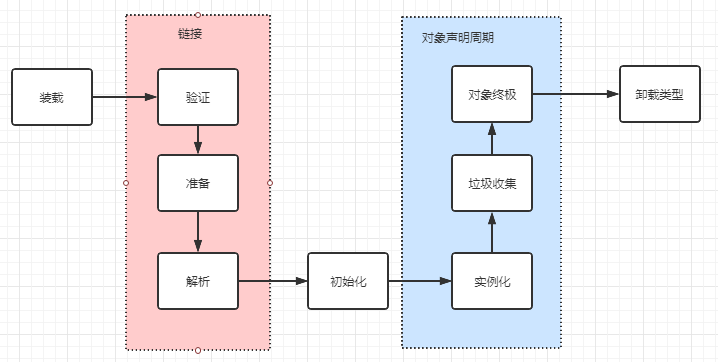
Load → Link (Verify → Prepare → Resolve) → Initialise → Use → Unload
- Load: read the
.classbytes, build the runtime representation, create theClass<?>object. - Verify: reject bytecode that would break the JVM (bad stack maps, illegal casts).
- Prepare: allocate static fields and set them to default values (not the initialiser’s value yet).
- Resolve: replace symbolic references with direct ones (may be lazy).
- Initialise: run
<clinit>— static initialisers and static field assignments, in source order, after the superclass is initialised. Triggered lazily by the first active use (JLS §12.4.1):new, invoking a static method, reading or assigning a static field, running the class’smain, or a reflective call that asks for initialisation (Class.forName(name)does;Class.forName(name, false, loader)andgetDeclaredMethoddo not). Two exceptions worth knowing: reading a compile-time constant (static final int X = 42) is inlined by the compiler and initialises nothing, and touching a subclass does not initialise it through a field declared only in the parent.
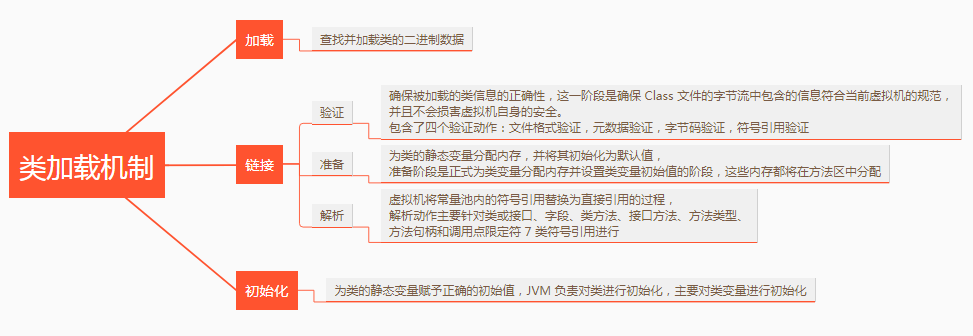
A class is unloaded only when its classloader becomes unreachable — which is why a retained classloader keeps every class it ever loaded alive (§5).
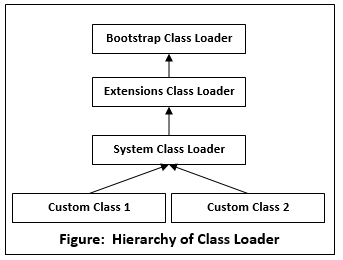
The loader hierarchy and parent delegation
| Loader | Loads |
|---|---|
| Bootstrap (native, no Java object) | Core JDK classes (java.*) |
| Platform / Extension | JDK modules beyond the core |
| Application (System) | Your classpath / modulepath |
| Custom | Plugins, hot reload, app-server isolation, encrypted or generated bytecode |
Parent delegation: a loader asks its parent before trying itself. So a class you name
java.lang.String can never shadow the real one — this is both a security property and a
uniqueness guarantee. Frameworks that need isolation (Tomcat per-webapp loaders, OSGi)
deliberately break delegation.
Class identity is (loader, name): the same bytecode loaded by two loaders gives two
distinct classes, and casting between them throws ClassCastException. That surprise is
the root of most “impossible” classloading bugs.
ClassLoader.loadClass() implements delegation, findClass() is what a custom loader
overrides, and defineClass() turns bytes into a Class.
7) Execution: Interpreter, JIT and AOT Priority 3 of 5 — Worth knowing — usually a variant of a must-know pattern
The JVM starts by interpreting bytecode and profiles as it goes. Hot methods and loops are compiled to native code by the JIT (tiered: C1 compiles quickly with light optimisation, C2 recompiles the hottest code aggressively). Because the JIT has runtime profiles, it can do what a static compiler cannot: inline through virtual calls it observes to be monomorphic, unroll, eliminate bounds checks, escape-analyse, and deoptimise back to the interpreter when an assumption breaks.
Consequences worth knowing:
- Warm-up matters: the first thousand iterations of a benchmark measure the
interpreter. Use JMH, never a hand-rolled
System.nanoTime()loop. - Compiled code lives in the code cache (
-XX:ReservedCodeCacheSize); exhausting it silently drops the JVM back to interpretation. -XX:+PrintCompilationand JITWatch show what got compiled and inlined.- CDS (
-XX:SharedArchiveFile, and AppCDS) memory-maps a pre-parsed archive of class metadata so start-up skips repeated class loading. Still an ordinary JVM, still JIT’d — little peak-throughput cost. - AOT native images (GraalVM
native-image) compile the whole application ahead of time into a native executable: milliseconds to start and a small footprint, but no JIT profile-guided peak throughput, and reflection/dynamic proxies must be declared at build time. This is why serverless Java gravitates to native images and long-running services usually do not.
JRE / JDK / JIT: the JRE is the runtime (JVM + core libraries), the JDK is the JRE
plus development tools (javac, jstack, jmap), and the JIT is the compiler inside
the JVM. Since Java 11 there is no separate JRE download — you use jlink to make one.
8) Flags, Tools and Diagnosis Priority 4 of 5 — High value — a gap here costs you rounds
Flags you actually set
| Flag | Meaning |
|---|---|
-Xms / -Xmx |
Initial / maximum heap. Set them equal in production to avoid resize pauses |
-Xss |
Thread stack size |
-XX:MaxMetaspaceSize |
Cap on class metadata |
-XX:+UseG1GC / -XX:+UseZGC |
Collector choice |
-XX:MaxGCPauseMillis |
G1’s pause target |
-XX:NewRatio / -XX:SurvivorRatio |
Young:old and Eden:survivor sizing (rarely needed with G1) |
-XX:+HeapDumpOnOutOfMemoryError -XX:HeapDumpPath=… |
Always on. The dump is the only evidence after an OOM |
-Xlog:gc*:file=gc.log:time,uptime |
Unified GC logging (9+; -XX:+PrintGCDetails before that) |
-XX:+UseContainerSupport -XX:MaxRAMPercentage=75 |
Size the heap from the container limit, not the host’s RAM |
Command-line tools (all ship with the JDK)
| Tool | Answers |
|---|---|
jps |
Which JVMs are running, and their PIDs |
jstat -gcutil <pid> 1s |
Live GC: generation occupancy, collection counts and time |
jmap -histo:live <pid> / -dump:... |
What is on the heap / a full dump |
jstack <pid> |
Thread dump — the tool for hangs and deadlocks (it names deadlocks explicitly) |
jcmd <pid> <command> |
The modern superset: GC.heap_info, Thread.print, VM.flags, JFR.start |
jinfo |
Read/modify manageable flags at runtime |
| JFR + JMC | Low-overhead always-on production profiler (-XX:StartFlightRecording) |
| VisualVM, MAT, async-profiler | GUI monitoring, heap-dump analysis, CPU/alloc flame graphs |
Reading the runtime from code
// java
Runtime rt = Runtime.getRuntime();
long used = rt.totalMemory() - rt.freeMemory();     // bytes currently in use
double pct = 100.0 * used / rt.maxMemory();         // % of -Xmx
Triage cheat-sheet
| Symptom | First move |
|---|---|
OutOfMemoryError: Java heap space |
Heap dump → MAT dominator tree. Leak, or genuinely too small? |
OutOfMemoryError: Metaspace |
Count loaded classes (jcmd GC.class_stats); suspect a classloader leak or a proxy/bytecode generator |
OutOfMemoryError: unable to create native thread |
Thread leak — jstack and count; check -Xss and OS limits |
StackOverflowError |
Unbounded recursion (read the repeating frames in the trace) |
| Latency spikes, CPU fine | GC log → pause distribution; is the collector or the pause target wrong? |
| High CPU | top -H -p <pid> → convert the thread id to hex → find it in jstack; or async-profiler |
| Application hangs | jstack twice, 10 s apart; look for BLOCKED threads and the deadlock section |
9) Common Interview Q&A
Q: Where do objects live — always the heap? Almost always, but escape analysis lets the JIT stack-allocate or scalar-replace objects that provably never escape their method.
Q: int size on a 64-bit JVM?
32 bits. Java’s primitive widths are fixed by the language spec, not the platform. What
does change is reference width (and compressed oops).
Q: Minor vs major vs full GC? Minor collects the young generation only (frequent, cheap). Major collects the old generation. Full collects everything including Metaspace, and is the most expensive.
Q: Does Java have memory leaks? Yes — see §5. The GC frees unreachable objects, not unused ones.
Q: What is a safepoint? A point where a thread’s state is known to the JVM, so it can be paused for GC, a thread dump or deoptimisation. “Time to safepoint” can itself be a latency source — a long counted loop may not poll for one.
Q: Why did PermGen become Metaspace? PermGen was a fixed-size heap region that was hard to size and a constant source of OOM on redeploy. Metaspace uses native memory and grows on demand.
Q: Reflection — what does it cost?
It bypasses compile-time checking, blocks some inlining, and had a real per-call overhead
(much reduced by modern JITs and method handles). Frameworks cache Method objects and
generate bytecode to avoid it in hot paths.
Q: How would you find why a service pauses for 2 s every few minutes?
Turn on GC logging, correlate pauses with full GCs; if GC is innocent, check safepoint
time (-Xlog:safepoint), then look outside the JVM (page cache, CPU throttling in a
container, a stop-the-world dependency).
10) Recap Checklist
[ ] Name the runtime areas and which are per-thread vs shared
[ ] Stack vs heap: what each holds, who frees it, which error each throws
[ ] Object creation steps; TLAB; compressed oops; escape analysis
[ ] Reachability from GC roots, not reference counting — and why (cycles)
[ ] Mark-sweep / mark-compact / copying, and where each is used
[ ] Eden → survivor → tenured; minor vs major vs full
[ ] G1 as the default; when ZGC/Shenandoah instead; what STW costs
[ ] Strong / soft / weak / phantom references
[ ] Class lifecycle and parent delegation; class identity = (loader, name)
[ ] Interpreter → C1 → C2, deoptimisation, and warm-up in benchmarks
[ ] Flags: -Xms/-Xmx, HeapDumpOnOutOfMemoryError, MaxRAMPercentage
[ ] jps / jstat / jstack / jmap / jcmd / JFR — which question each answers
References
jmm.md— the Java Memory Model (visibility, ordering, happens-before)java_multi_thread.md— threads, locks and pools- JavaGuide — JVM memory areas
- Oracle — HotSpot GC tuning guide
- Baeldung — Java classloaders