數學
範圍 — 面試中的數值操作 — 取位數、避免溢位的算術、進位轉換、開根號與次方。公式層級的計數則在隔壁那份。 另見:combinatorics_math_patterns.md — 計數、質數(prime)、模運算、幾何;bit_manipulation.md — 位元層級的視角;add_x_sum.md — 各種輸入形態下的加法。
LeetCode 題目清單
1) 通用形式
1-1) 基本操作
1-1-0) 把 10 based interger to N based
- 轉成 4 進位
- 轉成 7 進位 …
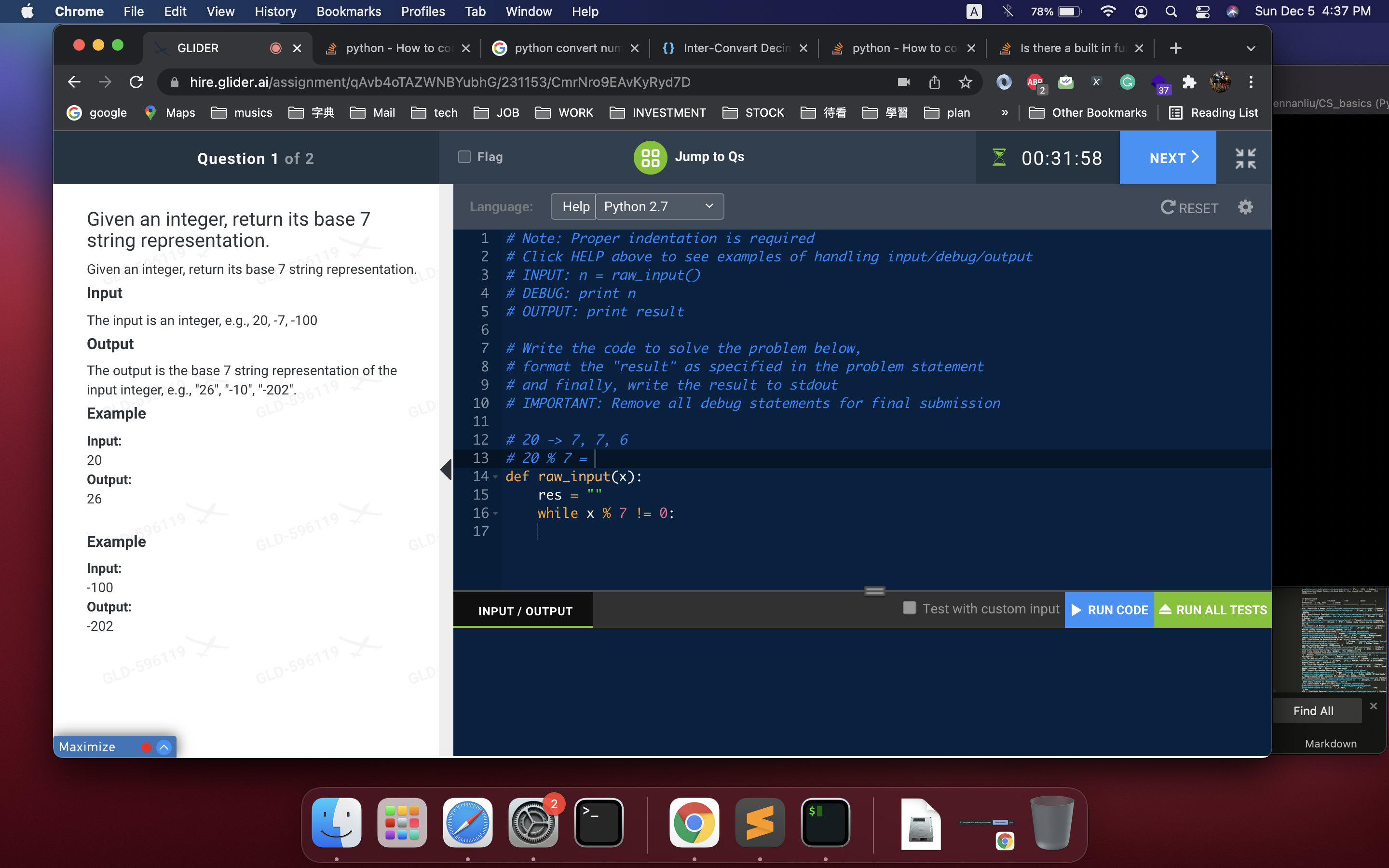
V0
IDEA : MATH : 10 based -> 7 based
“”"
NOTE :
1) for negative num : transform to positive int first, do 10 based -> 7 based op
                      then add "-" at beginning
2) for positive num : do 10 based -> 7 based op
                    -> keep checking if num % N == 0
                    -> if not == 0, keep do  num = num % N, and append cur result to res
                    -> reverse res
                    -> make array to string
                    -> return result
3) example:
    100 (10 based) -> "202" (7 based)

    tmp = 100
    a, b = divmod(tmp, 7)  -> a = 14, b = 2,  tmp  = 14
    a, b = divmod(tmp, 7)  -> a= 2, b = 0, tmp = 2
    a, b = divmod(tmp, 7)  -> a = 0, b = 2

    -> so res = [2,0,2]
“”"
V1
class Solution(object): def convertToBase7(self, num): # edge case if num == 0: return ‘0’ tmp = abs(num) res = [] while tmp > 0: a, b = divmod(tmp, 7) res.append(str(b)) tmp = a res = res[::-1] _res = “”.join(res) if num > 0: return _res else: return “-” + _res
test
#----------------
exmaple :
7 base
20 -> 26
-100 -> -202
#---------------- num = 20 # 26 num = -100 # -202 s = Solution() r = s.convertToBase7(num) print ®
V2
https://www.itread01.com/content/1544603062.html
https://kknews.cc/code/jlv38qp.html
class Solution(object): def convertToBase7(self, num): # edge case if num == 0: return ‘0’ tmp = abs(num) res = [] while tmp: i = tmp % 7 res.append(str(i)) tmp = tmp // 7 res = res[::-1] _res = “”.join(res) if num > 0: return _res else: return “-” + _res
#### 1-1-0') 把 `N based integer to 10 based`
```python
# V1
# LC 1022. Sum of Root To Leaf Binary Numbers
def convertToBaseN(num, n):
    return int(str(num), n)

In [34]: int("100",7)
Out[34]: 49

In [35]: int("14",7)
Out[35]: 11

In [36]: int("66",7)
Out[36]: 48
1-1-1) 判斷質數(prime)
# LC 762 Prime Number of Set Bits in Binary Representation
def check_prime(x):
    if x <= 1:
        return False
    for i in range(2, int(x**(0.5)+1)):
        if x % i == 0:
            return False
    return True
1-1-2) 計算質數(prime)個數
# LC 204 Count Primes
# V0
# IDEA : set
# https://leetcode.com/problems/count-primes/discuss/1343795/python%3A-sieve-of-eretosthenes
# prime(x) : number of prime in [0, x]
# prime(0) = 0
# prime(1) = 0
# prime(2) = 0
# prime(3) = 1
# prime(4) = 2
# prime(5) = 3
class Solution:
    def countPrimes(self, n):
        # using sieve of eretosthenes algorithm
        if n < 2: return 0
        nonprimes = set()
        for i in range(2, round(n**(1/2))+1):
            if i not in nonprimes:
                for j in range(i*i, n, i):
                    nonprimes.add(j)
        return n - len(nonprimes) - 2  # remove prime(1), prime(2)
// java
// algorithm book (labu) p.362
// V1
int countPrimes(int n){
    boolean[] isPrime = new boolean[n];

    // init array to true
    Arrays.fill(isPrime, true);

    // prime number start from 2
    for (int i = 2; i < n; i++){
        if (isPrime[i]){
            // if i is prime, then i's multiple is NOT prime
            for (int j = 2 * i; j < n; j += i){
                isPrime[j] = false;
            }
        }
    }

    int count = 0;
    for (int i = 2; i < n; i++){
        if (isPrime[i]){
            count ++;
        }
    }
    return count;
}
// java
// algorithm book (labu) p.363
// V1' (optimization)
int countPrimes(int n){
    boolean[] isPrime = new boolean[n];

    // init array to true
    Arrays.fill(isPrime, true);

    // prime number start from 2
    for (int i = 2; i * i  < n; i++){
        if (isPrime[i]){
            // if i is prime, then i's multiple is NOT prime
            /** optimize here :  make j start from i * i, instead of 2 * i */
            // (the only difference between V1 and V1')
            for (int j = i * i; j < n; j += i){
                isPrime[j] = false;
            }
        }
    }

    int count = 0;
    for (int i = 2; i < n; i++){
        if (isPrime[i]){
            count ++;
        }
    }
    return count;
}
1-1-2’) 取得 x 的因數 — 因數(divisor)與質因數(prime factor) 優先度 4/5 — 高價值 — 這裡有缺口就會掉關
「因數」這個詞底下其實藏了兩個不同的問題。兩者都靠同一個 while d * d <= x 迴圈解決,所以把這個迴圈學起來一次就夠:
| 問題 | x = 12 時的答案 |
答案的規模 | 成本 |
|---|---|---|---|
所有因數 — 每個滿足 x % d == 0 的 d |
1, 2, 3, 4, 6, 12 |
很小(x ≤ 10⁵ 時 ≤ 128 個) |
O(√x) |
質因數 — 相乘會等於 x 的那些質數 |
{2, 3}(即 2² × 3) |
x ≤ 10⁹ 時相異的約 ≤ 15 個 |
O(√x) |
為什麼掃到 √x 就夠了(兩者共同的關鍵想法):
Divisors come in PAIRS that multiply to x:   d  ×  (x / d) = x
  12 = 1×12 = 2×6 = 3×4
       ^         ^
       d <= √12  the partner is >= √12

So one member of every pair is <= √x  ->  scanning d = 1..√x sees them all.
a) x 的所有因數 — 掃到 √x,每組配對取兩邊
# python
# GENERAL PATTERN: all divisors of x, ascending
# IDEA: each divisor d <= sqrt(x) hands you its partner x // d for free
# time = O(sqrt(x)), space = O(number of divisors)
def get_divisors(x):
    small, large = [], []
    d = 1
    while d * d <= x:
        if x % d == 0:
            small.append(d)
            if d != x // d:          # perfect square: don't add sqrt(x) twice
                large.append(x // d)
        d += 1
    return small + large[::-1]        # large is descending -> reverse to merge sorted

# get_divisors(12) -> [1, 2, 3, 4, 6, 12]
# get_divisors(36) -> [1, 2, 3, 4, 6, 9, 12, 18, 36]   (6 counted once)
// java
// GENERAL PATTERN: all divisors of x, ascending
// time = O(sqrt(x)), space = O(number of divisors)
public List<Integer> getDivisors(int x) {
    List<Integer> small = new ArrayList<>(), large = new ArrayList<>();
    for (int d = 1; (long) d * d <= x; d++) {
        if (x % d == 0) {
            small.add(d);
            if (d != x / d) large.add(x / d);   // skip the duplicate sqrt
        }
    }
    Collections.reverse(large);
    small.addAll(large);
    return small;
}
b) x 的相異質因數 — 找到一個就把它整個「除乾淨」
這一段是主力。讓它同時正確又快速的技巧是:只要 d 整除 x,就在往下走之前把 x 裡的 d 全部除掉。這麼做之後,x 再也不可能被 d 整除,所以之後任何能整除的 d 自動就是質數 — 整段程式完全不需要做質數判斷。
# python
# GENERAL PATTERN: distinct prime factors of x  (x >= 1)
# IDEA: TRIAL DIVISION — strip each factor out completely, so every hit is prime
# time = O(sqrt(x)), space = O(number of distinct primes)
def get_prime_factors(x):
    """Returns the set of distinct prime factors of x."""
    factors = set()
    d = 2
    while d * d <= x:
        if x % d == 0:
            factors.add(d)
            while x % d == 0:     # strip ALL copies of d
                x //= d
        d += 1                    # x has shrunk, so the loop bound shrinks with it
    if x > 1:                     # leftover > 1 is a prime bigger than sqrt(original x)
        factors.add(x)
    return factors
// java
// GENERAL PATTERN: distinct prime factors of x
// time = O(sqrt(x)), space = O(number of distinct primes)
public List<Integer> getPrimeFactors(int x) {
    List<Integer> factors = new ArrayList<>();
    for (int d = 2; (long) d * d <= x; d++) {
        if (x % d == 0) {
            factors.add(d);
            while (x % d == 0) x /= d;   // strip ALL copies of d
        }
    }
    if (x > 1) factors.add(x);           // the last prime, > sqrt
    return factors;
}
追蹤 x = 360:
d=2 : 360 % 2 == 0  -> add 2, strip: 360 -> 180 -> 90 -> 45
d=3 :  45 % 3 == 0  -> add 3, strip:  45 ->  15 -> 5
d=4 : 4*4 = 16 > 5  -> loop ends       (bound checks the SHRUNK x, not the original)
x=5 > 1             -> add 5
=> {2, 3, 5}         (360 = 2³ × 3² × 5)
兩個最常被寫錯的地方:
- 漏了最後的
if x > 1。 以x = 14為例,迴圈只跑到d = 3(3*3 > 7),剩下的7— 一個大於√14的質數 — 就會被漏掉。這種漏網的質數最多只會有一個,因為兩個> √x的質數相乘會超過x。 - 先去判斷
d是不是質數。 沒必要:走到那裡時4根本不可能整除x,因為所有的2早就被除掉了。
也想要指數嗎? 在除的時候順便計次,就會得到 360 -> {2:3, 3:2, 5:1},這正是計算因數個數(∏(eᵢ+1))與尤拉函數(totient)公式需要的形式。見 combinatorics_math_patterns.md Prime Factorization。
c) 一次分解很多數字 — 最小質因數(SPF)篩法
試除法對每個數字都要 O(√x)。如果輸入是一個最多 10⁵ 個、每個值最大到 10⁵ 的陣列,就先篩出每個數的最小質因數,之後每次分解都只要 O(log x)。
# python
# GENERAL PATTERN: SPF sieve -> factor any x <= MAXV in O(log x)
# time = O(MAXV log log MAXV) build, O(log x) per query; space = O(MAXV)
MAXV = 100_001
spf = list(range(MAXV))                     # spf[i] = smallest prime factor of i
for i in range(2, int(MAXV ** 0.5) + 1):
    if spf[i] == i:                         # i is prime
        for j in range(i * i, MAXV, i):
            if spf[j] == j:                 # only the FIRST prime to reach j wins
                spf[j] = i

def prime_factors_fast(x):
    out = set()
    while x > 1:
        p = spf[x]
        out.add(p)
        while x % p == 0:
            x //= p
    return out
// java
// GENERAL PATTERN: SPF sieve
// time = O(MAXV log log MAXV) build, O(log x) per query; space = O(MAXV)
static final int MAXV = 100_001;
static int[] spf = new int[MAXV];
static {
    for (int i = 0; i < MAXV; i++) spf[i] = i;
    for (int i = 2; (long) i * i < MAXV; i++)
        if (spf[i] == i)
            for (int j = i * i; j < MAXV; j += i)
                if (spf[j] == j) spf[j] = i;
}

public List<Integer> primeFactorsFast(int x) {
    List<Integer> out = new ArrayList<>();
    while (x > 1) {
        int p = spf[x];
        out.add(p);
        while (x % p == 0) x /= p;
    }
    return out;
}
d) LC 4032 — Longest Subarray With at Most K Distinct Prime Factors
一個子陣列的質因數集合,是其所有元素的相異質因數的聯集。求聯集大小最多為
k的最長子陣列。
為什麼滑動視窗可行:視窗變大只會往聯集裡加質數,不會拿掉任何一個 — 聯集大小對視窗是單調的,所以經典的 右邊擴張/不合法就從左邊收縮 模板就適用。維護一個 質數 -> 視窗中有幾個元素含有它 的計數表;聯集大小就是還活著的鍵的個數。
# python
# LC 4032. Longest Subarray With at Most K Distinct Prime Factors
# IDEA: SLIDING WINDOW over a {prime: count} map; union size == len(map)
# time = O(n * sqrt(A)) to factor + O(n * distinct) window, space = O(n * distinct)
from collections import defaultdict

def longestSubarray(nums, k):
    facs = [get_prime_factors(v) for v in nums]   # factor each element ONCE
    cnt = defaultdict(int)
    left = best = 0
    for right in range(len(nums)):
        for p in facs[right]:
            cnt[p] += 1
        while len(cnt) > k:                       # too many distinct primes -> shrink
            for p in facs[left]:
                cnt[p] -= 1
                if cnt[p] == 0:
                    del cnt[p]                    # MUST delete, len(cnt) is the answer
            left += 1
        best = max(best, right - left + 1)
    return best

# nums = [7,6,10,12,11], k = 3 -> 3   ([6,10,12] -> {2,3,5})
# nums = [4,6,9,18],     k = 4 -> 4   (whole array -> {2,3})
# nums = [6,10,15],      k = 2 -> 1   (any pair already needs {2,3,5})
// java
// LC 4032. Longest Subarray With at Most K Distinct Prime Factors
// time = O(n * sqrt(A)), space = O(n * distinct)
public int longestSubarray(int[] nums, int k) {
    int n = nums.length;
    List<List<Integer>> facs = new ArrayList<>();
    for (int v : nums) facs.add(getPrimeFactors(v));

    Map<Integer, Integer> cnt = new HashMap<>();
    int left = 0, best = 0;
    for (int right = 0; right < n; right++) {
        for (int p : facs.get(right)) cnt.merge(p, 1, Integer::sum);
        while (cnt.size() > k) {
            for (int p : facs.get(left)) {
                if (cnt.merge(p, -1, Integer::sum) == 0) cnt.remove(p);
            }
            left++;
        }
        best = Math.max(best, right - left + 1);
    }
    return best;
}
在
nums[i] <= 10⁵、n <= 10⁵之下,試除法約是 3×10⁷ 次運算 — 對 Java 很輕鬆,對 Python 則在邊緣。把get_prime_factors換成上面的 SPF 篩法,分解那一步就會降到 O(n log A)。
「取得因數」會在哪些題目出現:
| 題目 | 因數被拿來做什麼 |
|---|---|
| LC 4032 - Longest Subarray With at Most K Distinct Prime Factors | 對質數集合的聯集做滑動視窗 |
| LC 952 - Largest Component Size by Common Factor | 併查集:把每個 x 和它的每個質因數 union 起來 |
| LC 1998 - GCD Sort of an Array | 同樣的想法 — 把共用質數的索引連起來 |
| LC 2521 - Distinct Prime Factors of Product of Array | 對整個陣列取 get_prime_factors(x) 的聯集 |
| LC 1390 - Four Divisors | 用 get_divisors,留下剛好有 4 個的 |
| LC 1492 - The k-th Factor of n | 用 get_divisors 由小到大排,取索引 k-1 |
| LC 204 - Count Primes | 改用篩法 — 見 1-1-2 |
1-1-3) 只保留餘數以避免溢位(Repunit/模運算)
核心想法:
當你一位一位地把數字建出來(例如 1 → 11 → 111 → …),這個數會呈指數成長並讓 int/long 溢位。
與其存整個數,每一步只保留對 k 取模的餘數。
之所以可行,是因為:
(a * 10 + 1) % k == ((a % k) * 10 + 1) % k
所以加上新的一位之後的餘數,永遠可以只用前一個餘數算出來。
模式:
int remainder = 0;
for (int len = 1; len <= k; len++) {
    remainder = (remainder * 10 + 1) % k;  // build next repunit mod k
    if (remainder == 0) return len;         // found divisible repunit
}
return -1;
關鍵洞察 — 鴿籠原理:
可能的餘數只有 k 種(0 到 k-1)。經過 k 步之後,如果沒有任何餘數是 0,就一定有餘數重複出現 → 進入循環且無解 → 回傳 -1。所以我們只需要迴圈跑到 k 次為止。
快速檢查 — 提早退出: 一個只由 1 組成的數,末位永遠不會是 0、2、4、5、6 或 8,所以它永遠不可能被 2 或 5 整除:
if (k % 2 == 0 || k % 5 == 0) return -1;
用到這個餘數技巧的相似 LC 題目:
| 題目 | 模式 |
|---|---|
| LC 1015 - Smallest Integer Divisible by K | repunit 對 k 取模 |
| LC 29 - Divide Two Integers | 用位元運算避免溢位 |
| LC 166 - Fraction to Recurring Decimal | 用餘數雜湊表偵測循環 |
| LC 523 - Continuous Subarray Sum | 前綴和對 k 取模 |
| LC 974 - Subarray Sums Divisible by K | 前綴和對 k 取模 |
// LC 1015 full solution
public int smallestRepunitDivByK(int k) {
    if (k % 2 == 0 || k % 5 == 0) return -1;
    int remainder = 0;
    for (int len = 1; len <= k; len++) {
        remainder = (remainder * 10 + 1) % k;
        if (remainder == 0) return len;
    }
    return -1;
}
1-1-4) 判斷 4 個點是否構成正方形(兩兩距離技巧)
核心想法: 給定順序任意的 4 個點,直接檢查角度/斜率會很麻煩(除以零、浮點誤差)。改成計算這 4 個點之間的6 個兩兩平方距離,再把它們當成一個多重集合來推理。
為什麼是 6 個距離? 4 個點 → C(4,2) = 6 組配對。對正方形來說:
A ----- B
|       |
|       |
D ----- C
AB = side
BC = side
CD = side
DA = side
AC = diagonal
BD = diagonal
所以把這 6 個平方距離排序之後,一定會得到4 個相等的(較小)值 + 2 個相等的(較大)值。
模式 — 合法的正方形具備:
- 邊長 > 0(沒有重疊的點)
- 4 條相等的邊
- 2 條相等的對角線
- 對角線 > 邊長
# LC 593. Valid Square
class Solution(object):
    def validSquare(self, p1, p2, p3, p4):
        points = [p1, p2, p3, p4]
        dists = []

        for i in range(4):
            for j in range(i + 1, 4):
                dists.append(self.get_len(
                    points[i][0], points[i][1],
                    points[j][0], points[j][1]
                ))

        dists.sort()

        return (
            dists[0] > 0 and                 # no overlapping points
            dists[0] == dists[1] ==
            dists[2] == dists[3] and         # four equal sides
            dists[4] == dists[5] and         # two equal diagonals
            dists[4] > dists[0]              # diagonal longer than side
        )

    def get_len(self, x1, y1, x2, y2):
        # use squared distance -> avoid float/sqrt precision issues
        return (x1 - x2) ** 2 + (y1 - y2) ** 2
另一種(集合式)寫法:
既然合法的正方形恰好只有 2 個相異的距離值(邊長²、對角線²),而且真正的正方形對角線永遠 > 邊長,你可以直接檢查 len(set(distances)) == 2(再加上 0 not in distances 這個防止重疊點的守衛):
class Solution(object):
    def validSquare(self, p1, p2, p3, p4):
        def dist(a, b):
            return (a[0] - b[0]) ** 2 + (a[1] - b[1]) ** 2

        points = [p1, p2, p3, p4]
        lookup = set(
            dist(points[i], points[j])
            for i in range(4) for j in range(i + 1, 4)
        )
        return 0 not in lookup and len(lookup) == 2
1-1-5) 加權旋轉和 — 疊縮遞迴式(避開 O(n²) 暴力法)
模式:
對每個旋轉 k 都重新計算 F(k) = sum(i * arr_k[i]),每次要 O(n) → 總共 O(n²)。改成推導出從 F(k-1) 到 F(k) 的 O(1) 轉移,就能在 O(n) 內滑過全部 n 個旋轉。
核心想法:
手動寫出幾個旋轉並逐項比較(nums = [A, B, C, D],n = 4):
F(0) = 0*A + 1*B + 2*C + 3*D
F(1) = 0*D + 1*A + 2*B + 3*C
F(2) = 0*C + 1*D + 2*A + 3*B
F(3) = 0*B + 1*C + 2*D + 3*A
每次旋轉時,每個元素的權重都會加 1 — 除了剛從尾端繞到前端的那個元素,它的權重會從 n-1 掉到 0。所以:
sum = A + B + C + D                 # total sum, weight-independent

F(1) = F(0) + sum - 4*D             # D's weight: 3 -> 0, i.e. -4*D; everything else: +1 each -> +sum
F(2) = F(1) + sum - 4*C
F(3) = F(2) + sum - 4*B
推廣之後,對 F(k) 而言繞到位置 0 的元素是 nums[n-k],得到遞迴式:
F(k) = F(k-1) + sum(nums) - n * nums[n-k]
這和前綴和是同一套「維護一個滾動的彙總值,而不是從頭重算」的哲學 — 只是套用在加權和上,而不是單純的和。
# LC 396. Rotate Function
# time = O(n), space = O(1)
class Solution(object):
    def maxRotateFunction(self, nums):
        size = len(nums)
        total = sum(nums)
        f = sum(i * x for i, x in enumerate(nums))  # F(0)

        ans = f
        for i in range(size - 1, 0, -1):
            # nums[i] is the element wrapping to front: weight n-1 -> 0
            f += total - size * nums[i]
            ans = max(ans, f)
        return ans
相似 LC 題目(同樣的「狀態之間 O(1) 轉移」想法):
| 題目 | 模式 |
|---|---|
| LC 396 - Rotate Function | 疊縮的加權和遞迴式:F(k) = F(k-1) + sum - n*nums[n-k] |
| LC 238 - Product of Array Except Self | 滾動的前綴/後綴乘積,而非每個索引重算 |
| LC 303 - Range Sum Query - Immutable | 預先算好前綴和,而非每次查詢重算 |
| LC 189 - Rotate Array | 真的做實體旋轉(反轉技巧)— 對比:沒有彙總公式,只是重新排列元素 |
1-1-6) 貪婪鋸齒建構 — 用閉合式 O(1) 取代模擬
題型形態(LC 3993 - Maximum Value of an Alternating Sequence):
給定 n、s、m — 建構一個長度為 n 的交錯(鋸齒)序列,滿足 seq[0] = s 且 |seq[i] - seq[i-1]| <= m。回傳任一合法序列中可能出現的最大元素。
核心想法: 不要在序列上搜尋/做動態規劃。只要問:多加一個波峰要付出多少代價? 然後答案就是一條公式。
三個貪婪觀察就能把一切釘死:
- 一開始一定要往上走。 以往下走開頭(
seq[0] > seq[1])會浪費第一步,之後每個波峰都更低。所以採用seq[0] < seq[1] > seq[2] < ...這種形狀。 - 每個向上的步伐都該是
+m— 允許的最大跳幅。 - 每個向下的步伐都該是
-1— 最小的合法下降幅度,因為不等式是嚴格的(>),所以最小的下降量是 1。掉得更多只會把後面所有波峰都拉低。
所以這個序列是一條爬升 m、只回吐 1 的鋸齒:
n = 6, s = 3, m = 5

              s+2m-1=12          s+3m-2=16
                 /\                 /\
      s+m=8    /    \             /
        /\    /      \           /
       /   \ /   s+2m-2=11      /
      /   s+m-1=7              /
   s=3

seq = [3, 8, 7, 12, 11, 16]
       ^  +5 -1  +5  -1  +5
計算步數:
- 波峰落在奇數索引
1, 3, 5, ...→ 向上步數k = n // 2 k個波峰之間有k - 1個向下步伐,每個恰好花掉1
max = s + k*m - (k - 1)
    = s + k*(m - 1) + 1        , where k = n // 2
邊界情況: n == 1 → 長度為 1 的序列依定義就是交錯的,而且它必須等於 s。(公式會給出 s + 1,那是錯的,所以要明確加守衛。)
模式:
# python
# LC 3993. Maximum Value of an Alternating Sequence
# time = O(1), space = O(1)
class Solution(object):
    def maximumValue(self, n, s, m):
        # IDEA: GREEDY ZIGZAG -> CLOSED FORM
        # go up by m, come down by only 1 (strict inequality), repeat

        # edge case: length-1 sequence is just [s]
        if n == 1:
            return s

        k = n // 2                 # number of "up" moves == number of peaks
        return s + k * (m - 1) + 1  # == s + k*m - (k-1)
// java
// LC 3993 - Maximum Value of an Alternating Sequence
// time = O(1), space = O(1)
public long maximumValue(int n, int s, int m) {
    // IDEA: GREEDY ZIGZAG -> CLOSED FORM
    if (n == 1) {
        return s;
    }
    long k = n / 2;                    // peaks == up moves
    return s + k * (m - 1) + 1;        // use long: n, s up to 1e9
}
驗算:
| n | s | m | k = n//2 | s + k*(m-1) + 1 | 序列 |
|---|---|---|---|---|---|
| 1 | 3 | 5 | — | 3(邊界情況) |
[3] |
| 2 | 4 | 3 | 1 | 4 + 1*2 + 1 = 7 |
[4, 7] |
| 4 | 3 | 5 | 2 | 3 + 2*4 + 1 = 12 |
[3, 8, 7, 12] |
| 5 | 3 | 5 | 2 | 3 + 2*4 + 1 = 12 |
[3, 8, 7, 12, 11] |
| 4 | 3 | 1 | 2 | 3 + 2*0 + 1 = 4 |
[3, 4, 3, 4] |
注意 n = 4 和 n = 5 得到相同的答案 — 尾端多出來的偶數步只能從最後一個波峰往下走,所以永遠不會抬高最大值。
關鍵心得(可遷移):
- 「嚴格不等式」⇒ 最小步伐是 1,不是 0。 那個
-1就是(m - 1)的由來。 - 當限制只落在相鄰配對上時,最佳解通常是一個貪婪的重複單元;先數有幾個單元塞得下,再乘起來。
- 像
1 <= n, s <= 1e9這種限制,是在強烈暗示預期解法是 O(1) 數學而不是模擬 — 而且你會需要 64 位元整數。
相似 LC 題目:
| 題目 | 模式 |
|---|---|
| LC 3993 - Maximum Value of an Alternating Sequence | 貪婪鋸齒(+m / -1)→ 閉合式 s + (n//2)*(m-1) + 1 |
| LC 376 - Wiggle Subsequence | 一樣上下交錯,但是要挑選元素(貪婪計算方向翻轉次數) |
| LC 280 - Wiggle Sort | 原地交換違規的相鄰元素,建構出交錯陣列 |
| LC 324 - Wiggle Sort II | 嚴格交錯 + 不允許相鄰相等 → 先排序(sorting)再交錯兩半 |
| LC 1846 - Maximum Element After Decreasing and Rearranging | 在 ` |
| LC 1936 - Add Minimum Number of Rungs | 相鄰間距上限為 dist → 每個間距 ceil(gap/dist) - 1(用算的,不是模擬) |
| LC 453 - Minimum Moves to Equal Array Elements | 把「增加 n-1 個」重新想成「減少 1 個」→ sum - n*min,O(1) 數學 |
| LC 462 - Minimum Moves to Equal Array Elements II | 移向中位數;用閉合式算成本,而不是逐一嘗試目標值 — 見 1-1-12 |
1-1-7) 把 n 盡量平均拆成 k 份 → 最大乘積(divmod 模式)優先度 5/5 — 必備 — 幾乎每一輪面試都會出現
題型形態(LC 343 - Integer Break):
把 n 拆成 k >= 2 個正整數的和,並最大化它們的乘積。
核心想法
兩個彼此獨立的問題 — 分開解:
- 在
k固定的前提下,每份該多大? → 盡量平均(divmod) - 哪個
k最好? → 全部試一遍(O(n²)),或用數學(O(log n),見下)
為什麼「盡量平均」是最佳解(交換論證):
在總和固定、份數固定的情況下,所有份數相等時乘積最大(算幾不等式 AM–GM)。但用整數沒辦法永遠完全相等,所以各份之間最多只能相差 1。
Proof sketch — suppose two parts differ by >= 2, i.e.  a >= b + 2
Replace (a, b) with (a-1, b+1)  -> sum is unchanged

  (a-1)(b+1) = ab + a - b - 1
             >= ab + 1          , since a - b >= 2

  -> product STRICTLY increases
  -> keep rebalancing until every pair differs by <= 1
所以整個拆法完全由 divmod 決定:
q, r = divmod(n, k)          # q = n // k  (商數), r = n % k  (餘數)

  ->  r     parts have value (q + 1)      <-- the "leftover" r units are spread
  ->  (k-r) parts have value  q               one-by-one over r parts

Sanity check the sum:
  r*(q+1) + (k-r)*q  =  r*q + r + k*q - r*q  =  k*q + r  =  n   ✅

Max product for that k:
  P(n, k) = (q + 1)^r  *  q^(k - r)
圖解範例
n = 10, k = 3
  q, r = divmod(10, 3) = (3, 1)
  -> 1 part  of q+1 = 4
  -> 2 parts of q   = 3
  -> [4, 3, 3]   sum = 10 ✅   product = 4*3*3 = 36

Compare with UNEVEN splits of the same n and k:
  [8, 1, 1] -> 8      [6, 2, 2] -> 24     [5, 4, 1] -> 20
  [4, 3, 3] -> 36  <-- max, and it is the "even" one ✅
對 n = 10 把 k 掃過一遍:
| k | divmod(10, k) = (q, r) |
各份 | 乘積 |
|---|---|---|---|
| 2 | (5, 0) | [5, 5] |
25 |
| 3 | (3, 1) | [4, 3, 3] |
36 ⭐ |
| 4 | (2, 2) | [3, 3, 2, 2] |
36 ⭐ |
| 5 | (2, 0) | [2, 2, 2, 2, 2] |
32 |
| 6 | (1, 4) | [2, 2, 2, 2, 1, 1] |
16 |
| 7 | (1, 3) | [2, 2, 2, 1, 1, 1, 1] |
8 |
→ 答案 = 36。注意乘積是先升後降 — 每份接近 3 時是甜蜜點(見下面的「為什麼是 3?」)。
模式 — 可重複使用的 divmod 輔助函式
# python
# GENERAL PATTERN: split n into k parts as evenly as possible
def get_product(n, k):
    """
    Split n into k parts as evenly as possible,
    return their (maximum) product.
    """
    ### NOTE !!! get q (商數), r (餘數) via divmod
    q = n // k
    r = n % k

    ### NOTE !!!
    #   r      parts have value q + 1   (the remainder is spread 1 unit each)
    #   k - r  parts have value q
    product = 1

    ### NOTE !!! build the product from q, r
    for _ in range(r):
        product *= (q + 1)

    for _ in range(k - r):
        product *= q

    return product


# one-liner form (same thing, via pow)
def get_product(n, k):
    q, r = divmod(n, k)
    return (q + 1) ** r * q ** (k - r)


# the parts themselves (when you need the list, not the product)
def split_evenly(n, k):
    q, r = divmod(n, k)
    return [q + 1] * r + [q] * (k - r)
// java
// GENERAL PATTERN: split n into k parts as evenly as possible
long getProduct(int n, int k) {
    int q = n / k;          // 商數
    int r = n % k;          // 餘數

    long product = 1;
    for (int i = 0; i < r; i++)     product *= (q + 1);   // r parts of q+1
    for (int i = 0; i < k - r; i++) product *= q;         // k-r parts of q
    return product;
}
套用 — LC 343 Integer Break
# python
# LC 343. Integer Break
# IDEA: MATH — for each k, split evenly (divmod); take max over all k
# time = O(n^2), space = O(1)
class Solution(object):
    def integerBreak(self, n):
        # edge case: k >= 2 is FORCED, so 2 must become 1 + 1
        if n == 2:
            return 1

        max_product = 1

        # try every possible number of parts
        for k in range(2, n + 1):
            max_product = max(max_product, self.get_product(n, k))

        return max_product

    def get_product(self, n, k):
        q, r = n // k, n % k
        # r parts of (q+1),  k-r parts of q
        product = 1
        for _ in range(r):
            product *= (q + 1)
        for _ in range(k - r):
            product *= q
        return product
關於迴圈上界的註記:
range(2, n + 1)是安全/完整的範圍(k = n→ 全部都是 1)。range(2, n)在這題也會過,因為全 1 的乘積是1,永遠贏不過max_product的初始值1。但k <= n才是正確的通用上界 —k > n不可能發生,因為每一份都必須>= 1。
為什麼答案是「盡量多的 3」— O(log n) 捷徑
上面的 divmod 掃描告訴你在給定 k 時怎麼拆;一點微積分則告訴你哪種份數大小會贏,於是整個迴圈都能省掉。
Splitting n into parts of size x gives n/x parts -> product = x^(n/x)
Maximize  f(x) = x^(1/x)   ->   maximum at x = e ≈ 2.718

Integer candidates around e:
  2^(1/2) ≈ 1.414
  3^(1/3) ≈ 1.442   <-- WINNER
  4^(1/4) ≈ 1.414   (== 2, since 4 = 2+2 -> 2*2 = 4)

Also, by direct comparison:
  x >= 5  ->  3 * (x - 3) > x     -> ALWAYS split a part of size >= 5
  x == 4  ->  2 * 2 == 4          -> splitting 4 is neutral
  part == 1 is pure waste (multiplying by 1 does nothing)

=> every part in the optimum is a 3 or a 2, and we prefer 3s.
小心處理餘數 — 千萬別留下一個孤零零的 1:
n % 3 == 0  ->  3^(n/3)                    e.g. 9  = 3+3+3      -> 27
n % 3 == 2  ->  3^(n/3) * 2                e.g. 11 = 3+3+3+2    -> 54
n % 3 == 1  ->  3^(n/3 - 1) * 4            e.g. 10 = 3+3+4      -> 36
                ^^^^^^^^^^^^^^^ borrow one 3 back and use 2+2,
                because 3*1 = 3  <  2*2 = 4
# python
# LC 343 - O(log n) math solution
# time = O(log n) (pow), space = O(1)
class Solution(object):
    def integerBreak(self, n):
        # n = 2 -> 1,  n = 3 -> 2  (forced to split, so we lose)
        if n < 4:
            return n - 1

        if n % 3 == 0:
            return 3 ** (n // 3)
        elif n % 3 == 2:
            return 3 ** (n // 3) * 2
        else:                      # n % 3 == 1 -> use 2*2 instead of 3*1
            return 3 ** (n // 3 - 1) * 4
# python
# LC 343 - O(n) DP solution (safest if you can't recall the math)
# dp[x] = max product of breaking x  (x itself allowed as a "part" for x >= 4)
# time = O(n), space = O(n)
class Solution(object):
    def integerBreak(self, n):
        if n <= 3:
            return n - 1
        dp = [0] * (n + 1)
        dp[2], dp[3] = 2, 3        # NOTE: 3 (not 2), because 3 can stay whole here
        for x in range(4, n + 1):
            dp[x] = max(3 * dp[x - 3], 2 * dp[x - 2])
        return dp[n]
解法比較
| 做法 | 時間 | 空間 | 備註 |
|---|---|---|---|
對所有 k 暴力 divmod |
O(n²) |
O(1) |
最直覺;就是上面的 get_product 模式 |
DP dp[x] = max(3*dp[x-3], 2*dp[x-2]) |
O(n) |
O(n) |
安全的後備方案;注意 dp[3] = 3(不是 2) |
| 數學(盡量多的 3) | O(log n) |
O(1) |
需要 n % 3 == 1 → 改用 4 這個洞察 |
常見陷阱
| 陷阱 | 為什麼會壞 | 修正 |
|---|---|---|
對 n = 2, 3 直接回傳 n |
k >= 2 是強制的 — 你一定得拆 |
if n < 4: return n - 1 |
n % 3 == 1 → 3^(n//3) * 1 |
乘以 1 等於浪費一個單位 |
借回一個 3:3^(n//3 - 1) * 4 |
DP 裡寫 dp[3] = 2 |
在 dp 內部,3 可以當成完整的因數保留 |
dp[3] = 3(只有最終答案才被強制要拆) |
拆得不平均([8,1,1]) |
違反 AM–GM | divmod → r 份 q+1、k-r 份 q |
Java int 溢位 |
對較大的 n,3^19 已經超出 int |
用 long / Python 的大整數 |
相似題目
| 題目 | LC# | 關鍵差異 |
|---|---|---|
| Integer Break | 343 | 整數分拆的最大乘積 — 基礎模式 |
| Maximize Number of Nice Divisors | 1808 | 同樣的「盡量多的 3」技巧,但答案要 mod 1e9+7 → 需要快速冪 |
| Maximum Product After K Increments | 2233 | 最大乘積 ⇒ 讓各值盡量平均 — 永遠對當前最小值做遞增(堆積(heap)) |
| Minimum Moves to Equal Array Elements II | 462 | 朝中位數拉平;用成本公式取代模擬 — 見 1-1-12 |
| Minimize Maximum of Array | 2439 | 把前綴平均攤開 → ceil(prefixSum / count) |
| Split Array Largest Sum | 410 | 拆成 k 段並最小化最大段和 — 二分搜尋(每段大小不自由) |
| Capacity To Ship Packages Within D Days | 1011 | 同樣是「在限制下平均拆分」的形態,用二分搜尋解 |
| Maximum Candies Allocated to K Children | 2226 | 對每份大小二分搜尋;divmod 用來數塞得下幾份 |
| Divide Array in Sets of K Consecutive Numbers | 1296 | 一樣是平均分組,但依數值相鄰性(貪婪 + 計數器) |
| Fair Distribution of Cookies | 2305 | 物品固定的平均分配 → 回溯(用不了 divmod) |
| Distribute Candies Among Children | 2929 | 是在數拆法數量,不是最大化乘積(組合數學/排容原理) |
關鍵心得(可遷移):
- 總和固定 + 份數固定 → 最大化乘積 ⇒ 讓各份相等。 用整數就是
divmod:r份q+1、k-r份q。 - 交換論證(
a >= b+2⇒ 重新平衡必定更好)是面試中證明「平均最佳」的標準做法。 - 反向也成立:在總和固定下要最小化乘積/平方和,就讓各份盡量不平均;要最小化最大值,就讓它們盡量平均。
- 當只有相鄰結構重要時,找閉合式(
O(1)/O(log n))而不是硬跑迴圈 — 和 1-1-6 是同一套哲學。
1-1-8) 快速冪(二進位取冪)優先度 5/5 — 必備 — 幾乎每一輪面試都會出現
模式: 用「底數平方、指數折半」的方式,在 O(log n) 而不是 O(n) 內算出 x^n。
核心想法 — 把指數看成二進位:
x^n  =  (x^2)^(n/2)              , n even
     =  x * (x^2)^((n-1)/2)      , n odd

-> equivalently: n = sum of powers of 2 (its binary bits)
   x^13 = x^(1101b) = x^8 * x^4 * x^1
所以維護一個滾動的 res,每當 n 當前的位元是 1,就把當前的平方值乘進 res:
x = 2, n = 13 (1101b)

step | bit | x (running square) | res
-----|-----|--------------------|------------
  0  |  1  | 2                  | 1 * 2   = 2       <- x^1
  1  |  0  | 4                  | 2                 (skip)
  2  |  1  | 16                 | 2 * 16  = 32      <- x^1 * x^4
  3  |  1  | 256                | 32 * 256 = 8192   <- x^1 * x^4 * x^8

2^13 = 8192  ✅
// java
// LC 50 - Pow(x, n)
// IDEA: FAST POWER (BINARY EXPONENTIATION) - square the base, halve the exponent
// time = O(log n), space = O(1)
public double myPow(double x, int n) {
    /** NOTE !!! promote to long FIRST
     *  -n overflows when n == Integer.MIN_VALUE (-2^31 has no positive int)
     */
    long N = n;
    if (N < 0) {
        x = 1 / x;
        N = -N;
    }

    double res = 1.0;
    while (N > 0) {
        // if current bit is 1 -> accumulate the current square
        if ((N & 1) == 1) {
            res *= x;
        }
        x *= x;      // x -> x^2 -> x^4 -> x^8 ...
        N >>= 1;
    }
    return res;
}
# python
# LC 50. Pow(x, n)
# IDEA: FAST POWER (BINARY EXPONENTIATION)
# time = O(log n), space = O(1)
class Solution(object):
    def myPow(self, x, n):
        # negative exponent -> invert the base
        if n < 0:
            x, n = 1 / x, -n

        res = 1.0
        while n:
            ### NOTE !!! if current bit is 1, accumulate the current square
            if n & 1:
                res *= x
            x *= x        # x -> x^2 -> x^4 -> x^8 ...
            n >>= 1
        return res
變形 — 模快速冪(x^n mod m)
變化點:在模數下相乘,讓中間值永遠不會溢位。這正是 LC 1808(在 1-1-7 提到過)需要的輔助函式,它也是用費馬小定理求模反元素的基礎:質數 m 時 inv(a) = a^(m-2) mod m。
// java
// GENERAL PATTERN: (base ^ exp) % mod
// DOMAIN: exp >= 0, mod > 0, mod < ~3e9 (so `res * base` fits in a long).
//         Negative base -> use Math.floorMod(base, mod); negative exp needs a modular inverse.
// time = O(log exp), space = O(1)
long powMod(long base, long exp, long mod) {
    long res = 1 % mod;      // NOTE: `1 % mod`, not `1` -> handles mod == 1
    base %= mod;
    while (exp > 0) {
        if ((exp & 1) == 1) {
            res = res * base % mod;   // use long, `int * int` overflows
        }
        base = base * base % mod;
        exp >>= 1;
    }
    return res;
}
# python
# GENERAL PATTERN: (base ** exp) % mod
# DOMAIN: exp >= 0, mod > 0. A negative `exp` never terminates here
#         (`exp >>= 1` on a negative int floors to -1 forever) -> use a modular inverse instead.
# time = O(log exp), space = O(1)
def pow_mod(base, exp, mod):
    res = 1 % mod
    base %= mod
    while exp:
        if exp & 1:
            res = res * base % mod
        base = base * base % mod
        exp >>= 1
    return res

# python builtin does exactly this:
#   pow(base, exp, mod)
常見陷阱:
| 陷阱 | 為什麼會壞 | 修正 |
|---|---|---|
對 int 做 n = -n |
Integer.MIN_VALUE 沒有對應的正 int |
取負之前先轉成 long |
遞迴時沒有把 half 記下來 |
myPow(x, n/2) * myPow(x, n/2) 會重算 → O(n) |
half 只算一次,再做 half * half |
在模運算下用 int 做 res * base |
在 % 執行前就溢位了 |
全程都用 long |
n < 0 時忘了 x = 1/x |
會回傳 x^abs(n) |
一開始就先把底數取倒數 |
1-1-9) 最大公因數(GCD) / 最小公倍數(LCM) — 輾轉相除法 優先度 4/5 — 高價值 — 這裡有缺口就會掉關
模式: gcd(a, b) = gcd(b, a % b),終止於 gcd(a, 0) = a。時間為 O(log(min(a,b)))。
為什麼可行: a 和 b 的任何公因數也會整除 a - k*b,所以把 a 換成 a % b 之後,公因數的集合不變。每一步至少會把較大的值砍半 → 對數時間。
gcd(48, 18)
  -> gcd(18, 48 % 18 = 12)
  -> gcd(12, 18 % 12 = 6)
  -> gcd(6,  12 % 6  = 0)
  -> 6

lcm(a, b) = a * b / gcd(a, b)
          = a / gcd(a, b) * b        <-- divide FIRST to avoid overflow
// java
// GENERAL PATTERN: Euclid gcd / lcm
// time = O(log(min(a,b))), space = O(1)
int gcd(int a, int b) {
    a = Math.abs(a);
    b = Math.abs(b);
    while (b != 0) {
        int t = a % b;
        a = b;
        b = t;
    }
    return a;          // NOTE: gcd(x, 0) == x, gcd(0, 0) == 0
}                      // (caveat: Math.abs(Integer.MIN_VALUE) stays negative -> use long if that's reachable)

long lcm(int a, int b) {
    // NOTE !!! lcm with 0 is 0 -> guard first, else gcd(0, 0) == 0 divides by zero
    if (a == 0 || b == 0) {
        return 0;
    }
    // NOTE !!! divide BEFORE multiplying, else a*b can overflow
    return (long) Math.abs(a) / gcd(a, b) * Math.abs(b);
}
# python
# GENERAL PATTERN: Euclid gcd / lcm
# time = O(log(min(a,b))), space = O(1)
def my_gcd(a, b):
    a, b = abs(a), abs(b)
    while b:
        a, b = b, a % b
    return a

def my_lcm(a, b):
    ### NOTE !!! lcm with 0 is 0 -> guard first, else my_gcd(0, 0) == 0 divides by zero
    if a == 0 or b == 0:
        return 0
    return abs(a) // my_gcd(a, b) * abs(b)

# python builtin:
#   from math import gcd, lcm      # lcm needs python 3.9+
套用 — LC 149 Max Points on a Line
關鍵想法: 絕對不要用浮點數比較斜率(dy/dx 在垂直線會炸掉,而且會失去精度)。改用約分後的方向向量 (dx/g, dy/g),其中 g = gcd(dx, dy),再正規化正負號,讓 (1, 2) 和 (-1, -2) 雜湊到同一條線。
// java
// LC 149 - Max Points on a Line
// IDEA: GCD-REDUCED SLOPE AS HASH KEY (no float division)
// time = O(n^2), space = O(n)
public int maxPoints(int[][] points) {
    int n = points.length;
    if (n <= 2) {
        return n;
    }

    int best = 1;
    for (int i = 0; i < n; i++) {
        // slope -> how many points share it with points[i]
        Map<String, Integer> cnt = new HashMap<>();
        for (int j = i + 1; j < n; j++) {
            int dx = points[j][0] - points[i][0];
            int dy = points[j][1] - points[i][1];

            /** NOTE !!! reduce by gcd -> canonical direction vector */
            int g = gcd(dx, dy);
            if (g != 0) {
                dx /= g;
                dy /= g;
            }

            /** NOTE !!! normalize sign, so (1,2) and (-1,-2) are the SAME line */
            if (dx < 0 || (dx == 0 && dy < 0)) {
                dx = -dx;
                dy = -dy;
            }

            int c = cnt.merge(dx + "/" + dy, 1, Integer::sum);
            best = Math.max(best, c + 1);   // +1 -> include points[i] itself
        }
    }
    return best;
}
# python
# LC 149. Max Points on a Line
# IDEA: GCD-REDUCED SLOPE AS HASH KEY (no float division)
# time = O(n^2), space = O(n)
from math import gcd

class Solution(object):
    def maxPoints(self, points):
        n = len(points)
        if n <= 2:
            return n

        best = 1
        for i in range(n):
            cnt = {}
            x1, y1 = points[i]
            for j in range(i + 1, n):
                dx = points[j][0] - x1
                dy = points[j][1] - y1

                ### NOTE !!! reduce by gcd -> canonical direction
                g = gcd(abs(dx), abs(dy))
                if g:
                    dx //= g
                    dy //= g

                ### NOTE !!! normalize sign
                if dx < 0 or (dx == 0 and dy < 0):
                    dx, dy = -dx, -dy

                cnt[(dx, dy)] = cnt.get((dx, dy), 0) + 1
                best = max(best, cnt[(dx, dy)] + 1)   # +1 -> points[i] itself
        return best
變形 — LC 365 Water and Jug Problem(貝祖等式)
變化點:與其在狀態上做 BFS,不如注意到每個可達的水量都是 a*x + b*y(a, b 為整數),而貝祖定理說這個集合恰好就是 gcd(x, y) 的倍數。於是整題塌縮成一次 gcd 檢查 — O(log(min(x,y))) 而不是 BFS。
// java
// LC 365 - Water and Jug Problem
// IDEA: BEZOUT -> reachable amounts == multiples of gcd(x, y)
// time = O(log(min(x,y))), space = O(1)
public boolean canMeasureWater(int x, int y, int target) {
    if (target == 0) {
        return true;                       // NOTE: guard first, gcd(0,0) == 0
    }
    if ((long) x + y < target) {
        return false;                      // can't hold more than both jugs
    }
    return target % gcd(x, y) == 0;
}
# python
# LC 365. Water and Jug Problem
# IDEA: BEZOUT -> reachable amounts == multiples of gcd(x, y)
# time = O(log(min(x,y))), space = O(1)
from math import gcd

class Solution(object):
    def canMeasureWater(self, x, y, target):
        if target == 0:
            return True                    # guard first (gcd(0,0) == 0)
        if x + y < target:
            return False
        return target % gcd(x, y) == 0
GCD 會出現在哪些地方:
| 題目 | gcd 的用途 |
|---|---|
| LC 149 - Max Points on a Line | 把 (dx, dy) 約分成標準化的斜率鍵值 |
| LC 365 - Water and Jug Problem | 貝祖:可達 ⟺ 是 gcd(x, y) 的倍數 |
| LC 1015 - Smallest Integer Divisible by K | 見 1-1-3 — 那個 k % 2 / k % 5 守衛其實就是 gcd(k, 10) > 1 的論證 |
1-1-10) 整數平方根 — 二分搜尋與牛頓法 優先度 4/5 — 高價值 — 這裡有缺口就會掉關
模式: isqrt(x) = 使 r*r <= x 成立的最大 r。兩套標準模板。
模板 A — 對答案做二分搜尋(可遷移的那一套:適用任何單調的判定條件,例如立方根、「最小的除數」、容量類題目):
// java
// LC 69 - Sqrt(x)
// IDEA: BINARY SEARCH ON ANSWER, keep last feasible mid
// time = O(log x), space = O(1)
public int mySqrt(int x) {
    if (x < 2) {
        return x;                    // 0 -> 0, 1 -> 1
    }
    int lo = 1, hi = x / 2, ans = 1; // NOTE: for x >= 2, isqrt(x) <= x/2
    while (lo <= hi) {
        int mid = lo + (hi - lo) / 2;
        /** NOTE !!! cast to long -> mid * mid overflows int */
        long sq = (long) mid * mid;
        if (sq == x) {
            return mid;
        } else if (sq < x) {
            ans = mid;               // feasible -> remember, then push right
            lo = mid + 1;
        } else {
            hi = mid - 1;
        }
    }
    return ans;
}
# python
# LC 69. Sqrt(x)
# IDEA: BINARY SEARCH ON ANSWER, keep last feasible mid
# time = O(log x), space = O(1)
class Solution(object):
    def mySqrt(self, x):
        if x < 2:
            return x
        lo, hi, ans = 1, x // 2, 1
        while lo <= hi:
            mid = lo + (hi - lo) // 2
            sq = mid * mid
            if sq == x:
                return mid
            elif sq < x:
                ans = mid            # feasible -> remember it
                lo = mid + 1
            else:
                hi = mid - 1
        return ans
模板 B — 牛頓法(二次收斂,約 5 行;面試中的「一行解」):
r_next = (r + x / r) / 2      # integer division is fine, it converges DOWN to isqrt(x)
loop while r * r > x
// java
// LC 69 - Sqrt(x)  (Newton)
// time = O(log x), space = O(1)
public int mySqrtNewton(int x) {
    long r = x;                     // NOTE: long, r*r overflows int
    while (r * r > x) {
        r = (r + x / r) / 2;
    }
    return (int) r;                 // x == 0 -> loop never runs -> 0
}
# python
# LC 69. Sqrt(x)  (Newton)
# time = O(log x), space = O(1)
class Solution(object):
    def mySqrt(self, x):
        r = x
        while r * r > x:
            r = (r + x // r) // 2
        return r
變形 — LC 367 Valid Perfect Square
變化點:同一個牛頓迴圈,但答案是相等性檢查而不是取下界值。
// java
// LC 367 - Valid Perfect Square
// time = O(log num), space = O(1)
public boolean isPerfectSquare(int num) {
    long r = num;
    while (r * r > num) {
        r = (r + num / r) / 2;
    }
    return r * r == num;            // only difference vs LC 69
}
# python
# LC 367. Valid Perfect Square
# time = O(log num), space = O(1)
class Solution(object):
    def isPerfectSquare(self, num):
        r = num
        while r * r > num:
            r = (r + num // r) // 2
        return r * r == num
變形 — LC 633 Sum of Square Numbers
變化點:在 [0, isqrt(c)] 上用雙指標 — 上界往下縮、下界往上長,O(sqrt(c))。
# python
# LC 633. Sum of Square Numbers
# IDEA: TWO POINTERS on [0, isqrt(c)]
# time = O(sqrt(c)), space = O(1)
from math import isqrt

class Solution(object):
    def judgeSquareSum(self, c):
        a, b = 0, isqrt(c)
        while a <= b:
            cur = a * a + b * b
            if cur == c:
                return True
            elif cur < c:
                a += 1               # need bigger -> raise the low end
            else:
                b -= 1               # too big -> lower the high end
        return False
// java
// LC 633 - Sum of Square Numbers
// time = O(sqrt(c)), space = O(1)
public boolean judgeSquareSum(int c) {
    long a = 0, b = (long) Math.sqrt(c);
    while (a <= b) {
        long cur = a * a + b * b;
        if (cur == c) {
            return true;
        } else if (cur < c) {
            a++;
        } else {
            b--;
        }
    }
    return false;
}
1-1-11) 隨機取樣模板 優先度 5/5 — 必備 — 幾乎每一輪面試都會出現
四套模板幾乎涵蓋所有「回傳一個隨機的 …」面試題。共通的技巧是:從陣列裡均勻取樣,並讓陣列保持緊密無空洞。
| 目標 | 模板 | LC |
|---|---|---|
| 均勻隨機排列 | Fisher–Yates(由後往前交換) | 384 |
| 依權重取隨機索引 | 前綴和 + 二分搜尋 | 528 |
| 取某個值的隨機索引,串流/O(1) 空間 | 蓄水池取樣 | 398 |
insert / remove / getRandom 全部 O(1) |
陣列 + val -> index 對照表,與最後一個交換 |
380 |
A) Fisher–Yates 洗牌 — LC 384
關鍵想法: 從尾端往前走;對每個 i,把 a[i] 和隨機的 a[j] 交換,其中 j ∈ [0, i](含端點)。每種排列的機率恰好都是 1/n!。
// java
// LC 384 - Shuffle an Array
// IDEA: FISHER-YATES (swap a[i] with a random j in [0, i])
// time = O(n) per shuffle, space = O(n)
class Solution {
    private final int[] original;
    private final Random rand = new Random();

    public Solution(int[] nums) {
        this.original = nums.clone();
    }

    public int[] reset() {
        return original.clone();
    }

    public int[] shuffle() {
        int[] a = original.clone();
        for (int i = a.length - 1; i > 0; i--) {
            /** NOTE !!! nextInt(i + 1) -> j in [0, i] INCLUSIVE
             *  using nextInt(n) here (a fixed bound) makes it NON-uniform
             */
            int j = rand.nextInt(i + 1);
            int t = a[i];
            a[i] = a[j];
            a[j] = t;
        }
        return a;
    }
}
# python
# LC 384. Shuffle an Array
# IDEA: FISHER-YATES
# time = O(n) per shuffle, space = O(n)
import random

class Solution(object):
    def __init__(self, nums):
        self.original = nums[:]

    def reset(self):
        return self.original[:]

    def shuffle(self):
        arr = self.original[:]
        for i in range(len(arr) - 1, 0, -1):
            ### NOTE !!! randint is INCLUSIVE on both ends -> j in [0, i]
            j = random.randint(0, i)
            arr[i], arr[j] = arr[j], arr[i]
        return arr
B) 加權隨機取樣 — LC 528
關鍵想法: 把權重轉成前綴和,然後往 [1, total] 射一支飛鏢,再二分搜尋最左邊 >= 目標值的前綴。權重 w[i] 恰好佔掉 total 個格子中的 w[i] 個。
w       = [1, 3, 2]
prefix  = [1, 4, 6]      total = 6

target: 1        -> idx 0   (prob 1/6)
        2,3,4    -> idx 1   (prob 3/6)
        5,6      -> idx 2   (prob 2/6)
// java
// LC 528 - Random Pick with Weight
// IDEA: PREFIX SUM + BINARY SEARCH (leftmost prefix >= target)
// time = O(n) build / O(log n) per pick, space = O(n)
class Solution {
    private final int[] prefix;
    private final int total;
    private final Random rand = new Random();

    public Solution(int[] w) {
        prefix = new int[w.length];
        int s = 0;
        for (int i = 0; i < w.length; i++) {
            s += w[i];
            prefix[i] = s;
        }
        total = s;
    }

    public int pickIndex() {
        /** NOTE !!! target in [1, total] (nextInt is exclusive on the bound) */
        int target = rand.nextInt(total) + 1;

        int lo = 0, hi = prefix.length - 1;
        while (lo < hi) {               // lower-bound style: NO `lo <= hi`
            int mid = lo + (hi - lo) / 2;
            if (prefix[mid] < target) {
                lo = mid + 1;
            } else {
                hi = mid;               // NOTE: hi = mid (not mid - 1)
            }
        }
        return lo;
    }
}
# python
# LC 528. Random Pick with Weight
# IDEA: PREFIX SUM + BINARY SEARCH (leftmost prefix >= target)
# time = O(n) build / O(log n) per pick, space = O(n)
import random

class Solution(object):
    def __init__(self, w):
        self.prefix = []
        s = 0
        for x in w:
            s += x
            self.prefix.append(s)
        self.total = s

    def pickIndex(self):
        target = random.randint(1, self.total)   # inclusive [1, total]
        lo, hi = 0, len(self.prefix) - 1
        while lo < hi:
            mid = lo + (hi - lo) // 2
            if self.prefix[mid] < target:
                lo = mid + 1
            else:
                hi = mid
        return lo

# builtin shortcut (still O(log n)): bisect.bisect_left(self.prefix, target)
C) 蓄水池取樣 — LC 398
關鍵想法: 要從長度未知的串流中以 O(1) 空間均勻挑出 1 個元素:當你看到第 k 個符合條件的元素時,以 1/k 的機率保留它。
Proof for k = 3 items:
  P(keep #3) = 1/3
  P(keep #2) = 1/2 * (1 - 1/3) = 1/2 * 2/3 = 1/3
  P(keep #1) = 1   * (1 - 1/2) * (1 - 1/3) = 1/2 * 2/3 = 1/3   ✅ uniform
// java
// LC 398 - Random Pick Index
// IDEA: RESERVOIR SAMPLING (keep the k-th match with prob 1/k)
// time = O(n) per pick, space = O(1) extra
class Solution {
    private final int[] nums;
    private final Random rand = new Random();

    public Solution(int[] nums) {
        this.nums = nums;
    }

    public int pick(int target) {
        int count = 0, res = -1;
        for (int i = 0; i < nums.length; i++) {
            if (nums[i] != target) {
                continue;
            }
            count++;
            /** NOTE !!! nextInt(count) == 0 happens with prob 1/count */
            if (rand.nextInt(count) == 0) {
                res = i;
            }
        }
        return res;
    }
}
# python
# LC 398. Random Pick Index
# IDEA: RESERVOIR SAMPLING (keep the k-th match with prob 1/k)
# time = O(n) per pick, space = O(1) extra
import random

class Solution(object):
    def __init__(self, nums):
        self.nums = nums

    def pick(self, target):
        count = 0
        res = -1
        for i, v in enumerate(self.nums):
            if v != target:
                continue
            count += 1
            ### NOTE !!! keep index i with probability 1 / count
            if random.randint(1, count) == 1:
                res = i
        return res
取捨: 用
value -> [indices]雜湊表可以讓pick變成O(1),但要付出O(n)記憶體。 當面試官補上*「陣列非常大/這是一個串流」*時,蓄水池取樣才是他想要的答案。
D) insert / remove / getRandom 都做到 O(1) — LC 380
關鍵想法: getRandom 需要一個緊密的陣列(索引 → 值);remove 需要一個對照表(值 → 索引)。要在 O(1) 內刪除又不留下空洞,就把被刪的元素和最後一個交換,再 pop 掉。
arr = [a, b, c, d]      idx = {a:0, b:1, c:2, d:3}
remove(b):
  1) move last (d) into b's slot ->  arr = [a, d, c, d]  idx[d] = 1
  2) pop the tail               ->  arr = [a, d, c]
  3) drop b from the map        ->  idx = {a:0, d:1, c:2}   ✅ still dense
// java
// LC 380 - Insert Delete GetRandom O(1)
// IDEA: ARRAY (dense) + MAP (val -> index), delete by SWAP-WITH-LAST
// time = O(1) all ops, space = O(n)
class RandomizedSet {
    private final List<Integer> arr = new ArrayList<>();
    private final Map<Integer, Integer> idx = new HashMap<>();   // val -> position
    private final Random rand = new Random();

    public boolean insert(int val) {
        if (idx.containsKey(val)) {
            return false;
        }
        idx.put(val, arr.size());
        arr.add(val);
        return true;
    }

    public boolean remove(int val) {
        Integer i = idx.get(val);
        if (i == null) {
            return false;
        }
        /** NOTE !!! move the LAST element into the hole, then pop the tail */
        int last = arr.get(arr.size() - 1);
        arr.set(i, last);
        idx.put(last, i);
        arr.remove(arr.size() - 1);   // remove by INDEX -> O(1)
        idx.remove(val);              // NOTE: remove val AFTER the put above
        return true;
    }

    public int getRandom() {
        return arr.get(rand.nextInt(arr.size()));
    }
}
# python
# LC 380. Insert Delete GetRandom O(1)
# IDEA: ARRAY (dense) + MAP (val -> index), delete by SWAP-WITH-LAST
# time = O(1) all ops, space = O(n)
import random

class RandomizedSet(object):
    def __init__(self):
        self.arr = []
        self.idx = {}                 # val -> position in arr

    def insert(self, val):
        if val in self.idx:
            return False
        self.idx[val] = len(self.arr)
        self.arr.append(val)
        return True

    def remove(self, val):
        if val not in self.idx:
            return False
        ### NOTE !!! overwrite the hole with the last element, then pop
        i = self.idx[val]
        last = self.arr[-1]
        self.arr[i] = last
        self.idx[last] = i
        self.arr.pop()
        del self.idx[val]             # NOTE: delete AFTER re-pointing `last`
        return True

    def getRandom(self):
        return self.arr[random.randint(0, len(self.arr) - 1)]
常見陷阱:
| 陷阱 | 為什麼會壞 | 修正 |
|---|---|---|
Fisher–Yates 用 rand.nextInt(n)(固定上界) |
有偏差 — 不是所有 n! 種排列都等機率 |
上界必須遞減:nextInt(i + 1) |
LC 528 飛鏢射在 [0, total) 卻用 <= 比較 |
差一錯誤 → 權重為零的項目也可能被選到 | 取 [1, total] + 最左邊 prefix >= target |
LC 528 的二分搜尋寫成 lo <= hi |
那是精確比對的搜尋;這裡一般不會有某個前綴剛好等於目標值 | 用 lower-bound 形式:while lo < hi、hi = mid |
LC 380 在 self.idx[last] = i 之前就 del self.idx[val] |
當 val == last 時,你會刪掉剛剛才寫入的那筆 |
先重新指向 last,最後才刪 val |
Java 裡 LC 380 用 list.remove(value) |
那是依值刪除 → O(n),而且對 Integer 語意也不對 |
用 arr.remove(arr.size() - 1)(依索引) |
1-1-12) 用固定步長拉平陣列 — 先看 mod x 可行性,再取中位數 優先度 4/5 — 高價值 — 這裡有缺口就會掉關
模式: 每次操作剛好把某個值移動 ±x,所以「用最小代價把所有數變成一樣」會拆成兩個彼此獨立的問題 — 而且要照這個順序回答:
- 到底做不做得到?
v能走到t的前提是(v - t) % x == 0,所以每個值對x的餘數都必須相同。只要有一個對不上就是-1,連排序都不必。 - 哪個目標值最便宜? 以
t為目標的成本是sum(abs(v - t)) / x,而絕對差之和會在中位數取得最小值。
為什麼是中位數 — 一行微分論證:
f(t) = sum |v_i - t|

slide t up by a tiny d:
  every v BELOW t gets d further away   ->  + (#below) * d
  every v ABOVE t gets d closer         ->  - (#above) * d

  f(t + d) - f(t) = (#below - #above) * d

  -> while #below < #above  (t too low)  f still DECREASES
  -> while #below > #above  (t too high) f INCREASES
  -> the minimum sits where the two sides balance == the MEDIAN

n odd  -> the middle element is the unique minimizer
n even -> every t in [v[n/2 - 1], v[n/2]] ties; take either endpoint
兩個值得在面試中講出來的推論:
- 最佳解一定是既有的元素(
sorted[n // 2]),所以你根本不用在候選目標上搜尋 — 任何其他同餘的值都嚴格更差; - 這裡平均數是錯的答案。平均數最小化的是
sum((v - t)^2)(L2);中位數最小化的才是sum(abs(v - t))(L1)。一個離群值就會把平均數拖走,中位數卻文風不動。
# python
# GENERAL PATTERN: equalize with step x -> remainder check, then the median
# time = O(n log n), space = O(n)     (the sort dominates)
def min_ops_to_equalize(vals, x):
    ### NOTE !!! feasibility FIRST - one bad remainder kills the whole input
    r = vals[0] % x
    if any(v % x != r for v in vals):
        return -1

    vals.sort()
    median = vals[len(vals) // 2]          # upper median; the lower one ties
    return sum(abs(v - median) // x for v in vals)
// java
// GENERAL PATTERN: equalize with step x -> remainder check, then the median
// time = O(n log n), space = O(1) extra (sorts in place)
int minOpsToEqualize(int[] vals, int x) {
    /** NOTE !!! java's % keeps the sign of the DIVIDEND -> normalize if vals can be negative */
    int r = ((vals[0] % x) + x) % x;
    for (int v : vals) {
        if (((v % x) + x) % x != r) {
            return -1;
        }
    }

    Arrays.sort(vals);
    int median = vals[vals.length / 2];

    long ops = 0;                       // NOTE !!! the total can outgrow int
    for (int v : vals) {
        ops += Math.abs(v - median) / x;
    }
    return (int) ops;
}
套用它 — LC 2033 Minimum Operations to Make a Uni-Value Grid
二維的形狀只多了一個步驟 — 先壓平;之後上面的模板原封不動就能跑。
# python
# LC 2033. Minimum Operations to Make a Uni-Value Grid
# IDEA: FEASIBILITY BY REMAINDER mod x, THEN THE MEDIAN MINIMIZES THE COST
# time = O(m * n * log(m * n)), space = O(m * n)
class Solution(object):
    def minOperations(self, grid, x):
        vals = [v for row in grid for v in row]

        ### NOTE !!! every cell must agree mod x, else no common target exists
        r = vals[0] % x
        if any(v % x != r for v in vals):
            return -1

        vals.sort()
        median = vals[len(vals) // 2]
        return sum(abs(v - median) // x for v in vals)
grid = [[2,4],[6,8]], x = 2

flatten + sort -> [2, 4, 6, 8]
remainders     -> [0, 0, 0, 0]        all equal -> feasible
median         -> vals[4 // 2] = 6

  v = 2 -> |2 - 6| / 2 = 2
  v = 4 -> |4 - 6| / 2 = 1
  v = 6 ->               0
  v = 8 -> |8 - 6| / 2 = 1
                        ---
                          4      <-- the expected answer (target 4 also costs 4: the even-n tie)

grid = [[1,2],[3,4]], x = 2
remainders -> [1, 0, 1, 0]        1 != 0 -> return -1 before any sorting
常見陷阱
| 陷阱 | 為什麼會壞 | 修正 |
|---|---|---|
| 拿平均數當目標 | 平均數最小化的是平方誤差而不是絕對誤差 — 會被離群值拉走 | 排序(sorting)後取 vals[n // 2] |
| 略過餘數檢查 | 對一個永遠拉不平的格子,你會回傳一個看似合理的正整數 | 先用 vals[0] % x 逐一比對 v % x |
把 abs(v - median) 當成成本 |
一次操作移動的是 x,不是 1 |
abs(v - median) // x |
Java 的 % 遇到負數(LC 462 那種輸入) |
-3 % 5 == -3,於是兩個同餘的值會比不相等 |
正規化:((v % x) + x) % x |
| 逐一嘗試每個候選目標 | O(n * range) → 在 m * n = 1e5 會 TLE |
中位數就是最佳解 — 排序後掃一遍即可 |
用 int 累加總數 |
1e5 個格子 × 1e4 的值域會溢位 |
累加到 long(Python 的整數沒有上限) |
相似題目
| 題目 | LC# | 關鍵差異 |
|---|---|---|
| Minimum Operations to Make a Uni-Value Grid | 2033 | 基礎模式 — 二維壓平、步長為 x,所以可行性是一個 mod x 檢查 |
| Minimum Moves to Equal Array Elements II | 462 | 同一套中位數論證,但 x = 1,所以永遠可行 — 不需要餘數檢查 |
| Minimum Moves to Equal Array Elements | 453 | 把「增加 n-1 個」重新想成「減少 1 個」→ sum - n*min;跟中位數無關 |
| Best Meeting Point | 296 | 二維曼哈頓距離可以拆成兩軸 → 各軸分別取中位數 |
| Minimum Cost to Make Array Equal | 2448 | 每個索引有自己的成本 → 加權中位數(或對凸的成本曲線二分搜尋) |
| Allocate Mailboxes | 1478 | 要 k 個中位數而不是一個 → 對分段做動態規劃,每段的成本就用這裡的算法 |
| Sum of Absolute Differences in a Sorted Array | 1685 | 一樣是 sum(abs(v - t)),但要每一個 t → 前綴和,全部目標共 O(n) |
| Minimum Operations to Make All Array Elements Equal | 2602 | 對很多目標值查詢成本 → 排序 + 前綴和 + 每次查詢做二分搜尋 |
| Minimum Number of Operations to Make Arrays Similar | 2366 | 操作是 +2 / -2 → 不變量變成奇偶性;先依它分組,再把排序後的兩邊配對 |
關鍵心得(可遷移):
- 先找不變量,再談最佳化。 任何「每步把某個值移動
±k」的題目都有一個mod k不變量 — 不同餘數類的值永遠碰不到面,而這個檢查是O(n)且不用排序。 - L1 → 中位數,L2 → 平均數。 加權 L1 → 加權中位數(LC 2448);二維的 L1 可以逐軸拆開(LC 296)。
- 排序後算出中位數的成本只要掃一遍;如果會問到很多目標值,就先算前綴和,每次查詢
O(log n)(LC 1685、LC 2602)。
1-1-13) 速查 — 其他高頻的數學類 LC
一些不需要完整模板的小模式,外加指向姊妹作弊表的連結(避免在這裡重複)。
| 題目 | 一句話模式 | 另見 |
|---|---|---|
| LC 9 - Palindrome Number | 只反轉一半的位數(while x > rev),再比較 x == rev || x == rev/10;不用字串、不會溢位 |
— |
| LC 172 - Factorial Trailing Zeroes | 零的個數 = 因數 5 的個數(2 多得是):while n: n //= 5; res += n(勒讓德公式) |
1-1-1 |
| LC 202 - Happy Number | 反覆取各位數平方和直到 1 或重複 → 循環偵測(雜湊集合,或 Floyd 快慢指標) | — |
| LC 12 - Integer to Roman | 對遞減的數值/符號表做貪婪(含 900/400/90/40/9/4) |
2-3-1 |
| LC 171 - Excel Sheet Column Number | 單純的 26 進位 Horner 法:res = res*26 + (ch - 'A' + 1) |
2-1-1 |
| LC 1492 / 1390 / 2521 / 952 | 「取得 x 的因數」— √x 試除法,或對整個陣列用 SPF 篩法 |
1-1-2’ |
| LC 2 / 66 / 67 / 415 / 43 / 7 | 逐位帶進位的加法/乘法、反轉整數 | add_x_sum.md |
| LC 62 / 60 | C(n, k) 路徑數、階乘進位制 |
combinatorics_math_patterns.md |
| LC 89 / 477 | 格雷碼(i ^ (i >> 1))、依位元欄位算漢明距離 |
bit_manipulation.md |
2) LC 範例
2-1) Excel Sheet Column Title — LC 168
# 168 Excel Sheet Column Title
# https://leetcode.com/problems/excel-sheet-column-title/discuss/205987/Python-Solution-with-explanation

# V0
# https://www.jianshu.com/p/591d3a2ab45d
class Solution(object):
    def convertToTitle(self, n):
        tar = "ABCDEFGHIJKLMNOPQRSTUVWXYZ"
        res = ""
        while n > 0:
            # why (n-1) ? : idx start from 0
            m = (n-1) % 26
            #result += tar[m]
            res = (tar[m] + res)
            if m == 0:
                # why n=n+1 ? : since there is no 0 residual (m = (n-1) % 26), so we need to "pass" this case
                n = n + 1
            n = (n-1) // 26
        return res
# V0'
class Solution:
    def convertToTitle(self, n):
        """
        :type n: int
        :rtype: str
        """
        d='0ABCDEFGHIJKLMNOPQRSTUVWXYZ'
        res=''
        if n<=26:
            return d[n]
        else:
            while n > 0:
                n,r=divmod(n,26)
                # This is the catcha on this problem where when r==0 as a result of n%26. eg, n=52//26=2, r=52%26=0.
                #To get 'AZ' as known for 52, n-=1 and r+=26. Same goes to 702.
                if r == 0:
                    n-=1
                    r+=26
                res = d[r] + res
        return res
2-1-1) Excel Sheet Column Number — LC 171
2-1 的變形: 反方向(標題 → 數字)。這是簡單的那個方向 — 沒有
n-1/r == 0的修正,因為你根本不用做除法。就是單純的 26 進位 Horner 累加,只是位數是A..Z = 1..26而不是0..25。
// java
// LC 171 - Excel Sheet Column Number
// IDEA: BASE-26 HORNER (A..Z == 1..26, i.e. "bijective base 26")
// time = O(n), space = O(1)
public int titleToNumber(String columnTitle) {
    int res = 0;
    for (char ch : columnTitle.toCharArray()) {
        /** NOTE !!! `+ 1` -> 'A' is 1 (NOT 0); that is why 168 needs the -1 fixup */
        res = res * 26 + (ch - 'A' + 1);
    }
    return res;
}
# python
# LC 171. Excel Sheet Column Number
# IDEA: BASE-26 HORNER (A..Z == 1..26)
# time = O(n), space = O(1)
class Solution(object):
    def titleToNumber(self, columnTitle):
        res = 0
        for ch in columnTitle:
            ### NOTE !!! 'A' maps to 1, not 0
            res = res * 26 + (ord(ch) - ord('A') + 1)
        return res

# "A"  -> 1
# "AB" -> 1*26 + 2  = 28
# "ZY" -> 26*26 + 25 = 701
為什麼 168 比 171 難 — 「雙射的 26 進位」沒有數字 0:
encode (168):  n -> title    needs  (n-1) % 26  and  n = (n-1) // 26
                             because a "digit" of 26 (Z) must borrow from the next place

decode (171):  title -> n    no fixup: res = res*26 + d,  d in [1, 26]
2-2) Solve the Equation — LC 640
# LC 640. Solve the Equation
# V0
# IDEA : replace + eval + math
# https://leetcode.com/problems/solve-the-equation/discuss/105362/Simple-2-liner-(and-more)
# eval : The eval() method parses the expression passed to this method and runs python expression (code) within the program.
# -> https://www.runoob.com/python/python-func-eval.html
class Solution(object):
    def solveEquation(self, equation):
        tmp = equation.replace('x', 'j').replace('=', '-(')
        z = eval(tmp + ")" , {'j':1j})
        # print ("equation = " + str(equation))
        # print ("tmp = " + str(tmp))
        # print ("z = " + str(z))
        a, x = z.real, -z.imag
        return 'x=%d' % (a / x) if x else 'No solution' if a else 'Infinite solutions'
2-3) Roman to Integer — LC 13
// java
// LC 13

// V0-1
// IDEA: MAP + STR OP (fixed by gpt)
public int romanToInt_0_1(String s) {
    if (s == null || s.isEmpty()) {
        return 0;
    }

    Map<Character, Integer> map = new HashMap<>();
    map.put('I', 1);
    map.put('V', 5);
    map.put('X', 10);
    map.put('L', 50);
    map.put('C', 100);
    map.put('D', 500);
    map.put('M', 1000);

    int total = 0;
    int prev = 0;

    /**
     * NOTE !!!
     *
     * loop reversely (from  idx = s.len() - 1)
     */
    for (int i = s.length() - 1; i >= 0; i--) {
        int curr = map.get(s.charAt(i));
        if (curr < prev) {
            total -= curr;
        } else {
            total += curr;
        }
        /**
         * NOTE !!!
         *
         *  set `prev` as curr
         */
        prev = curr;
    }

    return total;
}
2-3-1) Integer to Roman — LC 12
2-3 的變形: 反方向(數字 → 羅馬數字)。能消掉所有特例的技巧是:把六種減法形式(
900 CM、400 CD、90 XC、40 XL、9 IX、4 IV)直接放進數值表裡。之後就只是單純的遞減貪婪 — 不需要為「這是 4 還是 9」寫任何if。
// java
// LC 12 - Integer to Roman
// IDEA: GREEDY over a DESCENDING value table that already contains 900/400/90/40/9/4
// time = O(1) (num <= 3999), space = O(1)
public String intToRoman(int num) {
    /** NOTE !!! subtractive pairs are baked into the table -> no special cases */
    int[] vals    = {1000, 900, 500, 400, 100, 90, 50, 40, 10, 9, 5, 4, 1};
    String[] syms = {"M", "CM", "D", "CD", "C", "XC", "L", "XL", "X", "IX", "V", "IV", "I"};

    StringBuilder sb = new StringBuilder();
    for (int i = 0; i < vals.length && num > 0; i++) {
        // take the biggest symbol that still fits, as many times as possible
        while (num >= vals[i]) {
            num -= vals[i];
            sb.append(syms[i]);
        }
    }
    return sb.toString();
}
# python
# LC 12. Integer to Roman
# IDEA: GREEDY over a DESCENDING value table (subtractive forms included)
# time = O(1) (num <= 3999), space = O(1)
class Solution(object):
    def intToRoman(self, num):
        vals = [1000, 900, 500, 400, 100, 90, 50, 40, 10, 9, 5, 4, 1]
        syms = ["M", "CM", "D", "CD", "C", "XC", "L", "XL", "X", "IX", "V", "IV", "I"]

        res = []
        for v, s in zip(vals, syms):
            if num == 0:
                break
            ### NOTE !!! divmod gives "how many of this symbol" in one step
            cnt, num = divmod(num, v)
            res.append(s * cnt)
        return "".join(res)

# 3749 -> "MMMDCCXLIX"
# 1994 -> "MCMXCIV"
#    4 -> "IV"
LC 12 vs LC 13(編碼 vs 解碼):
| LC 12(int → roman) | LC 13(roman → int) | |
|---|---|---|
| 方向 | 編碼 | 解碼 |
| 核心技巧 | 對含減法配對的數值表做遞減貪婪 | 由右往左掃描,curr < prev 時做減法 |
處理 IV/IX/… |
直接內建在表格裡 | 由 curr < prev 的比較偵測 |
| 迴圈 | 貪婪 while num >= vals[i] |
單次掃描,帶著 prev |