Java Multi-thread FAQ
Scope — writing correct concurrent Java: thread lifecycle,
synchronizedandReentrantLock, CAS and atomics, thread pools,CompletableFuture,ThreadLocaland the concurrent collections. See also:jmm.md— why visibility and ordering need these tools;jvm.md— safepoints and thread dumps;java_modern.md— virtual threads.
1) Concurrency vs Parallelism Priority 3 of 5 — Worth knowing — usually a variant of a must-know pattern
- 並發 Concurrency — several tasks are in progress over the same period; on one core they interleave in slices. It is about structure: dealing with many things at once.
- 並行 Parallelism — several tasks execute at the same instant on different cores. It is about execution: doing many things at once.
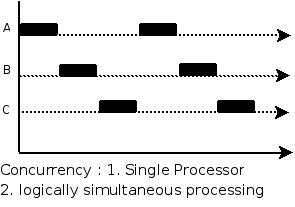
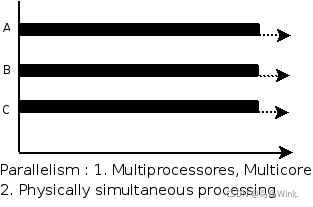
同步 Sync vs 非同步 Async is a different axis: a synchronous call does not return until
the result is ready; an asynchronous call returns immediately and the result arrives later
(callback, Future, event). Blocking/non-blocking describes whether the thread waits.
2) Threads: Lifecycle and Basics Priority 4 of 5 — High value — a gap here costs you rounds
// java
Thread t = new Thread(() -> work());   // Runnable — prefer over extending Thread
t.start();                             // start() spawns; run() would just call the method
t.join();                              // wait for it to finish
Java’s six thread states (Thread.State):
NEW ──start()──► RUNNABLE ◄──────────────┐
                  │  │                    │
                  │  └─ waiting for a monitor ──► BLOCKED ──┘
                  │
                  ├─ wait() / join() / park()        ──► WAITING
                  ├─ sleep(t) / wait(t) / join(t)    ──► TIMED_WAITING
                  └─ run() returns or throws         ──► TERMINATED
Note that RUNNABLE covers both “running on a CPU” and “ready but not scheduled” — the
JVM does not distinguish them. BLOCKED means specifically waiting to enter a
synchronized block, which is what makes a thread dump readable.
| Method | Releases the lock? | Notes |
|---|---|---|
Object.wait() |
Yes | Must hold the monitor; always call in a while loop guarding the condition |
Thread.sleep(ms) |
No | Pure delay |
Thread.join() |
n/a | Waits for another thread to terminate |
Thread.yield() |
No | A hint to the scheduler; rarely useful |
LockSupport.park() |
No | The primitive under ReentrantLock |
Interruption is cooperative. t.interrupt() sets a flag (and makes a blocking call
throw InterruptedException); it does not stop anything by force. Thread.stop() is
deprecated and unsafe — it can leave objects half-mutated. In a catch (InterruptedException e), either rethrow it or call
Thread.currentThread().interrupt() to restore the flag.
3) synchronized Priority 5 of 5 — Must know — expect it in almost every loop
Mutual exclusion plus the visibility guarantees of §4 in jmm.md.
// java
public synchronized void a() { ... }         // locks `this`
public static synchronized void b() { ... }  // locks the Class object
public void c() {
    synchronized (lockObject) { ... }        // locks an explicit object — preferred
}
- An instance method and a static method of the same class lock different monitors, so they do not exclude each other. A common bug.
- It is reentrant: a thread already holding the monitor can re-enter.
- Never lock on a
Stringliteral or a boxedInteger— the constant pool and the integer cache mean unrelated code may share your lock. Use aprivate final Object. - Lock the smallest critical section that keeps the invariant, and never call an unknown/blocking method while holding a lock.
Under the hood: monitorenter/monitorexit bytecodes on the object’s mark word.
HotSpot upgrades locks in one direction only — biased (a single thread, no CAS; disabled
by default in JDK 15, removed in 18) → lightweight (CAS spin, low contention) →
heavyweight (OS mutex, threads parked). This is why uncontended synchronized is nearly free and contended
synchronized is expensive.
4) ReentrantLock and AQS Priority 4 of 5 — High value — a gap here costs you rounds
// java
private final ReentrantLock lock = new ReentrantLock();

lock.lock();
try {
    // critical section
} finally {
    lock.unlock();          // ALWAYS in finally — an exception must not leak the lock
}
synchronized |
ReentrantLock |
|
|---|---|---|
| Level | JVM keyword | java.util.concurrent API |
| Release | Automatic on exit/exception | You must unlock() in finally |
| Try / timeout | No | tryLock(), tryLock(t, unit) |
| Interruptible wait | No | lockInterruptibly() |
| Fairness | Unfair only | new ReentrantLock(true) for FIFO (slower) |
| Condition queues | One (wait/notify) |
Many (newCondition() per predicate) |
| Reentrant | Yes | Yes |
Prefer synchronized for simple mutual exclusion (less to get wrong, and the JVM
optimises it); reach for ReentrantLock when you need a timeout, interruptibility,
fairness or multiple condition queues.
Related: ReentrantReadWriteLock (many readers or one writer — worth it only when reads
dominate and are slow), and StampedLock (adds an optimistic read mode; not reentrant).
AQS (AbstractQueuedSynchronizer) is the shared engine behind ReentrantLock,
Semaphore, CountDownLatch and ReadWriteLock: an int state manipulated by CAS, plus
a FIFO queue of threads parked with LockSupport. Knowing that one class powers all of
them is a good answer to “how does java.util.concurrent work?”.
5) Optimistic vs Pessimistic Locking, CAS Priority 4 of 5 — High value — a gap here costs you rounds
| 悲觀鎖 Pessimistic | 樂觀鎖 Optimistic | |
|---|---|---|
| Assumption | Conflict is likely | Conflict is rare |
| Mechanism | Take the lock first (synchronized, ReentrantLock, SELECT … FOR UPDATE) |
Read, compute, then check-and-swap (CAS, or a version column) |
| Cost | Blocking, context switches | Retries under contention |
| Best for | Write-heavy, contended | Read-heavy, low contention |
CAS (compare-and-swap) is a single atomic CPU instruction: if the memory location still holds the expected value, replace it. It is how the atomic classes avoid locks.
// java
AtomicInteger counter = new AtomicInteger();
counter.incrementAndGet();                    // CAS retry loop, no lock
counter.updateAndGet(x -> x * 2);
counter.compareAndSet(expected, updated);
Two things to say about CAS in an interview:
- The ABA problem: a value can change A → B → A between your read and your swap, so
the CAS succeeds even though the world moved. Fix with a version stamp —
AtomicStampedReference. - Spin cost: under heavy contention threads burn CPU retrying.
LongAdderbeatsAtomicLongfor hot counters precisely because it spreads the contention across cells and sums them only when read.
The atomic family: AtomicInteger/Long/Boolean/Reference, AtomicIntegerArray,
AtomicReferenceFieldUpdater, LongAdder/LongAccumulator.
6) Thread Pools Priority 5 of 5 — Must know — expect it in almost every loop
Creating a thread per task does not scale — each costs ~1 MB of stack and a syscall. A pool reuses threads and gives you a queue, a bound and a rejection policy.
// java
ThreadPoolExecutor pool = new ThreadPoolExecutor(
        8,                                      // corePoolSize   — kept alive
        32,                                     // maximumPoolSize
        60L, TimeUnit.SECONDS,                  // keepAlive for threads above core
        new ArrayBlockingQueue<>(1_000),        // BOUNDED work queue
        new ThreadFactoryBuilder().setNameFormat("order-%d").build(),   // named threads!
        new ThreadPoolExecutor.CallerRunsPolicy());
How a task is admitted — the order surprises people:
1. threads < corePoolSize      → create a new thread
2. else queue has room         → enqueue          ← the queue fills BEFORE extra threads
3. else threads < maximumPool  → create a new thread
4. else                        → rejection policy
So with an unbounded queue, maximumPoolSize is never reached and tasks pile up until
the heap dies — which is exactly what Executors.newFixedThreadPool and
newCachedThreadPool do (unbounded queue / unbounded threads respectively). Prefer
constructing ThreadPoolExecutor yourself with a bounded queue.
| Rejection policy | Behaviour |
|---|---|
AbortPolicy (default) |
Throws RejectedExecutionException |
CallerRunsPolicy |
The submitting thread runs the task — natural backpressure |
DiscardPolicy / DiscardOldestPolicy |
Silently drops — only for lossy work |
Sizing: CPU-bound → about cores + 1. I/O-bound → cores × (1 + waitTime/serviceTime);
in practice, measure. Always name your threads — an unnamed pool-1-thread-7 in a
production stack trace tells you nothing.
Other rules: shut down with shutdown() then awaitTermination() (shutdownNow()
interrupts and returns pending tasks); never submit a task that waits on another task in
the same bounded pool (self-deadlock); and remember an exception in a submit()ted task
is captured in the Future and is silent until you call get().
7) CompletableFuture Priority 4 of 5 — High value — a gap here costs you rounds
Future.get() blocks, which throws away the point of asynchrony.
CompletableFuture composes instead.
// java
CompletableFuture<User>  user  = CompletableFuture.supplyAsync(() -> loadUser(id), pool);
CompletableFuture<Stats> stats = CompletableFuture.supplyAsync(() -> loadStats(id), pool);

user.thenCombine(stats, Page::new)                 // join two results
    .thenApply(Page::render)                       // transform
    .orTimeout(2, TimeUnit.SECONDS)                // 9+
    .exceptionally(ex -> fallbackPage(ex))         // recover
    .thenAccept(this::send);                       // consume
| Method | Does |
|---|---|
supplyAsync / runAsync |
Start work (pass your executor — the default is the common ForkJoinPool) |
thenApply / thenCompose |
Map / flatMap (thenCompose when the function itself returns a future) |
thenCombine / allOf / anyOf |
Fan-in |
exceptionally / handle / whenComplete |
Error handling; handle sees both outcomes |
*Async variants |
Run the callback on the executor rather than the completing thread |
Two traps. First, supplyAsync/runAsync and every *Async method without an
explicit executor use the shared common ForkJoinPool (sized cores − 1, shared with
parallel streams — blocking there starves everything); the non-Async methods
(thenApply, thenCombine, …) pick no executor at all, running on whichever thread
completed the previous stage, or on the calling thread if it was already complete — which
is its own surprise when that thread is a Netty event loop. Second, an unhandled exception
is invisible unless a terminal exceptionally/whenComplete is attached.
8) Concurrent Collections & Coordination Priority 4 of 5 — High value — a gap here costs you rounds
| Need | Use | Not |
|---|---|---|
| Shared map | ConcurrentHashMap (CAS + per-bucket synchronized, lock-free reads) |
Hashtable, Collections.synchronizedMap (one global lock) |
| Producer/consumer hand-off | ArrayBlockingQueue, or LinkedBlockingQueue with an explicit capacity — its no-arg form holds Integer.MAX_VALUE, i.e. it fills the heap instead of blocking |
A List plus wait/notify |
| Mostly-read list | CopyOnWriteArrayList |
synchronizedList |
| Counter under contention | LongAdder |
AtomicLong, synchronized |
| Sorted concurrent map | ConcurrentSkipListMap |
TreeMap + lock |
ConcurrentHashMap’s atomic helpers (computeIfAbsent, merge, putIfAbsent) are how
you make check-then-act safe; map.get(k) followed by map.put(k, v) is a race no matter
how thread-safe the map is. Note it rejects null keys and values, unlike HashMap.
Coordination primitives:
| Class | Use |
|---|---|
CountDownLatch |
Wait for N events. One-shot |
CyclicBarrier |
N threads meet and continue together. Reusable |
Semaphore |
Limit concurrent access to a resource |
Phaser |
A barrier with a dynamic number of parties |
Exchanger |
Two threads swap objects |
More worked examples of these — plus thread-pool monitoring, graceful shutdown and
backpressure — are in
../backend/be_programming_notes_pt2.md.
9) ThreadLocal Priority 3 of 5 — Worth knowing — usually a variant of a must-know pattern
Per-thread state without passing it through every signature: request ids, user context,
non-thread-safe helpers like SimpleDateFormat.
// java
private static final ThreadLocal<SimpleDateFormat> FORMAT =
        ThreadLocal.withInitial(() -> new SimpleDateFormat("yyyy-MM-dd"));

try {
    return FORMAT.get().format(date);
} finally {
    FORMAT.remove();     // MANDATORY in a pooled thread
}
Each thread holds a ThreadLocalMap whose keys are weak references to the
ThreadLocal object but whose values are strong. In a thread pool the thread lives
forever, so a value you never remove() leaks — and worse, the next request served by
that thread can read the previous request’s data.
InheritableThreadLocal copies values to child threads (but not to pooled ones). Under
virtual threads, per-thread caching loses its point; scoped values are the successor.
10) Deadlock, Livelock, Starvation Priority 4 of 5 — High value — a gap here costs you rounds
// java
// Thread A: synchronized(lock1) { synchronized(lock2) { ... } }
// Thread B: synchronized(lock2) { synchronized(lock1) { ... } }   ← classic deadlock
All four Coffman conditions must hold: mutual exclusion, hold-and-wait, no pre-emption,
circular wait (see ../cs_basic.md). Break any one:
- Order your locks globally — the fix that scales. Order by a stable, unique rank
(an account id, a monotonic sequence assigned at creation).
hashCode()is not a total order: collisions leave two locks unordered, and a hash over mutable state can change. If you must fall back toSystem.identityHashCode, break ties with a third “ordering” lock held while acquiring the pair, as Java Concurrency in Practice does. - Acquire everything at once, or use
tryLock(timeout)and back off. - Shrink critical sections; better, avoid shared mutable state so no lock is needed.
Livelock: threads keep responding to each other and make no progress (two people stepping aside in a corridor) — randomised backoff fixes it. Starvation: a thread never gets the resource; fair locks or priority adjustments help.
Detecting one in production: jstack <pid> prints a “Found one Java-level deadlock”
section naming both threads and both monitors. That is usually the whole investigation.
11) Common Interview Q&A
Q: start() vs run()?
start() asks the JVM for a new thread that then calls run(). Calling run() directly
just executes it on the current thread — no concurrency at all.
Q: Runnable vs Callable?
Callable<V> returns a value and may throw a checked exception; Runnable returns
nothing and cannot. ExecutorService.submit accepts both and returns a Future.
Q: Why is volatile not enough for a counter?
It gives visibility and ordering but not atomicity — count++ is read-modify-write. Use
AtomicInteger or a lock. See jmm.md.
Q: Why must wait() be inside a while loop?
Because of spurious wakeups and because another thread may change the condition between
the notify and your re-acquisition of the lock. Re-check the predicate after waking.
Q: notify() vs notifyAll()?
notify() wakes one arbitrary waiter — if waiters are waiting for different conditions
you can wake the wrong one and stall. notifyAll() is the safe default; multiple
Conditions on a ReentrantLock are the precise alternative.
Q: How does ConcurrentHashMap stay thread-safe without locking the whole map?
Java 7 used segment striping; Java 8+ uses CAS to install a bucket head and
synchronized on that head node for updates within a bucket, so writes contend only when
they hit the same bucket. Reads are lock-free (volatile reads of the table).
Q: How do you make a class thread-safe?
In order of preference: make it immutable; confine state to one thread
(ThreadLocal, an actor-style queue); delegate to a thread-safe collection; and only then
guard mutable state with a lock — documenting which lock guards which field.
Q: Do virtual threads change any of this?
They change the cost model, not the correctness rules: races, deadlocks and visibility
still exist. Pools stop being the way to limit concurrency; a Semaphore is. See
java_modern.md.
12) Recap Checklist
[ ] Concurrency vs parallelism; sync/async vs blocking/non-blocking
[ ] Six thread states; which methods release the lock
[ ] Interruption is cooperative; restore the flag
[ ] synchronized: what object is locked, reentrancy, lock upgrades
[ ] ReentrantLock's four extras, and unlock() in finally
[ ] Optimistic vs pessimistic; CAS, the ABA problem, LongAdder
[ ] ThreadPoolExecutor's admission order and why unbounded queues kill
[ ] Rejection policies; sizing CPU- vs I/O-bound pools; name your threads
[ ] CompletableFuture composition, and never using the default common pool
[ ] ConcurrentHashMap atomic helpers vs get-then-put races
[ ] ThreadLocal.remove() in pooled threads
[ ] Four deadlock conditions and lock ordering; find it with jstack
References
jmm.md— happens-before,volatile,finalsemanticsjava_collection.md— collection internals../backend/be_programming_notes_pt2.md— thread pools,CompletableFutureand coordination in production shapes- JavaGuide — concurrency questions
- Java Concurrency in Practice, Goetz et al.