Sliding Window
Scope — Windows that grow and shrink on a condition — fixed-size, variable-size, at-most-k, and exactly-k by subtraction; owns the expand/contract loop and the seven canonical window templates. See also — split out of this file: sliding_window_examples.md — the worked LC solution archive, one canonical solution per problem per language; sliding_window_advanced.md — deque extrema, at-most-K generalisations, exactly-K beyond one instance, complement / word-level / bucketed windows. Neighbouring sheets: 2_pointers.md — pointers that converge instead of trailing; hash_map.md — the counting map most windows carry; monotonic_queue.md — window extrema in O(n); prefix_sum.md — when the window can be negative-valued.
LeetCode Problem Lists
Overview
Sliding Window is a technique that uses two pointers to maintain a “window” over arrays or strings, expanding and contracting to find optimal solutions efficiently.
Key Properties
- Time Complexity: O(n) - each element is visited at most twice
- Space Complexity: O(1) for pointers, O(k) for window state
- Core Idea: Maintain a window [left, right] that slides over the data structure
- Two-Phase Process:
- Expand: Move right pointer to grow window
- Contract: Move left pointer to shrink window when invalid
When to Use Sliding Window
- Subarray/Substring Problems: Finding optimal subarrays with specific properties
- Window-based Constraints: Problems involving fixed or variable window sizes
- Optimization: Min/max length, count, or sum within constraints
- Character/Element Tracking: Problems requiring frequency counting
References
Problem Categories
Core Components
- Two Pointers:
leftandrightto define window boundaries - Loop Structure:
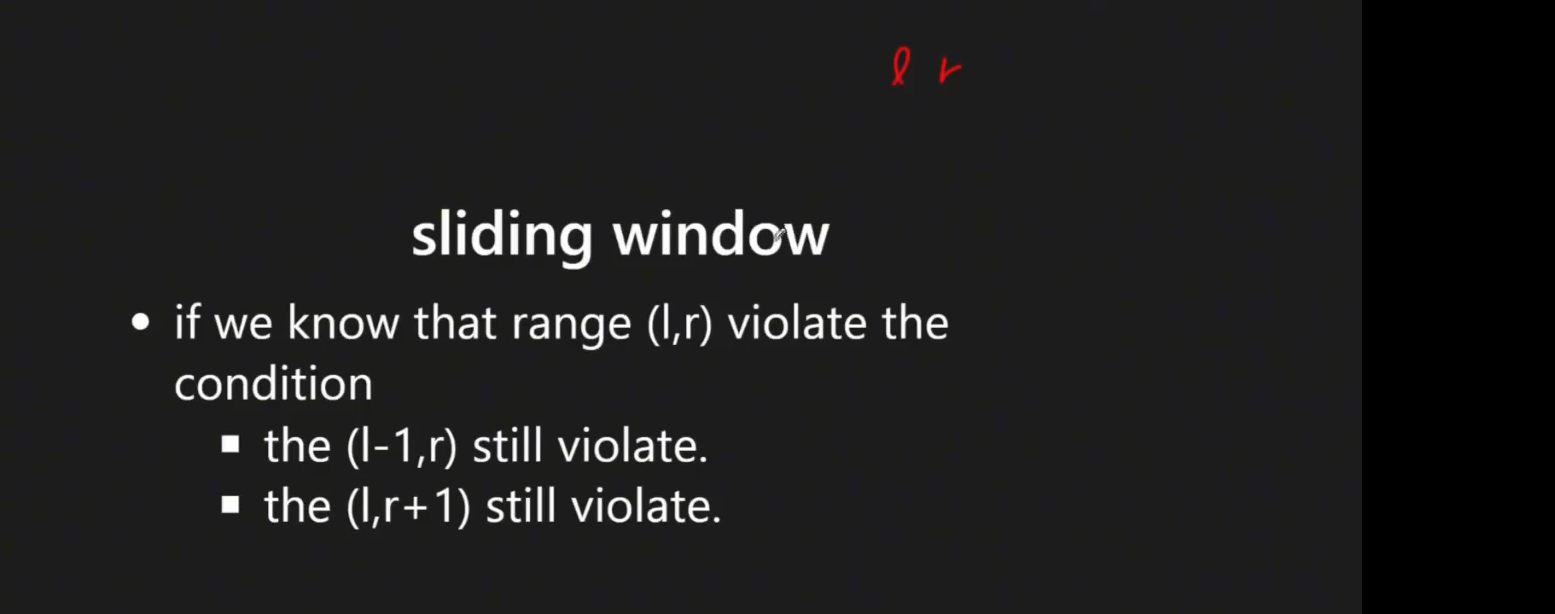
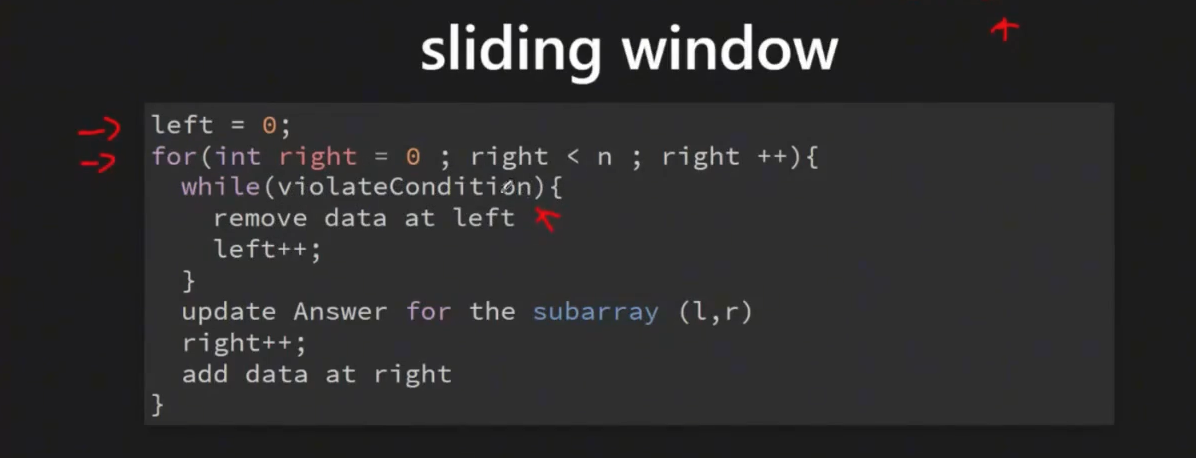
while-while: Outer loop expands, inner loop contractsfor-while: For loop expands, while loop contracts- Key Insight: 1st loop finds acceptable solution, 2nd loop optimizes to find the best
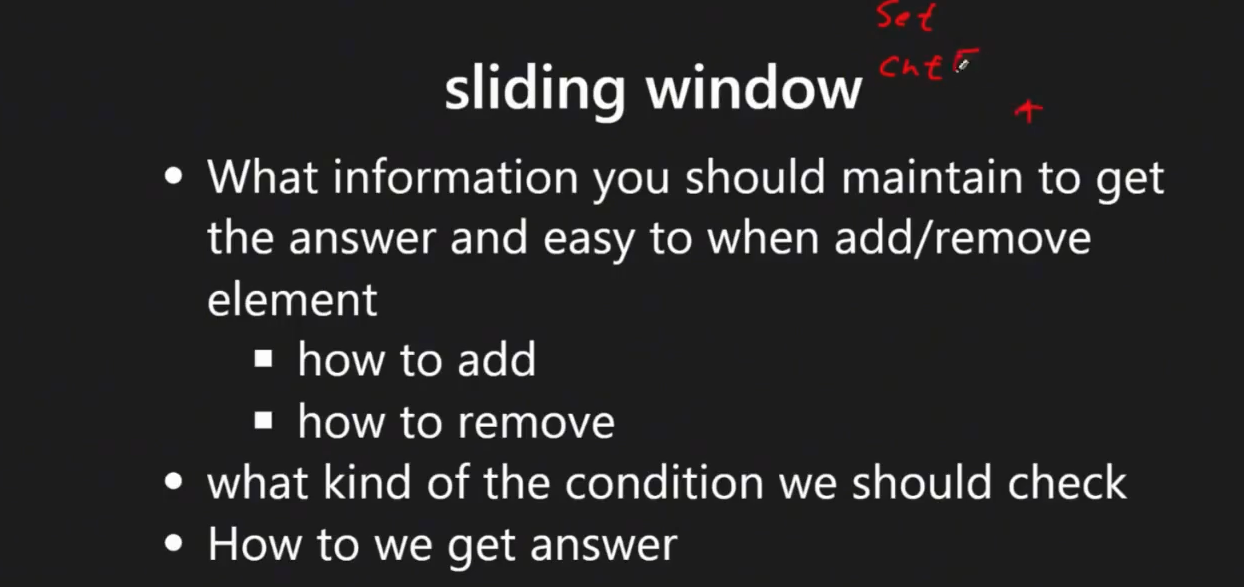
- Window State: Track elements, counts, or sums within current window
- Validity Condition: Define when window is valid/invalid
The Five Window Shapes
Fixed Size Window
- Description: Window size is predetermined and constant
- Examples: LC 438 (Find All Anagrams), LC 567 (Permutation in String)
- Pattern: Maintain exact window size, slide one position at a time
Variable Size Window - Maximum
- Description: Find maximum window size satisfying constraints
- Examples: LC 3 (Longest Substring), LC 424 (Character Replacement)
- Pattern: Expand until invalid, record max, then contract
Variable Size Window - Minimum
- Description: Find minimum window size satisfying constraints
- Examples: LC 209 (Minimum Subarray Sum), LC 76 (Minimum Window Substring)
- Pattern: Contract until invalid, record min, then expand
Subarray Counting
- Description: Count subarrays/substrings meeting criteria
- Examples: LC 713 (Subarray Product), LC 992 (Subarrays with K Different)
- Pattern: For each right position, count valid left positions
String Matching (Hash-based)
- Description: Track character frequencies in window
- Examples: LC 567 (Permutation), LC 438 (Anagrams), LC 76 (Window Substring)
- Pattern: Use HashMap/Counter to track character counts
Window State & Helper Tools
- Techniques: Two pointers, sliding window, frequency counting
- Data Structures: HashMap, Counter, Set, Array
- Helper Tools: Collections.Counter (Python), HashMap.getOrDefault (Java)
Fixed-Size Window vs Variable-Size Window
| Type | When to Use | Shrink Condition | Example |
|---|---|---|---|
| Fixed size k | Window size is given | right - left + 1 > k |
LC 567 (Permutation in String) |
| Variable (minimize) | Find smallest valid window | Shrink while window is valid | LC 76 (Min Window Substring) |
| Variable (maximize) | Find largest valid window | Shrink while window is invalid | LC 3 (Longest No-Repeat) |
| Exactly K → AtMost | Count windows with exact constraint | N/A — use subtraction trick | LC 992, LC 1248 |
| Variable (maximize), rule over pairs / triples | “no i, j, k in the window with …” |
Shrink while the newcomer would break the rule | LC 4067 (Restricted Pair Sums) |
Templates & Algorithms
Six templates cover every must-know sliding-window shape, and a seventh covers the case where the validity test, not the loop, is the hard part. Template 2 is the one to write from memory first — every variable-size window in the family is that loop with a different validity test and a different result update.
Template Comparison Table
| # | Template | Shape | Result update | Time / Space | Anchor problems |
|---|---|---|---|---|---|
| 1 | Fixed-Size Window | for i + evict i - k |
test when i >= k - 1 |
O(n) / O(k) | LC 643, 438, 567 |
| 2 | Grow-Then-Shrink (the while invariant) |
for right + while invalid: shrink |
any valid window | O(n) / O(k) | the base of 3–7 |
| 3 | Longest Window Satisfying P | shrink while invalid | max(res, r - l + 1) |
O(n) / O(k) | LC 3, 424, 1004 |
| 4 | Shortest Window Satisfying P | shrink while valid | min(res, r - l + 1) |
O(n) / O(k) | LC 209, 76 |
| 5 | Char-Count Window (have/need) |
freq map + match counter | on have == need |
O(n) / O(charset) | LC 76, 438, 567 |
| 6 | Exactly K via At-Most Subtraction | two at-most passes | count += r - l + 1 |
O(n) / O(k) | LC 992, 1248, 930 |
| 7 | Hereditary Constraint — test only the newcomer | while joins(a[r]): shrink, then add |
max(res, r - l + 1) |
O(n · V) / O(V) | LC 4067 |
Rows 3 and 4 differ by one word: longest shrinks while the window is invalid, shortest shrinks while it is valid. Get that word wrong and the answer is silently off.
Template 1: Fixed-Size Window Priority 5 of 5 — Must know — expect it in almost every loop
Worked instances: LC 643, LC 438, LC 567, LC 1456, LC 219 — see sliding_window_examples.md.
Outline, not runnable —
meets_condition/meetsConditionis the problem-specific test you fill in.
Use Cases: Anagrams, permutations, k-length substrings Pattern: Maintain exact window size, slide one position at a time
# Fixed Size Window Template
def fixed_window(s, k):
    window = {}
    result = []

    for i in range(len(s)):
        # Add current element to window
        window[s[i]] = window.get(s[i], 0) + 1

        # Remove element that's outside window
        if i >= k:
            left_char = s[i - k]
            window[left_char] -= 1
            if window[left_char] == 0:
                del window[left_char]

        # Process window when it reaches target size
        if i >= k - 1:
            # Check condition and update result
            if meets_condition(window):
                result.append(i - k + 1)

    return result
// Fixed Size Window Template - Java
public List<Integer> fixedWindow(String s, int k) {
    Map<Character, Integer> window = new HashMap<>();
    List<Integer> result = new ArrayList<>();

    for (int i = 0; i < s.length(); i++) {
        // Add current element
        char cur = s.charAt(i);
        window.put(cur, window.getOrDefault(cur, 0) + 1);

        // Remove element outside window
        if (i >= k) {
            char leftChar = s.charAt(i - k);
            window.put(leftChar, window.get(leftChar) - 1);
            if (window.get(leftChar) == 0) {
                window.remove(leftChar);
            }
        }

        // Process when window is full
        if (i >= k - 1 && meetsCondition(window)) {
            result.add(i - k + 1);
        }
    }
    return result;
}
Template 2: Grow-Then-Shrink — the while Invariant Priority 5 of 5 — Must know — expect it in almost every loop
The single most important idiom on this sheet. One for advances right and adds an
element; one while advances left until the window is valid again. Because left never moves
backwards, every element is added once and removed at most once → O(n), however the validity
test is written.
for right in range(n):         # 1. expand: the window may now be invalid
    add(a[right])
    while not valid(window):   # 2. restore the invariant (may run 0 times)
        remove(a[left]); left += 1
    update_result(left, right)  # 3. the window is valid HERE, and only here
Those three slots are the whole design space: what add/remove maintain, what valid tests,
and what update_result records. Templates 3–6 are this loop with the slots filled in.
Outline, not runnable —
is_valid,update_window_stateandupdate_resultare the problem-specific slots.
# Python Universal Template
def sliding_window(s, condition):
    # Initialize window state
    left = 0
    window_state = {}  # or Counter, set, etc.
    result = initialize_result()

    # Expand window with right pointer
    for right in range(len(s)):
        # Add current element to window
        update_window_state(s[right])

        # Contract window while invalid
        while not is_valid(window_state):
            # Remove leftmost element
            remove_from_window(s[left])
            left += 1

        # Update result with current valid window
        result = update_result(result, left, right)

    return result
// Java Universal Template
public ResultType slidingWindow(String s) {
    // Initialize window state
    int left = 0;
    Map<Character, Integer> window = new HashMap<>();
    ResultType result = initializeResult();

    // Expand window with right pointer
    for (int right = 0; right < s.length(); right++) {
        char rightChar = s.charAt(right);
        window.put(rightChar, window.getOrDefault(rightChar, 0) + 1);

        // Contract window while invalid
        while (!isValid(window)) {
            char leftChar = s.charAt(left);
            window.put(leftChar, window.get(leftChar) - 1);
            if (window.get(leftChar) == 0) {
                window.remove(leftChar);
            }
            left++;
        }

        // Update result with current valid window
        result = updateResult(result, left, right);
    }

    return result;
}
Template 3: Longest Window Satisfying P — LC 3 Priority 5 of 5 — Must know — expect it in almost every loop
Use Cases: Longest substring problems, maximum valid window Pattern: Expand until invalid, record max, then contract
Invariant: shrink while the window is invalid, so at the bottom of each iteration the
window is the longest valid one ending at right. Record r - l + 1 after the while, never
inside it.
// LC 3 - Longest Substring Without Repeating Characters
// IDEA: Sliding window with HashSet to track characters in window
// time = O(N), space = O(min(N, charset))
public int lengthOfLongestSubstring(String s) {
    Set<Character> set = new HashSet<>();
    int l = 0, ans = 0;
    for (int r = 0; r < s.length(); r++) {
        while (set.contains(s.charAt(r))) {
            set.remove(s.charAt(l++));
        }
        set.add(s.charAt(r));
        ans = Math.max(ans, r - l + 1);
    }
    return ans;
}
# LC 003 Longest Substring Without Repeating Characters
# IDEA : SLIDING WINDOW + DICT
#       -> use a hash table (d) record visited "element" (e.g. : a,b,c,...)
#          (but NOT sub-string)
class Solution(object):
    def lengthOfLongestSubstring(self, s):
        d = {}
        # left pointer
        l = 0
        res = 0
        # right pointer
        for r in range(len(s)):
            """
            ### NOTE : we deal with "s[r] in d" case first
            ### NOTE : if already visited, means "repeating"
            #      -> then we need to update left pointer (l)
            """
            if s[r] in d:
                """
                NOTE !!! this
                -> via max(l, d[s[r]] + 1) trick,
                   we can get the "latest" idx of duplicated s[r], and start from that one
                """
                l = max(l, d[s[r]] + 1)
            # if not visited yet, record the alphabet
            # and re-calculate the max length
            d[s[r]] = r
            res = max(res, r -l + 1)
        return res
The Java version shrinks one character at a time; the Python version jumps
leftstraight tod[c] + 1using the last-seen index. Same invariant, two spellings — the jump is whymax(l, ...)is needed, so a stale index can never pullleftbackwards.
Template 4: Shortest Window Satisfying P — LC 209 Priority 5 of 5 — Must know — expect it in almost every loop
Use Cases: Minimum window substring, smallest valid window Pattern: Expand until valid, record min, then try to contract
Invariant: shrink while the window is valid, recording the length before each shrink.
This is Template 3 with the while condition negated — nothing else changes.
// LC 209 - Minimum Size Subarray Sum
// IDEA: Sliding window — shrink left when sum >= target, record min length
// time = O(N), space = O(1)
public int minSubArrayLen(int target, int[] nums) {
    int l = 0, sum = 0, minLen = Integer.MAX_VALUE;
    for (int r = 0; r < nums.length; r++) {
        sum += nums[r];
        while (sum >= target) {
            minLen = Math.min(minLen, r - l + 1);
            sum -= nums[l++];
        }
    }
    return minLen == Integer.MAX_VALUE ? 0 : minLen;
}
# LC 209 Minimum Size Subarray Sum
# IDEA : SLIDING WINDOW : start, end
class Solution:
    def minSubArrayLen(self, s, nums):
        if nums is None or len(nums) == 0:
            return 0

        n = len(nums)
        minLength = n + 1
        sum = 0
        j = 0
        for i in range(n):
            ### NOTE the while loop condition (j < n and sum < s)
            while j < n and sum < s:
                sum += nums[j]
                j += 1
            # NOTE : we need to check if sum >= s here
            if sum >= s:
                minLength = min(minLength, j - i)

            ### NOTE : we need to get min length of sub array
            #          so once it meats the condition (sum >= s)
            #          we should update the minLength (minLength = min(minLength, j - i))
            #          and move to next i and roll back _sum (_sum -= nums[i])
            sum -= nums[i]

        ### NOTE : if minLength == n + 1, means there is no such subarray, so return 0 instead
        if minLength == n + 1:
            return 0
        return minLength
Template 5: Char-Count Window with the have/need Counter — LC 76 Priority 5 of 5 — Must know — expect it in almost every loop
Pattern: a frequency map of what the window needs, plus a single integer counting how much of it the window has. The counter is what makes validity O(1) instead of an O(charset) map comparison on every step — the detail interviewers push on.
Classic “shrink when valid” variable-size window:
from collections import Counter

def minWindow(s, t):
    need = Counter(t)
    missing = len(t)
    best = ""
    left = 0

    for right, c in enumerate(s):
        if need[c] > 0:
            missing -= 1
        need[c] -= 1

        if missing == 0:              # valid window found
            # Shrink from left
            while need[s[left]] < 0:
                need[s[left]] += 1
                left += 1
            if not best or right - left + 1 < len(best):
                best = s[left:right+1]
            # Break window to search for next
            need[s[left]] += 1
            missing += 1
            left += 1

    return best
// LC 76 - Minimum Window Substring
// IDEA: Sliding window with frequency maps; shrink when window is valid
// time = O(N + M), space = O(N + M)
public String minWindow(String s, String t) {
    Map<Character, Integer> need = new HashMap<>(), window = new HashMap<>();
    for (char c : t.toCharArray()) need.merge(c, 1, Integer::sum);
    int l = 0, valid = 0, start = 0, minLen = Integer.MAX_VALUE;
    for (int r = 0; r < s.length(); r++) {
        char c = s.charAt(r);
        window.merge(c, 1, Integer::sum);
        if (need.containsKey(c) && window.get(c).equals(need.get(c))) valid++;
        while (valid == need.size()) {
            if (r - l + 1 < minLen) { minLen = r - l + 1; start = l; }
            char d = s.charAt(l++);
            if (need.containsKey(d)) {
                if (window.get(d).equals(need.get(d))) valid--;
                window.merge(d, -1, Integer::sum);
            }
        }
    }
    return minLen == Integer.MAX_VALUE ? "" : s.substring(start, start + minLen);
}
Two spellings of the same counter: Python tracks
missing(characters still owed, counting down to 0), Java tracksvalid(characters fully satisfied, counting up toneed.size()). The map-equality shortcut — comparing two frequency maps directly — is only affordable for a fixed-size window; see LC 438 / LC 567 in sliding_window_examples.md.
Template 6: Exactly K via At-Most Subtraction — LC 992 Priority 5 of 5 — Must know — expect it in almost every loop
Core Insight: “Exactly K” problems are often difficult to solve directly, but can be transformed using the powerful formula:
Exactly K = At Most K - At Most (K-1)
Why This Works:
At Most K: All subarrays with ≤ K distinct/count
At Most (K-1): All subarrays with ≤ K-1 distinct/count

Difference: Only subarrays with EXACTLY K distinct/count
Proof by Example:
Array: [1, 2, 1, 2, 3]
K = 2 (exactly 2 distinct integers)

At Most 2 distinct:
[1], [1,2], [1,2,1], [1,2,1,2], [2], [2,1], [2,1,2], [1], [1,2], [2], [2,3], [3]
Count = 12

At Most 1 distinct:
[1], [2], [1], [2], [3]
Count = 5

Exactly 2 distinct = 12 - 5 = 7 ✓
[1,2], [1,2,1], [1,2,1,2], [2,1], [2,1,2], [1,2], [2,3]
The counting slot: count += right - left + 1
Once [left, right] is the longest valid window ending at right, every one of its suffixes
is valid too — so exactly right - left + 1 subarrays end at right. That one line is what
turns Template 3 into a counter.
Use Cases: Count subarrays meeting criteria Pattern: For each right position, count valid left positions
Outline, not runnable —
initialize_state,update_window_state,is_validandremove_from_windoware the problem-specific slots; the worked example below fills them in.
# Subarray Counting Template
def count_subarrays(nums, condition):
    left = 0
    count = 0
    window_state = initialize_state()

    for right in range(len(nums)):
        # Add current element
        update_window_state(nums[right])

        # Shrink window while invalid
        while not is_valid(window_state):
            remove_from_window(nums[left])
            left += 1

        # Count valid subarrays ending at 'right'
        count += right - left + 1

    return count
Worked example — Subarrays with K Different Integers
Problem: Count subarrays with exactly K distinct integers.
# Python - LC 992 Subarrays with K Different Integers
def subarraysWithKDistinct(nums, k):
    """
    Count subarrays with exactly K distinct integers.

    Time: O(n)
    Space: O(k)

    Key: Use Exactly K = At Most K - At Most (K-1) transformation
    """
    def at_most_k_distinct(k):
        """Count subarrays with at most K distinct integers."""
        left = 0
        count = 0
        freq = {}

        for right in range(len(nums)):
            # Add right element
            freq[nums[right]] = freq.get(nums[right], 0) + 1

            # Shrink while > k distinct
            while len(freq) > k:
                freq[nums[left]] -= 1
                if freq[nums[left]] == 0:
                    del freq[nums[left]]
                left += 1

            # Count subarrays ending at right
            count += right - left + 1

        return count

    # Edge case
    if k == 0:
        return 0

    # Exactly K = At Most K - At Most (K-1)
    return at_most_k_distinct(k) - at_most_k_distinct(k - 1)

# Example:
# nums = [1,2,1,2,3], k = 2
# at_most_k(2) = 12
# at_most_k(1) = 5
# exactly_k(2) = 12 - 5 = 7 ✓
// Java - LC 992 Subarrays with K Different Integers
/**
 * time = O(N)
 * space = O(K)
 */
public int subarraysWithKDistinct(int[] nums, int k) {
    // Exactly K = At Most K - At Most (K-1)
    return atMostK(nums, k) - atMostK(nums, k - 1);
}

private int atMostK(int[] nums, int k) {
    if (k == 0) return 0;

    int left = 0;
    int count = 0;
    Map<Integer, Integer> freq = new HashMap<>();

    for (int right = 0; right < nums.length; right++) {
        // Add right element
        freq.put(nums[right], freq.getOrDefault(nums[right], 0) + 1);

        // Shrink while > k distinct
        while (freq.size() > k) {
            freq.put(nums[left], freq.get(nums[left]) - 1);
            if (freq.get(nums[left]) == 0) {
                freq.remove(nums[left]);
            }
            left++;
        }

        // Count subarrays ending at right
        count += right - left + 1;
    }

    return count;
}
Problems using this transformation
| Problem | LC# | Difficulty | Transformation | Key Insight |
|---|---|---|---|---|
| Subarrays with K Different Integers | 992 | Hard | Exactly K distinct = atMost(K) - atMost(K-1) | Core example |
| Count Vowel Substrings of a String | 2062 | Medium | Exactly 5 vowels = atMost(5) - atMost(4) | Consonant resets window (vowels-only) |
| Count Nice Subarrays | 1248 | Medium | Exactly K odds = atMost(K) - atMost(K-1) | Transform odd→1, even→0 |
| Binary Subarrays With Sum | 930 | Medium | Exactly sum K = atMost(K) - atMost(K-1) | Subarray sum |
| Longest Substring with At Most K Distinct | 340 | Medium | Direct atMost(K) for max length | No subtraction needed |
| Fruits Into Baskets | 904 | Medium | atMost(2) distinct for max length | Simplified K=2 |
| Max Consecutive Ones III | 1004 | Medium | atMost(K) zeros for max length | Count zeros ≤ K |
The reset twist for restricted alphabets (LC 2062), the one-pass prefix alternative (LC 1248), the visual proof and the “why is direct exactly-K hard” argument all live in sliding_window_advanced.md.
Template 7: Hereditary Constraint — Test Only the Newcomer — LC 4067 Priority 3 of 5 — Worth knowing — usually a variant of a must-know pattern
Use Cases: “longest subarray with no two / no three elements such that …” — a validity rule
stated over every pair or triple in the window, not over a count or a sum
Pattern: Template 3’s loop, but valid() asks one question about the element about to join,
never a question about the whole window
Templates 3–6 lean on two facts they never have to state. Both must be checked before this loop is sound, and the second is what makes it fast:
- Validity is hereditary — every sub-window of a valid window is valid. That is what lets
leftonly move right: once[left, right]is invalid, so is every window containing it. Dropping elements can never create a forbidden pair or triple, so “noi, j, kwithnums[i] + nums[j] == nums[k]” is hereditary. “Sum equals k” over negatives is not, which is why LC 560 is a prefix sum and not a window. - The window before the newcomer joins is valid — the loop invariant at the top of every
iteration. So the only violations that can appear are the ones that use
nums[right], andvalid()shrinks from “is there any triple in the window” (O(w²) per step, O(n³) overall) to “doesnums[right]complete a triple with what is already here”.
For LC 4067 the newcomer v can play two roles, and each question is one scan of the value
range 1..V rather than of the window:
v is the sum    :  a + b == v   with a and b both in the window   (a == b needs two copies)
v is an addend  :  a and a + v  both in the window
Values are ≥ 1, so a pair’s sum is strictly bigger than both of its members: the k matching a
pair is never one of the pair’s own indices, and “three distinct indices” comes for free
(3 + 3 = 6 from two different 3s still counts, and the two-copies check sees it).
# LC 4067 Longest Subarray With Restricted Pair Sums
# IDEA : SLIDING WINDOW OVER VALUE COUNTS — test only the newcomer
# time = O(n * V), space = O(V)   (V = max(nums) <= 500)
class Solution(object):
    def maxSubarray(self, nums):
        n = len(nums)
        if n <= 2:                       # fewer than 3 elements can not form a triple
            return n
        max_val = max(nums)
        cnt = [0] * (max_val + 1)        # value -> copies inside the window
        left = 0
        best = 0
        for right in range(n):
            v = nums[right]
            # the window WITHOUT v is valid (loop invariant), so the only
            # triples that can appear are the ones that use v
            while self.joins_triple(cnt, v, max_val):
                cnt[nums[left]] -= 1     # removing can never create a triple
                left += 1
            cnt[v] += 1
            best = max(best, right - left + 1)
        return best

    def joins_triple(self, cnt, v, max_val):
        # 1) v is the sum : a + b == v, a <= b, both present (a == b needs two copies)
        for a in range(1, v // 2 + 1):
            b = v - a
            if a == b:
                if cnt[a] >= 2:
                    return True
            elif cnt[a] >= 1 and cnt[b] >= 1:
                return True
        # 2) v is an addend : a and a + v both present (a + v > a, so distinct indices)
        for a in range(1, max_val - v + 1):
            if cnt[a] >= 1 and cnt[a + v] >= 1:
                return True
        return False
// LC 4067 - Longest Subarray With Restricted Pair Sums
// IDEA: Sliding window over value counts; the window before nums[r] joins is valid,
//       so only a triple that uses nums[r] can appear — test the newcomer, not the window
// time = O(n * V), space = O(V)   (V = max(nums) <= 500)
public int maxSubarray(int[] nums) {
    int n = nums.length;
    if (n <= 2) return n;                 // fewer than 3 elements can not form a triple
    int maxVal = 0;
    for (int x : nums) maxVal = Math.max(maxVal, x);
    int[] cnt = new int[maxVal + 1];      // value -> copies inside the window
    int l = 0, best = 0;
    for (int r = 0; r < n; r++) {
        int v = nums[r];
        // the window WITHOUT v is valid, so shrink until v completes no triple
        while (joinsTriple(cnt, v, maxVal)) {
            cnt[nums[l++]]--;             // removing can never create a triple
        }
        cnt[v]++;
        best = Math.max(best, r - l + 1);
    }
    return best;
}

private boolean joinsTriple(int[] cnt, int v, int maxVal) {
    // 1) v is the sum: a + b == v, a <= b, both present (a == b needs two copies)
    for (int a = 1; a <= v / 2; a++) {
        int b = v - a;
        if (a == b) {
            if (cnt[a] >= 2) return true;
        } else if (cnt[a] >= 1 && cnt[b] >= 1) {
            return true;
        }
    }
    // 2) v is an addend: a and a + v both present (a + v > a, so distinct indices)
    for (int a = 1; a + v <= maxVal; a++) {
        if (cnt[a] >= 1 && cnt[a + v] >= 1) return true;
    }
    return false;
}
nums = [2,3,5,3,2,1]

r=0  v=2  window {}       joins nothing                         -> [2]        len 1
r=1  v=3  window {2}      2+3=5 absent, no a+b=3                -> [2,3]      len 2
r=2  v=5  window {2,3}    sum: 2+3 = 5     -> drop 2 -> {3} ok  -> [3,5]      len 2
r=3  v=3  window {3,5}    3+3=6, 3+5=8 absent, no a+b=3         -> [3,5,3]    len 3  <- answer
r=4  v=2  window {3,5,3}  addend: 3 and 3+2=5 -> drop 3, still  -> drop 5 -> [3,2]  len 2
r=5  v=1  window {3,2}    addend: 2 and 2+1=3 -> drop 3         -> [2,1]      len 2
Note the order inside the loop: test, shrink, then add. Template 2 adds first and shrinks after, which works when
valid()reads a count or a sum. Here the question is “doesvfit with what is already there”, sovmust not be incntwhile it is asked — adding first only happens to survive because values are ≥ 1 andvcan never be its own partner.
Where it goes wrong:
- Testing the whole window instead of the newcomer — correct, O(n³), and over the limit at n = 1000. The invariant is what you are being asked to notice.
- Forgetting that
a == bneeds two copies.[2, 2, 4]is invalid;[2, 4]is not. - Skipping the hereditary check. If dropping an element could turn an invalid window valid
and a valid one invalid,
leftis not monotone and this loop is unsound — reach for prefix_sum.md instead. - The O(n²) first draft keeps a
pair_sum -> countmap plus aconflictscounter and updates both for every element the newcomer pairs with, with mirror-image add/remove bookkeeping to get wrong. The version above is that solution after one observation — only the newcomer can be in a new triple — so nothing about the pairs needs keeping. The pair map earns its place only when the values are unbounded; the solution file carries both.
Summary & Quick Reference
Which Template? — Decision Table
| Problem Type | Template | Key Pattern | Examples |
|---|---|---|---|
| Find exact window size | 1 — Fixed Size | for i with size tracking |
LC 438, 567, 643 |
| Find maximum valid window | 3 — Longest Window | for-while, shrink while invalid |
LC 3, 424, 1004 |
| Find minimum valid window | 4 — Shortest Window | for-while, shrink while valid |
LC 76, 209 |
| Match a character multiset | 5 — Char-Count (have/need) |
freq map + match counter | LC 76, 438, 567 |
| Count valid subarrays | 6 — Counting slot | count += right-left+1 |
LC 713, 992 |
| Exactly K distinct/unique | 6 — At-Most Subtraction | atMostK(k) - atMostK(k-1) |
LC 992, 1248, 930 |
| Rule over every pair / triple in the window | 7 — Test the newcomer | hereditary check, then while joins(v): shrink |
LC 4067 |
| Window max/min in O(1) | not a template here | monotonic deque | LC 239 → monotonic_queue.md |
| Values may be negative | not a window at all | prefix sum + HashMap | LC 560, 974 → prefix_sum.md |
How to read: Start with your problem goal (maximum/minimum/count/exact), then choose the matching template. Template 2 underlies rows 2-7 — it is the loop, not a separate answer.
Template Complexity Reference
| Template | Time | Space | Where the space goes |
|---|---|---|---|
| 1 — Fixed Size | O(n) | O(k) | the window’s own contents |
| 2 — Grow-Then-Shrink | O(n) | O(k) | whatever the window state holds |
| 3 — Longest Window | O(n) | O(k) | freq map / counter |
| 4 — Shortest Window | O(n) | O(k) | freq map / counter |
| 5 — Char-Count | O(n + m) | O(charset) | two maps sized by the alphabet |
| 6 — Exactly K via At-Most | O(n) | O(k) | one map, two passes over the array |
| 7 — Test the newcomer | O(n · V) | O(V) | a count per value; the test scans the value range, not the window |
O(n) throughout because
leftnever moves backwards: each element is added once and removed at most once. Optimization: use a fixedint[26]/int[128]array instead of a HashMap when the character set is bounded — same asymptotics, materially faster and simpler to compare.
Problems by Pattern
Fixed Size Window Problems
| Problem | LC # | Key Technique | Difficulty |
|---|---|---|---|
| Find All Anagrams in a String | 438 | Character frequency matching | Medium |
| Permutation in String | 567 | Character frequency matching | Medium |
| Maximum Average Subarray I | 643 | Fixed window sum | Easy |
| Contains Duplicate II | 219 | Fixed window with HashSet | Easy |
| Maximum Number of Vowels | 1456 | Fixed window counting | Medium |
Variable Size - Maximum Length
| Problem | LC # | Key Technique | Difficulty |
|---|---|---|---|
| Longest Substring Without Repeating Characters | 3 | Character uniqueness tracking | Medium |
| Longest Repeating Character Replacement | 424 | Frequency + max character count | Medium |
| Max Consecutive Ones III | 1004 | K flips constraint | Medium |
| Longest Substring with At Most K Distinct Characters | 340 | Distinct character counting | Medium |
| Longest Substring with At Most Two Distinct Characters | 159 | Two distinct constraint | Medium |
| Longest Subarray With Restricted Pair Sums | 4067 | Hereditary constraint — test only the newcomer over the value range | Medium |
Variable Size - Minimum Length
| Problem | LC # | Key Technique | Difficulty |
|---|---|---|---|
| Minimum Window Substring | 76 | Character coverage tracking | Hard |
| Minimum Size Subarray Sum | 209 | Running sum comparison | Medium |
| Smallest Subarray with Sum ≥ K | 862 | Prefix sum + deque | Hard |
| Minimum Window with Characters | 1176 | Diet plan constraint | Hard |
Counting Subarrays
| Problem | LC # | Key Technique | Difficulty |
|---|---|---|---|
| Subarray Product Less Than K | 713 | Product constraint | Medium |
| Subarrays with K Different Integers | 992 | Exactly K = At most K - At most (K-1) | Hard |
| Count Vowel Substrings of a String | 2062 | Exactly 5 vowels = atMost(5) - atMost(4) (consonant resets) | Medium |
| Number of Subarrays with Bounded Maximum | 795 | Bounded value constraint | Medium |
| Count Number of Nice Subarrays | 1248 | Odd number counting | Medium |
Advanced Sliding Window
| Problem | LC # | Key Technique | Difficulty |
|---|---|---|---|
| Sliding Window Maximum | 239 | Monotonic deque | Hard |
| Sliding Window Median | 480 | Two heaps | Hard |
| Minimum Swaps to Group All 1’s Together | 1151 | Optimization with fixed window | Medium |
| Grumpy Bookstore Owner | 1052 | State change optimization | Medium |
Common Patterns & Tricks
Character Frequency Tracking
# Track character counts in window
window = {}
window[char] = window.get(char, 0) + 1

# Remove character from window
window[char] -= 1
if window[char] == 0:
    del window[char]
Validity Conditions
# Common validity checks
def is_valid_permutation(window, target):
    return window == target

def is_valid_distinct_k(window, k):
    return len(window) <= k

def is_valid_sum(current_sum, target):
    return current_sum >= target
Result Updates
# Maximum length problems
max_len = max(max_len, right - left + 1)

# Minimum length problems
if is_valid:
    min_len = min(min_len, right - left + 1)

# Counting problems
count += right - left + 1  # All subarrays ending at 'right'
Problem-Solving Steps
- Identify Pattern: Fixed size, variable max/min, or counting?
- Choose Template: Select appropriate template based on pattern
- Define Window State: HashMap, set, sum, or counter?
- Define Validity: What makes the window valid/invalid?
- Update Logic: When and how to update the result?
Common Mistakes & Tips
🚫 Common Mistakes:
- Wrong loop structure (using wrong template)
- Forgetting to handle window state correctly
- Incorrect validity condition logic
- Missing edge cases (empty input, single element)
✅ Best Practices:
- Use
collections.Counterfor character frequency problems - Always handle the case when removing elements from HashMap
- Test with edge cases: empty string, single character, all same characters
- Consider if the problem needs “exactly k” vs “at most k”
- For “exactly k” problems: use “at most k - at most (k-1)”
Interview Signals
| Signal | Pattern |
|---|---|
| “longest substring/subarray with constraint” | Variable window, expand right, shrink left |
| “minimum window containing all chars” | Shrink-when-valid (LC 76) |
| “window of fixed size k” | Fixed window, slide together |
| “exactly k distinct/odd/…” | AtMost(k) - AtMost(k-1) |
| “window maximum/minimum in O(n)” | Monotonic deque |
| “permutation/anagram in string” | Fixed window + Counter comparison |
| “longest subarray with no two / three elements such that …” | Check the rule is hereditary, then test only the newcomer (Template 7) |
Where the Rest Lives
| Looking for | Sheet |
|---|---|
| A worked solution to LC 567, 438, 1004, 424, 1838, 713, 413, 1151, 763 | sliding_window_examples.md |
| Deque extrema, at-most-K-distinct family, exactly-K deep dive, complement / word-level / bucketed windows | sliding_window_advanced.md |
| The full monotonic-deque family (LC 239, 862, 1438, 1499) | monotonic_queue.md |
| Windows that may contain negatives → prefix sum + HashMap | prefix_sum.md |
| Converging (not trailing) pointers | 2_pointers.md |