Sweep Line
Scope — Line sweep — turn each interval into
+1/-1events, sort by coordinate, sweep once. See also: scanning_line_examples.md — the six worked problems behind these templates; intervals.md — sort-and-merge without events; difference_array.md — the array-indexed version of the same trick; heap.md — sweeps that need a max over live intervals.
LeetCode Problem Lists
Overview
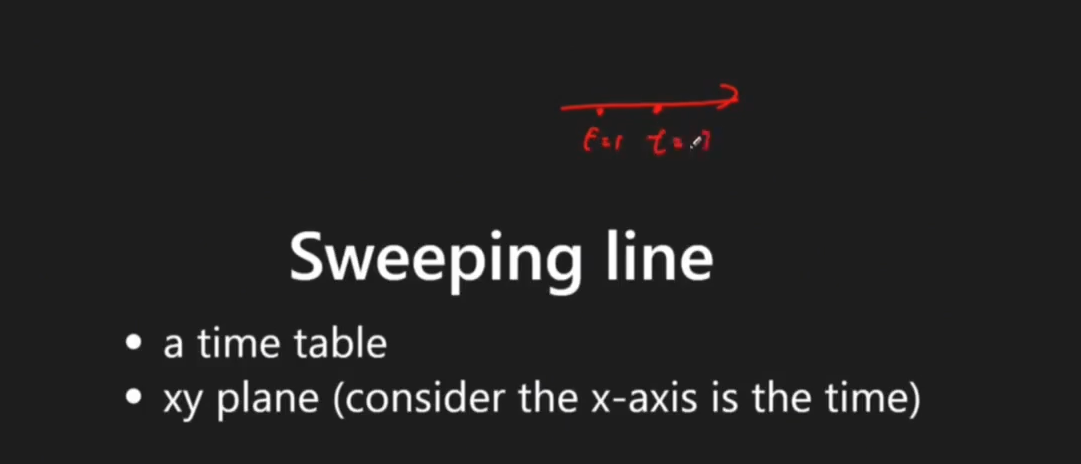
Scanning Line (also known as Line Sweep or Sweep Line) is an algorithmic paradigm that processes geometric objects by imagining a vertical line sweeping across the plane from left to right, processing events as they occur.
Key: transform change to event, so we can handle the changed state via program, instead of dealing with continouous info.
Key Properties
- Time Complexity: O(n log n) for sorting + O(n) for processing
- Space Complexity: O(n) for storing events
- Core Idea: Convert interval problems into event-based processing
- When to Use: Interval overlaps, skyline problems, calendar conflicts, geometric intersections
Algorithm Principle
- Convert intervals into events (start/end points)
- Sort events by position (and type if at same position)
- Process events in order while maintaining state
- Track maximum/minimum or other statistics during sweep
References
Problem Categories
Pattern 1: Interval Overlap
- Description: Finding maximum overlapping intervals at any point
- Examples: LC 253, 1094, 2021, 2406, 2848, 4057
- Pattern: Track active intervals using counter — read it at the peak for max concurrent, or at every start (
res += active) for number of intersecting pairs (Variation 1-1)
Pattern 2: Skyline Problems
- Description: Computing visible outline from overlapping rectangles
- Examples: LC 218, 850, 391
- Pattern: Process building start/end with heights
Pattern 3: Calendar Booking
- Description: Managing calendar events and conflicts
- Examples: LC 729, 731, 732, 1851
- Pattern: Track booking counts at each time point
Pattern 4: Employee Free Time / Interval Intersection
- Description: Finding common free time (gaps) or common busy time (intersections) across schedules
- Examples: LC 759, 986, 1229
- Pattern: One merged event stream + a predicate on the coverage counter —
count == 0→ free time (LC 759),count == 2→ intersection of 2 lists (LC 986, see 2-7)
Pattern 5: Range Updates
- Description: Applying updates to ranges efficiently
- Examples: LC 370, 1109, 1893, 2251
- Pattern: Difference array with sweep line
Pattern 6: Geometric Intersection
- Description: Finding intersections of geometric objects
- Examples: LC 836, 223, 391, 850
- Pattern: Sort by x-coordinate, track y-intervals
Pattern 7: Prefix Sum + Longest Positive-Sum Subarray
- Description: Find the longest subarray whose element sum > 0 after transforming values to +1/−1
- Examples: LC 1124, 525, 560, 974
- Pattern: Prefix sum with HashMap storing first-occurrence of each sum; if
prefix > 0take full length; else look upprefix - 1in map
Pattern 8: Time Sweep + Deadline Heap (greedy scheduling) Priority 4 of 5 — High value — a gap here costs you rounds
- Description: Sweep forward in time; each time slot can serve one item, and each item is only valid inside its window
[start, end] - Examples: LC 1353, 621, 1834, 630, 767
- Pattern: Sort by window start (items enter in time order) + min heap of window end (serve the most urgent) + lazy-delete expired tops
- Key difference from Pattern 1: Pattern 1 counts how many intervals are concurrent (
+1/−1counter). Pattern 8 picks a subset — the sweep consumes one slot per tick, so it needs a heap to decide which interval to spend the slot on - Signature: “one item per unit of time” + “each item has a deadline” → earliest-deadline-first is optimal
Pattern 9: Weighted Interval Scheduling (sweep + retired-job heap) Priority 5 of 5 — Must know — expect it in almost every loop
- Description: Pick a set of non-overlapping intervals maximising total weight; each chosen interval occupies its whole range
- Examples: LC 1235, 452, 1751
- Pattern: Sort by start; min heap keyed by end holding taken chains; pop everything with
end <= startinto a monotone runningbest; push(end, best + weight) - Key difference from Pattern 8: Pattern 8 spends one slot inside the interval; Pattern 9 blocks the whole interval, so compatibility (not urgency) drives the choice — and the weights kill pure greedy
- Unweighted degenerate case: all weights equal → the heap collapses to one
endvariable → sort-by-end greedy (LC 452)
Templates & Algorithms
Template Comparison Table
| Template Type | Use Case | Event Types | Complexity | When to Use |
|---|---|---|---|---|
| Basic Sweep | Count overlaps | Start/End | O(n log n) | Meeting rooms, intervals |
| Pair-Count Sweep | Number of intersecting pairs | Start/End | O(n log n) | res += active at each start (LC 4057) |
| Weighted Sweep | Sum of overlaps | Start/End + value | O(n log n) | Brightness, bandwidth |
| Skyline | Height tracking | Start/End + height | O(n log n) | Building outline |
| Difference Array | Range updates | Update points | O(n) | Batch updates |
| Interval Merge | Combine intervals | Start/End | O(n log n) | Free time, union |
| 2D Sweep | Rectangle area | X and Y events | O(n² log n) | Area calculation |
| Time Sweep + Deadline Heap | Pick max items, 1 per slot | Start (enter) + End (deadline) | O(n log n) | Max events attended, task scheduling |
| Sweep + Retired-Job Heap | Max weight of non-overlapping set | Start (enter) + End (retire) + weight | O(n log n) | Weighted interval scheduling (LC 1235) |
| Gap Sweep | Largest hole between events | Sorted coordinates only | O(n log n) | Max piece after cuts (LC 1465) |
| Index Sweep + Ordered Set | Nearest value in a window | Index enter/leave | O(n log k) | Near-duplicate detection (LC 220) |
| Intersection Sweep | Emit ranges where coverage == k | Start/End (+ list id) | O(n log n) | Interval list intersections (LC 986) |
Template 1: Basic Interval Overlap — LC 253
# Python - Count maximum overlapping intervals
def maxOverlap(intervals):
    events = []

    # Create events for each interval
    for start, end in intervals:
        events.append((start, 1))   # Start event
        events.append((end, -1))     # End event

    # Sort events (by time, then by type)
    events.sort(key=lambda x: (x[0], -x[1]))  # Process start before end at same time

    # Sweep through events
    max_overlap = 0
    current_overlap = 0

    for time, delta in events:
        current_overlap += delta
        max_overlap = max(max_overlap, current_overlap)

    return max_overlap

# With position tracking
def maxOverlapPosition(intervals):
    events = []
    for start, end in intervals:
        events.append((start, 1))
        events.append((end, -1))

    events.sort(key=lambda x: (x[0], -x[1]))

    max_overlap = 0
    max_position = 0
    current_overlap = 0

    for time, delta in events:
        current_overlap += delta
        if current_overlap > max_overlap:
            max_overlap = current_overlap
            max_position = time

    return max_overlap, max_position
// Java - Maximum interval overlap
public int maxOverlap(int[][] intervals) {
    List<int[]> events = new ArrayList<>();

    // Create events
    for (int[] interval : intervals) {
        events.add(new int[]{interval[0], 1});   // Start
        events.add(new int[]{interval[1], -1});  // End
    }

    // Sort events
    Collections.sort(events, (a, b) -> {
        if (a[0] != b[0]) return a[0] - b[0];
        return b[1] - a[1];  // Start before end
    });

    // Sweep
    int maxOverlap = 0;
    int currentOverlap = 0;

    for (int[] event : events) {
        currentOverlap += event[1];
        maxOverlap = Math.max(maxOverlap, currentOverlap);
    }

    return maxOverlap;
}
Variation 1-1: count intersecting pairs, not the peak — LC 4057 Priority 4 of 5 — High value — a gap here costs you rounds
Twist: the same event stream, but the question is how many pairs
(i, j)intersect rather than how many at once. The counter stays; what changes is when you read it — at every start event, not at the peak.
Key Idea: two intervals intersect iff, when the later-starting one opens, the other is still open. So each pair is counted exactly once, at the moment its second interval starts: res += active, then active += 1.
# python
# LC 4057 - Number of Intersecting Interval Pairs II
# IDEA: sweep +1/-1 events; each new start meets every interval still open -> res += active
# time = O(n log n), space = O(n)
class Solution(object):
    def countIntersectingIntervals(self, intervals):
        events = []
        for s, e in intervals:
            events.append((s, 1))
            events.append((e, -1))

        # closed intervals: at the same pos, start (+1) BEFORE end (-1),
        # so [1,2] is still open when [2,3] starts
        events.sort(key=lambda x: (x[0], -x[1]))

        res = active = 0
        for _pos, delta in events:
            if delta == 1:
                res += active          # the new interval meets every open one
                active += 1
            else:
                active -= 1
        return res
// java
// LC 4057 - Number of Intersecting Interval Pairs II
// IDEA: sweep +1/-1 events; each new start meets every interval still open
// time = O(N log N), space = O(N)
public long countIntersectingIntervals(int[][] intervals) {
    int n = intervals.length;
    int[][] events = new int[2 * n][];
    for (int i = 0; i < n; i++) {
        events[2 * i] = new int[]{intervals[i][0], 1};
        events[2 * i + 1] = new int[]{intervals[i][1], -1};
    }
    // same pos: start (+1) before end (-1) -> touching closed intervals intersect
    Arrays.sort(events, (a, b) -> a[0] != b[0] ? Integer.compare(a[0], b[0]) : b[1] - a[1]);

    long res = 0;                       // up to C(10^5, 2) ~ 5e9: overflows int
    int active = 0;
    for (int[] ev : events) {
        if (ev[1] == 1) { res += active; active++; }
        else active--;
    }
    return res;
}
[[1,5],[2,4],[3,6]]
events: (1,+) (2,+) (3,+) (4,-) (5,-) (6,-)
start 1: res += 0 -> 0   active 1
start 2: res += 1 -> 1   active 2
start 3: res += 2 -> 3   active 3        -> 3 pairs
🚫 Traps:
max(C(active, 2))is not the answer — that is only the largest group overlapping at a single point.[[1,2],[2,3],[3,4]]peaks at 2 open (C = 1) but has 2 pairs.- Tie order decides touching pairs. Closed intervals sharing an endpoint intersect, so starts go first (
(x, -delta)); for half-open intervals flip it — see Event Ordering & Tie-Break Rules. - The O(n²) double loop (LC 4056, sort by start, break once
start[j] > end[i]) is the brute force this replaces;n = 10^5rules it out.
Template 2: Weighted Interval Overlap — LC 2021
# Python - Sum of overlapping values (e.g., brightness)
def maxWeightedOverlap(weighted_intervals):
    events = []

    # weighted_intervals: [(start, end, weight)]
    for start, end, weight in weighted_intervals:
        events.append((start, weight))   # Add weight
        events.append((end, -weight))    # Remove weight

    events.sort()

    max_weight = 0
    current_weight = 0
    result_position = 0

    for position, delta in events:
        current_weight += delta
        if current_weight > max_weight:
            max_weight = current_weight
            result_position = position

    return max_weight, result_position

# Track all positions with their weights
def allWeightedPositions(weighted_intervals):
    from collections import defaultdict
    events = defaultdict(int)

    for start, end, weight in weighted_intervals:
        events[start] += weight
        events[end] -= weight

    sorted_positions = sorted(events.keys())
    positions_weights = {}
    current_weight = 0

    for pos in sorted_positions:
        current_weight += events[pos]
        positions_weights[pos] = current_weight

    return positions_weights
// Java - Weighted intervals
public int maxWeightedOverlap(int[][] weightedIntervals) {
    // weightedIntervals: [start, end, weight]
    TreeMap<Integer, Integer> events = new TreeMap<>();

    for (int[] interval : weightedIntervals) {
        events.put(interval[0],
                  events.getOrDefault(interval[0], 0) + interval[2]);
        events.put(interval[1],
                  events.getOrDefault(interval[1], 0) - interval[2]);
    }

    int maxWeight = 0;
    int currentWeight = 0;

    for (int delta : events.values()) {
        currentWeight += delta;
        maxWeight = Math.max(maxWeight, currentWeight);
    }

    return maxWeight;
}
Template 3: Skyline Problem — LC 218
# Python - Building skyline
def getSkyline(buildings):
    events = []

    # buildings: [[left, right, height]]
    for left, right, height in buildings:
        events.append((left, -height))  # Start (negative for max heap)
        events.append((right, height))  # End

    events.sort(key=lambda x: (x[0], x[1]))

    result = []
    heights = [0]  # Ground level

    import heapq
    for x, h in events:
        if h < 0:  # Building start
            heapq.heappush(heights, h)
        else:  # Building end
            heights.remove(-h)
            heapq.heapify(heights)

        # Check if max height changed
        max_h = -heights[0]
        if not result or result[-1][1] != max_h:
            result.append([x, max_h])

    return result
// Java - Skyline
public List<List<Integer>> getSkyline(int[][] buildings) {
    List<int[]> events = new ArrayList<>();

    for (int[] b : buildings) {
        events.add(new int[]{b[0], -b[2]});  // Start
        events.add(new int[]{b[1], b[2]});   // End
    }

    Collections.sort(events, (a, b) -> {
        if (a[0] != b[0]) return a[0] - b[0];
        return a[1] - b[1];
    });

    List<List<Integer>> result = new ArrayList<>();
    TreeMap<Integer, Integer> heights = new TreeMap<>();
    heights.put(0, 1);  // Ground

    for (int[] event : events) {
        int x = event[0], h = event[1];

        if (h < 0) {  // Start
            heights.put(-h, heights.getOrDefault(-h, 0) + 1);
        } else {  // End
            if (heights.get(h) == 1) {
                heights.remove(h);
            } else {
                heights.put(h, heights.get(h) - 1);
            }
        }

        int maxH = heights.lastKey();
        if (result.isEmpty() ||
            result.get(result.size() - 1).get(1) != maxH) {
            result.add(Arrays.asList(x, maxH));
        }
    }

    return result;
}
Template 4: Calendar Booking — LC 731
# Python - Calendar with multiple bookings
class MyCalendarTwo:
    def __init__(self):
        self.events = []  # List of (time, delta)

    def book(self, start, end):
        # Temporarily add new booking
        self.events.append((start, 1))
        self.events.append((end, -1))
        self.events.sort()

        # Check if triple booking
        booked = 0
        for time, delta in self.events:
            booked += delta
            if booked >= 3:
                # Remove the temporary booking
                self.events.remove((start, 1))
                self.events.remove((end, -1))
                return False

        return True
// Java - Calendar booking
class MyCalendarTwo {
    List<int[]> events;

    public MyCalendarTwo() {
        events = new ArrayList<>();
    }

    public boolean book(int start, int end) {
        events.add(new int[]{start, 1});
        events.add(new int[]{end, -1});

        Collections.sort(events, (a, b) -> {
            if (a[0] != b[0]) return a[0] - b[0];
            return a[1] - b[1];
        });

        int booked = 0;
        for (int[] event : events) {
            booked += event[1];
            if (booked >= 3) {
                events.remove(new int[]{start, 1});
                events.remove(new int[]{end, -1});
                return false;
            }
        }

        return true;
    }
}
Template 5: Difference Array Pattern — LC 370
# Python - Range addition using sweep line
def rangeAddition(length, updates):
    # updates: [[start, end, inc]]
    diff = [0] * (length + 1)

    for start, end, inc in updates:
        diff[start] += inc
        diff[end + 1] -= inc

    # Sweep to get final values
    result = [0] * length
    current = 0
    for i in range(length):
        current += diff[i]
        result[i] = current

    return result

# 2D range addition
def rangeAddition2D(m, n, updates):
    diff = [[0] * (n + 1) for _ in range(m + 1)]

    for r1, c1, r2, c2, inc in updates:
        diff[r1][c1] += inc
        diff[r1][c2 + 1] -= inc
        diff[r2 + 1][c1] -= inc
        diff[r2 + 1][c2 + 1] += inc

    # 2D prefix sum
    result = [[0] * n for _ in range(m)]
    for i in range(m):
        for j in range(n):
            result[i][j] = diff[i][j]
            if i > 0:
                result[i][j] += result[i-1][j]
            if j > 0:
                result[i][j] += result[i][j-1]
            if i > 0 and j > 0:
                result[i][j] -= result[i-1][j-1]

    return result
Template 6: Interval Merge with Sweep — LC 56
# Python - Merge overlapping intervals using sweep
def mergeIntervals(intervals):
    if not intervals:
        return []

    events = []
    for start, end in intervals:
        events.append((start, 1))
        events.append((end, -1))

    events.sort(key=lambda x: (x[0], -x[1]))

    merged = []
    active = 0
    start = 0

    for time, delta in events:
        if active == 0 and delta == 1:
            start = time  # New interval starts

        active += delta

        if active == 0:  # Interval ends
            merged.append([start, time])

    return merged
Template 7: Prefix Sum — Longest Positive-Sum Subarray — LC 1124
# Python - Longest subarray with sum > 0 after +1/-1 transform
def longestWPI(hours):
    prefix = 0
    max_len = 0
    seen = {}  # { prefix_sum: first_index }

    for i, h in enumerate(hours):
        prefix += 1 if h > 8 else -1

        if prefix > 0:
            # entire [0..i] is valid
            max_len = i + 1
        else:
            # look for earliest j where prefix[j] == prefix[i] - 1
            # subarray [j+1..i] then has sum == 1 > 0
            if (prefix - 1) in seen:
                max_len = max(max_len, i - seen[prefix - 1])

        seen.setdefault(prefix, i)  # only store first occurrence

    return max_len
// Java - LC 1124 Longest Well-Performing Interval
// IDEA: prefix sum +1/-1 transform + HashMap (first occurrence of each sum)
// Key insight: if prefix[i] <= 0, find earliest j where prefix[j] = prefix[i]-1
//              then subarray [j+1..i] has sum = 1 > 0 (well-performing)
// time = O(N), space = O(N)
public int longestWPI(int[] hours) {
    Map<Integer, Integer> map = new HashMap<>();
    int prefix = 0, maxLen = 0;

    for (int i = 0; i < hours.length; i++) {
        prefix += hours[i] > 8 ? 1 : -1;

        if (prefix > 0) {
            maxLen = i + 1;                          // whole prefix is valid
        } else {
            if (map.containsKey(prefix - 1))
                maxLen = Math.max(maxLen, i - map.get(prefix - 1));
        }

        map.putIfAbsent(prefix, i);                  // first occurrence only
    }
    return maxLen;
}
The same shape as LC 525 (Contiguous Array), where
0is mapped to-1: both look for the first index at which a prefix value was seen, because the earliest occurrence is what maximises the subarray length. Compare LC 560 (Subarray Sum Equals K) and LC 974 (Subarray Sums Divisible by K), which use the same map but ask for a count rather than a length.
Template 8: Time Sweep + Deadline Heap — LC 1353
# Python - sweep time forward, one slot per tick, serve earliest deadline
# time = O(n log n), space = O(n)
import heapq

def maxItemsServed(items):
    # items: [(start, end)]  -> item valid on ANY single day in [start, end]
    items.sort()             # 1) sort by START -> items become available in time order

    pq = []                  # 2) MIN heap of END days (deadlines) of open items
    i, day, served = 0, 0, 0
    n = len(items)

    while i < n or pq:
        if not pq:
            day = items[i][0]                 # nothing open -> JUMP time forward

        while i < n and items[i][0] <= day:   # PUSH: everything opened by `day`
            heapq.heappush(pq, items[i][1])
            i += 1

        while pq and pq[0] < day:             # PURGE: lazy-delete expired deadlines
            heapq.heappop(pq)

        if pq:                                # SERVE: earliest deadline, consume the day
            heapq.heappop(pq)
            served += 1
            day += 1

    return served
// Java - Time sweep + deadline heap (LC 1353 shape)
// IDEA: sort by start; min-PQ of end days; each day serve the earliest deadline
// time = O(N log N), space = O(N)
public int maxItemsServed(int[][] items) {
    Arrays.sort(items, (a, b) -> a[0] - b[0]);
    PriorityQueue<Integer> pq = new PriorityQueue<>();  // end days
    int i = 0, day = 0, served = 0, n = items.length;

    while (i < n || !pq.isEmpty()) {
        if (pq.isEmpty()) day = items[i][0];                 // jump time
        while (i < n && items[i][0] <= day) pq.add(items[i++][1]);  // push
        while (!pq.isEmpty() && pq.peek() < day) pq.poll();  // purge expired
        if (!pq.isEmpty()) { pq.poll(); served++; day++; }    // serve + consume day
    }
    return served;
}
Order matters: PUSH → PURGE → SERVE. Purging before pushing can leave stale deadlines on top; serving before purging can “serve” an already-expired item.
Template 9: Sweep + Heap of Retired Jobs (Weighted Interval Scheduling) — LC 1235 Priority 5 of 5 — Must know — expect it in almost every loop
Twist vs Template 8: here an interval occupies its whole
[start, end), and each interval carries a profit. Greedy fails — we needbest = max profit achievable up to the sweep position, carried forward by the sweep.
Key Idea: sweep by start time; the heap holds taken jobs keyed by their end time. Every job whose end <= current start has retired — pop it and fold its total into the running best. Then best + profit is the best total that ends with the current job.
// java
// LC 1235 - Maximum Profit in Job Scheduling
// IDEA: sweep by start; min-heap of (endTime, totalProfitEndingHere);
//       retire jobs with end <= start into a running `best`; push (end, best + profit)
// time = O(N log N), space = O(N)
public int jobScheduling(int[] startTime, int[] endTime, int[] profit) {
    int n = startTime.length;
    int[][] jobs = new int[n][3];
    for (int i = 0; i < n; i++) jobs[i] = new int[]{startTime[i], endTime[i], profit[i]};
    Arrays.sort(jobs, (a, b) -> Integer.compare(a[0], b[0]));      // sweep order = START

    // min-heap on end time: (end, best total profit of a chain ENDING with that job)
    PriorityQueue<int[]> pq = new PriorityQueue<>((a, b) -> Integer.compare(a[0], b[0]));
    int best = 0;                                                  // best profit fully behind the line

    for (int[] j : jobs) {
        // RETIRE: every job finished by the time this one starts is now compatible
        while (!pq.isEmpty() && pq.peek()[0] <= j[0]) best = Math.max(best, pq.poll()[1]);
        pq.add(new int[]{j[1], best + j[2]});                      // take j on top of `best`
    }
    while (!pq.isEmpty()) best = Math.max(best, pq.poll()[1]);     // drain the tail
    return best;
}
# python
# LC 1235 - Maximum Profit in Job Scheduling
# IDEA: sweep by start; min heap of (end, total profit ending with that job)
# time = O(N log N), space = O(N)
import heapq

class Solution:
    def jobScheduling(self, startTime, endTime, profit):
        jobs = sorted(zip(startTime, endTime, profit))   # sweep order = START
        pq = []          # min heap of (end_time, best_total_profit_ending_with_that_job)
        best = 0         # best profit among jobs already fully behind the sweep line

        for s, e, p in jobs:
            while pq and pq[0][0] <= s:                  # RETIRE finished jobs
                best = max(best, heapq.heappop(pq)[1])
            heapq.heappush(pq, (e, best + p))            # take this job on top of `best`

        while pq:                                        # drain
            best = max(best, heapq.heappop(pq)[1])
        return best
Why best is monotone: jobs retire in end-time order, and best only ever grows — so the value folded in at a given sweep position is exactly “best profit using only jobs that finished before now”. That is what makes the O(N log N) one-pass valid without an explicit DP array + binary search.
Equivalent formulation: sort by end,
dp[i] = max(dp[i-1], profit[i] + dp[binarySearch(start[i])]). Same recurrence — the heap just replaces the binary search. Compare with LC 1751 (Template 8’s table), which needs the DP form because it also caps the count.
Variation 9-1: drop the weights → plain greedy by END — LC 452
Twist: no profits, and we want the minimum number of groups of mutually overlapping intervals. With every job worth the same, the heap collapses into a single
endvariable.
// java
// LC 452 - Minimum Number of Arrows to Burst Balloons
// IDEA: sort by END; keep the current arrow at the smallest end seen; a balloon
//       starting after it forces a new arrow (classic activity-selection sweep)
// time = O(N log N), space = O(1) extra
public int findMinArrowShots(int[][] points) {
    if (points.length == 0) return 0;
    Arrays.sort(points, (a, b) -> Integer.compare(a[1], b[1]));  // Integer.compare: avoids overflow
    int arrows = 1, end = points[0][1];
    for (int[] p : points) {
        if (p[0] > end) { arrows++; end = p[1]; }   // strict > : touching ends still burst together
    }
    return arrows;
}
# python
# LC 452 - Minimum Number of Arrows to Burst Balloons
# IDEA: sort by END, greedily extend the current shot; new shot when start > current end
# time = O(N log N), space = O(1) extra
class Solution:
    def findMinArrowShots(self, points):
        points.sort(key=lambda x: x[1])          # sweep order = END
        arrows, end = 0, float('-inf')
        for s, e in points:
            if s > end:                          # current arrow cannot reach -> new arrow
                arrows += 1
                end = e
        return arrows
Sort by START vs sort by END — the one-line rule:
| Sort key | Question it answers | Examples |
|---|---|---|
| START | “how many are alive at once?” / “what can I chain onto what’s finished?” | 253, 2406, 1094, 1235 |
| END | “how many can I keep / how few points cover all?” (greedy pick) | 452, 1353 (heap of ends), 630 |
Template 10: Gap Sweep over Sorted Coordinates — LC 1465
Twist: instead of counting coverage, sweep the sorted cut positions and measure the holes between consecutive events — including the two boundary gaps. Separable dimensions ⇒ two independent 1-D sweeps instead of a real 2-D sweep.
// java
// LC 1465 - Maximum Area of a Piece of Cake After Horizontal and Vertical Cuts
// IDEA: 1-D gap sweep per axis: sort cuts, max( first cut, last->limit, consecutive diffs )
//       dimensions are independent -> answer = maxGap(h) * maxGap(w)
// time = O(H log H + V log V), space = O(1) extra
public int maxArea(int h, int w, int[] horizontalCuts, int[] verticalCuts) {
    long MOD = 1_000_000_007L;
    return (int) (maxGap(horizontalCuts, h) * maxGap(verticalCuts, w) % MOD);  // multiply in long!
}

private long maxGap(int[] cuts, int limit) {
    Arrays.sort(cuts);
    long g = Math.max(cuts[0], limit - cuts[cuts.length - 1]);   // the two EDGE gaps
    for (int i = 1; i < cuts.length; i++)
        g = Math.max(g, cuts[i] - cuts[i - 1]);                  // interior gaps
    return g;
}
# python
# LC 1465 - Maximum Area of a Piece of Cake After Horizontal and Vertical Cuts
# IDEA: sort each cut list, take the max gap (edges included), multiply the two axes
# time = O(H log H + V log V), space = O(1) extra
class Solution:
    def maxArea(self, h, w, horizontalCuts, verticalCuts):
        MOD = 10 ** 9 + 7

        def max_gap(cuts, limit):
            cuts = sorted(cuts)
            g = max(cuts[0], limit - cuts[-1])          # edge gaps: 0->first, last->limit
            for a, b in zip(cuts, cuts[1:]):
                g = max(g, b - a)                       # interior gaps
            return g

        return (max_gap(horizontalCuts, h) * max_gap(verticalCuts, w)) % MOD
🚫 Two classic traps: (1) forgetting the boundary gaps 0 → cuts[0] and cuts[-1] → limit; (2) applying % MOD to each factor before multiplying — the max area must be computed on the true values, then reduced once (max(a%M) * max(b%M) is not max(a*b) % M).
Template 11: Index Sweep + Active Ordered Set — LC 220
Twist: the sweep line runs over array indices, and the state is the set of values still inside the window, kept sorted. This is the classic sweep-line companion structure (balanced BST /
TreeSet) — it answers “is there a neighbour withinvalueDiff?” viaceiling/floorin O(log k).
// java
// LC 220 - Contains Duplicate III
// IDEA: sweep index i; TreeSet holds the last `indexDiff` values (evict as the window slides)
//       nearest candidate >= nums[i]-valueDiff is ceiling(); check it is <= nums[i]+valueDiff
// time = O(N log K), space = O(K)   K = indexDiff
public boolean containsNearbyAlmostDuplicate(int[] nums, int indexDiff, int valueDiff) {
    TreeSet<Long> active = new TreeSet<>();                    // long: |nums[i]| can reach 2^31
    for (int i = 0; i < nums.length; i++) {
        if (i > indexDiff) active.remove((long) nums[i - indexDiff - 1]);   // EVICT out-of-window
        Long c = active.ceiling((long) nums[i] - valueDiff);               // QUERY nearest above
        if (c != null && c <= (long) nums[i] + valueDiff) return true;
        active.add((long) nums[i]);                                        // INSERT current
    }
    return false;
}
# python
# LC 220 - Contains Duplicate III  (bucket sweep: O(N) alternative to an ordered set)
# IDEA: bucket width = valueDiff+1, so two values in the SAME bucket always qualify;
#       otherwise only the two neighbouring buckets can hold a match
# time = O(N), space = O(K)
class Solution:
    def containsNearbyAlmostDuplicate(self, nums, indexDiff, valueDiff):
        if valueDiff < 0 or indexDiff <= 0:
            return False
        w = valueDiff + 1
        buckets = {}                                # bucket id -> the single value in it

        for i, x in enumerate(nums):
            b = x // w                              # floor division: correct for negatives too
            if b in buckets:                        # same bucket -> diff <= valueDiff, guaranteed
                return True
            if b - 1 in buckets and x - buckets[b - 1] <= valueDiff:
                return True
            if b + 1 in buckets and buckets[b + 1] - x <= valueDiff:
                return True
            buckets[b] = x
            if i >= indexDiff:                      # EVICT the value leaving the window
                del buckets[nums[i - indexDiff] // w]
        return False
Why a bucket holds at most one value: if two values shared a bucket we would already have returned True, so the invariant is safe. Bucket width valueDiff + 1 is what makes “same bucket ⇒ answer” true.
Event Ordering & Tie-Break Rules (deep dive)
The single most common sweep-line bug is the tie at an identical coordinate. Decide it from the interval semantics, not by habit:
| Interval semantics | Do touching intervals overlap? | Tie order at equal coordinate | Doc example |
|---|---|---|---|
[s, e) half-open (meetings, times) |
No — [1,5) and [5,9) are fine |
END before START (sort by (x, delta)) |
LC 253 |
[s, e] inclusive (days, groups) |
Yes — [1,5] and [5,10] clash |
START before END (sort by (x, -delta)) |
LC 2406 |
| Inclusive, but you’d rather not think | — | emit the end event at e + 1, then any tie order works |
LC 2021, LC 1094 |
Escape hatch worth memorising: converting an inclusive end e into an exclusive e + 1 makes the tie-break disappear, because a start and an end can no longer land on the same coordinate for touching intervals. When coordinates are integers, prefer this over a clever comparator.
# python - the two orderings, side by side
events.sort(key=lambda x: (x[0],  x[1]))   # -1 before +1  -> touching does NOT overlap  (half-open)
events.sort(key=lambda x: (x[0], -x[1]))   # +1 before -1  -> touching DOES overlap      (inclusive)
// java - same two orderings
events.sort((a, b) -> a[0] != b[0] ? a[0] - b[0] : a[1] - b[1]);  // end(-1) first : half-open
events.sort((a, b) -> a[0] != b[0] ? a[0] - b[0] : b[1] - a[1]);  // start(+1) first: inclusive
Third tie-break level: when several events share a coordinate and a type (skyline starts at the same x), order by the payload — LC 218 sorts starts by descending height so the tallest wins immediately and no spurious key point is emitted. See heap_advanced.md for the lazy-deletion max-heap that pairs with it.
Sweep + Heap / Ordered-Set Problems
| Problem | LC # | Key Technique | Difficulty |
|---|---|---|---|
| Maximum Profit in Job Scheduling | 1235 | Sweep by start + heap of retired jobs (running best) |
Hard |
| Minimum Number of Arrows to Burst Balloons | 452 | Sort by end + greedy end pointer |
Medium |
| Maximum Area of a Piece of Cake | 1465 | Gap sweep on sorted cuts, per axis | Medium |
| Contains Duplicate III | 220 | Index sweep + TreeSet window (or bucket sweep) | Hard |
| Minimum Cost to Hire K Workers | 857 | Sort by ratio + max heap of wages (sort one key, heap another) | Hard |
| Minimum Area Rectangle | 939 | Sweep column pairs + seen-pair hash set | Medium |
| Vertical Order Traversal of a Binary Tree | 987 | Vertical sweep with 3-level sort key (col, row, val) |
Hard |
Problems by Pattern
Pattern-Based Problem Tables
Interval Overlap Problems
| Problem | LC # | Key Technique | Difficulty |
|---|---|---|---|
| Meeting Rooms II | 253 | Basic sweep line | Medium |
| Car Pooling | 1094 | Capacity tracking | Medium |
| Brightest Position on Street | 2021 | Weighted intervals | Medium |
| Maximum Population Year | 1854 | Year range counting | Easy |
| Maximum Sum Obtained | 2848 | Points on line | Medium |
| Describe the Painting | 1943 | Segment merging | Medium |
| Divide Intervals Into Minimum Number of Groups | 2406 | Event sweep, max concurrent overlaps | Medium |
| Number of Intersecting Interval Pairs II | 4057 | Event sweep, res += active at each start (Variation 1-1) |
Medium |
Skyline Problems
| Problem | LC # | Key Technique | Difficulty |
|---|---|---|---|
| The Skyline Problem | 218 | Height tracking | Hard |
| Rectangle Area II | 850 | 2D sweep | Hard |
| Perfect Rectangle | 391 | Corner counting | Hard |
| Falling Squares | 699 | Segment tree + sweep | Hard |
Calendar Booking Problems
| Problem | LC # | Key Technique | Difficulty |
|---|---|---|---|
| My Calendar I | 729 | No overlap check | Medium |
| My Calendar II | 731 | Double booking | Medium |
| My Calendar III | 732 | K-booking | Hard |
| Minimum Interval to Include Query | 1851 | Query + sweep | Hard |
Employee Schedule Problems
| Problem | LC # | Key Technique | Difficulty |
|---|---|---|---|
| Employee Free Time | 759 | Interval gaps | Hard |
| Interval List Intersections | 986 | Two pointers or coverage-==2 sweep (see 2-7) |
Medium |
| Meeting Scheduler | 1229 | Common slots (same sweep as 986 + length filter) | Medium |
| Remove Covered Intervals | 1288 | Sorting + sweep | Medium |
Range Update Problems
| Problem | LC # | Key Technique | Difficulty |
|---|---|---|---|
| Range Addition | 370 | Difference array | Medium |
| Corporate Flight Bookings | 1109 | Difference array | Medium |
| Plates Between Candles | 2055 | Prefix + binary search | Medium |
| Count Integers in Intervals | 2276 | Interval merge | Hard |
Prefix Sum Subarray Problems
| Problem | LC # | Key Technique | Difficulty |
|---|---|---|---|
| Longest Well-Performing Interval | 1124 | Prefix sum +1/−1, first-occurrence map | Medium |
| Contiguous Array | 525 | Prefix sum 0→−1, first-occurrence map | Medium |
| Subarray Sum Equals K | 560 | Prefix sum count map | Medium |
| Subarray Sums Divisible by K | 974 | Prefix mod, count map | Medium |
Time Sweep + Deadline Heap Problems
| Problem | LC # | Key Technique | Difficulty |
|---|---|---|---|
| Maximum Number of Events That Can Be Attended | 1353 | Sort by start + min heap of end days, earliest-deadline-first | Medium |
| Max Number of Events That Can Be Attended II | 1751 | DP + binary search (not sweep/heap) | Hard |
| Task Scheduler | 621 | Max heap on frequency + cooling queue | Medium |
| Single-Threaded CPU | 1834 | Jump time to next arrival + min heap on (proc time, idx) | Medium |
| Course Schedule III | 630 | Greedy by deadline + max heap replace | Hard |
| Reorganize String | 767 | Max heap on remaining count, one slot per position | Medium |
Geometric Problems
| Problem | LC # | Key Technique | Difficulty |
|---|---|---|---|
| Rectangle Overlap | 836 | 2D overlap | Easy |
| Rectangle Area | 223 | Area calculation | Medium |
| Number of Airplanes in Sky | 391 | Time points | Medium |
| Line Reflection | 356 | Coordinate mapping | Medium |
Pattern Selection Strategy
Problem Analysis Flowchart:

0. Does each time slot serve only ONE interval (pick a subset, not count)?
   ├── YES → Use Time Sweep + Deadline Heap (Template 8)
   │         ├── Sort by start, min heap of END, serve earliest deadline
   │         └── Jump time when heap empty → drops the O(day-range) factor
   └── NO → Continue to 1

1. Are you counting overlapping intervals?
   ├── YES → Use Basic Sweep Line
   │         ├── Fixed capacity? → Track current count
   │         └── Variable weight? → Track weighted sum
   └── NO → Continue to 2

2. Is it about building heights/skyline?
   ├── YES → Use Skyline Template
   │         ├── 1D skyline → Height events
   │         └── 2D rectangles → Coordinate compression
   └── NO → Continue to 3

3. Managing calendar/bookings?
   ├── YES → Use Calendar Template
   │         ├── Single booking → Simple overlap
   │         ├── Double booking → Count = 2 check
   │         └── K-booking → Count = K check
   └── NO → Continue to 4

4. Finding free time/gaps?
   ├── YES → Use Interval Merge
   │         ├── Merge all intervals
   │         └── Find gaps between merged
   └── NO → Continue to 5

5. Batch range updates?
   ├── YES → Use Difference Array
   │         ├── 1D ranges → Simple difference
   │         └── 2D ranges → 2D difference
   └── NO → Use appropriate combination
Summary & Quick Reference
Complexity Quick Reference
| Operation | Time Complexity | Space | Notes |
|---|---|---|---|
| Event Creation | O(n) | O(n) | 2 events per interval |
| Event Sorting | O(n log n) | O(1) | Dominant operation |
| Sweep Processing | O(n) | O(1) | Single pass |
| With TreeMap/Heap | O(n log n) | O(n) | For skyline problems |
| Difference Array | O(n + m) | O(m) | m = range size |
| 2D Sweep | O(n² log n) | O(n²) | Rectangle problems |
Template Quick Reference
| Template | Pattern | Key Code |
|---|---|---|
| Basic Sweep | Count overlaps | events.sort(); count += delta |
| Pair-Count Sweep | Intersecting pairs | if start: res += active; active += 1 |
| Weighted | Sum values | weight += delta * value |
| Skyline | Track heights | heapq for max height |
| Calendar | Booking conflicts | if count >= k: reject |
| Difference | Range updates | diff[start]++; diff[end+1]-- |
| Merge | Combine intervals | if active==0: new interval |
| Time Sweep + Deadline Heap | Pick 1 item per slot | push start<=day; pop end<day; pop pq; day+=1 |
| Retired-Job Heap | Max-weight non-overlapping set | while pq[0].end<=start: best=max(...); push (end, best+w) |
| Gap Sweep | Largest hole | sort(cuts); max(cuts[0], limit-cuts[-1], diffs) |
| Ordered-Set Sweep | Nearest value in window | set.remove(out); set.ceiling(x-t) <= x+t |
| Intersection Sweep | AND of 2 interval lists | if ++count==2: start=x / if count==2: emit [start,x] |
Common Patterns & Tricks
Event Ordering Rule
# Critical: Handle events at same position correctly
# Start before End at same position
events.sort(key=lambda x: (x[0], -x[1]))
# OR End before Start (depends on problem)
events.sort(key=lambda x: (x[0], x[1]))
Interval to Events Conversion
# Standard conversion
for start, end in intervals:
    events.append((start, +1))  # Enter
    events.append((end, -1))     # Exit

# Inclusive vs Exclusive endpoints
events.append((end, -1))     # Exclusive end
events.append((end+1, -1))   # Inclusive end
Maximum Tracking Pattern
max_value = 0
current = 0
max_position = 0

for pos, delta in events:
    current += delta
    if current > max_value:
        max_value = current
        max_position = pos
Skyline Height Management
# Use negative for max heap in Python
import heapq
heights = [0]  # Ground level
heapq.heappush(heights, -height)  # Add
max_height = -heights[0]           # Get max
Problem-Solving Steps
-
Identify Event Types
- What marks the start of an interval?
- What marks the end?
- Are there other event types?
-
Design Event Structure
- Position/time
- Event type (start/end)
- Additional data (value, id, etc.)
-
Determine Sort Order
- Primary: By position/time
- Secondary: Start vs End handling
- Tertiary: By value if needed
-
Process Events
- Maintain running state
- Update maximum/minimum
- Check constraints
-
Handle Edge Cases
- Same position events
- Empty intervals
- Single point intervals
- Overlapping endpoints
Common Mistakes & Tips
🚫 Common Mistakes:
- Wrong event ordering at same position
- Off-by-one errors with inclusive/exclusive ends
- Not handling empty interval list
- Forgetting to track position of maximum
- Using wrong data structure for height tracking
✅ Best Practices:
- Always clarify inclusive vs exclusive intervals
- Use TreeMap/TreeSet for dynamic height queries
- Consider difference array for range updates
- Test with overlapping endpoints
- Visualize the sweep line movement
Interview Tips
-
Problem Recognition
- “Maximum overlapping” → Sweep line
- “How many pairs intersect” → same sweep,
res += activeat each start — notC(max, 2)(Variation 1-1) - “Skyline/outline” → Height tracking
- “Free time” → Merge then find gaps (
count == 0) - “Intersection of TWO interval lists” → 2 pointers (O(m+n)); sweep with
count == 2if unsorted / k lists (Template 2-7) - “Range updates” → Difference array
- “One event per day / per slot, each with a deadline” → Time sweep + deadline heap
- “Max profit/weight from non-overlapping intervals” → Sweep by start + retired-job heap (Template 9)
- “Fewest points/arrows covering every interval” → Sort by end + greedy (Variation 9-1)
- “Any two values within t, indices within k” → Index sweep + ordered set / buckets (Template 11)
-
Clarify Requirements
- Are intervals inclusive or exclusive?
- Can intervals have zero length?
- How to handle same-position events?
- Is the answer count or specific intervals?
-
Optimization Opportunities
- Coordinate compression for large ranges
- Segment tree for dynamic updates
- Binary search for point queries
- Lazy propagation for range updates
-
Common Follow-ups
- Handle dynamic interval additions
- Query at specific points
- Find k-th largest overlap
- Support interval modifications
Advanced Techniques
Coordinate Compression
# Compress large coordinate space
coords = set()
for start, end in intervals:
    coords.add(start)
    coords.add(end)
coord_map = {v: i for i, v in enumerate(sorted(coords))}
Segment Tree Integration
- Use for dynamic updates
- Query range maximum/minimum
- Lazy propagation for efficiency
Persistent Data Structure
- Track history of changes
- Query at any timestamp
- Useful for temporal databases
Related Topics
- Interval Problems: Merge, insert, remove intervals
- Greedy Algorithms: Activity selection
- Computational Geometry: Line intersection
- Data Stream: Processing events in order
- Difference Array: Efficient range updates
Worked Examples
Six problems live in scanning_line_examples.md, grouped by what the sweep is counting:
| Group | Problems |
|---|---|
| Counting overlap | LC 253, 2406, 731 |
| Weighted sweeps | LC 2021 |
| Sweep plus a heap | LC 1353 |
| Two-pointer intersection | LC 986 |
LC 1124 no longer has an example section: it was Template 7 re-pasted in both languages, and what the copy added — the connection to LC 525 — is now a note on the template itself.