Queue Data Structure
Scope — FIFO fundamentals — BFS queues, deques, circular buffers, queue-backed designs. See also: monotonic_queue.md — sliding-window max/min; heap.md — when order is by priority, not arrival; bfs.md — the algorithm that consumes queues; stack.md — the LIFO counterpart.
LeetCode Problem Lists
Time Complexity
| Data structure | Search | Insert | Delete | Min/Max |
|---|---|---|---|---|
| Queue | O(n) | O(1) | O(1) | O(n) |
Insert = enqueue (rear), Delete = dequeue (front), both O(1) — but only on a linked-list / deque backing; a naive array-front dequeue is O(n). Min/Max over a sliding window can be made O(1) amortized with a monotonic deque (monotonic_queue.md). Space is O(n).
Overview
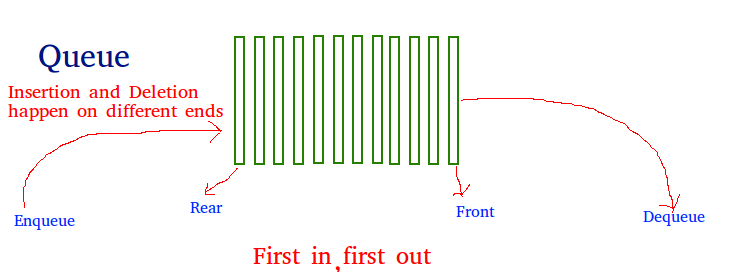
Queue is a linear data structure that follows the First In First Out (FIFO) principle. Elements are added at the rear (enqueue) and removed from the front (dequeue), similar to a real-world queue or line.
Key Properties
- Complexity: see the Time Complexity table above
- Core Idea: First element added is the first to be removed (FIFO)
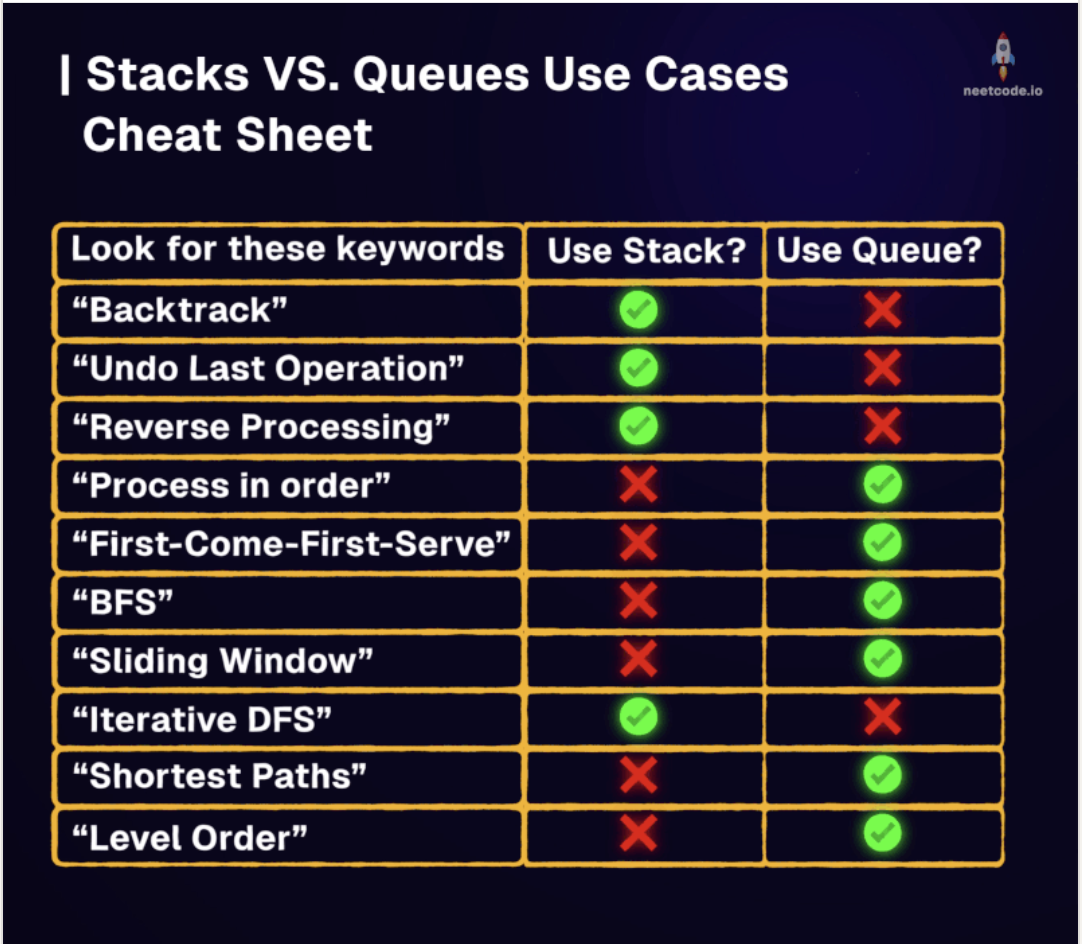
- When to Use: BFS traversal, level-order processing, task scheduling, buffering
Implementation Options
- Array-based: Fixed size, circular buffer for efficiency
- Linked List: Dynamic size, efficient operations
- Deque: Double-ended queue for both ends access
- Priority Queue: Elements processed by priority (covered separately)
References
Problem Categories
Pattern 1: BFS & Level-Order Traversal — LC 102
- Description: Layer-by-layer processing in trees and graphs
- Examples: LC 102, 103, 107, 199, 513, 515, 637
- Pattern: Process all nodes at current level before next level
Pattern 2: Sliding Window with Queue — LC 239
- Description: Maintaining window state with FIFO ordering
- Examples: LC 239, 346, 362, 933, 1438
- Pattern: Use deque for O(1) operations at both ends
Pattern 3: Design Queue Variants — LC 232
- Description: Implementing queue with constraints or special features
- Examples: LC 225, 232, 622, 641, 1670
- Pattern: Use stacks, arrays, or linked lists with specific logic
Pattern 4: Monotonic Queue — LC 239
- Description: Maintaining increasing/decreasing order in queue
- Examples: LC 239, 862, 907, 1425, 1696
- Pattern: Remove elements that break monotonic property
Pattern 5: Stream Processing — LC 346
- Description: Processing continuous data streams
- Examples: LC 346, 352, 362, 703, 933
- Pattern: Fixed-size window or time-based eviction
Pattern 6: Task Scheduling & Simulation — LC 621
- Description: Simulating real-world queuing systems
- Examples: LC 621, 1429, 1834, 2073
- Pattern: Process tasks in order with constraints
Templates & Algorithms
Template Comparison Table
| Template Type | Use Case | Implementation | Complexity | When to Use |
|---|---|---|---|---|
| Basic Queue | Simple FIFO | Array/LinkedList | O(1) ops | General queue operations |
| Circular Queue | Fixed size buffer | Array with pointers | O(1) ops | Bounded buffer, ring buffer |
| Deque | Both ends access | Double linked list | O(1) ops | Sliding window, palindrome |
| Monotonic Queue | Order maintenance | Deque with logic | O(1) amortized | Max/min in window |
| Queue with Stacks | Queue using stacks | Two stacks | O(1) amortized | Interview problems |
| Level-Order BFS | Tree/graph traversal | Queue + size tracking | O(n) | Layer processing |
Template 1: Basic Queue Operations
# Python - Using collections.deque (recommended)
from collections import deque

class Queue:
    def __init__(self):
        self.queue = deque()

    def enqueue(self, item):
        self.queue.append(item)  # Add to rear

    def dequeue(self):
        if not self.is_empty():
            return self.queue.popleft()  # Remove from front
        return None

    def front(self):
        if not self.is_empty():
            return self.queue[0]
        return None

    def is_empty(self):
        return len(self.queue) == 0

    def size(self):
        return len(self.queue)

# Using list (less efficient for dequeue)
class SimpleQueue:
    def __init__(self):
        self.queue = []

    def enqueue(self, item):
        self.queue.append(item)

    def dequeue(self):
        if self.queue:
            return self.queue.pop(0)  # O(n) operation
        return None
// Java - Using LinkedList
import java.util.*;

class Queue<T> {
    private LinkedList<T> queue;

    public Queue() {
        queue = new LinkedList<>();
    }

    public void enqueue(T item) {
        queue.addLast(item);  // Add to rear
    }

    public T dequeue() {
        if (!isEmpty()) {
            return queue.removeFirst();  // Remove from front
        }
        return null;
    }

    public T front() {
        if (!isEmpty()) {
            return queue.getFirst();
        }
        return null;
    }

    public boolean isEmpty() {
        return queue.isEmpty();
    }

    public int size() {
        return queue.size();
    }
}

// Using Java Queue interface
Queue<Integer> queue = new LinkedList<>();
queue.offer(1);  // enqueue
queue.poll();    // dequeue
queue.peek();    // front
Template 2: Level-Order BFS Pattern — LC 102 Priority 5 of 5 — Must know — expect it in almost every loop
# Python - Tree level-order traversal
def levelOrder(root):
    if not root:
        return []

    result = []
    queue = deque([root])

    while queue:
        level_size = len(queue)
        current_level = []

        # Process all nodes at current level
        for _ in range(level_size):
            node = queue.popleft()
            current_level.append(node.val)

            if node.left:
                queue.append(node.left)
            if node.right:
                queue.append(node.right)

        result.append(current_level)

    return result

# Graph BFS with distance
def bfs(graph, start):
    visited = set([start])
    queue = deque([(start, 0)])  # (node, distance)

    while queue:
        node, dist = queue.popleft()

        for neighbor in graph[node]:
            if neighbor not in visited:
                visited.add(neighbor)
                queue.append((neighbor, dist + 1))

    return visited
// Java - Level-order traversal
public List<List<Integer>> levelOrder(TreeNode root) {
    List<List<Integer>> result = new ArrayList<>();
    if (root == null) return result;

    Queue<TreeNode> queue = new LinkedList<>();
    queue.offer(root);

    while (!queue.isEmpty()) {
        int levelSize = queue.size();
        List<Integer> currentLevel = new ArrayList<>();

        for (int i = 0; i < levelSize; i++) {
            TreeNode node = queue.poll();
            currentLevel.add(node.val);

            if (node.left != null) {
                queue.offer(node.left);
            }
            if (node.right != null) {
                queue.offer(node.right);
            }
        }

        result.add(currentLevel);
    }

    return result;
}
Template 3: Circular Queue Pattern — LC 622 Priority 3 of 5 — Worth knowing — usually a variant of a must-know pattern
# Python - Fixed size circular queue
class CircularQueue:
    def __init__(self, k):
        self.queue = [0] * k
        self.capacity = k
        self.head = 0
        self.count = 0

    def enqueue(self, value):
        if self.is_full():
            return False

        # Calculate tail position
        tail = (self.head + self.count) % self.capacity
        self.queue[tail] = value
        self.count += 1
        return True

    def dequeue(self):
        if self.is_empty():
            return False

        self.head = (self.head + 1) % self.capacity
        self.count -= 1
        return True

    def front(self):
        if self.is_empty():
            return -1
        return self.queue[self.head]

    def rear(self):
        if self.is_empty():
            return -1
        tail = (self.head + self.count - 1) % self.capacity
        return self.queue[tail]

    def is_empty(self):
        return self.count == 0

    def is_full(self):
        return self.count == self.capacity
// Java - Circular Queue
class CircularQueue {
    private int[] queue;
    private int head;
    private int count;
    private int capacity;

    public CircularQueue(int k) {
        queue = new int[k];
        capacity = k;
        head = 0;
        count = 0;
    }

    public boolean enqueue(int value) {
        if (isFull()) return false;

        int tail = (head + count) % capacity;
        queue[tail] = value;
        count++;
        return true;
    }

    public boolean dequeue() {
        if (isEmpty()) return false;

        head = (head + 1) % capacity;
        count--;
        return true;
    }

    public int front() {
        if (isEmpty()) return -1;
        return queue[head];
    }

    public int rear() {
        if (isEmpty()) return -1;
        int tail = (head + count - 1) % capacity;
        return queue[tail];
    }

    public boolean isEmpty() {
        return count == 0;
    }

    public boolean isFull() {
        return count == capacity;
    }
}
Template 4: Monotonic Queue Pattern — LC 239 Priority 5 of 5 — Must know — expect it in almost every loop
# Python - Monotonic decreasing queue for sliding window maximum
class MonotonicQueue:
    def __init__(self):
        self.queue = deque()

    def push(self, val):
        # Remove smaller elements from rear
        while self.queue and self.queue[-1] < val:
            self.queue.pop()
        self.queue.append(val)

    def pop(self, val):
        # Remove if it's the front element
        if self.queue and self.queue[0] == val:
            self.queue.popleft()

    def max(self):
        # Front is always the maximum
        return self.queue[0] if self.queue else None

# Sliding window maximum
def maxSlidingWindow(nums, k):
    from collections import deque

    dq = deque()  # Store indices
    result = []

    for i in range(len(nums)):
        # Remove indices outside window
        while dq and dq[0] <= i - k:
            dq.popleft()

        # Remove smaller elements
        while dq and nums[dq[-1]] <= nums[i]:
            dq.pop()

        dq.append(i)

        # Add to result after first window
        if i >= k - 1:
            result.append(nums[dq[0]])

    return result
// Java - Monotonic Queue
class MonotonicQueue {
    private LinkedList<Integer> queue;

    public MonotonicQueue() {
        queue = new LinkedList<>();
    }

    public void push(int val) {
        // Remove smaller elements from rear
        while (!queue.isEmpty() && queue.getLast() < val) {
            queue.pollLast();
        }
        queue.addLast(val);
    }

    public void pop(int val) {
        // Remove if it's the front element
        if (!queue.isEmpty() && queue.getFirst() == val) {
            queue.pollFirst();
        }
    }

    public int max() {
        return queue.isEmpty() ? -1 : queue.getFirst();
    }
}

// Sliding window maximum
public int[] maxSlidingWindow(int[] nums, int k) {
    Deque<Integer> dq = new LinkedList<>();
    int[] result = new int[nums.length - k + 1];
    int idx = 0;

    for (int i = 0; i < nums.length; i++) {
        // Remove indices outside window
        while (!dq.isEmpty() && dq.peekFirst() <= i - k) {
            dq.pollFirst();
        }

        // Remove smaller elements
        while (!dq.isEmpty() && nums[dq.peekLast()] <= nums[i]) {
            dq.pollLast();
        }

        dq.offerLast(i);

        // Add to result after first window
        if (i >= k - 1) {
            result[idx++] = nums[dq.peekFirst()];
        }
    }

    return result;
}
Template 5: Queue Using Stacks Pattern — LC 232 Priority 4 of 5 — High value — a gap here costs you rounds
# Python - Implement queue using two stacks
class MyQueue:
    def __init__(self):
        self.in_stack = []   # For enqueue
        self.out_stack = []  # For dequeue

    def push(self, x):
        self.in_stack.append(x)

    def pop(self):
        self.peek()  # Ensure out_stack has elements
        return self.out_stack.pop()

    def peek(self):
        if not self.out_stack:
            # Transfer all from in_stack to out_stack
            while self.in_stack:
                self.out_stack.append(self.in_stack.pop())
        return self.out_stack[-1] if self.out_stack else None

    def empty(self):
        return len(self.in_stack) == 0 and len(self.out_stack) == 0
// Java - Queue using stacks
class MyQueue {
    private Stack<Integer> inStack;
    private Stack<Integer> outStack;

    public MyQueue() {
        inStack = new Stack<>();
        outStack = new Stack<>();
    }

    public void push(int x) {
        inStack.push(x);
    }

    public int pop() {
        peek();  // Ensure outStack has elements
        return outStack.pop();
    }

    public int peek() {
        if (outStack.isEmpty()) {
            // Transfer all from inStack to outStack
            while (!inStack.isEmpty()) {
                outStack.push(inStack.pop());
            }
        }
        return outStack.peek();
    }

    public boolean empty() {
        return inStack.isEmpty() && outStack.isEmpty();
    }
}
Template 6: Stream Processing Pattern — LC 346
# Python - Moving average from data stream
class MovingAverage:
    def __init__(self, size):
        self.queue = deque()
        self.window_sum = 0
        self.size = size

    def next(self, val):
        self.queue.append(val)
        self.window_sum += val

        if len(self.queue) > self.size:
            removed = self.queue.popleft()
            self.window_sum -= removed

        return self.window_sum / len(self.queue)

# Hit counter for last 5 minutes
class HitCounter:
    def __init__(self):
        self.queue = deque()

    def hit(self, timestamp):
        self.queue.append(timestamp)

    def getHits(self, timestamp):
        # Remove hits older than 5 minutes (300 seconds)
        while self.queue and self.queue[0] <= timestamp - 300:
            self.queue.popleft()
        return len(self.queue)
// Java - Moving average
class MovingAverage {
    private Queue<Integer> queue;
    private int windowSum;
    private int size;

    public MovingAverage(int size) {
        queue = new LinkedList<>();
        this.size = size;
        windowSum = 0;
    }

    public double next(int val) {
        queue.offer(val);
        windowSum += val;

        if (queue.size() > size) {
            windowSum -= queue.poll();
        }

        return (double) windowSum / queue.size();
    }
}
Template 7: Flatten-to-Queue Iterator Pattern — LC 341
Key Idea: an iterator over a nested structure becomes trivial once the structure is flattened into a FIFO queue in the constructor.
next()=popleft(),hasNext()=queue is non-empty.
// LC 341 - Flatten Nested List Iterator
// IDEA: Eagerly DFS-flatten the nested list into a queue; next()/hasNext() are O(1)
// time = O(N) constructor + O(1) per next/hasNext, space = O(N)
public class NestedIterator implements Iterator<Integer> {
    private final Deque<Integer> queue = new ArrayDeque<>();

    public NestedIterator(List<NestedInteger> nestedList) {
        flatten(nestedList);
    }

    private void flatten(List<NestedInteger> list) {
        for (NestedInteger ni : list) {
            if (ni.isInteger()) {
                queue.addLast(ni.getInteger());
            } else {
                flatten(ni.getList()); // recurse into sub-list
            }
        }
    }

    @Override
    public Integer next() { return queue.pollFirst(); }

    @Override
    public boolean hasNext() { return !queue.isEmpty(); }
}
# python
# LC 341 - Flatten Nested List Iterator
# IDEA: Eagerly DFS-flatten the nested list into a deque; next()/hasNext() are O(1)
# time = O(N) constructor + O(1) per next/hasNext, space = O(N)
from collections import deque

class NestedIterator:
    def __init__(self, nestedList):
        self.q = deque()
        self._flatten(nestedList)

    def _flatten(self, lst):
        for ni in lst:
            if ni.isInteger():
                self.q.append(ni.getInteger())
            else:
                self._flatten(ni.getList())   # recurse into sub-list

    def next(self):
        return self.q.popleft()

    def hasNext(self):
        return len(self.q) > 0
Interview follow-up: “what if the list is huge / infinite?” → switch to the lazy stack variant: push
nestedListreversed onto a stack, and inhasNext()keep popping+expanding while the top is a list. Same amortized O(1), but only O(depth + top-level size) extra space instead of O(N).
Template 8: First-Unique Queue (Queue + Count Map) Pattern — LC 387
Key Idea: keep a queue of candidate elements and a count map. Before answering, evict from the front every candidate whose count has grown past 1. Front is then the first still-unique element. Works online (streaming), unlike the count-then-rescan solution.
// LC 387 - First Unique Character in a String
// IDEA: Queue of candidate indices + freq map; evict front while it's no longer unique
// time = O(N) (each index enqueued/dequeued once), space = O(N)
public int firstUniqChar(String s) {
    int[] cnt = new int[26];
    Deque<Integer> q = new ArrayDeque<>(); // candidate indices, in arrival order

    for (int i = 0; i < s.length(); i++) {
        cnt[s.charAt(i) - 'a']++;
        q.addLast(i);
        // front is only valid while it is still unique
        while (!q.isEmpty() && cnt[s.charAt(q.peekFirst()) - 'a'] > 1) {
            q.pollFirst();
        }
    }
    return q.isEmpty() ? -1 : q.peekFirst();
}
# python
# LC 387 - First Unique Character in a String
# IDEA: Queue of candidate indices + freq map; evict front while it's no longer unique
# time = O(N) (each index enqueued/dequeued once), space = O(N)
from collections import deque, defaultdict

def firstUniqChar(s):
    cnt = defaultdict(int)
    q = deque()  # candidate indices, in arrival order

    for i, c in enumerate(s):
        cnt[c] += 1
        q.append(i)
        # front is only valid while it is still unique
        while q and cnt[s[q[0]]] > 1:
            q.popleft()

    return q[0] if q else -1
Variation — LC 1429 (First Unique Number): same structure, but the eviction loop moves into
showFirstUnique()andadd()only updates the count + enqueues. That makes it a design problem with amortized O(1) per call.
Template 9: Queue Rotation / Simulation Pattern — LC 1823
Key Idea: when a problem describes people/cards cycling through a line, literally simulate it:
q.addLast(q.pollFirst())rotates one step;q.pollFirst()eliminates. The deque is the circle.
// LC 1823 - Find the Winner of the Circular Game (Josephus)
// IDEA: Rotate k-1 survivors to the back, then eliminate the front; repeat until 1 left
// time = O(N * k), space = O(N)
public int findTheWinner(int n, int k) {
    Deque<Integer> q = new ArrayDeque<>();
    for (int i = 1; i <= n; i++) q.addLast(i);

    while (q.size() > 1) {
        for (int i = 0; i < k - 1; i++) {
            q.addLast(q.pollFirst()); // survivors go to the back
        }
        q.pollFirst();                // k-th player is out
    }
    return q.peekFirst();
}

// O(N) time / O(1) space math alternative (Josephus recurrence):
// f(1) = 0 ; f(i) = (f(i-1) + k) % i ; answer = f(n) + 1
public int findTheWinnerMath(int n, int k) {
    int ans = 0;
    for (int i = 2; i <= n; i++) ans = (ans + k) % i;
    return ans + 1;
}
# python
# LC 1823 - Find the Winner of the Circular Game (Josephus)
# IDEA: Rotate k-1 survivors to the back, then eliminate the front; repeat until 1 left
# time = O(N * k), space = O(N)
from collections import deque

def findTheWinner(n, k):
    q = deque(range(1, n + 1))
    while len(q) > 1:
        q.rotate(-(k - 1))   # move k-1 survivors to the back
        q.popleft()          # k-th player is out
    return q[0]

# O(N) time / O(1) space math alternative
def findTheWinnerMath(n, k):
    ans = 0
    for i in range(2, n + 1):
        ans = (ans + k) % i
    return ans + 1
Variations of the same simulation idea:
- LC 950 (Reveal Cards In Increasing Order) — twist: simulate the process backwards. Sort ascending, then walk the sorted deck from largest to smallest; each step undo one round: move the back card to the front, then push the new card to the front.
- LC 649 (Dota2 Senate) — twist: two queues instead of one. Queue the indices of each party; each round pop one from each, the smaller index wins and is re-queued at
index + n(i.e. next round).
// LC 950 - Reveal Cards In Increasing Order
// IDEA: Reverse-simulate the reveal: undo "move top to bottom", then undo "reveal"
// time = O(N log N) (sort), space = O(N)
public int[] deckRevealedIncreasing(int[] deck) {
    Arrays.sort(deck);
    Deque<Integer> q = new ArrayDeque<>();
    for (int i = deck.length - 1; i >= 0; i--) {
        if (!q.isEmpty()) q.addFirst(q.pollLast()); // undo: bottom card back to top
        q.addFirst(deck[i]);                        // undo: put the revealed card back
    }
    int[] ans = new int[deck.length];
    int i = 0;
    for (int v : q) ans[i++] = v;
    return ans;
}

// LC 649 - Dota2 Senate
// IDEA: Two index queues; smaller index bans the other and re-enters at index + n
// time = O(N), space = O(N)
public String predictPartyVictory(String senate) {
    int n = senate.length();
    Queue<Integer> radiant = new LinkedList<>(), dire = new LinkedList<>();
    for (int i = 0; i < n; i++) {
        if (senate.charAt(i) == 'R') radiant.offer(i);
        else dire.offer(i);
    }
    while (!radiant.isEmpty() && !dire.isEmpty()) {
        int r = radiant.poll(), d = dire.poll();
        if (r < d) radiant.offer(r + n); // R acts first, survives to next round
        else dire.offer(d + n);
    }
    return radiant.isEmpty() ? "Dire" : "Radiant";
}
# python
# LC 950 - Reveal Cards In Increasing Order
# time = O(N log N) (sort), space = O(N)
from collections import deque

def deckRevealedIncreasing(deck):
    deck.sort()
    q = deque()
    for x in reversed(deck):
        if q:
            q.appendleft(q.pop())  # undo: bottom card back to top
        q.appendleft(x)            # undo: put the revealed card back
    return list(q)

# LC 649 - Dota2 Senate
# time = O(N), space = O(N)
def predictPartyVictory(senate):
    n = len(senate)
    radiant = deque(i for i, c in enumerate(senate) if c == 'R')
    dire    = deque(i for i, c in enumerate(senate) if c == 'D')
    while radiant and dire:
        r, d = radiant.popleft(), dire.popleft()
        if r < d:
            radiant.append(r + n)  # R acts first, survives to next round
        else:
            dire.append(d + n)
    return "Radiant" if radiant else "Dire"
Template 10: Queue of Active Window Effects Pattern — LC 995
Key Idea: when an operation at index
iaffects the nextkindices, don’t re-apply itktimes. Push its start index into a queue, expire it from the front oncefront + k <= i, and letqueue.size()tell you how many effects are still active ati. (Same trick as a difference array, but expressed with a queue.)
// LC 995 - Minimum Number of K Consecutive Bit Flips
// IDEA: Queue holds start indices of flips still covering i; parity of queue size = current value
// time = O(N), space = O(k)
public int minKBitFlips(int[] nums, int k) {
    int n = nums.length, res = 0;
    Deque<Integer> flips = new ArrayDeque<>(); // start indices of active flips

    for (int i = 0; i < n; i++) {
        // expire flips whose window [start, start + k) no longer covers i
        while (!flips.isEmpty() && flips.peekFirst() + k <= i) {
            flips.pollFirst();
        }
        // effective value = nums[i] flipped flips.size() times
        if ((nums[i] + flips.size()) % 2 == 0) { // still 0 -> must start a flip here
            if (i + k > n) return -1;            // window would run off the end
            flips.addLast(i);
            res++;
        }
    }
    return res;
}
# python
# LC 995 - Minimum Number of K Consecutive Bit Flips
# IDEA: Queue holds start indices of flips still covering i; parity of queue size = current value
# time = O(N), space = O(k)
from collections import deque

def minKBitFlips(nums, k):
    n, res = len(nums), 0
    flips = deque()  # start indices of active flips

    for i, x in enumerate(nums):
        # expire flips whose window [start, start + k) no longer covers i
        while flips and flips[0] + k <= i:
            flips.popleft()
        # effective value = x flipped len(flips) times
        if (x + len(flips)) % 2 == 0:   # still 0 -> must start a flip here
            if i + k > n:
                return -1               # window would run off the end
            flips.append(i)
            res += 1
    return res
Problems by Pattern
Pattern-Based Problem Tables
BFS & Level-Order Problems
| Problem | LC # | Key Technique | Difficulty |
|---|---|---|---|
| Binary Tree Level Order Traversal | 102 | Queue + level tracking | Medium |
| Binary Tree Zigzag Level Order | 103 | Queue + direction flag | Medium |
| Binary Tree Level Order II | 107 | Queue + reverse result | Medium |
| Binary Tree Right Side View | 199 | Queue + last in level | Medium |
| Find Bottom Left Tree Value | 513 | Queue + track level | Medium |
| Find Largest Value in Each Tree Row | 515 | Queue + max per level | Medium |
| Average of Levels in Binary Tree | 637 | Queue + sum per level | Easy |
| Maximum Width of Binary Tree | 662 | Queue + position encoding | Medium |
| Populating Next Right Pointers | 116 | Queue + level connection | Medium |
| N-ary Tree Level Order Traversal | 429 | Queue + multiple children | Medium |
Sliding Window Queue Problems
| Problem | LC # | Key Technique | Difficulty |
|---|---|---|---|
| Sliding Window Maximum | 239 | Monotonic deque | Hard |
| Moving Average from Data Stream | 346 | Fixed size queue | Easy |
| Design Hit Counter | 362 | Time-based eviction | Medium |
| Number of Recent Calls | 933 | Time window queue | Easy |
| Longest Subarray Absolute Diff | 1438 | Two deques (min/max) | Medium |
| Jump Game VI | 1696 | DP + monotonic queue | Medium |
| Constrained Subsequence Sum | 1425 | DP + monotonic queue | Hard |
Design Queue Problems
| Problem | LC # | Key Technique | Difficulty |
|---|---|---|---|
| Implement Stack using Queues | 225 | Two queues or rotation | Easy |
| Implement Queue using Stacks | 232 | Two stacks | Easy |
| Design Circular Queue | 622 | Array with pointers | Medium |
| Design Circular Deque | 641 | Double-ended circular | Medium |
| Design Front Middle Back Queue | 1670 | Two deques balance | Medium |
| Design Most Recently Used Queue | 1756 | Deque + set | Medium |
Monotonic Queue Problems
| Problem | LC # | Key Technique | Difficulty |
|---|---|---|---|
| Sliding Window Maximum | 239 | Decreasing monotonic | Hard |
| Shortest Subarray with Sum K | 862 | Prefix sum + monotonic | Hard |
| Sum of Subarray Minimums | 907 | Monotonic stack/queue | Medium |
| Maximum Score of Good Subarray | 1793 | Monotonic boundaries | Hard |
| Jump Game VI | 1696 | DP + monotonic queue | Medium |
| Longest Continuous Subarray | 1438 | Two monotonic queues | Medium |
| Maximum Sum Circular Subarray | 918 | Prefix sums over doubled array + deque (window ≤ n) — see monotonic_queue.md | Medium |
Iterator & Queue Simulation Problems
| Problem | LC # | Key Technique | Difficulty |
|---|---|---|---|
| Flatten Nested List Iterator | 341 | Flatten-to-queue in constructor (Template 7) | Medium |
| First Unique Character in a String | 387 | Queue of candidates + count map (Template 8) | Easy |
| First Unique Number | 1429 | Same as 387, as a design/streaming problem | Medium |
| Find the Winner of the Circular Game | 1823 | Rotate-and-eliminate / Josephus (Template 9) | Medium |
| Reveal Cards In Increasing Order | 950 | Reverse simulation with a deque (Template 9) | Medium |
| Dota2 Senate | 649 | Two index queues, re-queue at i + n (Template 9) |
Medium |
| Minimum Number of K Consecutive Bit Flips | 995 | Queue of active window effects (Template 10) | Hard |
Stream Processing Problems
| Problem | LC # | Key Technique | Difficulty |
|---|---|---|---|
| Moving Average from Data Stream | 346 | Fixed window | Easy |
| Data Stream as Disjoint Intervals | 352 | Interval merging | Hard |
| Design Hit Counter | 362 | Time-based queue | Medium |
| Logger Rate Limiter | 359 | Time window | Easy |
| Number of Recent Calls | 933 | Time window | Easy |
| Finding MK Average | 1825 | Multiple queues | Hard |
Task Scheduling Problems
| Problem | LC # | Key Technique | Difficulty |
|---|---|---|---|
| Task Scheduler | 621 | Queue + cooling time | Medium |
| Design a Number Container | 2349 | Queue per number | Medium |
| Time Needed to Buy Tickets | 2073 | Queue simulation | Easy |
| Single-Threaded CPU | 1834 | Queue + priority queue | Medium |
| Number of Visible People in Queue | 1944 | Monotonic stack | Hard |
Pattern Selection Strategy
Problem Analysis Flowchart:

1. Is it a tree/graph traversal problem?
   ├── YES → Use BFS with Queue
   │         ├── Level-order → Track level size
   │         └── Shortest path → Track distance
   └── NO → Continue to 2

2. Do you need to maintain window order?
   ├── YES → Use Sliding Window Queue
   │         ├── Max/Min → Monotonic queue
   │         └── Fixed size → Regular queue
   └── NO → Continue to 3

3. Is it a design problem?
   ├── YES → Choose appropriate structure
   │         ├── Fixed size → Circular queue
   │         ├── Both ends → Deque
   │         └── Stack behavior → Queue with rotation
   └── NO → Continue to 4

4. Need monotonic property?
   ├── YES → Use Monotonic Queue
   │         ├── Increasing → Remove larger from rear
   │         └── Decreasing → Remove smaller from rear
   └── NO → Continue to 5

5. Processing data stream?
   ├── YES → Use Stream Processing
   │         ├── Time window → Remove old entries
   │         └── Count window → Fixed size queue
   └── NO → Use basic queue operations
Basic Operations Reference
Python collections.deque
from collections import deque

# Create deque
dq = deque()
dq = deque([1, 2, 3])
dq = deque(maxlen=10)  # Fixed size

# Add elements
dq.append(4)       # Add to right: [1,2,3,4]
dq.appendleft(0)   # Add to left: [0,1,2,3,4]
dq.extend([5,6])   # Extend right: [0,1,2,3,4,5,6]
dq.extendleft([-2,-1]) # Extend left: [-1,-2,0,1,2,3,4,5,6]

# Remove elements
val = dq.pop()     # Remove from right
val = dq.popleft() # Remove from left

# Access elements
first = dq[0]      # Access by index
last = dq[-1]      # Last element

# Other operations
dq.rotate(2)       # Rotate right by 2
dq.rotate(-1)      # Rotate left by 1
dq.reverse()       # Reverse in-place
dq.clear()         # Remove all elements

# Check state
size = len(dq)
is_empty = len(dq) == 0
count = dq.count(value)
index = dq.index(value)
Java Queue & Deque Operations Priority 4 of 5 — High value — a gap here costs you rounds
import java.util.*;

// Queue interface (FIFO)
Queue<Integer> queue = new LinkedList<>();
queue.offer(1);    // Add to rear (returns boolean)
queue.add(2);      // Add to rear (throws exception)
Integer val = queue.poll();  // Remove from front (returns null)
val = queue.remove();        // Remove from front (throws exception)
val = queue.peek();          // View front (returns null)
val = queue.element();       // View front (throws exception)

// Deque interface (double-ended)
Deque<Integer> deque = new LinkedList<>();
// or ArrayDeque for better performance
Deque<Integer> deque = new ArrayDeque<>();

// Add operations
deque.addFirst(1);     // Add to front
deque.addLast(2);      // Add to rear
deque.offerFirst(0);   // Add to front (returns boolean)
deque.offerLast(3);    // Add to rear (returns boolean)

// Remove operations
val = deque.removeFirst(); // Remove from front
val = deque.removeLast();  // Remove from rear
val = deque.pollFirst();   // Remove from front (returns null)
val = deque.pollLast();    // Remove from rear (returns null)

// Peek operations
val = deque.peekFirst();   // View front
val = deque.peekLast();    // View rear
val = deque.getFirst();    // View front (throws exception)
val = deque.getLast();     // View rear (throws exception)

// Stack operations on Deque
deque.push(5);         // Push to front (stack top)
val = deque.pop();     // Pop from front (stack top)
Summary & Quick Reference
Complexity Quick Reference
| Operation | Array Queue | Linked Queue | Deque | Circular Queue |
|---|---|---|---|---|
| Enqueue | O(1) | O(1) | O(1) | O(1) |
| Dequeue | O(n) | O(1) | O(1) | O(1) |
| Peek Front | O(1) | O(1) | O(1) | O(1) |
| Peek Rear | O(1) | O(1) | O(1) | O(1) |
| Space | O(n) | O(n) | O(n) | O(k) fixed |
Template Quick Reference
| Template | Pattern | Key Code |
|---|---|---|
| BFS | Level processing | for _ in range(level_size) |
| Circular | Fixed buffer | (head + count) % capacity |
| Monotonic | Order maintenance | while q and q[-1] < val: q.pop() |
| Two Stacks | Queue simulation | if not out: transfer from in |
| Sliding | Window tracking | if i >= k-1: result.append() |
| Stream | Time/count window | while old: queue.popleft() |
Common Patterns & Tricks
Level-Order Processing
# Process nodes level by level
level_size = len(queue)
for _ in range(level_size):
    node = queue.popleft()
    # Process node
    # Add children
Circular Index Calculation
# Wrap around in circular buffer
tail_index = (head + count) % capacity
next_index = (current + 1) % capacity
Monotonic Property Maintenance
# Decreasing monotonic queue
while queue and queue[-1] < new_val:
    queue.pop()
queue.append(new_val)
Two-Stack Queue Optimization
# Amortized O(1) operations
if not out_stack:
    while in_stack:
        out_stack.append(in_stack.pop())
Problem-Solving Steps
-
Identify Queue Usage
- FIFO processing needed?
- Level-by-level traversal?
- Sliding window with order?
- Stream processing?
-
Choose Implementation
- Simple queue → deque or LinkedList
- Fixed size → Circular queue
- Both ends → Deque
- Priority → Priority Queue (separate DS)
-
Handle Edge Cases
- Empty queue operations
- Full queue (for bounded queues)
- Single element scenarios
- Wraparound in circular queues
-
Optimize Operations
- Use deque for O(1) operations
- Circular buffer for fixed size
- Two stacks for interview problems
- Monotonic for min/max queries
Common Mistakes & Tips
🚫 Common Mistakes:
- Using list.pop(0) in Python (O(n) operation)
- Forgetting to track level size in BFS
- Not handling circular wraparound correctly
- Mixing up queue.poll() vs queue.remove() in Java
- Not maintaining monotonic property correctly
✅ Best Practices:
- Always use collections.deque in Python
- Use ArrayDeque over LinkedList in Java for better performance
- Track queue size explicitly for level-order
- Clear old elements in sliding window
- Use modulo for circular indexing
Interview Tips
-
Clarify Requirements
- Fixed or dynamic size?
- Need access to both ends?
- Thread safety required?
- Space constraints?
-
BFS vs DFS Decision
- BFS → Shortest path, level-order
- DFS → Path finding, backtracking
- Queue for BFS, Stack for DFS
-
Implementation Choice
- Python: Always prefer deque
- Java: ArrayDeque for performance
- Consider circular for bounded problems
-
Common Follow-ups
- Make it thread-safe
- Handle multiple producers/consumers
- Implement with different constraints
- Optimize space/time complexity
Advanced Techniques
Lock-Free Queue
- Used in concurrent programming
- Compare-and-swap operations
- Michael & Scott algorithm
Priority Deque
- Combines priority queue and deque
- Double-ended priority queue
- Interval heap implementation
Persistent Queue
- Immutable queue with versioning
- Functional programming style
- Uses two stacks internally
Related Topics
- Stack: LIFO vs FIFO comparison
- Priority Queue: Ordered processing
- BFS: Primary application of queues
- Circular Buffer: Fixed-size queue implementation
- Producer-Consumer: Classic queue application
LC Examples
2-1) Sliding Window Maximum — LC 239
Maintain a decreasing deque of indices; front is always the current window maximum.
// LC 239 - Sliding Window Maximum
// IDEA: Monotonic deque — remove out-of-window front, remove smaller rear, front = max
// time = O(N), space = O(k)
public int[] maxSlidingWindow(int[] nums, int k) {
    int n = nums.length;
    int[] ans = new int[n - k + 1];
    Deque<Integer> dq = new ArrayDeque<>(); // indices, decreasing by value
    for (int i = 0; i < n; i++) {
        while (!dq.isEmpty() && dq.peekFirst() < i - k + 1) dq.pollFirst();
        while (!dq.isEmpty() && nums[dq.peekLast()] < nums[i]) dq.pollLast();
        dq.addLast(i);
        if (i >= k - 1) ans[i - k + 1] = nums[dq.peekFirst()];
    }
    return ans;
}
2-2) Design Circular Queue — LC 622
Fixed-size array; track head index and count; use modular arithmetic for wrap-around.
// LC 622 - Design Circular Queue
// IDEA: Fixed array + head pointer + count; tail = (head + count - 1) % capacity
// time = O(1) all ops, space = O(k)
class MyCircularQueue {
    int[] data;
    int head, count, capacity;
    public MyCircularQueue(int k) { data = new int[k]; capacity = k; }
    public boolean enQueue(int value) {
        if (isFull()) return false;
        data[(head + count) % capacity] = value;
        count++;
        return true;
    }
    public boolean deQueue() {
        if (isEmpty()) return false;
        head = (head + 1) % capacity;
        count--;
        return true;
    }
    public int Front() { return isEmpty() ? -1 : data[head]; }
    public int Rear()  { return isEmpty() ? -1 : data[(head + count - 1) % capacity]; }
    public boolean isEmpty() { return count == 0; }
    public boolean isFull()  { return count == capacity; }
}