Binary Search
Scope — Halving a monotonic search space — the loop-invariant reasoning behind
l <= rvsl < r, the boundary (lower/upper bound) templates, rotated arrays, and floating-point and 2D search. See also — deep dives split out of this file: binary_search_on_answer.md — searching the answer space: thecanFinish/isValidpredicate, minimise-maximum vs maximise-minimum, and value-domain counting; binary_search_examples.md — the worked-problem archive, one canonical solution per problem. Neighbouring sheets: patience_sorting.md — §1.5’s scan told as the card game, with reconstruction, the pile/Dilworth proof and the LIS-reduction problems; sort.md — getting the array sorted first; advanced_divide_and_conquer.md — halving with a merge step; bst.md — the same invariant as a data structure; heap.md — k-th element without ordering; monotonic_stack.md — the positional “next greater”, which is the pattern lower bound is most often confused with.
LeetCode Problem Lists
Overview
Binary Search is an efficient algorithm to find a target value in a sorted search space using two pointers.
Key Properties
- Time Complexity: O(log n)
- Space Complexity: O(1) iterative, O(log n) recursive
- Prerequisites: Sorted array OR monotonic property
- Search Space: Not limited to fully sorted arrays - works with:
- Fully sorted arrays
- Partially sorted arrays
- Rotated sorted arrays
- Any space with monotonic properties
Core Algorithm Steps
- Define boundaries: Initialize
leftandrightpointers to include all possible cases - Define return values: Determine what to return (index, value, -1, etc.)
- Define exit condition: Choose appropriate loop condition (
<=,<, or< -1) - Update pointers: Move boundaries based on comparison with target
When to Use Binary Search
- Sorted arrays: Classic use case for finding exact values
- Monotonic functions: If
condition(k)impliescondition(k+1), binary search applies - Search boundaries: Finding first/last occurrence of a value
- Optimization problems: Finding minimum/maximum values satisfying constraints
References
- Frameworks:
- Problem Collections:
- Python Tools:
- Python bisect module - maintains sorted order during insertions
- Python Universal Binary Search Template - one template, many problems
Understanding Binary Search Pointer Behavior
Core Insight: What Do l and r Actually Mean?
This is the fundamental concept that makes binary search work and explains why returning l is correct for insertion position problems like LC 35.
During the Loop: The Search Space Invariant
Throughout the binary search loop while (l <= r):
- Everything left of
lis strictly< target - Everything right of
ris strictly> target - The possible location of
targetis always inside[l, r]
Each iteration removes half the search space while preserving this invariant.
// Standard binary search pattern
while (l <= r) {
    int mid = l + (r - l) / 2;

    if (nums[mid] == target) {
        return mid;
    } else if (nums[mid] < target) {
        l = mid + 1;  // All elements [0..mid] are < target
    } else {
        r = mid - 1;  // All elements [mid..end] are > target
    }
}
When the Loop Ends: Pointer Positions
The loop terminates when l > r, which means l == r + 1.
At this exact moment, the array is split into two parts:
Visual Representation:

index:     0   ...   r   l   ...   n-1
value:   [< target]  gap  [> target]
Key Properties When Loop Ends:
ris the last element smaller than targetlis the first element greater than or equal to target- There is no index between r and l (since
r = l - 1)
This is why l is the correct insertion position!
Visual Example
Let’s trace through nums = [1, 3, 5, 6], target = 4:
Initial:
l=0, r=3
[1, 3, 5, 6]
 l        r

Step 1:
mid = 1, nums[1] = 3
3 < 4, so l = mid + 1 = 2
[1, 3, 5, 6]
       l  r

Step 2:
mid = 2, nums[2] = 5
5 > 4, so r = mid - 1 = 1
[1, 3, 5, 6]
    r  l

Loop ends (l > r):
- r points to 3 (last element < 4)
- l points to 5 (first element > 4)
- Insertion position is l = 2
Summary Table
| State | l Position |
r Position |
Meaning |
|---|---|---|---|
| During loop | First unchecked index >= target | Last unchecked index <= target | Search space is [l, r] |
| Loop ends | First element >= target | Last element < target | l is insertion point |
| Visual | ... r | l ... |
No gap between them | l = r + 1 |
Application: Search Insert Position (LC 35)
// LC 35 - The cleanest solution using pointer behavior
public int searchInsert(int[] nums, int target) {
    if (nums == null || nums.length == 0) {
        return 0;
    }

    int l = 0;
    int r = nums.length - 1;

    while (l <= r) {
        int mid = l + (r - l) / 2;

        if (nums[mid] == target) {
            return mid;
        } else if (nums[mid] < target) {
            l = mid + 1;
        } else {
            r = mid - 1;
        }
    }

    // Key insight: l is always the correct insertion position
    return l;
}
Why this works without special cases:
- If target exists: we return mid during the loop
- If target doesn’t exist:
- Loop ends with
l > r - By invariant:
nums[0..l-1] < targetandnums[l..end] >= target - Therefore
lis exactly where target should be inserted
- Loop ends with
Common Mistake to Avoid
// ❌ WRONG: Trying to handle "between mid and mid+1" during the loop
while (l <= r) {
    int mid = l + (r - l) / 2;
    if (nums[mid] == target) return mid;

    // This is unnecessary and error-prone!
    // ❌ WRONG — can cause index out of bounds
    if (mid + 1 <= nums.length - 1 && target < nums[mid+1] && target > nums[mid]) {
        return mid + 1;
    }
    // ...
}
Why this is wrong: Binary search naturally converges to the correct position. Trust the pointer invariant and just return l after the loop.
1) Binary Search Types & Patterns
1.1) Types at a Glance
Basic Binary Search — LC 704 (canonical template: §2.1)
- Purpose: Find exact target value in sorted array
- Return: Index of target, or -1 if not found
- Complexity: O(log n)
Recursive Binary Search
- Use Cases: When recursive approach is more intuitive
- Space: O(log n) due to call stack
Search in Rotated Array (§1.2)
- Key Concept: Determine which half is sorted, then decide search direction
- Applications: Find target, find minimum element
Find Boundaries — left / right, i.e. lower / upper bound (§1.3)
- Purpose: Find the first / last index satisfying a predicate instead of an exact value
- Return: The partition point — never
return mid
Search in 2D Matrix (§2.3)
- Approach 1: Flatten matrix using
row = idx / cols,col = idx % cols - Approach 2: Row-by-row binary search
- Time: O(log(m×n))
Binary Search on Answer Space (§1.4)
- Purpose: Search a range of candidate answers, not an array
- Return: The boundary of a monotone feasibility predicate
Binary Search into an Array You Maintain — the tails pattern (§1.5)
- Purpose: Collapse an
O(n²)“best per achieved length” DP into one lower-bound lookup - Return: The size of the maintained array (a length, not the chain)
1.2) Rotated Sorted Array — Find the Pivot
- Key Concept: Determine which half is sorted, then decide search direction
- Applications: Find target, find minimum element
Find Minimum in Rotated Sorted Array (LC 153) Priority 5 of 5 — Must know — expect it in almost every loop
Pattern: Find Rotation Point
A rotated sorted array always has this structure:
[Left Higher Plateau] > [Right Lower Plateau]
e.g. [3, 4, 5, 1, 2]
      ^^^^^^^^  ^^^^
      left part  right part (contains minimum)
The minimum is always at the rotation point — the single “drop” in the array.
Core Idea
Check which side of mid is on which plateau, then move toward the unsorted side (which contains the minimum):
Rotation examples (length 5):
[1, 2, 3, 4, 5]  → already sorted, min at index 0
[5, 1, 2, 3, 4]  → mid < r → right is sorted → go left (r = mid)
[4, 5, 1, 2, 3]  → mid < r → right is sorted → go left (r = mid)
[3, 4, 5, 1, 2]  → mid >= l → left is sorted → go right (l = mid + 1)
[2, 3, 4, 5, 1]  → mid >= l → left is sorted → go right (l = mid + 1)
Decision Rule:
nums[mid] >= nums[l]→ mid is on the Left Plateau → minimum is to the right →l = mid + 1nums[mid] < nums[l]→ mid is on the Right Plateau → minimum is at mid or left →r = mid - 1
Recommended Template (Closed Boundary, track ans)
// LC 153 - Find Minimum in Rotated Sorted Array
// time = O(log N), space = O(1)
public int findMin(int[] nums) {
    int l = 0, r = nums.length - 1;
    int ans = nums[0];

    while (l <= r) {
        // Early exit: current window already sorted → minimum is at l
        if (nums[l] <= nums[r]) {
            ans = Math.min(ans, nums[l]);
            break;
        }

        int mid = l + (r - l) / 2;
        ans = Math.min(ans, nums[mid]);

        if (nums[mid] >= nums[l]) {
            l = mid + 1;  // left plateau → go right
        } else {
            r = mid - 1;  // right plateau → go left
        }
    }
    return ans;
}
Alternative Template (Open Boundary r > l, no ans variable)
// Cleaner: converges l == r to the minimum index
// time = O(log N), space = O(1)
public int findMin(int[] nums) {
    int l = 0, r = nums.length - 1;
    while (r > l) {
        int mid = l + (r - l) / 2;
        if (nums[mid] < nums[r]) {
            r = mid;       // right side sorted → min could be at mid
        } else {
            l = mid + 1;   // left side sorted → min is to the right
        }
    }
    return nums[l];  // l == r → minimum
}
Visual Trace: nums = [3,4,5,1,2]
l=0, r=4: nums[l]=3 > nums[r]=2 → rotated
  mid=2, nums[2]=5 >= nums[0]=3 → left plateau → l=3

l=3, r=4: nums[l]=1 < nums[r]=2 → sorted → ans=min(ans,1), break

Answer = 1 ✓
Template Comparison
| Template | Loop condition | Update | Return | Best when |
|---|---|---|---|---|
Closed l <= r + ans |
l <= r |
l=mid+1 / r=mid-1 |
ans |
Need to track candidate |
Open r > l |
r > l |
r=mid / l=mid+1 |
nums[l] |
Cleanest, converges to index |
Similar Problems
| LC # | Problem | Key Difference |
|---|---|---|
| 153 | Find Minimum in Rotated Sorted Array | Unique elements, find min |
| 154 | Find Minimum in Rotated Sorted Array II | With duplicates — use r-- when nums[mid]==nums[r] |
| 33 | Search in Rotated Sorted Array | Find target (not min) — check target location within sorted half |
| 81 | Search in Rotated Sorted Array II | Find target with duplicates |
| 189 | Rotate Array | Related concept, different task |
Search in Rotated Sorted Array (LC 33, LC 81)
# LC 033. Search in Rotated Sorted Array
# LC 081. Search in Rotated Sorted Array II
# V0
# IDEA : BINARY SEARCH
#        -> CHECK WHICH PART IS ORDERING
#        -> CHECK IF TARGET IS IN WHICH PART
# CASES :
#  1) if mid is on the right of pivot -> array[mid:] is ordering
#     -> check if mid in on the left or right on mid
#     -> binary search on left or right sub array
#  2) if mid in on the left of pivot  -> array[:mid] is ordering
#     -> check if mid in on the left or right on mid
#     -> binary search on left or right sub array
### NOTE : THE NESTED IF ELSE CONDITION
class Solution(object):
    def search(self, nums, target):
        if not nums: return -1
        left, right = 0, len(nums) - 1
        while left <= right:
            mid = (left + right) // 2
            if nums[mid] == target:
                return mid
            #---------------------------------------------
            # Case 1 :  nums[mid:right] is ordering
            #---------------------------------------------
            # all we need to do is : 1) check if target is within mid - right, and move the left or right pointer
            if nums[mid] < nums[right]:
                # mind NOT use (" nums[mid] < target <= nums[right]")
                # mind the "<="
                if target > nums[mid] and target <= nums[right]: # check the relationship with target, which is different from the default binary search
                    left = mid + 1
                else:
                    right = mid - 1
            #---------------------------------------------
            # Case 2 :  nums[left:mid] is ordering
            #---------------------------------------------
            # all we need to do is : 1) check if target is within left - mid, and move the left or right pointer
            else:
                # # mind NOT use (" nums[left] <= target < nums[mid]")
                # mind the "<="
                if target < nums[mid] and target >= nums[left]:  # check the relationship with target, which is different from the default binary search
                    right = mid - 1
                else:
                    left = mid + 1
        return -1
// LC 33 - Search in Rotated Sorted Array
// IDEA: Binary search — identify sorted half, narrow range
// time = O(log N), space = O(1)
public int search(int[] nums, int target) {
    int l = 0, r = nums.length - 1;
    while (l <= r) {
        int mid = (l + r) / 2;
        if (nums[mid] == target) return mid;
        if (nums[l] <= nums[mid]) {           // left half is sorted
            if (nums[l] <= target && target < nums[mid]) r = mid - 1;
            else l = mid + 1;
        } else {                               // right half is sorted
            if (nums[mid] < target && target <= nums[r]) l = mid + 1;
            else r = mid - 1;
        }
    }
    return -1;
}
Key Differences:
- LC 153 (Find Min): Only needs to determine which side to search
- LC 33/81 (Find Target): Must check target location within sorted half
1.3) Find Boundaries — Lower and Upper Bound (LC 34) Priority 5 of 5 — Must know — expect it in almost every loop
Purpose: Answer bound queries on a sorted array — the first index >= target, the
last index <= target, and everything that reduces to them (first/last occurrence, insertion
point, floor/ceiling lookups)
Recognition — “the smallest value >= target” is a Lower Bound Priority 5 of 5 — Must know — expect it in almost every loop
Before choosing a template, read the problem’s own wording. A query phrased as 「最小的 value >= target」 — the smallest value that is at least X — is a lower bound, no matter how the problem dresses it up (intervals, timestamps, spell strengths, LIS tails).
Pattern: Sort Once, Then One Bound Query per Element
| Wording in the problem | What you are asking for | Template |
|---|---|---|
| “smallest value >= X”, “first one that is at least X” | lower bound | findLeft → l (bisect_left) |
| “smallest value > X”, “strictly greater” | upper bound | findRight → r + 1 (bisect_right) |
| “largest value <= X”, “floor”, “most recent before X” | upper bound − 1 | findRight → r (bisect_right - 1) |
| “largest value < X” | lower bound − 1 | findLeft → l - 1 (bisect_left - 1) |
The shape is always the same three lines — and when the answer must be the element’s original position, pair the value with its index before sorting so the sort keeps them glued together:
# python - the generic "sort once, lower-bound each query" shape
# time = O(n log n) build + O(log n) per query, space = O(n)
import bisect

pairs = sorted((v, i) for i, v in enumerate(raw))   # NOTE !!! pair value WITH original idx
keys  = [v for v, _ in pairs]                       # bisect needs a plain sorted list

j = bisect.bisect_left(keys, x)                     # first value >= x
ans = pairs[j][1] if j < len(keys) else -1          # map sorted pos -> original idx
// java - the same query, hand-rolled (identical to findLeft in the template below)
// time = O(log N), space = O(1)
private int lowerBound(int[] keys, int x) {
    int l = 0, r = keys.length - 1;
    while (l <= r) {
        int mid = l + (r - l) / 2;
        if (keys[mid] < x) l = mid + 1;   // strict < → equality falls right, pushing l left
        else r = mid - 1;
    }
    return l;                              // l == keys.length → no value >= x
}
Core Idea: Lower Bound vs Monotonic Stack
These two get confused constantly, because both sound like “find the next bigger thing”. They answer different questions:
Monotonic stack : for each i, the FIRST element to its LEFT / RIGHT that is > (or <) nums[i]
                  -> a POSITIONAL neighbour; array order is the whole point

Lower bound     : for each query x, the SMALLEST value >= x in the WHOLE set
                  -> a VALUE ranking; position is irrelevant, so sort first
Test to apply: if reordering the input would change the answer, it is a monotonic stack (a nearest-neighbour scan). If it would not — you would still want the same minimal value — it is a lower bound, so sort once and binary search.
LC 436 (Find Right Interval) is the clean example of the second: it wants the interval
whose start is the minimum start >= end_i across all intervals, not the nearest
interval sitting to the right in the input array — so it is binary search, not a
monotonic stack.
current.end
     ↓
all intervals' starts (sorted)
     ↓
first start >= end          → lower bound
Worked solution for LC 436 — including the sort-with-index recipe — lives in binary_search_examples.md §16.
Similar Problems: Bound Queries on a Sorted Set
| LC # | Problem | The query, in bound form |
|---|---|---|
| 436 | Find Right Interval | smallest start >= end_i → lower bound, answer is the original index |
| 35 | Search Insert Position | smallest index with nums[i] >= target → lower bound, unvalidated |
| 34 | Find First and Last Position of Element in Sorted Array | lower bound and upper bound − 1 together |
| 744 | Find Smallest Letter Greater Than Target | strictly > → upper bound, then wrap with % n |
| 981 | Time Based Key-Value Store | largest timestamp <= query → upper bound − 1, per key |
| 1146 | Snapshot Array | same floor query, on a per-index version list |
| 300 | Longest Increasing Subsequence (O(N log N)) | smallest tail >= x, then overwrite it — §1.5 |
| 2300 | Successful Pairs of Spells and Potions | smallest potion >= ceil(success / spell), then count the suffix |
| 1170 | Compare Strings by Frequency of the Smallest Character | count of words with freq > query → n - upperBound |
If the set mutates between queries (insertions arriving over time), a sorted array plus binary search is no longer enough — reach for
SortedList/ a BST / a BIT instead.
Pattern: Two Independent Boundary Searches
A sorted array with duplicates looks like three blocks:
nums = [5, 7, 7, 8, 8, 10],  target = 8

  [ < target ] [ == target ] [ > target ]
   5  7  7       8  8          10
   0  1  2       3  4          5
                 ^  ^
              first  last
Because the equal block is contiguous, one exact-match binary search is useless (it lands anywhere inside the block). Instead run two separate searches, each looking for a block edge:
findLeft→ first index wherenums[i] >= target(start of the equal block)findRight→ last index wherenums[i] <= target(end of the equal block)
Core Idea ⭐⭐⭐⭐⭐
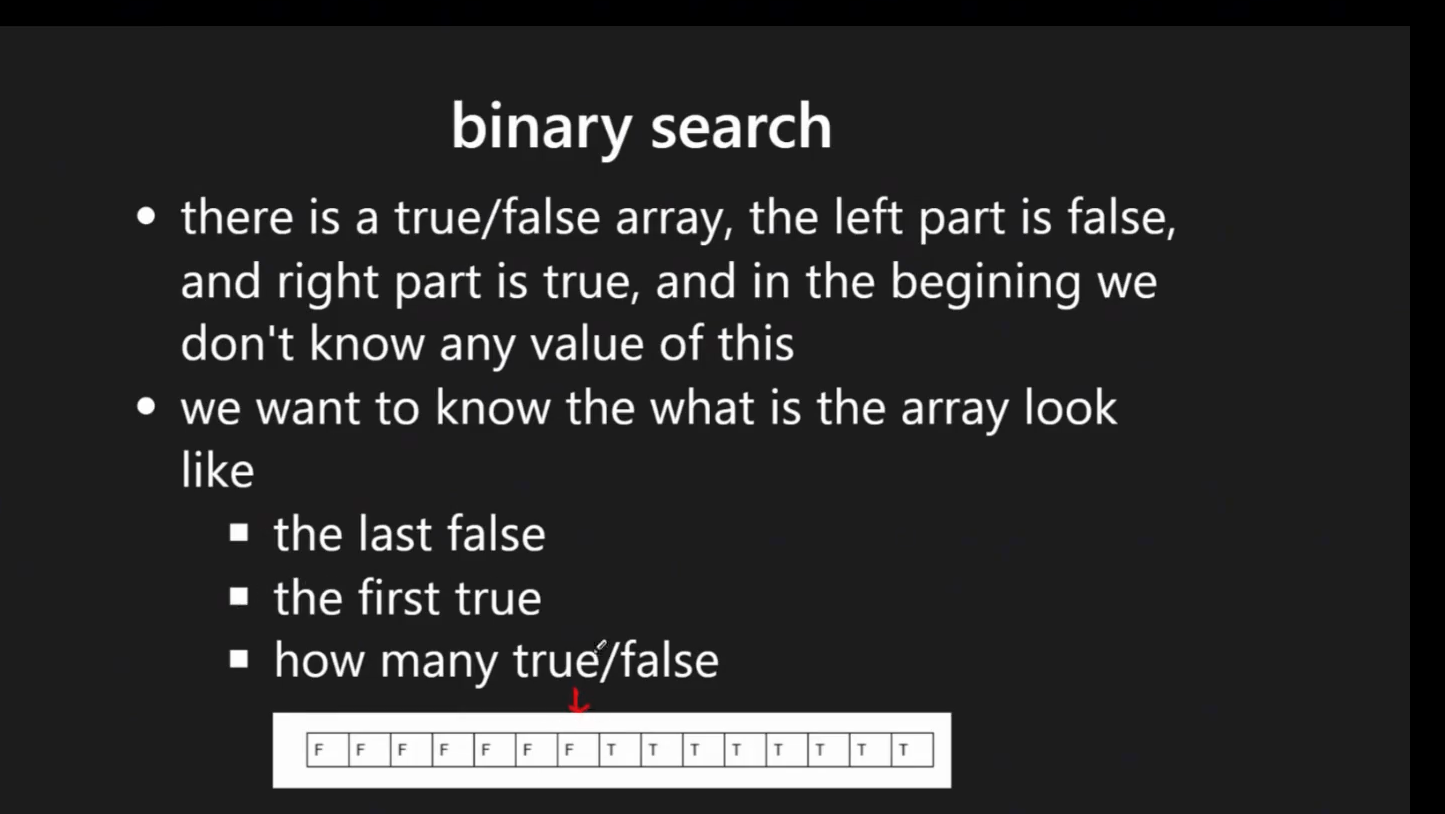
Key Idea: Don’t search for the value — search for the partition point between “too small” and “big enough”. Never return mid early; keep shrinking to squeeze the pointer onto the edge.
The two helpers are the same code differing by one character (< vs <=) and they never test equality at all:
| Helper | Condition to move l |
Where equality goes | Return |
|---|---|---|---|
findLeft |
nums[mid] < target |
into the else → r = mid - 1 (push left) |
l |
findRight |
nums[mid] <= target |
into the if → l = mid + 1 (push right) |
r |
Why this works — on exit, l and r have crossed with r == l - 1, and they straddle the partition:
after findLeft :  everything left of l is  < target   → l = first index >= target
after findRight:  everything right of r is > target   → r = last  index <= target
Why [l, r] is also the validity check (no need to re-read nums):
target present  → l = first equal idx, r = last equal idx  → l <= r  ✅
target absent   → both searches collapse to the same gap:
                  l = insertion point p,  r = p - 1        → l >  r  ❌ return [-1,-1]
Equivalence to Python bisect — memorize this mapping, it makes the two helpers unforgettable:
findLeft(nums, target)  ==  bisect.bisect_left(nums, target)       # count of elements < target
findRight(nums, target) ==  bisect.bisect_right(nums, target) - 1  # count of elements <= target, minus 1
Recommended Template (two helpers, closed boundary l <= r)
# python - LC 34 Find First and Last Position of Element in Sorted Array
# IDEA: two binary searches — left boundary + right boundary
# time = O(log N), space = O(1)
class Solution:
    def searchRange(self, nums, target):
        l = self.findLeft(nums, target)
        r = self.findRight(nums, target)
        # NOTE !!! l <= r is the existence check (no nums[] lookup needed)
        return [l, r] if l <= r else [-1, -1]

    def findLeft(self, nums, target):
        l, r = 0, len(nums) - 1
        while l <= r:
            mid = l + (r - l) // 2
            # NOTE !!! strict `<` → equality falls to else → keep pushing LEFT
            if nums[mid] < target:
                l = mid + 1
            else:
                r = mid - 1
        return l   # NOTE !!! return l

    def findRight(self, nums, target):
        l, r = 0, len(nums) - 1
        while l <= r:
            mid = l + (r - l) // 2
            # NOTE !!! `<=` → equality goes into if → keep pushing RIGHT
            if nums[mid] <= target:
                l = mid + 1
            else:
                r = mid - 1
        return r   # NOTE !!! return r
// java - LC 34 Find First and Last Position of Element in Sorted Array
// IDEA: two binary searches — left boundary + right boundary
// time = O(log N), space = O(1)
public int[] searchRange(int[] nums, int target) {
    int l = findLeft(nums, target);
    int r = findRight(nums, target);
    return l <= r ? new int[]{l, r} : new int[]{-1, -1};
}

private int findLeft(int[] nums, int target) {
    int l = 0, r = nums.length - 1;
    while (l <= r) {
        int mid = l + (r - l) / 2;
        if (nums[mid] < target) l = mid + 1;   // strict <
        else r = mid - 1;
    }
    return l;
}

private int findRight(int[] nums, int target) {
    int l = 0, r = nums.length - 1;
    while (l <= r) {
        int mid = l + (r - l) / 2;
        if (nums[mid] <= target) l = mid + 1;  // <= (the only difference)
        else r = mid - 1;
    }
    return r;
}
Alternative 1: One Helper, Called Twice (target and target + 1) ⭐⭐⭐⭐⭐
Cleanest trick — write only bisect_left, then note that the last occurrence of target
is one slot before the first occurrence of target + 1:
# python - LC 34, half-open boundary [lo, hi)
# time = O(log N), space = O(1)
class Solution:
    def searchRange(self, nums, target):
        def search(x):
            """first index i where nums[i] >= x  (== bisect_left)"""
            lo, hi = 0, len(nums)          # NOTE: hi = len(nums), NOT len-1
            while lo < hi:
                mid = (lo + hi) // 2
                if nums[mid] < x:
                    lo = mid + 1
                else:
                    hi = mid               # NOTE: no -1 (half-open)
            return lo

        lo = search(target)
        hi = search(target + 1) - 1        # last idx of target = first idx of target+1, minus 1
        return [lo, hi] if lo <= hi else [-1, -1]
Alternative 2: Track bound on Equality (most explicit)
Keeps the nums[mid] == target branch, and records the best candidate seen so far:
# python - LC 34, explicit "record then keep searching"
# time = O(log N), space = O(1)
class Solution:
    def searchRange(self, nums, target):
        def find_bound(is_first):
            l, r = 0, len(nums) - 1
            bound = -1
            while l <= r:
                mid = l + (r - l) // 2
                if nums[mid] == target:
                    bound = mid                      # record candidate
                    if is_first:
                        r = mid - 1                  # DON'T return — keep going left
                    else:
                        l = mid + 1                  # keep going right
                elif nums[mid] < target:
                    l = mid + 1
                else:
                    r = mid - 1
            return bound

        left = find_bound(True)
        if left == -1:                               # early exit: target absent
            return [-1, -1]
        return [left, find_bound(False)]
Alternative 3: bisect One-Liner (interview fallback / sanity check)
# python - LC 34 via bisect
# time = O(log N), space = O(1)
import bisect
class Solution:
    def searchRange(self, nums, target):
        left = bisect.bisect_left(nums, target)
        if left >= len(nums) or nums[left] != target:
            return [-1, -1]
        return [left, bisect.bisect_right(nums, target) - 1]
Visual Trace: nums = [5,7,7,8,8,10], target = 8
findLeft (strict <, return l):
  l=0 r=5  mid=2  nums[2]=7 <  8  → l=3
  l=3 r=5  mid=4  nums[4]=8 !< 8  → r=3
  l=3 r=3  mid=3  nums[3]=8 !< 8  → r=2
  l=3 > r=2 → exit, return l=3          ✓ first index of 8

findRight (<=, return r):
  l=0 r=5  mid=2  nums[2]=7 <= 8  → l=3
  l=3 r=5  mid=4  nums[4]=8 <= 8  → l=5
  l=5 r=5  mid=5  nums[5]=10 > 8  → r=4
  l=5 > r=4 → exit, return r=4          ✓ last index of 8

l=3 <= r=4 → [3, 4] ✓
Absent target, nums = [5,7,7,8,8,10], target = 6:
findLeft  → l = 1   (insertion point)
findRight → r = 0   (= insertion point - 1)
l=1 > r=0 → [-1, -1] ✓
Template Comparison
| Template | Boundary | Loop | Update on “too small” | Return | Best when |
|---|---|---|---|---|---|
Two helpers < / <= |
Closed [l, r] |
l <= r |
l = mid + 1 / r = mid - 1 |
l / r |
Recommended — symmetric, no equality branch, l <= r validates |
One helper, target & target+1 |
Half-open [lo, hi) |
lo < hi |
lo = mid + 1 / hi = mid |
lo |
Least code to memorize; only works for integer targets |
Track bound on == |
Closed [l, r] |
l <= r |
keeps 3-way if/elif/else |
bound |
Most readable when explaining out loud |
bisect_left / bisect_right |
— | — | — | — | Python interviews where library use is allowed |
Common Pitfalls
- ❌
return midwhennums[mid] == target→ lands mid-block, not on the edge - ❌ Returning
rfromfindLeft(orlfromfindRight) → off by one; left search returnsl, right search returnsr - ❌ Mixing boundary styles:
hi = len(nums)requireswhile lo < hiandhi = mid(no-1);r = len(nums)-1requireswhile l <= randr = mid - 1 - ❌ Forgetting the empty-array case — both closed-boundary helpers handle it naturally (
l=0, r=-1→ loop skipped →l=0 > r=-1→[-1,-1]) - ❌ Pre-checking
if target not in nums— that’s O(N) and destroys the O(log N) requirement
Similar Problems
| LC # | Problem | Key Difference |
|---|---|---|
| 34 | Find First and Last Position of Element in Sorted Array | Baseline — both boundaries |
| 35 | Search Insert Position | findLeft alone, return l unvalidated |
| 704 | Binary Search | Exact match only, no duplicates to handle |
| 278 | First Bad Version | findLeft on a boolean predicate instead of < |
| 852 / 162 | Peak Index / Find Peak Element | Boundary on nums[mid] < nums[mid+1] |
| 744 | Find Smallest Letter Greater Than Target | bisect_right + wraparound modulo |
| 1146 | Snapshot Array | bisect on version list per index |
| 658 | Find K Closest Elements | findLeft to locate window start, then expand |
| 300 | Longest Increasing Subsequence (O(N log N)) | bisect_left to replace tails — §1.5 |
| 981 | Time Based Key-Value Store | findRight (largest timestamp <= query) |
| 436 | Find Right Interval | findLeft on sorted starts |
| 1898 | Maximum Number of Removable Characters | Boundary search on answer + feasibility check |
1.4) Binary Search on the Answer Space Priority 5 of 5 — Must know — expect it in almost every loop
Instead of searching for a value in an array, binary search a range of candidate answers and use a feasibility predicate to decide which half to keep. It is the single most under-practised tier-5 binary-search skill, so it has a sheet of its own:
Full treatment — the
canFinish/isValidframing, the minimise-vs-maximise decision matrix, theleft = max(nums)/right = sum(nums)boundary recipe, the monotonic-predicate proof, value-domain counting, and every worked problem (LC 875, 410, 1011, 1283, 1482, 1231, 2616, 1631, 378, 287, 1539): binary_search_on_answer.md.
Recognition keywords: “minimize the maximum”, “maximize the minimum”, “find the smallest capacity / speed / divisor”, “can we split / allocate / distribute”.
1.5) Binary Search into an Array You Maintain — the tails Pattern (LC 300) Priority 5 of 5 — Must know — expect it in almost every loop
Every template above searches the input. This one searches a small array that the scan
builds as it goes — and that array is kept sorted on purpose, precisely so a lower
bound can be run on it. It is the pattern behind O(n log n) LIS, and the reason LC 300
is filed under binary search at all.
The algorithm’s own sheet — the card game it comes from, the pile/Dilworth argument, recovering the subsequence itself, and the problems that reduce to LIS — is patience_sorting.md. This section is the binary-search view: which template runs, and why one write per element is the complete update.
Core Idea — One Slot per Achievable Length, Holding the Smallest Tail
# python - LC 300 Longest Increasing Subsequence, O(n log n)
# IDEA: tails[k] = the SMALLEST tail value among increasing subsequences of length k+1
#       -> tails is sorted -> lower-bound it (findLeft, §1.3) -> append or overwrite
# time = O(n log n), space = O(n)
class Solution(object):
    def lengthOfLIS(self, nums):
        # tails[k] : smallest possible ending value of an increasing run of length k + 1
        tails = []

        for num in nums:
            # NOTE !!! this IS findLeft from §1.3, run on `tails` instead of on `nums`
            l, r = 0, len(tails) - 1
            while l <= r:
                mid = l + (r - l) // 2
                if tails[mid] < num:
                    l = mid + 1      # strict < -> equality fails this test, so it
                                     # takes the else and pushes r left
                else:
                    r = mid - 1
            # l == lower_bound(tails, num) == first index with tails[l] >= num

            if l == len(tails):
                tails.append(num)    # num beats every tail -> a NEW longest length exists
            else:
                tails[l] = num       # same length, cheaper tail -> overwrite

        return len(tails)            # NOTE !!! the LENGTH is the answer, not the contents
The
bisect_leftone-liner version, the Java version, and the LC 354 variation are in binary_search_examples.md §18. The loop is spelled out here on purpose: it is character-for-characterfindLeft(§1.3), which is the whole reason this problem belongs on this sheet.
Why It Works — Three Claims
1) tails is always sorted, so binary search is legal.
Assume it is strictly increasing, and check the two cases the scan can take. The lower
bound gives tails[l-1] < num whenever slot l-1 exists, and num <= tails[l] whenever
slot l exists:
- append (
l == len(tails)): the array grows bynumat the end, andtails[l-1] < num— still strictly increasing. - overwrite (
l < len(tails)):numreplacestails[l], so the new neighbours aretails[l-1] < num <= tails[l] < tails[l+1]— the last term only if slotl+1exists, and dropping to a smaller value cannot break it either way.
So the array is strictly increasing after every element, which makes the predicate
tails[i] < num true on a prefix and false on a suffix — the monotone condition every
binary search needs.
2) Exactly one slot can ever improve, and l is it.
num can extend an increasing run of length k+1 only if that run’s tail is < num.
Because tails is sorted, the lengths whose tail is < num are exactly k = 0 .. l-1,
so the longest run num can extend has length l, producing a run of length l+1:
tails:   [ tails[0] ... tails[l-1] | tails[l] ... ]
           <  num  (extendable)      >= num
                          ^ longest extendable run has length l
                            -> num is a candidate tail for length l + 1 -> slot l
- Slot
limproves: the new candidate tail isnum, andnum <= tails[l], somin(tails[l], num) = num. (Iflis past the end, lengthl+1was not achievable before and now is — that is theappend.) - No slot
j < limproves:numcould end a run of lengthj+1, buttails[j] < num, so the stored tail is already smaller. - No slot
j > limproves: reaching lengthj+1throughnumneeds a run of lengthjending< num, andtails[j-1] >= tails[l] >= num. There is none.
So the single write per element is not an optimisation — it is the complete update.
3) len(tails) is the LIS length.
>= : every slot that exists was created by an append, and an append happened only when
num genuinely extended a run — so a run of length len(tails) exists.
<= : an increasing subsequence of length L makes length L achievable, which by
claim 2 forces tails to have a slot L-1. Neither direction can be beaten.
tails is not a subsequence. Only its length means anything:
nums  = [3, 4, 5, 1]
tails = [1, 4, 5]     <- 1 sits at index 0 but arrives LAST in the input
len   = 3             <- correct: the LIS is [3,4,5]
The Greedy That the Overwrite Encodes
tails[l] = num is the greedy “a smaller tail is never worse”: any future y that could
be appended after the old tail can also be appended after num, and possibly more. The
overwrite throws away no reachable answer, which is exactly what claim 2 proves. It is the
same move as patience sorting — place each card on the leftmost pile whose top is >= num,
start a new pile if there is none, and the answer is the pile count.
Pattern: Recognising It
Reach for tails when all of these hold:
- the answer is the length of a longest chain (or
n − length), not the chain itself and not how many such chains exist; - “chainable” is a total order on one key (
<on a number, or on a key you can sort by first), so partial progress can be summarised by a single tail value; - an
O(n²)DPdp[i] = max(dp[j]) + 1is the obvious solution and the follow-up asks forO(n log n).
The generalisation is worth naming: when a DP’s state is “best value for each achieved length” and that table is monotone, the table is binary-searchable and the whole DP row collapses to one lower-bound lookup.
| Off-by-one | Query | Python |
|---|---|---|
| strictly increasing (LC 300) | first tail >= num |
bisect_left |
| non-decreasing (duplicates allowed) | first tail > num |
bisect_right |
| non-increasing / decreasing | negate the values, then the above | bisect_* on -num |
Need the subsequence itself, not its length? Keep, alongside
tails, the input index written into each slot and aprev[i]pointing at the index that was in slotl-1wheniwas placed; walkprevback from the last append.tailsalone cannot be read off as the answer (see the[3,4,5,1]trace above).
Similar Problems: Same tails + Lower Bound
| LC # | Problem | What changes |
|---|---|---|
| 300 | Longest Increasing Subsequence | Baseline — bisect_left, answer len(tails) |
| 354 | Russian Doll Envelopes | Sort (w asc, h desc), then LIS on heights — the tie rule is what blocks same-width chains |
| 1964 | Longest Obstacle Course at Each Position | Non-decreasing → bisect_right, and the answer per index is the insertion position + 1, reported as you go |
| 2111 | Minimum Operations to Make the Array K-Increasing | Split into k residue classes, run the non-decreasing variant on each; keep len - LIS |
| 1671 | Minimum Removals to Make a Mountain Array | LIS ending at i from the left + LIS starting at i from the right, both by this scan |
| 646 | Maximum Length of Pair Chain | Same chain question; sorting by end value makes plain greedy enough, but the tails scan also solves it |
| 1996 | The Number of Weak Characters | The sibling sort-with-a-tie-rule trick from LC 354, without the binary search |
Traps — problems that look like LIS but are not this pattern:
| LC # | Problem | Why tails fails |
|---|---|---|
| 673 | Number of Longest Increasing Subsequence | A count, not a length — a single tail per length cannot carry multiplicities. O(n²) DP with a count array, or a BIT over values |
| 368 | Largest Divisible Subset | “Chainable” is divisibility, which is not a total order, so no single tail summarises a chain — O(n²) DP + parent pointers |
| 1027 | Longest Arithmetic Subsequence | State is (index, difference) — a hash map DP, not a sorted table |
1.6) Related Algorithms & Data Structures
Complementary Algorithms:
- Two Pointers: For sorted arrays without random access
- Sliding Window: For subarray problems with certain properties
- Recursion: Alternative implementation approach
Data Structures:
- Arrays: Primary use case for binary search
- Binary Search Trees: Implicit binary search in tree traversal
- Hash Tables: O(1) lookup alternative when sorting not required
2) Binary Search Templates & Patterns
Additional Resources
2.0) Loop Exit Conditions Comparison
Key Difference: The exit condition determines when the loop terminates and affects boundary handling.
| Condition | Boundary Type | When to Use | Key Characteristics |
|---|---|---|---|
while (l <= r) |
Closed [l, r] | Standard binary search | • Most common approach • Search space includes both l and r • Need l = mid + 1, r = mid - 1 |
while (l < r) |
Half-open [l, r) | Finding boundaries/insertion points | • Search space excludes r • Loop ends when l == r• Use l = mid + 1, r = mid |
while (l < r - 1) |
Gap-based | Avoiding infinite loops in special cases | • Ensures l and r are never adjacent • Requires final check after loop • Less common, used for complex conditions |
Detailed Analysis:
// 1) while (l <= r) - CLOSED BOUNDARY [l, r]
while (l <= r) {
    int mid = l + (r - l) / 2;
    if (nums[mid] == target) return mid;
    else if (nums[mid] < target) l = mid + 1;  // MUST +1
    else r = mid - 1;                          // MUST -1
}
// Pros: Standard, easy to understand
// Cons: Can return -1 if not found
// 2) while (l < r) - HALF-OPEN [l, r)
while (l < r) {
    int mid = l + (r - l) / 2;
    if (nums[mid] < target) l = mid + 1;       // +1 to exclude mid
    else r = mid;                              // NO -1, keep mid in range
}
// After loop: l == r, points to answer or insertion point
// Pros: Great for finding boundaries, no -1 return
// Cons: Requires different logic for different problems
// 3) while (l < r - 1) - GAP-BASED
while (l < r - 1) {
    int mid = l + (r - l) / 2;
    if (condition(mid)) l = mid;
    else r = mid;
}
// Final check needed: examine both l and r
// Pros: Avoids infinite loops in complex conditions
// Cons: More complex, requires post-processing
When to Use Each:
while (l <= r): Classic binary search, finding exact valueswhile (l < r): Finding first/last occurrence, insertion position, peak findingwhile (l < r - 1): Complex conditions where mid might equal l or r
Classic LeetCode Problems by Pattern
Pattern 1: while (l <= r) - Exact Search
- LC 704: Binary Search (basic implementation)
- LC 33: Search in Rotated Sorted Array
- LC 81: Search in Rotated Sorted Array II
- LC 74: Search a 2D Matrix
- LC 240: Search a 2D Matrix II
- LC 69: Sqrt(x)
- LC 367: Valid Perfect Square
- LC 441: Arranging Coins
Pattern 2: while (l < r) - Boundary/Peak Finding
- LC 34: Find First and Last Position of Element
- LC 35: Search Insert Position
- LC 162: Find Peak Element
- LC 852: Peak Index in a Mountain Array
- LC 153: Find Minimum in Rotated Sorted Array
- LC 154: Find Minimum in Rotated Sorted Array II
- LC 278: First Bad Version
- LC 658: Find K Closest Elements
- LC 744: Find Smallest Letter Greater Than Target
Pattern 3: Validation-function problems (LC 410, 875, 1011, 1060, 1482) — these binary search the answer, not an index; see binary_search_on_answer.md.
2.1) Standard Binary Search Template — LC 704
Key Principles:
- Initialization:
left = 0, right = nums.length - 1(closed interval) - Loop Condition:
while (left <= right) - Pointer Updates:
left = mid + 1,right = mid - 1 - Clarity Tip: Use
else iffor all conditions to make logic explicit
Programming Tip: Avoid using
else- write all conditions aselse ifto clearly show all cases and avoid bugs.
// Java Implementation
public int binarySearch(int[] nums, int target) {
    int left = 0;
    int right = nums.length - 1;

    // Use <= to search when left == right
    while (left <= right) {
        int mid = left + (right - left) / 2;  // Avoid overflow

        if (nums[mid] == target) {
            return mid;
        } else if (nums[mid] < target) {
            left = mid + 1;   // Target in right half
        } else {  // nums[mid] > target
            right = mid - 1;  // Target in left half
        }
    }
    return -1;  // Not found
}
# Python Implementation
def binary_search(nums, target):
    left, right = 0, len(nums) - 1

    # Closed boundary [left, right] - includes both endpoints
    while left <= right:
        mid = left + (right - left) // 2  # Avoid overflow

        if nums[mid] == target:
            return mid
        elif nums[mid] < target:
            left = mid + 1   # Search right half
        else:
            right = mid - 1  # Search left half

    return -1  # Target not found
2.2) Floating-Point Binary Search
For problems asking for a real-number answer (sqrt, optimal allocation, geometric problems):
def sqrt(x: float, precision=1e-9) -> float:
    lo, hi = 0.0, max(1.0, x)
    while hi - lo > precision:
        mid = (lo + hi) / 2
        if mid * mid <= x:
            lo = mid
        else:
            hi = mid
    return lo

# General pattern: binary search on continuous domain
def minimize_real(lo: float, hi: float, iterations=100) -> float:
    for _ in range(iterations):   # fixed iterations avoids float precision issues
        mid = (lo + hi) / 2
        if feasible(mid):
            hi = mid
        else:
            lo = mid
    return (lo + hi) / 2
2.3) Search in 2D Matrix — Two Different Problems (LC 74 / LC 240)
LC 74 (matrix rows and columns both sorted, values increase left-to-right, top-to-bottom):
def searchMatrix(matrix, target):
    m, n = len(matrix), len(matrix[0])
    lo, hi = 0, m * n - 1
    while lo <= hi:
        mid = (lo + hi) // 2
        val = matrix[mid // n][mid % n]
        if val == target: return True
        elif val < target: lo = mid + 1
        else: hi = mid - 1
    return False
LC 240 (each row sorted, each column sorted, but NOT globally sorted — use Staircase Search):
def searchMatrix(matrix, target):
    row, col = 0, len(matrix[0]) - 1   # start top-right
    while row < len(matrix) and col >= 0:
        if matrix[row][col] == target: return True
        elif matrix[row][col] > target: col -= 1   # too big → go left
        else: row += 1                             # too small → go down
    return False
Key insight: Staircase Search on LC 240 eliminates one row or column per step → O(m+n). Do NOT treat LC 240 as a flat binary search — the matrix is NOT globally sorted.
Java — the same flatten, written out:
// java
// LC 74
// V1
// IDEA : BINARY SEARCH + FLATTEN MATRIX
// https://leetcode.com/problems/search-a-2d-matrix/editorial/
public boolean searchMatrix_2(int[][] matrix, int target) {
    int m = matrix.length;
    if (m == 0)
        return false;
    int n = matrix[0].length;

    // binary search
    /** NOTE !!! FLATTEN MATRIX */
    int left = 0, right = m * n - 1;
    int pivotIdx, pivotElement;
    while (left <= right) {
        pivotIdx = (left + right) / 2;
        /** NOTE !!! TRICK HERE :
         *
         *   pivotIdx / n : y index
         *   pivotIdx % n : x index
         */
        pivotElement = matrix[pivotIdx / n][pivotIdx % n];
        if (target == pivotElement)
            return true;
        else {
            if (target < pivotElement)
                right = pivotIdx - 1;
            else
                left = pivotIdx + 1;
        }
    }
    return false;
}
2.4) Bitonic / Mountain Array — the Descending-Order Flip
A mountain (bitonic) array is not sorted, but it is the concatenation of two sorted runs, so it takes three binary searches: a hill-climbing search for the peak, an ordinary ascending search on the left run, then a descending search on the right run.
The descending-order template is the standard one with the comparison flipped:
ascending : nums[mid] < target  -> go RIGHT (l = mid + 1)
descending: nums[mid] > target  -> go RIGHT (l = mid + 1)
A neat way to write both in one function: if ((val < target) == ascending) l = mid + 1; else r = mid - 1;
Worked example — LC 1095 Find in Mountain Array — in binary_search_examples.md.
2.5) No Right End — Exponential (Galloping) Search Priority 4 of 5 — High value — a gap here costs you rounds
Binary search needs a right end, and sometimes the input refuses to give you one: LC 702
(Search in a Sorted Array of Unknown Size) hands you a reader with no length, CtCI 10.4
hands you a Listy whose elementAt() just returns -1 past the end, and a paginated API
behaves the same way. Find a right end by doubling, then binary search inside it.
probe 1, 2, 4, 8, 16, ...  until the value overshoots the target (or falls off the end)
                           -> the answer is inside [prev probe, this probe]
Both halves cost O(log p) probes, where p is the target’s index — so the whole search
is O(log p), independent of the array’s (unknown, possibly huge) total length.
# python
# LC 702 - Search in a Sorted Array of Unknown Size
# IDEA: double the index until reader.get() overshoots -> that bounds the answer;
#       then run an ordinary binary search inside the window
# time = O(log p) where p is the target's index, space = O(1)
class Solution(object):
    def search(self, reader, target):
        hi = 1
        while reader.get(hi) < target:       # out of range returns 2^31-1, so this stops
            hi <<= 1                         # 1, 2, 4, 8, ... only O(log p) probes
        lo = hi >> 1                         # the previous probe was still < target

        while lo <= hi:
            mid = lo + (hi - lo) // 2
            val = reader.get(mid)
            if val == target:
                return mid
            elif val < target:
                lo = mid + 1
            else:
                hi = mid - 1                 # also the "past the end" case
        return -1
// java
// CtCI 10.4 - search a sorted "Listy" that has no size(); elementAt() returns -1 past the end
// IDEA: same doubling, but the sentinel here is -1, which reads as TOO SMALL —
//       so it has to be tested for explicitly instead of comparing naturally
// time = O(log p), space = O(1)
int search(Listy list, int target) {
    int hi = 1;
    while (list.elementAt(hi) != -1 && list.elementAt(hi) < target) {
        hi *= 2;
    }
    int lo = hi / 2;

    while (lo <= hi) {
        int mid = lo + (hi - lo) / 2;
        int val = list.elementAt(mid);
        if (val == target) return mid;
        if (val == -1 || val > target) hi = mid - 1;   // -1 means past the end -> go left
        else lo = mid + 1;
    }
    return -1;
}
- The trap is the out-of-range sentinel’s direction.
2^31-1sorts above every real value, so the ordinary comparisons handle it.-1sorts below them, so an untested-1sends the search right, off the end, forever. - Why doubling and not a fixed stride. A stride of
kcostsp/kprobes; doubling costslog2(p), and it never overshoots the answer by more than a factor of two. - The same trick outside interviews. Intersecting a small sorted list with a huge one galloping-searches each element instead of scanning, and Timsort’s merge uses it to skip long runs from one side.
2.6) The Probe Can Land on a Hole — Sparse Search Priority 3 of 5 — Worth knowing — usually a variant of a must-know pattern
CtCI 10.5: a sorted array of strings padded with "" at random positions. mid can land
on an empty string, which carries no order information — you cannot tell whether the
target is left or right of it, so the standard template stalls. Fix: step outward from
mid to the nearest real entry, then compare as usual.
# python
# CtCI 10.5 - find a word in a sorted string array that is padded with "" entries
# IDEA: a probe landing on "" tells you nothing, so walk outward from mid — both
#       directions at once — to the closest real string, then continue normally
# time = O(log n) when holes are sparse, O(n) worst case; space = O(1)
def sparse_search(words, target):
    if not target:                            # "" has no defined position
        return -1
    lo, hi = 0, len(words) - 1

    while lo <= hi:
        mid = lo + (hi - lo) // 2

        if not words[mid]:                    # in a hole: find the nearest word
            left, right = mid - 1, mid + 1
            while True:
                if left < lo and right > hi:
                    return -1                 # this whole window is empty
                elif right <= hi and words[right]:
                    mid = right
                    break
                elif left >= lo and words[left]:
                    mid = left
                    break
                left -= 1
                right += 1

        if words[mid] == target:
            return mid
        elif words[mid] < target:
            lo = mid + 1
        else:
            hi = mid - 1
    return -1
- Step outward, not just rightward. Scanning only right can run past
hiand force you to discard a half that still contained the target. - The guarantee is gone, and that is the answer. A run of
""of lengthnmakes itO(n); you keepO(log n)only while the holes are sparse. Say this — it is the same lesson as LC 81 (§1.2), wherenums[l] == nums[mid] == nums[r]leaves the probe uninformative and the fallbackl++ / r--degrades the search toO(n).
2.7) Quick Reference — Other Binary-Search-Flavoured Problems
Famous problems that reuse a template already in this doc; listed so you recognise them, no new technique needed.
| LC | Problem | Which template |
|---|---|---|
| 275 | H-Index II | boundary search on index: first i with citations[i] >= n - i (§1.3) |
| 1268 | Search Suggestions System | sort products, lower_bound the growing prefix (§1.3; LC 436 in binary_search_examples.md); Trie is the alternative |
| 349 / 350 | Intersection of Two Arrays I / II | sort the bigger array, binary search each element (hash set / two-pointer alternatives) |
| 792 | Number of Matching Subsequences | per-char sorted index list + upper_bound to jump to the next occurrence (the prefix-sum + lower-bound family — binary_search_examples.md §19) |
| 222 | Count Complete Tree Nodes | binary search the last level’s node index, testing each candidate by walking its bit path — O(log²n) |
| 1044 | Longest Duplicate Substring | binary search on the answer length + Rabin-Karp rolling hash as the predicate (binary_search_on_answer.md) |
| 1385 | Find the Distance Value Between Two Arrays | sort arr2, binary search each arr1[i] for the closest neighbour |
| 1346 | Check If N and Its Double Exist | sort + binary search for 2*x (hash set alternative) |
3) Summary & Quick Reference
3.1) When to Use Binary Search
✅ Use Binary Search When:
- Array is sorted (fully, partially, or rotationally)
- Search space has monotonic property
- Need O(log n) search performance
- Looking for boundaries or insertion points
- Optimization problems with binary nature
3.2) Template Selection Guide
One table for the whole sheet: given the shape of the input, this is the template to reach for.
| Problem type / input shape | Template | Worked example |
|---|---|---|
| Exact search in a sorted array | Standard closed boundary while l <= r — §2.1 |
LC 704 |
Left boundary (first index >= target) |
Lower bound — §1.3 | LC 34, LC 35, LC 278 |
Right boundary (last index <= target) |
Upper bound − 1 — §1.3 | LC 34, LC 981 |
| Insert position | Lower bound, return l unvalidated — §1.3 |
LC 35 |
| Peak / valley, no target value | Half-open while l < r, r = mid |
LC 162, LC 852 |
| Rotated sorted array | Identify the sorted half — §1.2 | LC 33, LC 81, LC 153, LC 154 |
| Array goes up then down (mountain / bitonic) | Peak + two ordered searches, one descending — §2.4 | LC 1095 |
| Input has no length (reader / stream / paginated API) | Double the index to find a right end, then search — §2.5 | LC 702 |
A probe can land on an uninformative slot ("", duplicates) |
Step outward to the nearest usable entry — §2.6 | CtCI 10.5, LC 81 |
| 2D matrix | Flatten if globally sorted, staircase if only rows+cols sorted — §2.3 | LC 74 vs LC 240 |
| Real-number answer, precision required | Floating-point / fixed-iteration — §2.2 | LC 69 (float variant) |
| “Minimize the maximum” / “maximize the minimum” | Binary search on answer — binary_search_on_answer.md | LC 410, 875, 1011, 1231, 2616 |
| Values in a known range, array NOT sorted | Binary search the value domain + count — binary_search_on_answer.md | LC 287, LC 378 |
| Feasibility needs a graph walk | Binary search on answer + BFS/DFS predicate — binary_search_on_answer.md | LC 1631, LC 778 |
O(n log n) LIS, weighted pick, sorted history |
lower_bound on a sorted array you maintain — §1.5, worked in binary_search_examples.md |
LC 300, LC 354, LC 528, LC 981 |
3.3) Common Pitfalls & Tips
🚫 Common Mistakes:
- Integer overflow in
mid = (left + right) / 2→ Usemid = left + (right - left) / 2 - Wrong boundary updates (
midvsmid ± 1) - Forgetting post-processing validation
- Infinite loops with
while l < rand wrong updates
✅ Best Practices:
- Always use
else iffor clarity - Validate results after boundary searches
- Choose consistent boundary type (closed vs half-open)
- Test with edge cases: empty array, single element, duplicates
3.4) Interview Signals — Which Pattern?
| Signal | Pattern |
|---|---|
| “find minimum/maximum X such that…” | Binary search on answer |
| “sorted array, find first/last occurrence” | Left/right boundary binary search |
| “the smallest value >= X” / “largest <= X”, asked once per element | Sort once + lower/upper bound — §1.3 |
| “the first element to the left/right that is bigger” (positional) | Monotonic stack, NOT binary search — §1.3 |
“the array has no size()” / “the API is paginated” |
Exponential (galloping) search for a right end — §2.5 |
| “matrix with row+col sorted” | Staircase search (NOT flat binary search) |
| “real number answer, precision required” | Floating-point binary search |
“longest increasing/chained subsequence”, O(n²) DP asked to become O(n log n) |
tails + lower bound — §1.5 |
| “can we achieve X?” is monotonic | Binary search on monotonic predicate |
| O(n) solution exists but O(log n) asked | Think: what is the sorted search space? |