Backtracking
Scope — Systematic search with undo: the choose/explore/un-choose skeleton,
start_idxcontrol, duplicate skipping, pruning, and exactly one canonical template per must-know shape — the long tail of worked solutions and the hard-tier state-carrying templates live in its two satellites. See also: backtrack_examples.md — the worked LC solutions for these templates; backtrack_advanced.md — Trie-pruned grid search, expression building, deletion budgets, memoised partitioning; dfs.md — traversal without the undo step; recursion.md — recursion mechanics; tree_backtrack.md — root→leaf path problems; dp.md — when memoising the search beats exploring it.
LeetCode Problem Lists
Overview
Backtracking is a brute-force search over a decision tree: at each step we make a choice, recurse deeper, then undo the choice (“backtrack”) to try the next one. It is the go-to pattern for generating all subsets / permutations / combinations, or finding any/one valid configuration under constraints (N-Queens, Sudoku, word search).
Key Properties
- Core idea:
choose → explore (recurse) → un-choose (undo) - Time Complexity: exponential —
O(b^d), whereb= branching factor,d= decision-tree depth - Space Complexity:
O(d)recursion depth (excluding the output list) - When to Use: the problem asks for all / every / how many configurations, or to place / fill / partition under constraints
- Optimization path: Backtrack (brute force) → add pruning → often → DP (memoize overlapping subproblems)
- Algorithm: DFS + recursion
- Common data structures:
dict(counter for dedup),set(visited / constraints),array/list(the route)
The 3 things every backtrack tracks
| Element | Meaning |
|---|---|
| Route (路徑) | choices made so far (the current path) |
| Choice list (選擇清單) | choices available right now |
| End condition | leaf of the decision tree — record the route and return |
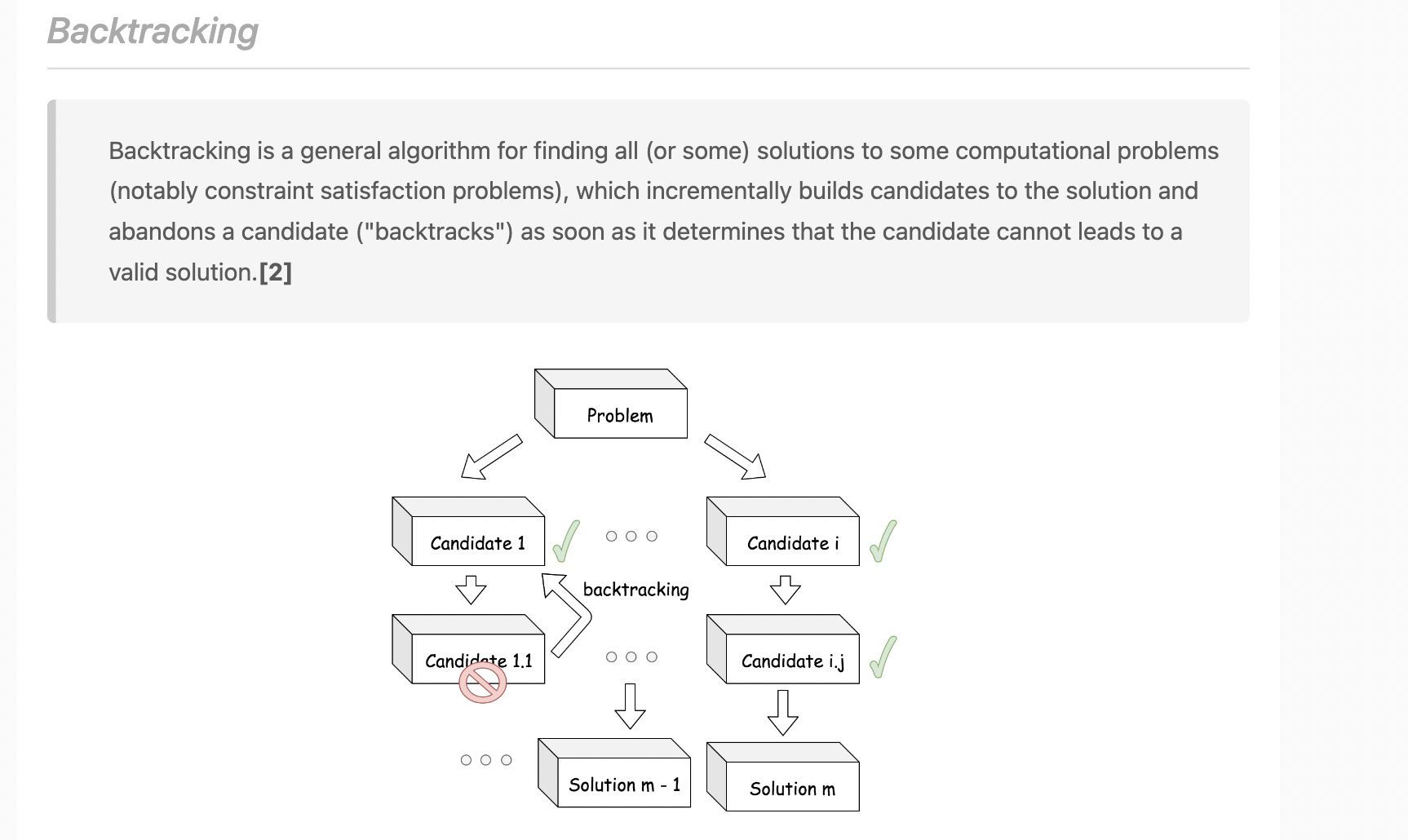
The three rows above map onto Template 1 —
pathis the route, theforloop is the choice list, theifat the top is the end condition.
Time Complexity by Problem Type
| Problem type | Typical Time | Space (excl. output) | Example |
|---|---|---|---|
| Subsets | O(2^n · n) | O(n) | LC 78, 90 |
| Permutations | O(n! · n) | O(n) | LC 46, 47 |
| Combinations | O(C(n,k) · k) | O(k) | LC 77 |
| Combination Sum | exponential | O(target / min) | LC 39, 40 |
| Partitioning | O(2^n · n) | O(n) | LC 131 |
| N-Queens | O(n!) | O(n) | LC 51 |
The trailing
· n/· kis the cost of copying each valid path into the result. Pruning trims branches and the constant factor but does not change the worst-case class.
References
- labuladong — Backtracking framework
- labuladong — Two views of backtracking
- LeetCode — A general approach to backtracking (Java)
Problem Categories
Four shapes cover almost every backtracking question. The taxonomy below decides which template you reach for; the code for each lives in Templates & Algorithms and the fully worked solutions in backtrack_examples.md.
| # | Shape | start_idx? |
Canonical template | LC |
|---|---|---|---|---|
| 1 | Subsets (子集) | ✅ i + 1 |
Template 3 / Template 4 | 78, 90 |
| 2 | Permutations (排列組合) | ❌ visited[] |
Template 5 | 46, 47 |
| 3 | Combinations (組成) | ✅ i + 1 |
Template 6 | 77, 216 |
| 4 | Combination Sum | ✅ i (reuse) or i + 1 |
Template 7 | 39, 40 |
| 5 | Partitioning | ✅ i + 1 on a substring / bucket |
Template 8 / Template 13 | 131, 698, 473 |
| 6 | Grid / word search | ❌ mark-and-restore the cell | Template 9 | 79, 980, 1219 |
| 7 | Constraint satisfaction | ❌ one row / cell per depth | Template 10 / Template 11 | 51, 37 |
| 8 | Parentheses / string building | ❌ counters as constraints | backtrack_examples.md | 20, 22, 93 |
Type Notes
Working notes per shape — the mnemonic for the loop body, and the gotcha.
-
Type 1) :
Subsets(子集)- Problems : LC 78, 90, 17
- 代碼隨想錄 - 0078.子集
- (for loop call help func) + start_idx + for loop + pop(-1)
- backtrack. find minumum case. transform the problem to
tree-problem. viastartremove already used numbers and return all cases - Need
!cur.contains(nums[i])-> to NOT add duplicated element
-
Subsets II- LC 90
- start idx + backtrack + dedup (seen)
- dedup : can use dict counter or idx
-
Type 2) :
Permutations (排列組合)(全排列)- Problems : LC 46, 47
- (for loop call help func) + contains + pop(-1)
- backtrack. via
containsremove already used numbers and return all cases NO NEEDto use start_idx
-
Type 3) :
Combinations (組成)- LC 77
- (for loop call help func) + start_idx + for loop + + check if len == k + pop(-1)
-
Type 4) :
Others -
Parentheses (括弧)
- LC 20, LC 22
Templates & Algorithms
Template Comparison Table
| Template | Shape | Loop / next index | Undo | LC |
|---|---|---|---|---|
| 1 | choose → explore → un-choose | for i in start..n |
path.pop() |
— |
| 2 | start_idx control |
i (reuse) vs i + 1 (once) |
— | 39 vs 40 |
| 3 | Subsets | record at every node, i + 1 |
remove(last) |
78 |
| 4 | Subsets II | i > start && a[i] == a[i-1] skip |
remove(last) |
90 |
| 5 | Permutations | scan all, skip visited[i] |
pop() + visited[i] = False |
46, 47 |
| 6 | Combinations | stop at len(path) == k |
pop() |
77 |
| 7 | Combination Sum | i reuse / i + 1 once + break prune |
pop() |
39, 40 |
| 8 | Palindrome partition | for end in start+1..n, palindrome gate |
remove(last) |
131 |
| 9 | Grid / word search | 4-way from each cell | restore the cell | 79 |
| 10 | N-Queens | one row per depth, 3 constraint sets | remove from all 3 sets | 51 |
| 11 | Sudoku | one empty cell per depth, row/col/box sets | reset cell + sets | 37 |
| 12 | Pruning | break / continue before recursing |
— | 39, 40 |
| 13 | k-bucket partition | for each bucket, sorted desc | buckets[i] -= v |
698, 473 |
| 14 | Mutable vs immutable state | — | undo only mutable state | 113, 1740 |
Template 1: choose → explore → un-choose Priority 5 of 5 — Must know — expect it in almost every loop
The canonical choose → explore → un-choose skeleton, ready to adapt:
# python
# time = O(b^d * w), space = O(d)   b = branching factor, d = depth, w = work done at a leaf
def backtrack(start_idx, path):
    if end_condition:            # e.g. len(path) == k, or start_idx == len(s)
        res.append(path[:])      # NOTE: copy the path, not the reference
        return
    for i in range(start_idx, n):
        path.append(nums[i])         # 1) choose
        backtrack(i + 1, path)       # 2) explore  (i -> reuse, i+1 -> use once)
        path.pop()                   # 3) un-choose (undo)

res = []
backtrack(0, [])
// java
// time = O(b^d * w), space = O(d)   b = branching factor, d = depth, w = work done at a leaf
private void backtrack(int startIdx, List<Integer> path, int[] nums, List<List<Integer>> res) {
    if (endCondition) {                       // e.g. path.size() == k
        res.add(new ArrayList<>(path));       // NOTE: copy the path, not the reference
        return;
    }
    for (int i = startIdx; i < nums.length; i++) {
        path.add(nums[i]);                    // 1) choose
        backtrack(i + 1, path, nums, res);    // 2) explore (i -> reuse, i+1 -> use once)
        path.remove(path.size() - 1);         // 3) un-choose (undo)
    }
}
Two knobs turn this template into every variant:
start_idx— controls the search space (combinations/subsets vs permutations)- early quit / pruning — cut branches that cannot lead to a valid answer
Duplicate skipping — the same-level skip rule Priority 5 of 5 — Must know — expect it in almost every loop
We do not skip every duplicate — only a duplicate appearing at the same recursion level. Three spellings of the same rule (fragments, not runnable classes):
// time = O(2^n * n), space = O(n)   every subset, each copied out
// LC 40
// java
// ...

/**
*  NOTE !!!   skip a duplicate at the same recursive level.
*
*   -> Key idea of the duplicate-skipping logic
*       •    We do not skip all duplicates.
*       •    We only skip a duplicate at the same recursive level.
*/

if (i > startIdx && candidates[i] == candidates[i - 1]) {
    continue;
}

// ...
// time = O(2^n * n), space = O(n)   every subset, each copied out
// LC 90
// java

// ...
for (int j = i; j < nums.length; j++) {
    /**
     *  NOTE !!! below !!
     *
     *  via below, we avoid add `duplicated` element
     *
     */
    if (j > i && nums[j] == nums[j - 1]) {
        continue;
    }
    // ...
}
// ...
// java
// time = O(n! * n), space = O(n)    every permutation, each copied out
// LC 47
// ...

// Skip duplicates in the same recursion layer
if (i > 0 && nums[i] == nums[i - 1] && !used[i - 1])
    continue;

// ...
Template 2: start_idx — i vs i + 1 Priority 5 of 5 — Must know — expect it in almost every loop
start_idx (or index, or similar) is used to control the search space — to avoid duplicates and maintain order in the generated result.
-> Use start_idx when:
- You’re generating combinations/subsets
- You want to avoid duplicates
- You want to preserve order of choices
Once you’ve decided you need a start_idx, the next question is what to pass as the
next start index — i (reuse the current element) or i + 1 (move past it).
| Pass | Meaning | Analogy | Examples |
|---|---|---|---|
i |
Reuse the same element again | Unbounded knapsack (infinite supply) | LC 39 (Combination Sum), LC 518 (Coin Change II), LC 377 |
i + 1 |
Use each element at most once | 0/1 knapsack, subsets | LC 40 (Combination Sum II), LC 78/90 (Subsets), LC 131, LC 494 |
Permutations use neither — they revisit earlier elements, so they track a
visited[]array /containscheck instead of astart_idx(see Problem Categories).
// time = O(n^(T/M + 1)), space = O(T/M)   T = target, M = smallest candidate
// LC 39 Combination Sum — reuse allowed → pass i
for (int i = start; i < candidates.length; i++) {
    backtrack(i, remain - candidates[i]);      // can pick candidates[i] again
}

// LC 40 Combination Sum II — each used once → pass i + 1
for (int i = start; i < candidates.length; i++) {
    backtrack(i + 1, remain - candidates[i]);  // move past candidates[i]
}
Key takeaway: reuse allowed →
i; use once →i + 1.
Template 3: Subsets — LC 78 Priority 5 of 5 — Must know — expect it in almost every loop
Record the path at every node (pre-order), and pass i + 1 so each element is used once.
The // ... lines are elided boilerplate, not code.
// java
// time = O(2^n * n), space = O(n)   2^n subsets, O(n) to copy each
// LC 78 - Subsets
public List<List<Integer>> subsets(int[] nums) {
    // ...
    this.getSubSet(start_idx, nums, cur, res);
    //System.out.println("(after) res = " + res);
    return res;
}

public void getSubSet(int start_idx, int[] nums, List<Integer> cur, List<List<Integer>> res){

    if (!res.contains(cur)){
        // NOTE !!! init new list via below
        res.add(new ArrayList<>(cur));
    }

    if (cur.size() > nums.length){
        return;
    }

    for (int i = start_idx; i < nums.length; i++){
        /**
         * NOTE !!!
         *
         *  for subset,
         *  we need "!cur.contains(nums[i])"
         *  -> to NOT add duplicated element
         */
        if (!cur.contains(nums[i])){
            cur.add(nums[i]);
            /**
             *  NOTE !!!
             *
             *   at LC 78 subset, we need to use `i+1` idx
             *   in recursive call
             *
             *   while at LC 39 Combination Sum,
             *   we use `i` directly
             *
             *
             *   e.g. next start_idx is ` i+1`
             */
            this.getSubSet(i+1, nums, cur, res);
            // undo
            cur.remove(cur.size()-1);
        }
    }
}
# python
# time = O(2^n * n), space = O(n)   2^n subsets, O(n) to copy each
# LC 78 - Subsets
# IDEA : DFS
class Solution(object):
    def subsets(self, nums):
        def dfs(layer, start, tmp):
            if tmp not in res:
                res.append(tmp)
            if layer == len(nums):
                return
            ### NOTE : we have if condition first, then for loop
            for i in range(start, len(nums)):
                ### NOTE below can make loop start `start idx` updated each time
                dfs(layer+1, i+1, tmp + [nums[i]])
        nums.sort()
        res = []
        dfs(0, 0, [])
        return res
Template 4: Subsets II (skip same-level duplicates) — LC 90 Priority 5 of 5 — Must know — expect it in almost every loop
// java
// time = O(2^n * n), space = O(n)   the sort is O(n log n) and is dominated
// LC 90
private void backtrack(List<List<Integer>> list, List<Integer> tempList, int [] nums, int start){
    list.add(new ArrayList<>(tempList));
    for(int i = start; i < nums.length; i++){
        // skip duplicates
        /**
         *  NOTE !!!
         *
         *   below is the key shows how to simply skip duplicates
         *   (instead of using hashmap counter)
         */
        if(i > start && nums[i] == nums[i-1]){
            continue;
        }
        tempList.add(nums[i]);
        backtrack(list, tempList, nums, i + 1);
        tempList.remove(tempList.size() - 1);
    }
}
Template 5: Permutations — LC 46 Priority 5 of 5 — Must know — expect it in almost every loop
# python
# time = O(n! * n), space = O(n)     n! permutations, O(n) to copy each
# LC 46 - Permutations
# IDEA : BACKTRACK with a `visited` array (instead of `contains`)
class Solution(object):
    def permute(self, nums):
        res = []
        visited = [False] * len(nums)

        def dfs(path):
            if len(path) == len(nums):
                res.append(path[:])          # NOTE: copy the path
                return
            for i in range(len(nums)):
                if visited[i]:
                    continue
                visited[i] = True            # choose
                path.append(nums[i])
                dfs(path)                    # explore
                path.pop()                   # un-choose
                visited[i] = False

        dfs([])
        return res
// java
// time = O(n! * n), space = O(n)    n! permutations, O(n) to copy each
// LC 46. Permutations
    List<List<Integer>> ans = new ArrayList<>();

    // IDEA : BACKTRACK
    public List<List<Integer>> permute(int[] nums) {

        if (nums.length == 1){
            List<List<Integer>> _ans = new ArrayList<>();
            List<Integer> cur = new ArrayList<>();
            cur.add(nums[0]);
            _ans.add(cur);
            return _ans;
        }

        List<Integer> cur = new ArrayList<>();
        /** NOTE !!! we don't need to set idx param */
        helper(nums, cur);

        return this.ans;
    }

    private void helper(int[] nums, List<Integer> cur){

        if (cur.size() > nums.length){
            return;
        }

        if (!this.ans.contains(cur) && cur.size() == nums.length){

            /** NOTE !!! we use below to add current ArrayList instance to ans */
            this.ans.add(new ArrayList<>(cur));
        }


        for (int i = 0; i < nums.length; i++){
            int val = nums[i];
            // input nums is array with distinct integers
            /** NOTE !!! ONLY do recursive, backtrack when meet distinct element */
            if(!cur.contains(val)){
                cur.add(val);
                // recursive call
                helper(nums, cur);
                // undo last op
                cur.remove(cur.size()-1); // NOTE !!! remove last element
            }
        }
    }
Permutations with duplicates — LC 47
A Counter replaces visited[]: decrement on choose, increment back on un-choose. The
alternative (sort + i > 0 and a[i] == a[i-1] and not used[i-1]) is the Java snippet in
Duplicate skipping.
# python
# time = O(n! * n), space = O(n)     duplicates only prune, they do not change the bound
# LC 47 - Permutations II
# IDEA : BACKTRACK with a Counter (decrement on choose, increment back on un-choose)
class Solution(object):
    def permuteUnique(self, nums):
        def help(res, cur, cnt):
            if len(cur) == len(nums):
                if cur not in res:
                    res.append(cur[:])
                    return
            if len(cur) > len(nums):
                return
            for x in _cnt:
                #print ("i = " + str(i) + " cur = " + str(cur))
                #if i not in cur:
                if _cnt[x] > 0:
                    cur.append(x)
                    _cnt[x] -= 1
                    help(res, cur, _cnt)
                    """
                    NOTE !!! : we UNDO the last op we just made (pop last element we put into array)
                    """
                    cur.pop(-1)
                    _cnt[x] += 1
        # edge case
        if not nums:
            return [[]]
        _cnt = Counter(nums)
        #print ("_cnt = " + str(_cnt))
        res = []
        cur = []
        help(res, cur, _cnt)
        return res
Template 6: Combinations — LC 77
start_idx + a size gate. Stop as soon as len(path) == k.
# python
# time = O(C(n,k) * k), space = O(k) one copy per combination
# LC 77. Combinations
# IDEA : BACKTRACK
class Solution(object):
    def combine(self, n, k):
        def dfs(current, start):
            if(len(current) == k):
                """
                Both of below approach are OK

                list(current) : transform current reference to list
                current[:] : shallow copy
                """
                result.append(list(current))
                return

            for i in range(start, n + 1):
                current.append(i)
                dfs(current, i + 1)
                current.pop()

        result = []
        dfs([], 1)
        return result
Template 7: Combination Sum — LC 39 / LC 40 Priority 4 of 5 — High value — a gap here costs you rounds
i in the recursive call means reuse allowed (LC 39); i + 1 means use once (LC 40).
LC 40 additionally needs the same-level duplicate skip.
// java
// time = O(n^(T/M + 1)), space = O(T/M)   reuse allowed, so depth is bounded by T/M
// https://leetcode.com/problems/subsets/solutions/27281/a-general-approach-to-backtracking-questions-in-java-subsets-permutations-combination-sum-palindrome-partitioning/
// LC 39 - Combination Sum
public List<List<Integer>> combinationSum(int[] nums, int target) {
    List<List<Integer>> list = new ArrayList<>();
    Arrays.sort(nums);
    backtrack(list, new ArrayList<>(), nums, target, 0);
    return list;
}

private void backtrack(List<List<Integer>> list, List<Integer> tempList, int [] nums, int remain, int start){
    if(remain < 0) return;
    else if(remain == 0) list.add(new ArrayList<>(tempList));
    else{
        for(int i = start; i < nums.length; i++){
            tempList.add(nums[i]);
            /** NOTE !!!
             *
             *   use i, since we need to use start from current (i) index in recursion call
             *    (reuse current index)
             */
            backtrack(list, tempList, nums, remain - nums[i], i);
            tempList.remove(tempList.size() - 1);
        }
    }
}
// java
// time = O(2^n * n), space = O(n)   each candidate used at most once
// https://leetcode.com/problems/subsets/solutions/27281/a-general-approach-to-backtracking-questions-in-java-subsets-permutations-combination-sum-palindrome-partitioning/
// LC 40 - Combination Sum II
 public List<List<Integer>> combinationSum2(int[] nums, int target) {
    List<List<Integer>> list = new ArrayList<>();
    Arrays.sort(nums);
    backtrack(list, new ArrayList<>(), nums, target, 0);
    return list;

}

private void backtrack(List<List<Integer>> list, List<Integer> tempList, int [] nums, int remain, int start){
    if(remain < 0) return;
    else if(remain == 0) list.add(new ArrayList<>(tempList));
    else{
        for(int i = start; i < nums.length; i++){
            if(i > start && nums[i] == nums[i-1]) continue; // skip duplicates
            tempList.add(nums[i]);
            backtrack(list, tempList, nums, remain - nums[i], i + 1);
            tempList.remove(tempList.size() - 1);
        }
    }
}
Python — LC 40 with both prunings (sort() first, so break is legal):
# python
# time = O(2^n * n), space = O(n)    each candidate used at most once
# LC 40 - Combination Sum II
def combinationSum2(candidates, target):
    def backtrack(start, path, current_sum):
        if current_sum == target:
            result.append(path[:])
            return

        for i in range(start, len(candidates)):
            # Pruning: skip duplicates at same level
            if i > start and candidates[i] == candidates[i-1]:
                continue

            # Pruning: early termination
            if current_sum + candidates[i] > target:
                break

            path.append(candidates[i])
            backtrack(i + 1, path, current_sum + candidates[i])
            path.pop()

    candidates.sort()
    result = []
    backtrack(0, [], 0)
    return result
Template 8: Palindrome Partitioning — LC 131 Priority 5 of 5 — Must know — expect it in almost every loop
Core idea — choose where to cut, not what to take
Every other template on this page chooses which element to take. A partitioning problem
chooses where to cut. Standing at index start, the choice list is every prefix of the
remaining string — s[start:end] for end in start+1 .. n. Take a prefix only if it
passes a validity gate (here: is it a palindrome?), then recurse on the rest, from
end. Running out of string means every piece passed the gate, so the path is a complete
answer.
That reframing is the whole problem. A string of n characters has n - 1 gaps between
characters, and a partition is just a subset of gaps to cut — so LC 131 is
LC 78 Subsets wearing a costume, with isPalindrome as the
filter. It is also where the bound comes from: 2^(n-1) candidate partitions, O(n) to
check and copy each → O(2^n · n).
s = "aab"        gaps:  a|a|b  ->  2 gaps  ->  2^2 = 4 candidate partitions

start=0  "a"   ✔ ─┬─ start=1  "a"   ✔ ── start=2  "b" ✔ ── start=3 ✅ ["a","a","b"]
                  └─ start=1  "ab"  ✘  (not a palindrome — branch dies here)
start=0  "aa"  ✔ ─── start=2  "b"   ✔ ─────────────────── start=3 ✅ ["aa","b"]
start=0  "aab" ✘  (not a palindrome)
Pattern — one gate, three knobs
The shape is fixed; three knobs turn it into every other partitioning problem:
| Knob | LC 131 | Swap it for… |
|---|---|---|
the gate is_valid(piece) |
piece == piece[::-1] |
0 <= int(piece) <= 255 and no leading zero → LC 93; piece in wordDict → LC 140 |
the cut range for end in … |
every prefix, start+1 .. n |
a capped length — <= 3 for an IP octet, <= maxWordLen for a dictionary |
| the end condition | start == n |
start == n and len(path) == 4 (LC 93 needs exactly four pieces) |
Two things that actually go wrong:
- Recurse from
end, not fromstart + 1. After cutting a 2-character piece,start + 1re-consumes its second character. This is the partitioning equivalent of theivsi + 1question in Template 2. - Copy the path at the leaf (
path[:]/new ArrayList<>(path)). The Python variant below sidesteps it by passingpath + [piece]— a brand-new list per call, which is also why it needs nopop(); see Template 14.
// java
// time = O(2^n * n), space = O(n)   2^(n-1) cut positions, O(n) per palindrome check+copy
// https://leetcode.com/problems/subsets/solutions/27281/a-general-approach-to-backtracking-questions-in-java-subsets-permutations-combination-sum-palindrome-partitioning/
// LC 131 - Palindrome Partitioning
public List<List<String>> partition(String s) {
   List<List<String>> list = new ArrayList<>();
   backtrack(list, new ArrayList<>(), s, 0);
   return list;
}

public void backtrack(List<List<String>> list, List<String> tempList, String s, int start){
   if(start == s.length())
      list.add(new ArrayList<>(tempList));
   else{
      for(int i = start; i < s.length(); i++){
         if(isPalindrome(s, start, i)){
            tempList.add(s.substring(start, i + 1));

            // NOTE !!! `i+1`
            backtrack(list, tempList, s, i + 1);
            tempList.remove(tempList.size() - 1);
         }
      }
   }
}

public boolean isPalindrome(String s, int low, int high){
   while(low < high)
      if(s.charAt(low++) != s.charAt(high--)) return false;
   return true;
}
# python
# time = O(2^n * n), space = O(n)    2^(n-1) cut positions, O(n) per palindrome check+copy
# LC 131 Palindrome Partitioning
# IDEA : BACKTRCK, similar as LC 046 permutations
class Solution(object):
    def partition(self, s):
        def help(s, res, path):
            # NOTE !!! no remaining string -> every piece passed the gate -> record
            if not s:
                res.append(path)
                return
            # NOTE !!! `range(1, len(s)+1)` — every prefix, INCLUDING the whole of s
            for i in range(1, len(s)+1):
                if s[:i] == s[:i][::-1]:
                    # NOTE !!! recurse on the REST (`s[i:]`), and pass a NEW list
                    #          (`path + [s[:i]]`), so there is nothing to undo
                    help(s[i:], res, path + [s[:i]])
        # edge case
        if not s:
            return
        res = []
        path = []
        help(s, res, path)
        return res
The Python form slices the string (
s[i:]) instead of carrying an index. It reads more cleanly, but each slice is anO(n)copy — in Java, passstartand uses.substring(start, i + 1)as above.
Making the gate O(1) — the precomputed palindrome table Priority 3 of 5 — Worth knowing — usually a variant of a must-know pattern
The gate sits in the innermost loop and costs O(n) per call. Precompute
dp[i][j] = "is s[i..j] a palindrome" in O(n^2) first, and every gate check becomes
O(1). The output is still exponential, so the complexity class does not change — but
it is a real constant-factor win, and naming it is the follow-up an interviewer is waiting
for.
# python
# time = O(2^n * n), space = O(n^2)   the O(n^2) table replaces an O(n) check per cut
# LC 131 - Palindrome Partitioning (precomputed palindrome table)
# IDEA : BACKTRACK + DP gate. dp[i][j] is built bottom-up so dp[i+1][j-1] is already known.
def partition(s):
    n = len(s)
    dp = [[False] * n for _ in range(n)]
    for i in range(n - 1, -1, -1):          # i descends so the inner span is ready
        for j in range(i, n):
            dp[i][j] = s[i] == s[j] and (j - i < 2 or dp[i + 1][j - 1])

    res, path = [], []

    def backtrack(start):
        if start == n:
            res.append(path[:])             # NOTE: copy — `path` is one shared list here
            return
        for end in range(start, n):
            if dp[start][end]:              # O(1) gate
                path.append(s[start:end + 1])
                backtrack(end + 1)          # NOTE !!! `end + 1`, not `start + 1`
                path.pop()

    backtrack(0)
    return res
Similar problems — the partitioning family
| LC | Problem | What changes vs LC 131 |
|---|---|---|
| 93 | Restore IP Addresses | gate = 0..255 with no leading zero; cut length capped at 3; the end condition also demands exactly 4 pieces (worked) |
| 140 | Word Break II | gate = piece in wordDict; needs memoisation on start, or "aaaa…aaab" explodes (worked) |
| 139 | Word Break | same search, but it only asks whether — so drop the path and it collapses to DP/BFS over start |
| 132 | Palindrome Partitioning II | asks for the minimum number of cuts, not every partition — enumerate nothing, DP over start |
| 842 | Split Array into Fibonacci Sequence | gate = “this piece equals the previous two summed”, so the recursion carries the last two values as state |
| 306 | Additive Number | LC 842’s yes/no twin — return on the first success instead of collecting |
| 816 | Ambiguous Coordinates | a two-level partition: cut into 2 pieces, then place a decimal point inside each |
| 291 | Word Pattern II | partition + a bijection char -> piece that must be undone on backtrack |
| 698 | Partition to K Equal Sum Subsets | partitions a multiset into k buckets, not a sequence into contiguous pieces — a different template (Template 13) |
LC 131 → LC 132 is the canonical backtrack → DP step from Key Properties: the moment the question stops asking for every partition and starts asking for the best one, enumerating them is waste.
Template 9: Grid / Word Search — LC 79 Priority 4 of 5 — High value — a gap here costs you rounds
Mark the cell, recurse 4-ways, restore the cell. The visited[][] matrix variant and the
count/max variants (LC 980, LC 1219) are in
backtrack_examples.md §3.
# python
# time = O(m * n * 4^L), space = O(L)   L = len(word); 4 directions, minus the one we came from
# LC 079 Word Search
# IDEA : DFS + backtracking
class Solution(object):
    def exist(self, board, word):
        if not board or not board[0]:
            return False

        self.rows = len(board)
        self.cols = len(board[0])

        for r in range(self.rows):
            for c in range(self.cols):
                if self.dfs(board, word, r, c, 0):
                    return True

        return False

    def dfs(self, board, word, r, c, idx):
        if r < 0 or r >= self.rows or c < 0 or c >= self.cols:
            return False
        if board[r][c] != word[idx]:
            return False
        if idx == len(word) - 1:
            return True

        # Mark current cell as visited
        temp = board[r][c]
        board[r][c] = "#"

        # Explore 4 directions
        found = (
            self.dfs(board, word, r + 1, c, idx + 1) or
            self.dfs(board, word, r - 1, c, idx + 1) or
            self.dfs(board, word, r, c + 1, idx + 1) or
            self.dfs(board, word, r, c - 1, idx + 1)
        )

        # NOTE !!! MUST save `found` first, THEN backtrack, THEN return found.
        # -> The restore (backtrack) must happen before return.
        # -> Returning directly from the recursive call skips the restore:
        #
        #   WRONG pattern:
        #     board[r][c] = "#"
        #     return (self.dfs(...) or self.dfs(...) or ...)
        #     board[r][c] = temp   # NEVER REACHED
        #
        #   CORRECT pattern:
        #     board[r][c] = "#"
        #     found = (self.dfs(...) or ...)   # collect result
        #     board[r][c] = temp               # backtrack (restore)
        #     return found                     # return after restore

        # Backtrack: restore original value
        board[r][c] = temp

        return found
Template 10: N-Queens — LC 51
Classic backtracking with O(n!) search space, pruned by column/diagonal tracking.
# python
# time = O(n!), space = O(n^2)       n choices, then n-1, ...; the board is the space
# LC 51 - N-Queens
def solveNQueens(n):
    result = []
    cols = set()
    diag1 = set()   # row - col (top-left to bottom-right)
    diag2 = set()   # row + col (top-right to bottom-left)

    def backtrack(row, board):
        if row == n:
            result.append(["".join(r) for r in board])
            return
        for col in range(n):
            if col in cols or (row - col) in diag1 or (row + col) in diag2:
                continue
            cols.add(col); diag1.add(row - col); diag2.add(row + col)
            board[row][col] = 'Q'
            backtrack(row + 1, board)
            board[row][col] = '.'; cols.remove(col)
            diag1.remove(row - col); diag2.remove(row + col)

    backtrack(0, [['.']*n for _ in range(n)])
    return result
Key pruning: Three O(1) sets replace the O(n) column/diagonal scans. Time: O(n!), Space: O(n).
Template 11: Sudoku Solver — LC 37
Backtrack cell by cell; prune using row/col/box sets.
# python
# time = O(9^m), space = O(1)        m = blank cells; the board is a fixed 81 slots
# LC 37 - Sudoku Solver
def solveSudoku(board):
    rows = [set() for _ in range(9)]
    cols = [set() for _ in range(9)]
    boxes = [set() for _ in range(9)]

    empty = []
    for r in range(9):
        for c in range(9):
            if board[r][c] != '.':
                d = board[r][c]
                rows[r].add(d); cols[c].add(d); boxes[(r//3)*3+c//3].add(d)
            else:
                empty.append((r, c))

    def backtrack(idx):
        if idx == len(empty): return True
        r, c = empty[idx]
        box = (r//3)*3 + c//3
        for d in '123456789':
            if d in rows[r] or d in cols[c] or d in boxes[box]: continue
            board[r][c] = d
            rows[r].add(d); cols[c].add(d); boxes[box].add(d)
            if backtrack(idx + 1): return True
            board[r][c] = '.'; rows[r].remove(d); cols[c].remove(d); boxes[box].remove(d)
        return False

    backtrack(0)
Pushing this further — eliminating a digit from peer cells the moment it is placed, and failing as soon as a cell has zero candidates — is constraint propagation, in backtrack_advanced.md.
Template 12: Pruning Techniques Priority 4 of 5 — High value — a gap here costs you rounds
Definition: Optimization methods to reduce the search space by eliminating branches that cannot lead to valid solutions.
Types of Pruning:
1. Constraint-based Pruning
- Early termination when constraints are violated
- Check validity before recursive calls
2. Bound-based Pruning
- Use upper/lower bounds to eliminate suboptimal paths
- Branch and bound technique
3. Symmetry Pruning
- Skip equivalent states to avoid duplicates
- Sort inputs to handle permutations
4. Memoization Pruning
- Cache results of subproblems
- Avoid recomputing same states
Common Pruning Patterns — an outline, not runnable code: current_sum, target_length,
is_valid and result stand in for whatever the problem supplies.
# python
def backtrack_with_pruning(path, choices, target):
    # Early termination (constraint pruning)
    if current_sum > target:
        return  # No need to continue

    # Bound pruning
    if current_sum + min_remaining > target:
        return  # Cannot reach target

    # Base case
    if len(path) == target_length:
        if is_valid(path):
            result.append(path[:])
        return

    # Symmetry pruning
    for i in range(start_idx, len(choices)):
        # Skip duplicates (symmetry pruning)
        if i > start_idx and choices[i] == choices[i-1]:
            continue

        # Make choice
        path.append(choices[i])

        # Recursive call with pruning
        backtrack_with_pruning(path, choices, target)

        # Undo choice
        path.pop()
Worked pruning — LC 39 Combination Sum (sort() enables the break):
# python
# time = O(n^(T/M + 1)), space = O(T/M)   sorting first is what makes the early break sound
# LC 39 - Combination Sum (with sum + sorted-break pruning)
def combinationSum(candidates, target):
    def backtrack(start, path, current_sum):
        # Pruning: if current sum exceeds target
        if current_sum > target:
            return

        if current_sum == target:
            result.append(path[:])
            return

        for i in range(start, len(candidates)):
            # Pruning: if adding current number exceeds target
            if current_sum + candidates[i] > target:
                break  # Since array is sorted

            path.append(candidates[i])
            backtrack(i, path, current_sum + candidates[i])
            path.pop()

    candidates.sort()  # Enable break pruning
    result = []
    backtrack(0, [], 0)
    return result
Template 13: k-Bucket Partitioning — LC 698 / LC 473
Assign each number to one of k buckets. Three prunings make it tractable: fail fast on
sum % k != 0, sort descending so large numbers fail early, and break instead of
trying a second empty bucket (it only relabels the same partition).
# python
# time = O(k * 2^n), space = O(2^n)  memoised on the used-mask; O(k^n) without it
# LC 698 - Partition to K Equal Sum Subsets
def canPartitionKSubsets(nums, k):
    total = sum(nums)
    if total % k != 0:
        return False

    target = total // k
    nums.sort(reverse=True)  # Start with larger numbers

    def backtrack(index, buckets):
        if index == len(nums):
            return True

        for i in range(k):
            # Pruning techniques
            if buckets[i] + nums[index] > target:
                continue
            if i > 0 and buckets[i] == buckets[i-1]:
                continue

            buckets[i] += nums[index]
            if backtrack(index + 1, buckets):
                return True
            buckets[i] -= nums[index]

        return False

    return backtrack(0, [0] * k)
Variation — LC 473 (Matchsticks to Square): the exact same k-bucket template with
khard-coded to 4 andtarget = perimeter // 4. Same three prunings apply: fail fast ifsum % 4 != 0ormax(nums) > target, sort descending first, andif buckets[i] == 0: breakafter an undo (trying a second empty bucket only relabels the same partition).
Return true up the stack immediately
A decision problem (“can it be partitioned?”) returns as soon as one branch succeeds —
do not keep looping after a true:
// java
// time = O(k * 2^n), space = O(2^n)  memoised on the used-mask; O(k^n) without it
// LC  698

// ...
if (backtrack_(nums, j + 1, k, subsetSum + nums[j], used)){
            return true;
        }

// ...
Template 14: When to Undo — Mutable vs Immutable State Priority 4 of 5 — High value — a gap here costs you rounds
// java
// time = O(m * n * 4^L), space = O(L)   L = len(word)
// LC 79

// https://github.com/yennanliu/CS_basics/blob/master/leetcode_java/src/main/java/LeetCodeJava/BackTrack/WordSearch.java#L133


// In Java, primitive types like int are passed by value. This means when you do:

// dfsFind(board, word, x+1, y, visited, start_idx + 1)

//  1) You're passing a copy of start_idx + 1 to the recursive function. So, inside the recursive call, start_idx is a new variable, and changes to it won't affect the start_idx in the calling function.


// 2) We don't need start_idx -= 1; because start_idx is passed by value, not by reference. So modifying it in the recursive call doesn't affect the caller's start_idx. We're already handling the correct index in each recursive call by passing start_idx + 1.
Important Note: When Backtracking is NOT Needed
// time = O(n), space = O(h)         one pass over the tree, h = height
// LC 1740
// NOTE !!! we don't need a `backtrack` below,
// since `int` is a `primitive dtype in java
//  ->     Each recursive call gets its own copy of move.
// if we use dtype such as Mutable shared state (e.g. List, Set)
// we need a backtrack (undo)

private int getPathLen(TreeNode root, int target, int dist) {
    if (root == null) {
        return -1;  // not found
    }
    if (root.val == target) {
        return dist;
    }
    int left = getPathLen(root.left, target, dist + 1);

    if (left != -1) {
        return left;
    }
    int right = getPathLen(root.right, target, dist + 1);

    // NOTE !!! we don't need a `backtrack` below,
    // since `int` is a `primitive dtype in java
    //  ->  Each recursive call gets its own copy of move.
    // if we use dtype such as Mutable shared state (e.g. List, Set)
    // we need a backtrack (undo)
    return right;
}
When to Use Backtracking (Undo):
| Data Type | Need Backtrack? | Reason |
|---|---|---|
Primitive types (int, char, boolean, etc.) |
❌ No | Passed by value; each recursive call gets its own copy |
Mutable objects (List, Set, Map, StringBuilder, etc.) |
✅ Yes | Passed by reference; modifications affect all recursive calls |
Immutable objects (String, Integer, etc.) |
❌ No | Modifications create new instances |
Python equivalent — int accumulator vs list path (LC 113 Path Sum II) ⭐
The same rule holds in Python. In a DFS that carries both a running sum (cur_sum,
an int) and a path (cache, a list), we cache.pop() but never “un-add”
cur_sum:
cur_sum(int) — NO backtrack. Integers are immutable.cur_sum += root.valdoes NOT change the parent’s integer in place; it rebinds the localcur_sumto a brand-new int object. When the child frame ends, the parent’scur_sumis untouched.cache(list) — NEEDS backtrack. There is only one list instance shared across the whole recursion tree. A child’sappendis visible to the parent, so we MUSTpop()to restore state for the sibling branch.
# python
# time = O(n^2), space = O(n)        O(n) root-to-leaf paths, O(n) to copy each
# LC 113 - Path Sum II
# https://github.com/yennanliu/CS_basics/blob/master/leetcode_python/Depth-First-Search/path-sum-ii.py
class Solution(object):
    def pathSum(self, root, targetSum):
        self.res = []
        if not root:
            return self.res
        self.helper(root, targetSum, 0, [])
        return self.res

    def helper(self, root, targetSum, cur_sum, cache):
        if not root:
            return

        cur_sum += root.val        # int  -> rebinds LOCAL name to a NEW int (immutable)
        cache.append(root.val)     # list -> mutates the ONE shared list

        if not root.left and not root.right and cur_sum == targetSum:
            self.res.append(cache[:])   # snapshot, else later pops corrupt it

        self.helper(root.left,  targetSum, cur_sum, cache)
        self.helper(root.right, targetSum, cur_sum, cache)

        cache.pop()                # MUST backtrack the list ...
        # NOTE: NO `cur_sum -= root.val` — the int never changed for the parent
Memory walk-through — parent at cur_sum = 5, cache = [5], step into a child of value 3:
| Going DOWN into child | Coming back UP to parent | |
|---|---|---|
cache (list) |
cache.append(3) → [5, 3] (same object) |
without pop() it stays [5, 3] → parent corrupted → backtrack required |
cur_sum (int) |
cur_sum + 3 → 8 (new int, local) |
child frame destroyed → parent’s cur_sum still 5 → no backtrack needed |
See also python_trick.md §1-54 —
str/tuple/int(immutable, no backtrack) vslist.append(mutable, needspop).
Why cache.pop() is necessary — walk a 3-node tree:
Suppose the tree is:
    1
   / \
  2   3
Without cache.pop():
visit 1: cache = [1]
visit 2: cache = [1,2]
return
visit 3: cache = [1,2,3]   # Wrong! 2 leaked into 3's path
With cache.pop():
visit 1: cache = [1]
visit 2: cache = [1,2]
return -> pop() => [1]
visit 3: cache = [1,3]     # Correct
Alternative (no explicit pop): pass a new list each call (
path + [node.val]) so every branch owns its own copy — then nopop()is needed; that is the form tree_backtrack.md uses. The trade-off is extra copying vs. one shared list with backtrack.
Summary & Quick Reference
Decision Table — which backtrack shape? Priority 5 of 5 — Must know — expect it in almost every loop
| Problem Type | Use start_idx? |
Example Problem |
|---|---|---|
| Subsets | ✅ Yes | Leetcode 78 |
| Combinations | ✅ Yes | Leetcode 77 |
| Combination Sum | ✅ Yes | Leetcode 39 |
| Permutations | ❌ No | Leetcode 46 |
| N-Queens | ❌ No | Leetcode 51 |
| Partitioning | ✅ Yes | Leetcode 131 |
Sort, dedup, prune — when
| Question | Answer |
|---|---|
| Sort the input first? | Yes whenever you must skip duplicates (LC 40, 47, 90, 996) or want a break prune on a sorted candidate pool (LC 39, 216) |
| Skip duplicates how? | Same level only: i > start && a[i] == a[i-1] (index-based, LC 40/90) or i > 0 && a[i] == a[i-1] && !used[i-1] (visited-based, LC 47/996); a Counter is the third spelling |
break or continue? |
break when the pool is sorted and overflowing kills the whole tail (LC 39, 216); continue when only this one candidate is invalid (LC 698 bucket full) |
| Prune where? | Before recursing — check the constraint at the choice, not at the leaf (LC 526, 996) |
| When to stop pruning and memoise? | When the same state (not the same path) recurs — that is the DP boundary |
Problems that need start_idx
Combinations, subsets and multi-use elements: order does not matter, earlier choices must not be revisited.
| Problem | Use of start_idx |
Why? |
|---|---|---|
Subsets (Leetcode 78) |
✅ Yes | To avoid duplicate subsets |
Combination Sum (Leetcode 39) |
✅ Yes | Reuse allowed, but in order |
Combination Sum II (Leetcode 40) |
✅ Yes | No reuse, skip duplicates |
Combinations (Leetcode 77) |
✅ Yes | Choose k out of n, in order |
Palindrome Partitioning |
✅ Yes | Explore substrings from start |
Problems that do not use start_idx
Permutation-shaped problems: order matters, every ordering is a distinct answer, and earlier choices are revisited.
| Problem | Use of start_idx |
Why Not? |
|---|---|---|
Permutations (Leetcode 46) |
❌ No | All orderings are valid |
Permutations II (Leetcode 47) |
❌ No | Just skip duplicates smartly |
N-Queens |
❌ No | One row per recursion depth |
Word Break II |
❌ No | Choices depend on substring matches |
Termination Condition Patterns
Three shapes of base case (fragments — pick the one the problem’s “done” condition matches):
# python
if len(current) == target_length:   # fixed-size result (permutations, combinations of size k)
    result.append(current[:])
    return

if sum(current) == target:          # value-based result (subset sum, coin change)
    result.append(current[:])
    return

if index == len(input):             # exhausted input (string partition, IP addresses)
    if is_valid(current):
        result.append(result_repr)
    return
Branching Factor & Pruning Reference
| Problem | Branching Factor | Depth | Pruning | Worst Case |
|---|---|---|---|---|
| Subsets | 2 | n | None | O(2^n) |
| Permutations | n, n-1, … | n | Used-set | O(n!) |
| Combinations | n-k+1 | k | Start index | O(C(n,k)) |
| N-Queens | n | n | 3 sets | O(n!) → much better in practice |
| Sudoku | 9 | 81 | Row/col/box | O(9^81) → O(1) per board in practice |
Worst-case classes are in the Time Complexity by Problem Type table above; this table is about what prunes them.
Interview Signal → Pattern
| When you hear… | Reach for… |
|---|---|
| “all possible combinations/permutations” | Standard backtracking + result.append(copy) |
| “place N non-attacking queens” | N-Queens with 3 pruning sets |
| “fill a grid with constraints” | Sudoku-style + row/col/box sets |
| “partition string into valid parts” | Index-based backtrack with is_valid check |
| “generate valid parentheses” | Track open/close counts as constraints |
| “too slow? prune harder” | Propagate constraints before recursing |
Related Topics
- backtrack_examples.md — worked LC solutions for every template here
- backtrack_advanced.md — Trie-pruned grid search (LC 212), expression building (LC 282), deletion budgets (LC 301), memoised / generic partitioning
- tree_backtrack.md — root→leaf path backtracking on an explicit tree
- dfs.md — DFS traversal without the undo step
- dp.md / knapsack.md — the memoised end of the same search